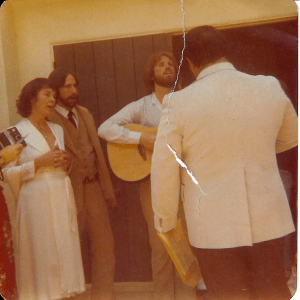


Marilyn, Jeff Pasternak, Bryan MacLean, and I went to University High School in La La Land. Bryan played at my wedding. Marilyn was there. You can just see her. All four of us are now at the epicenter of the La La Land Cultural Hoedown. Kenny Reed, and Rick Cobian did a Black and Mexican Bro Thing against Whitey Me in some sick need to change the outcome of their High School days. Marilyn played me that way too. This subject is all good thanks Karem Abdul-Jabbar’s essay. Nisha Calkins didn’t want to be associated with my blog about “threatening women” nor did Belle, Alley, and Rena. That might have changed. It’s good to be topical! Below is the e-mail I sent Jeff in 2011 saying Marilyn and I are collaborating on our story! I refer to my blog that got sabotaged, it named after Eugene’s first newspaper that Joaquin Miller was the editor for.
Jon Presco
Copyright 2017
http://www.thehollywoodsurvivor.com/SendEmail.php
https://rosamondpress.com/2016/09/20/the-sabotage-of-threatening-women/
John Ambrose <braskewitz@yahoo.com>
|
Hi Jeff
Marilyn and I are going to co-author our story. I will be seeing an attorney today. We are going to split the proceeds.
I would like you to contribute your memories of us, and you and Marilyn. Your honesty will be most welcome.
Jon
|
.com>
| Master Jubla
The rhythm in this Bo Diddley song, and the Hambone song, are identical. I wonder if the hand gesture at hips was taken from a slapping on the thighs to make a drum beat?
http://www.youtube.com/watch?v=YMJeaZtgwng
http://www.youtube.com/watch?v=HICsPNm2ARY&feature=related My ancestor, Will Rosamond, born in 1887, was performing the Hambone in Mississippi. At the Obama celebration I got folks dancing in a circle clapping hands. I wanted African dancers doing the Jubla in the skit I authored. http://en.wikipedia.org/wiki/Juba_dance
The StoryIn 1966 Jeff Pasternak, songwriter, artist and son of legendary film producer Joe Pasternak, was strongly advised by his father not to get involved in Show Business. However, after meeting Elvis Presley on an MGM soundstage Jeff quickly forgot that advice. Months later, out for a good time at the London Fog on Hollywood’s Sunset Strip, Jeff and a friend found their way to a sleazy backstreet bar and Jeff’s life changed forever. The club was almost deserted as they waited for the new band they’d come to hear. Then, around 9:00 pm Jim Morrison and The Doors strolled onto the tiny dance floor. Jeff was captivated and mesmerized. He recalls that surreal night as one of The Doors‘ very best performances. “I knew after I left the club that night that this was the style of music I wanted to write, and the singer I wanted to sound like.” Shortly after that evening Joe Pasternak approached Jeff, asking, “What rock and roll band would you recommend for my new movie, The Sweet Ride?” Jeff immediately told him about The Doors, whom Jeff had been following to about every gig they had around L.A. By then, Jeff says, “Their music and energy had saturated every part of my being.” In a few more weeks Jeff had convinced his friend, John Branca (to later become one of the world’s top music attorneys) to experience The Doors. Two months later, Jeff and John had their own band, The Mustard Greens. “I was on top of the world,” Jeff says, “co-writing original material with John and waiting for my dad to sign The Doors. Who could ask for anything more?” Unfortunately for both the film’s success and music history, Joe Pasternak chose to sign Moby Grape, because they wanted $5,000 less. Shortly thereafter Light My Fire soared up the charts, racking up sales and fans. That’s Show Biz Then Jeff’s rebel ways at home resulted in a one-way ticket to the sidewalks of Hollywood. “I’ll never forget the family chauffeur bidding good-bye to me and my stereo on a side street one block from The Whiskey a Go Go. A few nights later inside The Whiskey, Jim Morrison was screaming at his parents on stage, and the song, The End, had me questioning my own destiny,” Jeff recalls. The Juba dance or hambone, originally known as Pattin’ Juba (Giouba, Haiti: Djouba), is a style of dance that involves stomping as well as slapping and patting the arms, legs, chest, and cheeks. It is similar to clogging and the jig, and “pattin’ Juba” would be used to keep time for other dances during a walkaround. A Juba Dance performance could include: various steps such as “the Jubal Jew”, “Yaller Cat”, “Pigeon Wing” and “Blow That Candle Out”.
The dance traditionally ends with a step called “the Long Dog Scratch”. Modern variations on the dance include Bo Diddley‘s “Bo Diddley Beat” and the step-shows of African American and Latino Greek organizations.[1]// [edit] History of the dance The Juba dance was originally an African-American plantation dance, brought from West Africa by slaves who performed it during their gatherings when no rhythm instruments were allowed due to fear of secret codes hidden in the drumming. The sounds were also used just as Yoruba and Haitian talking drums were used to communicate[1]. The dance was performed in Dutch Guiana, the Caribbean, and the southern United States.[2]
Later in the mid-1800s, music and lyrics were added, and there were public performances of the dance. Its popularization may have indirectly influenced the development of modern Tap dance[citation needed]. The most famous Juba dancer was William Henry Lane, or Master Juba, one of the first black performers in the United States. It was often danced in minstrel shows, and is mentioned in songs such as “Christy’s New Song”[3] and “Juba”[4], the latter by [[Nathaniel R. Dett][5].
Will:William Richard “Will” Rosamond and his wife Virginia Lee Knight are buried in Evergreen Cemetery, Carrolton, Carrolton County, MS., Lot #403. Will was an excellent bas et weaver and as a young boy he spent many hours at an Indian Reservation near Ackerman, Choctaw County, MS., squatting and watching them weave baskets. Ila Mae, his daughter, remember s him stating that he was a “hobo for a few years and that he rode the train through Meridian [MS].” He was a good singer with a fine bass voice. He could even make music by slapping his knees and chest. He could also play a cross cut saw, and make it sing! He was an excellent story teller and a lover of riddles. His daughter, Maxine, stated that in the 1920’s after his mother, Nancy Bowie Rosamond sold the old home place, Will and wife Virgie moved from the hills around Weir, Choctaw, MS to the Delta area and share-cropped. I would BREAKAWAY from the poor girl I asked to dance , I already knowing she could not keep up with me, she left standing there doing The Fox Trot, her hand held out to hold her dance partner who was now twenty feet away bucking and kicking like a wild young stallion who did not like being corralled, and was circling her, ignoring her hand coaxing me to get close to her once again. But, I had BROKEOUT, and was free! This was my Bo Diddley moment. I had heard him sound the charge with his guitar. And it was an anthem. And here they come, moving as one, the Canaanites, the Daughters of Ahserah, the Sisters of Ashtoreth, the alleged Temple Prostitutes doing the fertility dance of the seven veils in order summon the thunder and rain god, Baal-el! Here come the Tough Chicks that scared the Be-Jesus out of the Sons of Abraham, cause they perfected the Shimmy Shimmy Shake that came out of Africa long ago. [edit] Related songs
Websites: · Juba Dance · Juba! Masters of Tap & Percussive Dance · Patting Juba Song History “Patting Juba” was first described and derided as a “secular amusement” practiced by slaves in Kentucky by Henry Bibb in the 1820s (Bibb in Epstein 142). Bibb’s frustration with slaveholders’ indulgence of slaves “patting juber” was not shared by poets, who were interested in the metrical complexities of the rhythms involved by those patting juba. Patting or clapping juba was described as percussive sounds made on the body, usually with hands, thighs, and feet. The music was performed in a circular formation customarily with variations on the basic rhythm, in the form of syncopation and shifting accented notes. Patting juba was not linked exclusively to the song Juba, but these dance movements were used to a variety of songs. The circular dance formation involving hand clapping was recorded in Africa as early as 1621, by Richard Jobson, a European traveler, wrote: “the standers by seem to grace the dancer, by clapping their hands together after the manner of keeping time” (Jobson in Epstein 141). The word juba is derived from an African word meaning ‘king’ or ‘dove’ in East African languages. It is also the name of a city in Sudan. Haitians have called this dance the djouba. Others posit the word is derived from Jubal, the inventor of musical instruments described in the Old Testament. Bessie Jones, a 20th century-born African-American song-keeper, contests that juba is similar to ‘jibba’ or giblets, the ends of food. Finally, Juba was a person, AKA William Henry Lane, an African-American minstrel performer in the 1840s. After winning a dance competition against a white performer, he was given the title “Juba,” or master of all dancers (Juba Dance). Circular dancing involving percussive body movements are mirrored in current dance forms: tap dancing, step dancing, and break dancing. The influence of this dance form continues, most recently in choreographer Robert Battle’s dance called “Juba” for the Alvin Ailey Company, which premiered this year.
These lyrics were recorded in Prince Edward County, Virginia, sometime before 1838:
Juber up and Juber down
Juber all around de town (Smith in Epstein 143). Here are the lyrics from a 1969 children’s book: Juba this and Juba that Juba killed a yellow cat Juba up and Juba down Juba runnin’ all around (Tashjian 4). These lyrics were found online: Juba up ‘n Juba down Juba all aroun’ the town Juba jump, Juba sing Juba cut that pigeon wing Juba kick off this old show Juba dance that Jubilo Juba this and Juba that Juba killed a yella’ cat Juba for Ma, Juba for Pa Juba for your brother-in-law (Patting Juba website). These lyrics are those performed by Bessie Jones in 1972: Juba this and Juba that Juba killed a yellow cat And get over double trouble, Juba. You sift-a the meal, you give me the husk You cook-a the bread, you give me the crust. You fry the meat, you give me the skin And that’s where my mama’s trouble begin. And then you Juba. You just Juba. Juba up, Juba down Juba all around the town. Juba for ma, Juba for pa Juba for your brother-in-law. (Jones 37). Procedure http://www.streetswing.com/histmain/z3juba.htmThe juba (often referred to as “patting the juba”) is a dance created by slaves as a celebratory and spiritual release from a life that constantly tested their endurance, patience, and faith. The word “juba” can be traced back to Africa, where there’s a dance called “djouba.” The dance itself was also common in Haiti, where it is called “martinique.” William Henry Lane (1825-1851), who was known as Master Juba, popularized the dance from America to England, where he performed for Queen Victoria. Charles Dickens, upon witnessing William Lane, hailed him as the “danciest fellow ever was.” Master JubaBorn William Henry Lane, Master Juba (c.1825-c.1852) combined quick footwork with powerful African rhythms in an extraordinary style that evolved into American tap dance. Lane was born a freeman in Rhode Island and began his early career in Manhattan’s Five Points neighborhood, mastering the dances of Irish immigrants and free blacks. In this antebellum era, when blacks were not allowed to perform with whites, Master Juba was the first African-American to obtain international prominence as a minstrel entertainer, performing with four well-known early minstrel companies. Music historian Eileen Southern has noted that Master Juba was “a link between the white world and authentic black source materials, whose dancing contributed to the preservation of artistic integrity in the performance of black dances on the minstrel stage.” In 1848 he performed to high critical praise in London with Pell’s Ethiopian Serenaders and writers of the time noted that Master Juba’s dancing utilized a potent mixture of jig, clog dancing, and African-American styles with unique rhythms. Because Europe was more accepting of Lane and his dancing, he became one of the first expatriate black dancers, never returning to the United States.
Patting JubaIn this song (Juba), Clarke is striking the hands on the knees, then striking the hands together, like so: Slap Knees (3X), Clap Hands (1X)Slap Knees (3X), Clap Hands (1X)Slap Knees (3X), Clap Hands (1X) Slap Knees (2X), Clap Hands (1X) rest Counting: 1 2 3 4, 1 2 3 4, 1 2 3 4, 1 2 3 4…
Some of the multitude of verses: Juba up ‘n’ Juba down, Juba all aroun’ the town. Juba jump, Juba sing, Juba cut that pigeon wing.Juba kick off this old shoe, Juba dance that Jubilo.Juba this and Juba that, Juba killed a yella’ cat Juba for Ma, Juba for Pa, Juba for your brother-in-law.
Posted January 21, 2009
The Reed-O-Meter Shocks One World Cafe Part 2
On Inauguration Day, I heard mention that Martin Luther King believed in 1966 would be a Black President in twenty five years. In the clip, Martin seems puzzled by his own prediction, it perhaps coming from a source outside the Civil Rights Movement and the Black Church. What could it be? Perhaps King noticed there were allot more young white folk who wanted to be black, then young black folk who wanted to be white? Kenny Reed called me a half hour after I published part one of the Reed-O-Meter. He thanked me for helping put the Inauguration show together. I told him I had just published a review, and mentioned Bo Diddley. Kenny said he saw him in person. He mentioned other Black groups and singers he saw in person.
In 1963 my white friends talked me out of going to the Oakland Auditorium and seeing Ray Charles and Bobby Bluebland. They said they would kill me, cut my throat with razors. I made a picture of that possibility. I had no car, so I would have to take a bus, or walk there. I saw a white sixteen year old male walking amongst a sea of black faces to the ticket window. I looked at those who were checking me out, including the “tough” black girls decked out in their finest. Tough is a perfect word to describe the Bo Dancer on the left. But then there is that cute beam in her eye, and that smile. In Junior High, my best friend and his girlfriend held the door close as I ran down the hall in an attempt to get away from Mary Brau and her three black girlfriends who wanted to kick my ass. Mary was in one of my classes. One day I caught her looking at me. There was a cute beam in her eye. I looked for this light in all the young girls at McCheznie Junior High, because I was a poet whose art toured the world when I was thirteen. This spark said it all, contained it all, the meaning of life. Mary Brau was beautiful, and perhaps one of her friends saw us making eyes at one another, or Mary made the mistake of saying I was cute, and there was insntant jealousy, the extinguisher of the spark. One morning I was shocked to see Mary in my face, she full of anger as she asked; “Did you call me a Nigger? My friend here said she overheard you call me a Nigger!”
I professed my innocence, but, was now was in full retreat as those who championed Mary’s cause joined in.. To be chased by four black girls was an experience I would never forget. After two days of this, they gave up. This is for certain, on my death bed I will rue the day I did not go see Bobbly Bluebland, and, own the courage to BREAKOUT, stand up against all odds, and do the right thing by my standards – for me!I am certain that many young black would have respected my choice to cross the line. I would have enjoyed the show, been just another face, digging it, the Real Revolution – a Heterosexual Revolution that was sweeping the Land of the Free. I told Kenny how much I admired Bo Diddley, and, even wanted to be like him. “His music had this drive that I wanted to emulate, and then give it to young whites! I wanted to be Bo Diddley”I used to claim I was the best dancer at Oakland High, and indeed I was the inventor of dancing without a partner. Half the kids at the School Dance would form a circle around me as I did ‘The Pony’ around the dance floor. I would BREAKAWAY from the poor girl I asked to dance , I already knowing she could not keep up with me, she left standing there doing The Fox Trot, her hand held out to hold her dance partner who was now twenty feet away bucking and kicking like a wild young stallion who did not like being corralled, and was circling her, ignoring her hand coaxing me to get close to her once again. But, I had BROKEOUT, and was free!
This was my Bo Diddley moment. I had heard him sound the charge with his guitar. And it was an anthem. And here they come, moving as one, the Canaanites, the Daughters of Ahserah, the Sisters of Ashtoreth, the alleged Temple Prostitutes doing the fertility dance of the seven veils in order summon the thunder and rain god, Baal-el! Here come the Tough Chicks that scared the Be-Jesus out of the Sons of Abraham, cause they perfected the Shimmy Shimmy Shake that came out of Africa long ago. Here come the wives of the Sons of Abraham and Jacob, the separated ones, the consecrated ones devoted to the Queen of Heaven. Here come the Nazarites
|

 Rosamond Press
Leave a comment