


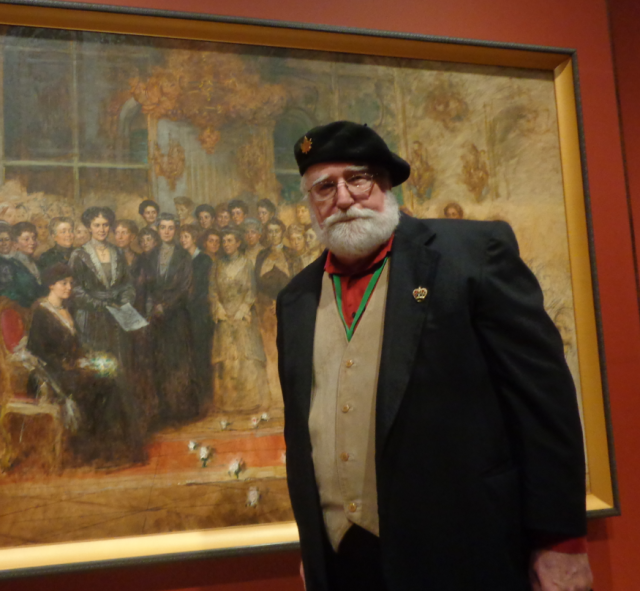
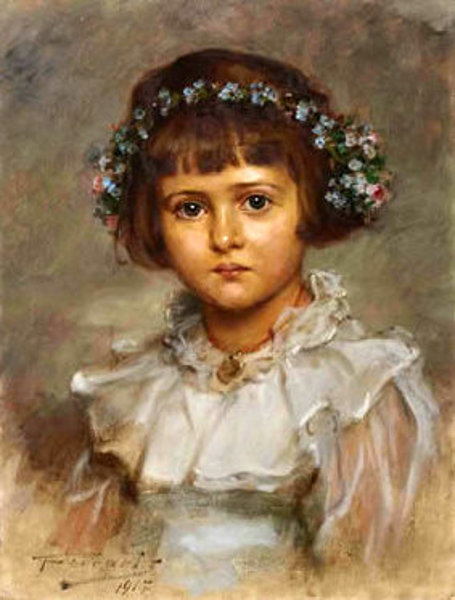
I just discovered Lynn S. McCready was the president of the bank the ‘Last Audience of the Habsburgs’ was stored for seventeen years. He was secretary of ‘Friends of the Museum’ that unveiled this large canvas at the El Union, A replica of the Shonbrunn Palace was a backdrop for a faux Vienna feast, the guests enjoying Euro-Quiseen as they pretend to be Habsburg Royalty. Lynn knew the history of this painting. He had to know the owner, or, the person that put this painting in his care. Did this person disappear, and, thus McCready considered it IS HIS to do what he want with it? Did this person sell, or, pay off a debt with this incredible work of art? Was it seized in a foreclosure? Did Lynn consider contacting the Austrian Government, or, a living Habsburg, to see if they wanted it? Would he make a gift of it, or, would he be looking for a buyer? What if they demanded the return this painting? Do any of the past regents of the University of Oregon know the truth about the unfinished image of the little girl without a body?
As a profound coincidence First National was purchased by TransAmerica Corporation that my father’s high school chum became the president of. Victor was invited to come aboard, but, he became a Loan Shark instead.
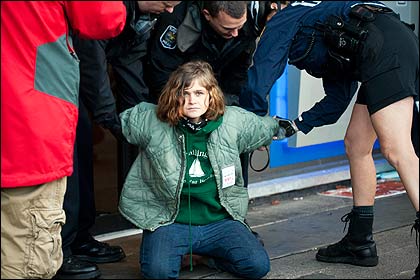
Alley Valkyrie was arrested after trespassing in a Eugene Bank. I filmed the OCCUPY demonstration I took part in front of Chase.
What is truly extraordinary, is, members of the Habsburg family are demanding their assets and property be returned to them. This reference to being treated like second class citizens, involves the recovery of ‘The Lady in Gold’ that is on display at the Neue Galery in New York, who I sent an e-mail to, that was read at the same time by representatives of the Austrian Government.
I am working on a theory that Georg Granitsch founded several banks, with Habsburg Money, including the Raiffeisen Banking Group Austria
Are we looking at an international banking conspiracy, that could have involved Thomas G. Hendricks who got a park named after him, and, was a friend of George Miller, the founder of Fairmont? Is Eugene a secret Habsburg City?
Banks should not end up with valuable National Treasures, or, hold private shindigs where the little people are not invited. Marie Antionette was a Habsburg.
“Let them eat cake!” Donald Von Trump has said as much! He promises to build a giant wall between the Haves and Have Nots.
“This is what Democracy looks like!”
Do not pluck my roses without my permission!
Jon Presco
Copyright 2016
McCready continued as President until February 8, 1954, when the bank was merged into the First National Bank of Oregon, at which time he became Vice-President and Manager of the Eugene Main Branch.
“We are talking about properties that my family had privately owned that were seized by the Nazis in 1938 and then taken after the war without compensation.”
Yet Herbert Golsong, a Washington-based lawyer representing the family, said: “This was an act of Nazi revenge. It was a personal instruction from Hitler because members of the Habsburg family were employed in anti-Nazi propaganda abroad, especially in the US.” The family had also helped Jewish people to flee to America, he said.
“We don’t want to be treated like second-class citizens any longer,” said Christian Habsburg, the Euro MP’s cousin, who co-filed last week’s claim. “The Habsburgs were dispossessed by the Nazis and should be handed back property by the state, just like all the other victims of national socialism.


https://en.wikipedia.org/wiki/Sch%C3%B6nbrunn_Palace
The First National Bank of Eugene began as the Bank of Hendricks and Eakin on December 1, 1883. The bank was founded by Thomas G. Hendricks and Stewart B Eakin, Jr. Two years later the founders decided to “nationalize” and on March 9, 1886, they reopened as The First National Bank of Eugene City; the “City” was dropped in 1906.
Original shareholders were Thomas G. Hendricks at 360 shares. Stewart B. Eakin, Jr. at 100 shares, and G. R. Chrisman, J. M. Hendricks, E. Stewart, and W. R. McCornack at 10 shares each, for a total of 500 shares.
As the bank grew, services were expanded, including the addition of the first unit of safe deposit boxes in July of 1908, establishment of the Savings Department in July 1911, and the opening of the Trust Department in 1915. Growth was enhanced by consolidation with the Chambers-Bristow Banking Company on February 10, 1908.
The banks first president was Thomas G. Hendricks, who served until January, 1917. He was followed by Pe. E. Snodgrass in 1917, A. A. Rogers in 1929, Richard Shore smith in 1931, and Lynn S. McCready in 1945.
In December, controlling interest in the bank was sold to TransAmerica Corporation, a San Francisco based holding company. McCready continued as President until February 8, 1954, when the bank was merged into the First National Bank of Oregon, at which time he became Vice-President and Manager of the Eugene Main Branch. Prior to the merger, two additional branches of the original back were established: the West Eugene Branch in August 1949 and the Springfield Branch in August 1950.
On June 1, 1981, the First National Bank of Oregon became First Interstate Bank of Oregon, an affiliate in a regional banking system covering eleven western states.
http://socialarchive.iath.virginia.edu/ark:/99166/w6616mvz
https://rosamondpress.com/2015/06/04/the-monkey-block-and-queen-calafia/
https://en.wikipedia.org/wiki/5th_SS_Panzer_Division_Wiking
http://daughternumberthree.blogspot.com/2013/12/the-girl-in-last-audience-of-hapsburgs.html
http://socialarchive.iath.virginia.edu/ark:/99166/w6616mvz
In 1938, one day after the German occupation of Austria, it was taken over by a provisional administrator and subsequently nationalised. The bank was not returned to its pre-war owners until 1955.
https://en.wikipedia.org/wiki/Raiffeisen_Zentralbank
Since the end of the Monarchy some members of the Habsburg family have insisted that the ‘tied assets’ be returned and have taken the matter to both the Austrian Constitutional Court and the European Commission of Human Rights. They consider the tied assets to be their private property.
What is to be done with all the Habsburgs’ assets when the Monarchy is suddenly abolished and the Republic proclaimed in its place?
The Habsburgs’ assets were a matter Austria had to deal with even after the end of the Monarchy. In 1919 a special Habsburg law was passed, which a year later was given constitutional status. It laid down which of the Habsburgs’ assets were to be transferred to the new state. Ultimately it was Emperor Karl who was responsible for this law, as he had rescinded his renunciation of ‘any participation in the business of State’ as soon as he had crossed the border into Switzerland. As a result the Republic needed a legal handle.
State property included the ‘aulic’ and the ‘tied’ assets, while the Habsburgs’ considerable ‘private’ assets remained in the hands of the family. Exceptions were, for example, the Court Library (now the National Library) and the Albertina Palace. The tied assets included those which the family had at their disposal as the ruling dynasty as well as the family support fund.
In the 1930s, during the years of the Corporate State (Ständestaat), the property which had been confiscated was returned to the Habsburgs, but this measure was rescinded by the National Socialists shortly after the Anschluss in 1938. After the Second World War the laws passed by the Corporate State and the National Socialists were declared null and void, a clause which was also included in the Austrian State Treaty of 1955. Since the end of the Monarchy some members of the Habsburg family have insisted that the ‘tied assets’ be returned and have taken the matter to both the Austrian Constitutional Court and the European Commission of Human Rights. They consider the tied assets to be their private property.
The most recent development has been to link the question of the Habsburg assets to the laws regulating compensation for property lost during the National Socialist era. These stipulate that victims of the National Socialists can demand the return of confiscated property. Some members of Habsburg family cite these laws and demand the return of those assets expropriated by the National Socialists but which have actually been the property of the Republic since the end of the Monarchy.
The grandson of Karl I, the last Austro-Hungarian emperor, has launched a controversial claim for the return of palaces and land seized by the Nazis and now held by the Austrian state.
Karl Habsburg and two relatives are demanding that property worth hundreds of millions of pounds, including several castles and about 50,000 acres of woodland, be given back to the family in a claim filed with the Austrian Restitution Fund for the Victims of National Socialism.
Mr Habsburg, 42, dropped the aristocratic “von” from his name before becoming an MEP for the conservative Austrian People’s Party. His father, Otto von Habsburg, is the head of the family.
The intervention by the dynasty’s future patriarch has given fresh impetus to a campaign launched by other members of a family whose empire once stretched across much of central and eastern Europe. They say that if they win, the property will be placed in a trust for the benefit of 160 surviving Habsburgs.
“We don’t want to be treated like second-class citizens any longer,” said Christian Habsburg, the Euro MP’s cousin, who co-filed last week’s claim. “The Habsburgs were dispossessed by the Nazis and should be handed back property by the state, just like all the other victims of national socialism.
 Rosamond Press
Leave a comment