

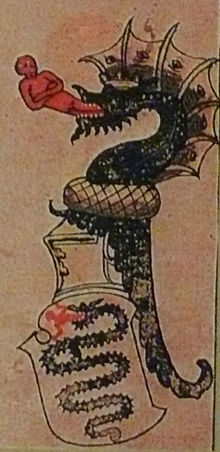
Yesterday, when I awoke. I went to my computer and found an invitation from Princess Georgiana Spencer to join a closed FB on royalty. I was struck by her beauty. I posted about ten of my blogs, and got approval. I told Georgiana we were kin via the Hart family. What I did not show, is, her tie to the Clifford family and Rosamond Clifford. I was poised to reveal the amazing history of the Rhys family from whom the Tudors descend. In my new story ‘The Voice of the Mountain – The Second Coming of Wolfdietrich’ – I was climbing a Mountain in Montana and became Dragon Born. Note the dragons on the Clifford and Rhys cote of arms. I own the greatest genealogical story of all time!
That Georgiana comes into my life the day after I bid Rena Easton to apologize to me so this tale of a Dragon Family Tree can go forth, is pure Kismet. The Princess may have read my plea, but could not have known the importance of her voice, the voice of a stranger that came down from Rose Mountain, and bid me enter a royal realm.
Jon Presco
President: Royal Rosamond Press
Copyright 2015
https://rosamondpress.com/2012/01/31/wolfdietrich-von-talac-de-rougemont/
https://rosamondpress.com/2015/06/05/the-voice-of-the-mountain/
https://rosamondpress.com/2014/12/30/the-hidden-dragon-and-branch/
Lady Georgiana Spencer was born on 7 June 1757.1 She was the daughter of John Spencer, 1st Earl Spencer and Margaret Georgiana Poyntz.1 She was baptised on 12 July 1757 at Wimbledon, London, England. She married William Cavendish, 5th Duke of Devonshire, son of William Cavendish, 4th Duke of Devonshire and Charlotte Elizabeth Boyle, Baroness Clifford, on 5 June 1774.4 She died on 30 March 1806 at age 48 from an abscess of the liver.4 She was buried at All Saints Church, Derby, Derbyshire, England.
From 5 June 1774, her married name became Cavendish. As a result of her marriage, Lady Georgiana Spencer was styled as Duchess of Devonshire on 5 June 1774. She has an extensive biographical entry in the Dictionary of National Biography.5
http://www.mppoland.com/poyntzfam.html
http://en.wikipedia.org/wiki/Baron_Clifford
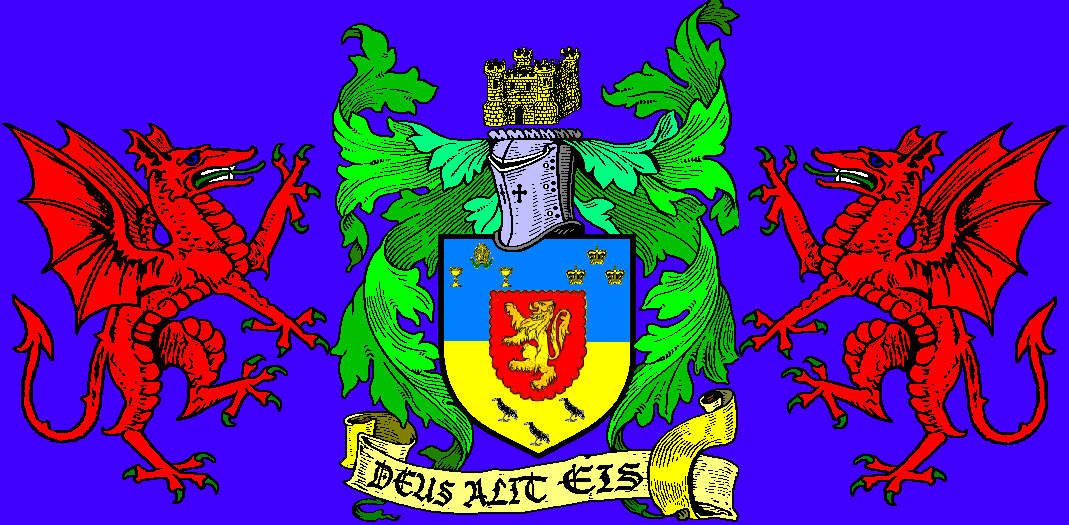

At the base of the coat of arms is the heraldic symbol of Wales, the red dragon. The flag of Wales, approved in 1953, pictures a red dragon on a green and white flag with the motto “Y Ddraig Goch Ddyry Cychwyn,” meaning “The red dragon gives the lead” (Cohen, pg 196). Note that the eldest-son label is around the neck of the dragon, thus associating it with Prince Charles.
http://juchre.org/nor/charles.htm
The barony of this name has been in abeyance since 1858 – for the baronies with similar names that (as of 2012[update]) remain extant see Baron Clifford of Chudleigh and Baron de Clifford

Clifford arms
Baron Clifford is a barony by writ of summons in the Peerage of England. It was created on 17 February 1628 by virtue of Henry Clifford‘s summons to Parliament (by writ). Upon his death in 1643, his daughter Elizabeth succeeded to the title (although she never made claim to it). Lady Elizabeth Clifford had married, in 1634, Richard Boyle, 1st Earl of Burlington and 2nd Earl of Cork, who was created Baron Clifford of Lanesborough in 1644 so as to provide him with an English peerage and a guaranteed seat in the House of Lords at Westminster.
The Clifford barony of 1628 creation was held by the Earls of Burlington and Cork until the death of the 3rd and last Earl of Burlington in 1753, when that earldom and the Clifford of Lanesborough barony (ie. 1644 creation) became extinct.
The Clifford barony then devolved upon Charlotte Cavendish, Marchioness of Hartington, the wife of the future 4th Duke of Devonshire. Thus barony of Clifford was held by the Dukes of Devonshire until the death of William Cavendish, 6th Duke of Devonshire in 1858, when it fell into abeyance as it still remains.
Barons Clifford (1628)[edit]
- Henry Clifford 1st Baron Clifford, 5th Earl of Cumberland (1591–1643) summoned to Parliament as Lord Clifford in 1628; succeeded to the earldom in 1641
- Elizabeth, Countess of Burlington and 2nd Baroness Clifford (1613–1691)
- Charles Boyle, 3rd Viscount Dungarvan, 3rd Baron Clifford (1639–1694)
- Charles Boyle, 4th Baron Clifford, 2nd Earl of Burlington, 3rd Earl of Cork (1660–1704)
- Richard Boyle, 5th Baron Clifford, 3rd Earl of Burlington, 4th Earl of Cork (1694–1753)
- Charlotte Elizabeth Cavendish, 6th Baroness Clifford (1731–1754)
- William Cavendish, 7th Baron Clifford, 5th Duke of Devonshire (1748–1811)
- William Spencer Cavendish, 8th Baron Clifford, 6th Duke of Devonshire (1790–1858), upon whose death in 1858 the barony became abeyant
Henry Clifford, 5th Earl of Cumberland (28 February 1591 – 11 December 1643) was an English landowner and politician who sat in the House of Commons between 1614 and 1622. He was created a Baron in 1628 and succeeded to the title Earl of Cumberland in 1641.
Clifford was the son of Francis Clifford, 4th Earl of Cumberland and Grisold Hughes and a member of the Clifford family which held the seat of Skipton from 1310 to 1676.[1] In 1607 he became joint Lord Lieutenant of Cumberland, Northumberland and Westmorland. He was elected Member of Parliament for Westmorland in 1614, and was re-elected in 1621.[2] In 1621 he became Custos Rotulorum of Westmorland. He was created Baron Clifford in 1628.
Clifford succeeded to the title of Earl of Cumberland in 1641 and died two years later in 1643 at the age of 52.
Clifford married Frances Cecil (1593 – 14 February 1644), daughter of Robert Cecil, 1st Earl of Salisbury and Elizabeth Brooke. They had one child: Elizabeth Clifford, 2nd Baroness Clifford who married Richard Boyle, 1st Earl of Burlington.[1]
Home to one of the oldest mills in North Yorkshire, historical documents indicate High Corn Mill,[2] which is powered by the waters of Eller Beck, dates to 1310 when it was owned by Robert de Clifford, 1st Baron de Clifford, at this point it was transferred to the powerful Clifford family by the then King Edward II.[citation needed] The mill as it appears today is only half of what used to exist when two mills were in operation to produce corn for the whole of Skipton. The mill has been completely redesigned, from the mill grounds to the buildings themselves. The outside walls of the mill have been sandblasted and the two main buildings of the old mill have been turned into flats from 2007 onwards, with one stand-alone building yet to be redesigned, touched or Sandblasted.
http://en.wikipedia.org/wiki/Robert_de_Clifford,_1st_Baron_de_Clifford
When his heir, Roger de Breteuil, 2nd Earl of Hereford, forfeited his lands for rebellion against the King in 1075, the castle was granted to Ralph Tosny who held it directly from the Crown. From Ralph, it passed to his son-in-law Richard des Ponts (more correctly Richard Fitz Pons). Richard’s son Walter Fitz Richard later took the name of Walter de Clifford after he seized the castle from its Tosny overlord before 1162. Much of the stone castle would seem to have been built before 1162 as it much resembles the Tosny Conches Castle in Normandy.
The King’s mistress[edit]
Clifford Castle was the home of Walter Fitz Richard’s daughter Rosamund Clifford, who was also known as the Fair Rosamund. She was the mistress of Henry II until her death in 1176 or 1177 when she was buried at Godstow in Oxfordshire. A property near the castle is called Rosamund House today.
Since its last use in the 15th century it has fallen into ruins with much of the stone pillaged for the older properties seen in the village today. Large dressed stone blocks can be seen in garden walls. The castle is currently on the English Heritage Heritage At Risk Register 2010. The present owners are working closely with English Heritage to implement a maintenance policy, followed by a program of works to stabilise the current structure and prevent further decay. Most at risk are Rosamund’s Tower and the arched window in the Hall.
http://en.wikipedia.org/wiki/Clifford_Castle
https://rosamondpress.com/2015/05/28/rosamonds-tower-of-love-2/
Rosamund Clifford (before 1150 – ca. 1176), often called “The Fair Rosamund” or the “Rose of the World”, was famed for her beauty and was a mistress of King Henry II of England, famous in English folklore.
Rosamund is believed to have been the daughter of the marcher lord Walter de Clifford and his wife Margaret. Walter was originally known as Walter fitz Richard (i.e. son of Richard), but his name was gradually changed to that of his major holding, first as steward, then as lord. This was Clifford Castle on the River Wye. Rosamund had two sisters, Amice and Lucy. Amice married Osbern fitz Hugh of Richard’s Castle and Lucy, Hugh de Say of Stokesay. She also had three brothers, Walter II de Clifford, Richard and Gilbert. Her name, “Rosamund”, may have been influenced by the Latin phrase rosa mundi, which means “rose of the world.”[1]
Rosamund grew up at Castle Clifford, before going to Godstow Nunnery, near Oxford, to be educated by the nuns.[2] Henry publicly acknowledged the liaison with Rosamund in 1174.[citation needed] When the affair ended, Rosamund retired to Godstow Abbey, where she died, not thirty years old, in 1176. According to Mike Ibeji, “there is …no doubt that the great love of his life was Rosamund Clifford.”[3]
Legend[edit]
The traditional story recounts that King Henry adopted her as his mistress, and that, in order to conceal his illicit amours from his Queen, Eleanor of Aquitaine, he conducted them within the innermost recesses of a complicated maze which he caused to be made in his park at Woodstock. Rumours having reached the ears of Queen Eleanor, the indignant lady contrived to penetrate the labyrinth, confronted her terrified and tearful rival, and forced her to choose between the dagger and the bowl of poison; Rosamund chose the latter and died.[4]
The poisoning incident is not mentioned in an account given by a chronicler of that time, John Brompton, Abbot of Jervaulx (Yorks), and does not appear before the fourteenth century.[4]
The story was handed down for generations and gradually embroidered with various additional details, more or less scandalous, gathered around the central tale, as, for instance, that Rosamond presented Henry with the son who was afterwards known as William Longsword, Earl of Salisbury.[4] His mother was, however, Ida de Tosny, Countess of Norfolk.
Rosamund Clifford was reputedly one of the great beauties of the 12th Century and inspired ballads, poems, stories and paintings.[5]
Possible children[edit]
Historians are divided over whether or not Rosamund’s relationship with the King produced children. Legend has falsely attributed to Rosamund another of Henry’s illegitimate sons: Geoffrey Plantagenet (1151–1212), Archbishop of York. Her maternity in this case was only claimed centuries later. Geoffrey was apparently born before Henry and Rosamund met and is presumed to be the son of another otherwise unknown mistress.
Other stories[edit]

Eleanor prepares to poison Rosamund, a Pre-Raphaelite painting by Evelyn De Morgan, illustrating one of the later myths about her
Rosamund’s story first appears in fourteenth century “French Chronicle of London”, which purports to recount the confrontation with Queen Eleanor. In one version Rosamund is improbably described as having been roasted between two fires, stabbed, and left to bleed to death in a bath of scalding water by the Queen.[6] During the Elizabethan era, stories claiming that she had been murdered by Eleanor of Aquitaine gained popularity; but the Ballad of Fair Rosamund by Thomas Deloney (1612) and the Complaint of Rosamund by Samuel Daniel (1592) are both purely fictional. Most medieval chroniclers acknowledged that by 1173, Eleanor was held in close confinement, having raised her sons in rebellion against their father.[6]
The underground labyrinth was added to the tale in 1516. However, Robert Gambles cites a 1231 reference to “Rosamund’s Chamber, with gardens, a cloister and a well.[6] According to local tales, “Rosamund’s Bower,” is said to have been pulled down when Blenheim Palace was built. A pool on the grounds of Blenheim Palace is known as “Fair Rosamund’s Well”, and is said to be fed by a spring that never stops flowing.[5]
The cup of poison first appears in a ballad of 1611.[6] Accounts made around the time of the dissolution report that, along with other engravings, Rosamund’s tomb in the chapter house contained the depiction of a chalice.
She is thought to have entered Henry’s life around the time that Eleanor was pregnant with her final child, John who was born on 24 December 1166 at Oxford. Indeed, Eleanor is known to have given birth to John at Beaumont Palace rather than at Woodstock because, it is speculated, having planned to give birth at Woodstock, she refused to do so upon finding Rosamund there.
Authorities differ over whether Rosamund stayed quietly in seclusion at Woodstock while Henry went back and forth between England and his continental possessions, or whether she travelled with him as a member of his household. If the former, the two of them could not have spent more than about a quarter of the time between 1166 and 1176 together (as historian Marion Meade puts it: “For all her subsequent fame, Rosamund must be one of the most neglected concubines in history”).
Rosamund was also associated with the village of Frampton on Severn in Gloucestershire, another of her father Walter’s holdings. Walter granted the mill at Frampton to Godstow Abbey for the good of the souls of Rosamund and his wife Margaret. The village green at Frampton became known as Rosamund’s Green by the 17th century.[7]
A cultivar R. gallica var. officinalis ‘Versicolor’, with striped pink blooms, is commonly known as Rosa mundi.[8] It’s connection to Rosamund Clifford dates to the sixteenth century.
Death and aftermath[edit]

Godstow Abbey ruins
Her death was remembered at Hereford Cathedral on 6 July, the same day as that of the king thirteen years later. Henry and the Clifford family paid for her tomb at Godstow in the choir of the monastery church and for an endowment that would ensure care of the tomb by the nuns. It became a popular local shrine until 1191, two years after Henry’s death. Hugh of Lincoln, Bishop of Lincoln, while visiting Godstow, noticed Rosamund’s tomb laden with flowers and candles. The bishop ordered her remains removed from the church: instead, she was to be buried outside ‘with the rest, that the Christian religion may not grow into contempt, and that other women, warned by her example, may abstain from illicit and adulterous intercourse’. Her tomb was moved to the cemetery by the nuns’ chapter house, where it could be visited until it was destroyed in the Dissolution of the Monasteries under Henry VIII of England.[9] The remains of Godstow Priory still stand and are open to the public.
Paul Hentzner, a German traveler who visited England c.1599 records [10] that her faded tombstone inscription read in part:
… Adorent, utque tibi detur requies Rosamunda precamur. (“Let them adore… and we pray that rest be given to you, Rosamund.”) Followed by a rhyming epitaph: Hic jacet in tumba Rosamundi non Rosamunda, non redolet sed olet, quae redolere solet. (“Here in the tomb lies the rose of the world, not a pure rose; she who used to smell sweet, still smells–but not sweet.”)
Apollinaire was to use Rosamond as the central character in his poem Rosemonde, taken from the 1913 collection ‘Alcools’ (citation taken from Garnet Rees 1975 edition of Guillaume Apollinaire’s Alcools; The Athlone Press; London)
Fiction[edit]
-
Rosamund Clifford is the subject of Samuel Daniel’s 1592 poem, “The Complaint of Rosamond.”
- Rosamund is a German Singspiel by Anton Schweitzer on a text by Christoph Martin Wieland (Mannheim 1780)
- Rosmonda d’Inghilterra (Rosamund of England) is an 1834 Italian opera by Gaetano Donizetti.
- Rosamund is a character in the novel Eleanor the Queen (1955, 1983) by Norah Lofts.
- Rosamund is mentioned in the play and movie versions of The Lion in Winter (1966, 1968).
- Rosamund appears as “Rose Parrish” in Susan Howatch‘s family saga Penmarric (1971), a re-telling of the story of Henry II and Eleanor of Aquitaine.
- Rosamund is a character in the novel The Courts of Love: The Story of Eleanor of Aquitaine (1987) by Jean Plaidy.
-
Rosamund is mentioned in Virginia Henley’s romance, The Falcon and the Flower (1988).
-
Rosamund is a character in the novel The Book of Eleanor, A Novel of Eleanor of Aquitaine (2002) by Pamela Kaufman.
- Rosamund’s affair with Henry II is detailed in Sharon Penman‘s novel Time and Chance (2002), and continued in Penman’s Devil’s Brood (2008).
-
The relationship between Rosamund and Henry is a major framing device in Robin Paige’s mystery novel, Death at Blenheim Palace (2006).
- Rosamund appears in the novel The Death Maze (2008). published in the U.S. as The Serpent’s Tale, by Ariana Franklin.
- Rosamund is mentioned as past mistress of Henry II in the novel The Time of Singing (2008) by Elizabeth Chadwick.
- Rosamund is a character in the novel The Captive Queen: A Novel of Eleanor of Aquitaine (2010) by Alison Weir.
http://www.castlewales.com/clifford.html
or De Pons; the ancestor of the Cliffords; from Pons in Saintonge. “The Lords of Pons in Acquitaine were one of the most powerful families in France, and are frequently mentioned in history. Pontius or Pons, who in 1079 granted a church to the Abbey of Cormery (Gall. Christ, xii. 14) had four younger sons who went to England, of whom Drogo Fitz-Ponce and Walter Fitz-Ponce held important baronies in 1086 (Domesd.) Their younger brothers were 1. Richard Fitz-Ponce; 2. Osbert Fitz-Ponce, ancestor of the Veseys and Burghs. The names of these sons are mentioned by Henry I. in his charter confirming their gifts to Malvern Abbey (Mon. Angl. i. 366) and from the Monasticon (i. 365, ii. 876) it appears that they also bore the name of “Pontium” or des Pons, from which it appears they were sons of Ponce “of Pons.”
“Richard Fitz-Ponce witnessed, with Bernard de Neumarche’, a charter of Brecknock Priory c. 1120 (Jones, History of Brecon ii. 75) and was, as is generally known, the ancestor of the De Cliffords.”—The Norman People.
It certainly argues an unaccountable ignorance of his own pedigree in some one or other of the Cliffords, that he should have caused the name they had adopted temp. Henry II. to be inserted on the Roll (see Vol. 1, p. 278), when that of their first ancestor Pons was already there. Clifford Castle in Herefordshire, built in the Conqueror’s time by William Fitz Osbern, the first Norman Earl of that county, passed through his daughter to Ralph de Toesni; and Margaret de Toesni, in her turn, brought it to Richard Fitz Pons’ second son, Walter, thenceforward known as Walter de Clifford. Their eldest daughter was the Fair Rosamond—Rosa mundi, non Rosa munda, (“the rose of this world, but not the cleane flowre”) as she is called in her monkish epitaph at Godstowe, who became celebrated as the mistress of Henry II., and the mother of one of the greatest soldiers of his time (see Vol. 1, p. 323). The Cliffords continued for several generations in the marches of Wales, fighting the Welsh, and once bringing home a Welsh princess as a bride,[5] till Roger, fourth in descent from Walter, by his marriage with a great Northern heiress, removed them to a fresh scene of Border warfare. Roger’s wife was Isabel de Vipont, whose father was Baron and Hereditary High Sheriff of Westmoreland, by a grant of King John to her great-grandfather. She brought him four fair castles, probably all of them the work of Ranulph de Meschines: Brough, built to fortify the pass of Stainmore; Pendragon, that of Mallerstang; Appleby, the head of the honour, for its “central as well as strong and beautiful position in the barony;” and Brougham, to guard its Northern boundary. Her successors in this great inheritance continued to be for three hundred and twenty-six years High Sheriffs of Westmoreland; and her son Robert (one of the four knights of Aymery de Valence, Earl of Pembroke, whose portraits are on his tomb in Westminster Abbey) was summoned to Parliament in 1299. “He was educated,” says Sir Matthew Hale, “in the schoole of Warre, under King Edward I., as great a master, for valour and prudence, as this worlde afforded;” who appointed him Constable of Carlisle, Chief Justice of the royal forests beyond Trent, and Earl Marshall of England. Several of his Scottish forays are on record. In 1297, “he entered Annandale with the power of Carlisle, and slew three hundred and eighty Scots near Annan Kirke”; and in 1306, he, with the Earl of Pembroke, defeated the newly-crowned King, Robert Bruce, at St. John’s Town (Perth). He received from Edward I. the castle of Caerlaverock,[6] with all the lands of Robert Maxwell and William Douglas, but, “not willing to build any great confidence on these debateable acquisitions, caste his eye upon a more firme possession at a reasonable distance from Scotland, and this was the castle and honour of Skipton-in-Craven”; of which we find him possessed in 1314. He was killed at Bannockburn; the first often stout Lord Cliffords that successfully bore arms on the Border, and of one of whom it is recounted, as an exceptional case, that he died in his bed.
The seventh Lord married Hotspur’s daughter; and their son and grandson both figure in Shakespeare’s King Henry VI. The son—challenged by the King-maker on the field of St. Albans—
“Proud Norman lord, Clifford of Cumberland,[7]
Warwick is hoarse with calling thee to arms!”
 Rosamond Press
Leave a comment