
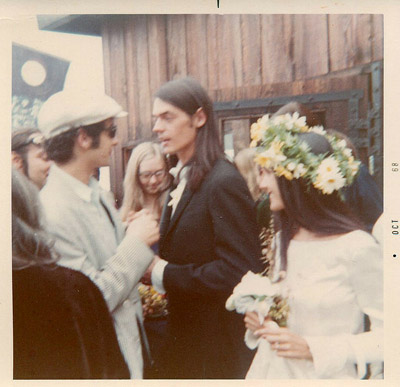
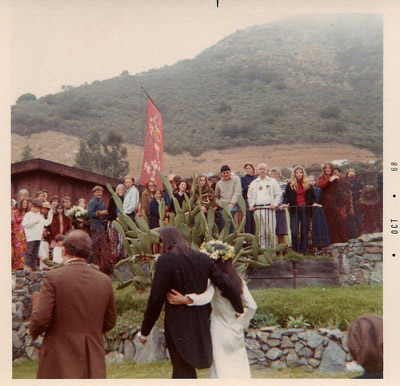
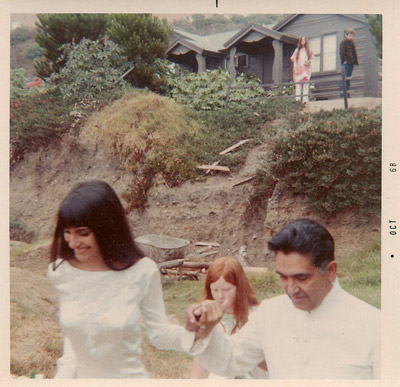
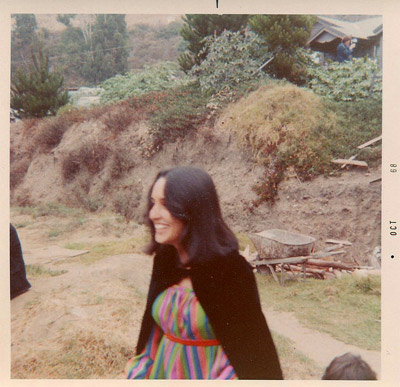
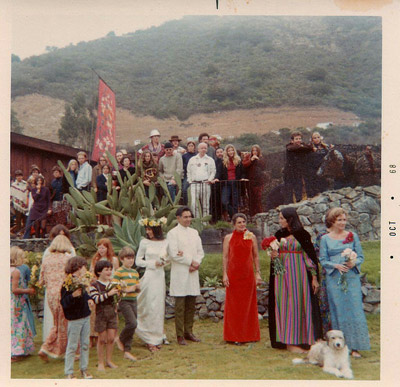
I just discovered this film that may be the West Coast’s answer to Woodstock. Mimi farina got remarried for this event. It was filmed by Baird Bryant who filmed ‘Gimme Shelter’ a film about Altamont that was the Hippie Doomsday. I was Chris Wandel’s roommate when Peter Shapiro dropped in and asked me if I was going to see the Stones. I warned him not to go because I had a bad feeling. Consider my musical ‘Love Dance’
a.k.a.’My Beautiful Blue Bicycle’ Mimi was a dancer.
Jon Presco
Wenzell Baird Bryant (Columbus, Indiana, December 12, 1927 – Hemet, California, November 13, 2008) was an American filmmaker. He is best known as the cameraman on the Albert Maysles film Gimme Shelter who filmed the fatal stabbing of Rolling Stones concertgoer Meredith Hunter by Hells Angel Alan Passaro at the Altamont Free Concert in December 1969.
As a cinematographer, Bryant also worked on Easy Rider, filming the famous LSD scene with Dennis Hopper in a New Orleans cemetery. He was also a writer, living in 1950s Paris with William S. Burroughs, Allen Ginsberg, and Jack Kerouac and writing Play This Love With Me (1955) pseudonymously. He also wrote the first translation of Pauline Réage’s erotic novel Story of O.
He studied at Deep Springs College and Harvard University.[1][2]
Celebration at Big Sur
Celebration at Big Sur
Directed by
Baird Bryant, Johanna Demetrakas
Produced by
Ted Mann, Carl Gottlieb
Cinematography
Baird Bryant, Johanna Demetrakas, Gary Weis, Peter Smokler, Joan Churchill[1]
Distributed by
20th Century Fox
Release date(s)
1971
Running time
82:24[2]
Language
English
Celebration at Big Sur (also known simply as Celebration) is a film of the 1969 Big Sur Folk Festival in Big Sur, California, featuring Crosby, Stills, Nash and Young (CSNY), Joan Baez, Joni Mitchell and others.
Released in 1971, the film was directed by Baird Bryant and Johanna Demetrakas. A young Gary Weis was among the cinematographers;[3] other members of the camera and sound crew also went on to become famous in their fields, including Peter Smokler,[4] Peter Pilafian,[5] and Joan Churchill.[6]
As of 2011, the film has finally been released as at least a Region 1 DVD.
The festival, one in an annual series of concerts held on the grounds of the Esalen Institute in Big Sur from 1964 to 1971, was held on the weekend of September 13–14, 1969,[7] only one month after the famous and considerably larger Woodstock Music & Art Fair, which is referred to repeatedly. Celebration at Big Sur did not receive the same critical acclaim as the 1970 Woodstock film.[8]
Celebration at Big Sur (also known simply as Celebration) is a film of the 1969 Big Sur Folk Festival in Big Sur, California, featuring Crosby, Stills, Nash and Young (CSNY), Joan Baez, Joni Mitchell and others.
Released in 1971, the film was directed by Baird Bryant and Johanna Demetrakas. A young Gary Weis was among the cinematographers;[3] other members of the camera and sound crew also went on to become famous in their fields, including Peter Smokler,[4] Peter Pilafian,[5] and Joan Churchill.[6]
As of 2011, the film has finally been released as at least a Region 1 DVD.
The festival, one in an annual series of concerts held on the grounds of the Esalen Institute in Big Sur from 1964 to 1971, was held on the weekend of September 13–14, 1969,[7] only one month after the famous and considerably larger Woodstock Music & Art Fair, which is referred to repeatedly. Celebration at Big Sur did not receive the same critical acclaim as the 1970 Woodstock film.[8]
Contents
[hide]
1 Performances
1.1 Crosby, Stills, Nash & Young
1.2 Joni Mitchell
1.3 Joan Baez
1.4 Others
2 Songs performed
3 Notes
4 External links
Performances[edit]
The concert occurs on a low stage by the Pacific Ocean, which the audience faces. Musical performances dominate the film, with footage of surrounding occurrences interspersed and montaged into the music sequences.
Crosby, Stills, Nash & Young[edit]
The film includes early footage of Neil Young,[9] who had recently appeared at Woodstock with Crosby, Stills & Nash, but refused to be filmed. Here, fortified by session drummer Dallas Taylor and Motown bassist Greg Reeves, CSNY perform Young’s “Sea of Madness” and “Down by the River”. Perhaps the film’s most famous scene is an altercation between Stephen Stills and a heckler.[10]
Joni Mitchell[edit]
Mitchell, who did not appear at the Woodstock Festival, performs the song “Woodstock” prior to any album release, first attempting to teach the audience to sing the melodically complicated refrain. Ironically, Mitchell would later develop a well-known distaste for festival gigs, but in this performance her enthusiasm is evident. Mitchell talks about having spotted whales off the coast, and is generally seen with then-boyfriend Graham Nash of CSNY. She also sings “Get Together” with members of Crosby, Stills & Nash in a seemingly impromptu jam.
Although Mitchell had made earlier televised appearances, this may be her earliest filmed performance.[11]
Joan Baez[edit]
Baez was a Big Sur-festival regular whose folk-music workshop at Esalen in 1965 helped attract pop/rock acts later to the festival.[12][clarification needed] She is featured prominently throughout the film. Celebration begins with Baez opening the festival with Bob Dylan’s “I Shall Be Released” and closes with her leading a large crowd in singing “Oh Happy Day” in the event’s finale. She also sings two of her own compositions, “A Song for David” and “Sweet Sir Galahad”, during the course of the film.
Others[edit]
In addition to CSNY, Baez and Mitchell, other performers featured in Celebration included John Sebastian, Dorothy Combs Morrison and The Combs Sisters, Mimi Fariña, Carol Ann Cisneros, Julie Payne, Chris Ethridge and The Struggle Mountain Resistance Band.[8]
While Ruthann Friedman, The Flying Burrito Brothers and The Incredible String Band performed at this event,[7][13] they do not appear in the film.
In the opening scene the filmmakers attempt to interview local patrol police, but fail to get permission.
Songs performed[edit]
1. “I Shall Be Released” – Baez
2. “Mobile Line” – Sebastian with Stills
offstage
3. “Song for David” – Baez
shown rehearsing offstage, with stage performance of same song cut in
4. “All of God’s Children Got Soul” – Morrison and the Combs Sisters
5. “Sea of Madness” – CSNY
6. “4 + 20” – Stills solo performance
Stills introduces this number discussing his interaction with a heckler in the previous scene
7. “Get Together” – Mitchell with Crosby, Stills & Nash and Sebastian
8. “Put a Little Love in Your Heart” – Morrison and the Combs Sisters
incomplete
non-musical footage of nude sauna, audience happenings
9. “Swing Down Sweet Chariot” – various
offstage, incomplete
10. “Rainbows All Over Yours Blues” – Sebastian
11. “Woodstock” – Mitchell
non-musical footage of self-identified “freak” with Woodstock-themed bus
12. “Red-Eye Express” – Sebastian with Stills
13. “Changes” – Fariña and Payne with Stills
incomplete
14. “Malagueña Salerosa” – Cisneros
15. “Rise, Shine, and Give God the Glory” – The Struggle Mountain Resistance Band
incomplete
16. “Down By the River” – CSNY
incomplete, over 7 minutes
folk musician improvising outside the festival
17. “Sweet Sir Galahad” – Baez
18. “Oh Happy Day” – Morrison and the Combs Sisters with Baez
opens with Baez rehearsing same number with Morrison

 Rosamond Press
Leave a reply to Royal Rosamond Press Cancel reply