Both books of the Bible depict women with power as being Witches, thus, they are the inventions of Judeo-Christians. If so called Christians bid Rena Easton to tear up my letter and burn my ‘Birth of Venus’, then they used Witchcraft against me. Many vengeful women become Christians.
“Judge not, lest thee be judged!”
Jon the Nazarite
The Witch of Endor, Hebrew, אוב מעין הדור, sometimes called the Medium of Endor, was a medium who apparently summoned the prophet Samuel’s spirit, at the demand of King Saul of the Kingdom of Israel in the First Book of Samuel, chapter 28:3–25. The witch is absent from the version of that event recounted in the deuterocanonical Book of Sirach (46:19–20).
Story[edit]
After Samuel had died, he was buried in Ramah. After Samuel’s death, Saul received no answer from God from dreams, prophets, or the Urim and Thummim as to his best course of action against the assembled forces of the Philistines. Consequently Saul, who has earlier driven out all necromancers and magicians from Israel, seeks out a medium, anonymously and in disguise. Following the instruction of her visitor, the woman claims that she sees the ghost of Samuel rising from the abode of the dead.[1] The voice of the prophet’s ghost, after complaining of being disturbed, berates Saul for disobeying God, and predicts Saul’s downfall, with his whole army, in battle the next day, then adds that Saul and his sons will join him, then, in the abode of the dead. Saul is shocked and afraid, and following the encounter his army is defeated and Saul commits suicide after being wounded.
The woman is described as “a woman with an ob” (אוֹב, a talisman[2] or perhaps wineskin)[3] in Hebrew, which may be a reference to ventriloquism,[4] and claims to see “elohim arising” (plural verb) from the ground.
Interpretations[edit]
Judaism[edit]
In the Septuagint (2nd century BCE) the woman is described as a “ventriloquist”,[5] possibly reflecting the consistent view of the Alexandrian translators concerning “demons… which exist not”.[6] However Josephus (1st century) appears to find the story completely credible (Antiquities of the Jews 6,14).
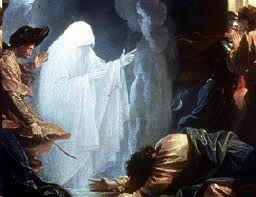
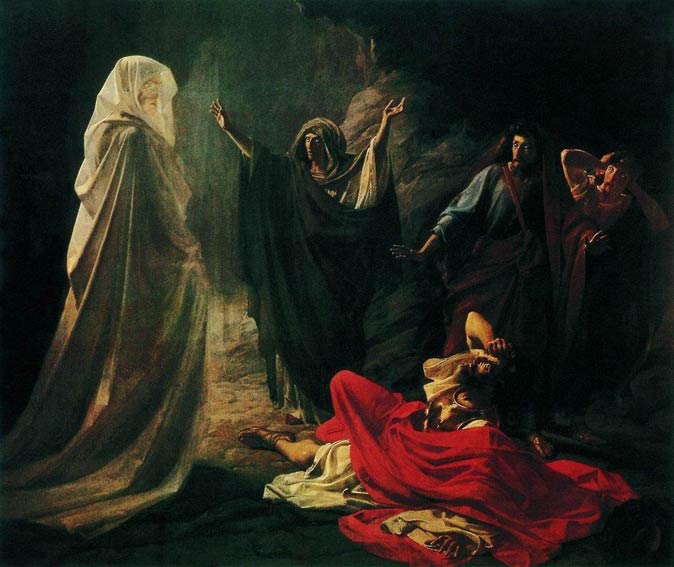
Witch of Endor by Nikolai Ge, 1857.
The Yalkut Shimoni (11th century) identifies the anonymous witch as the mother of Abner.[7] Based upon the witch’s claim to have seen something, and Saul having heard a disembodied voice, the Yalkut suggests that necromancers are able to see the spirits of the dead but are unable to hear their speech, while the person for whom the deceased was summoned hears the voice but fails to see anything.[8]
Christianity[edit]
The Church Fathers and some modern Christian writers have debated the theological issues raised by this text. The story of King Saul and the Medium of Endor would appear at first sight to affirm that it is possible for humans to summon the spirits of the dead by magic.
Medieval glosses to the Bible suggested that what the witch actually summoned was not the ghost of Samuel, but a demon taking his shape or an illusion crafted by the witch.[9] Martin Luther, who believed that the dead were unconscious, read that it was “the Devil’s ghost”, whereas John Calvin, who did believe in the immortal soul, read that “it was not the real Samuel, but a spectre.”[10]
Mortalist denominations, such as Seventh-day Adventists, generally teach that the story is an example of ancient witchcraft or sorcery in the Bible.
In popular culture[edit]
The witch appears as a character in oratorios (including Mors Saulis et Jonathae (c.1682) by Charpentier, In Guilty Night: Saul and the Witch of Endor (1691) by Henry Purcell, Saul (1738) by Handel on the death of Saul, and Le roi David (1921) by Honegger) and operas (David et Jonathas (1688) by the afore-mentioned Charpentier and Saul og David (1902) by Carl Nielsen).
A year after the death of his son at Loos, Rudyard Kipling wrote a poem called En-Dor (1916), about communicating with the dead.[11] It concludes,
“ Oh the road to En-dor is the oldest road
And the craziest road of all!
Straight it runs to the Witch’s abode,
As it did in the days of Saul,
And nothing has changed of the sorrow in store
For such as go down on the road to En-dor! ”
Willa Cather used this to express her young hero’s feelings in A Lost Lady in 1923.
A British cutter with the name Witch of Endor is commandeered by Captain Horatio Hornblower during his escape from France in Flying Colours (1938), a novel by C.S. Forester set in the Napoleonic Wars.
The poet Howard Nemerov wrote a one act drama entitled “Endor” (1961) in which Saul visits the Witch of Endor.
The mother of the witch Samantha on the TV sitcom Bewitched was named Endora.
In the book series The Secrets of the Immortal Nicholas Flamel, the Witch of Endor is a secondary character.
“In Endor” by Shaul Tchernichovsky, describing King Saul’s encounter with the Witch of Endor, is considered a major work of modern Hebrew poetry. Tchernichovsky particularly identified with the character of Saul, perhaps due to his own name, and the poem expresses considerable empathy to this King’s tragic fate.
The Israeli Kibbutz Ein Dor derives its name from the Biblical witch’s place of residence.
“The Witch of Endor” is the title of a song by artist Moondog.
 Rosamond Press
Leave a comment