 Right after the sheriff in Montana told me Rena Easton filed stalking charges against me I felt I was being set-up for something. When the sheriff told me Rena became angry and destructive after an un-named person confirmed Rena’s paranoia was spot-on, I wondered if I was dealing with a radical feminist, or crazy evangelical. A half hour ago I recalled the Andy Warhol was shot by a crazed feminist. Hmmm! Artist killed by his Muse?
Jon Presco
Valerie Jean Solanas (April 9, 1936 – April 25, 1988) was an American radical feminist writer who is best known for her assassination attempt on artist Andy Warhol. Born in New Jersey, Solanas after her parents’ divorce had a volatile relationship with her mother and stepfather, as a teenager. As a consequence, she was sent to live with her grandparents. Her alcoholic grandfather physically abused her and Solanas ran away and became homeless. She came out as a lesbian in the 1950s. She graduated with a degree in psychology from the University of Maryland, College Park. Solanas relocated to Berkeley, California. There, she began writing her most notable work, the SCUM Manifesto, which urged women to “overthrow the government, eliminate the money system, institute complete automation and eliminate the male sex.”[1][2]
Solanas moved to New York City in the mid-1960s, working as a writer. She met Andy Warhol and asked Warhol to produce her play, Up Your Ass. She gave him her script, which he proceeded to lose, followed by Warhol expressing additional indifference to her play. After Solanas demanded financial compensation for the lost script, Warhol hired her to perform in his film, I, A Man, paying her $25.
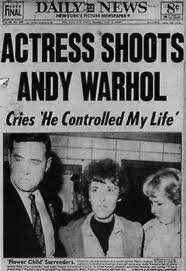
In 1967, Solanas began self-publishing the SCUM Manifesto. Olympia Press owner Maurice Girodias offered to publish Solanas’ future writings, and she understood the contract to mean that Girodias would own her writing. Convinced that Girodias and Warhol were conspiring to steal her work, Solanas purchased a gun in the spring of 1968. On June 3, she sought out Girodias, who was gone for the weekend. She then went to The Factory, where she found Warhol. She shot at Warhol three times, with the first two shots missing and the final wounding Warhol. She also shot art critic Mario Amaya, and attempted to shoot Warhol’s manager, Fred Hughes, point blank, but the gun jammed. Solanas then turned herself in to the police. She was charged with attempted murder, assault, and illegal possession of a gun. She was diagnosed as paranoid schizophrenic and pleaded guilty to “reckless assault with intent to harm”, serving a three-year prison sentence, including psychiatric hospital time. After her release, she continued to promote the SCUM Manifesto. She died in 1988 of pneumonia, in San Francisco.

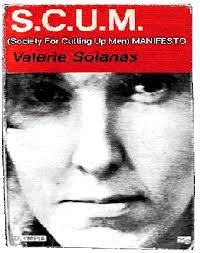
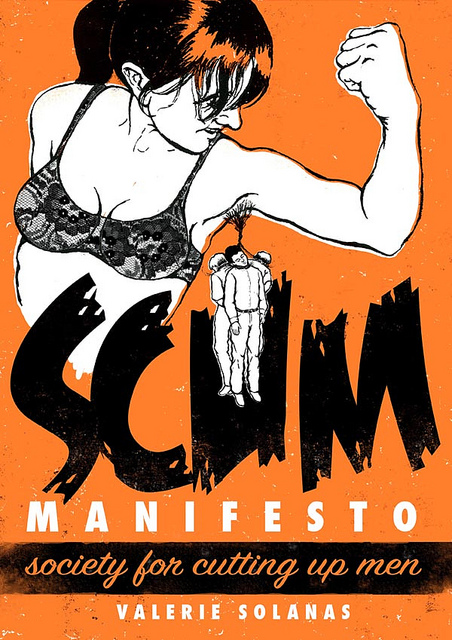
The SCUM Manifesto is a radical feminist manifesto[1][2] written in 1967[3][4] by Valerie Solanas. It argues that men have ruined the world and that women should overthrow society and eliminate the male sex.[5][6] “SCUM” stands for “Society For Cutting Up Men” according to Sharon L. Jansen,[7] but whether it was an acronym has been disputed.
Reprinted at least 10 times, translated into 13 languages, and excerpted several times, the SCUM Manifesto generated a range of reactions, including that it was utopian, feminist, pre-feminist, crusading, and a call to act; accurate, symbolic, irreverent, funny, outrageous, and extreme; parodic and satiric but not a put-on; witty, shocking, and articulative of rage; nonviolent, a suggestion for retraining of men, a declaration that men would be killed, and a charter for violence; and misandrous; and that it sought a women-only world and that it wouldn’t be necessary to kill men. The term SCUM was often described as an abbreviation for “Society for Cutting Up Men” but Solanas denied it, although the expanded term appeared on a cover of an edition she self-published. An organization did not exist, other than for one public forum with herself as the only member.
The Manifesto was little-known until Solanas attempted to kill Andy Warhol in 1968. This event brought significant public attention to the Manifesto and Solanas herself.[8][9] While some feminists defended Solanas and considered the Manifesto a valid criticism of the patriarchal order, others, such as Betty Friedan, considered Solanas’s views to be too radical and polarizing. Although Solanas’s motives for shooting Warhol remain unclear, the Manifesto is still frequently associated with this event.
 Rosamond Press
Leave a comment