

 I awoke pondering the heading for my first post. I considered the above, and “Repent!” When I turned on my computer, I saw images of an eclipse of Africa and Kenyans viewing it. I thought about the Shembe Zulu Nazarites.
“Repent” is the cry from John the Baptist, the Nazarite for life, whom I was named after because my mother began to have labour pains on Yom Kippur, the Day of Atonement, that fell on October 5, 1946. I was born at 6:02 P.M. The sun set at 6:17. Within minutes you could see hundreds of shooting stars.
The nurses were at the window beholding the celestrial event, and bid my mother to come look, but she was too spent.
When my mother left the hospital and read my birth certificate, she went into a rage. They had put an H on my name. My mother wanted it spelled JON. She refused to call me Jon to the day she died. She would use Jon Gregory. I was called Greg.
The day after Yom Kippur is just as holy. There is the presence of four angels and “THE NAME” called B’shem Hashem. It is my belief John’s father, Zachariah, was in the temple when these angels appeared and told him his baren wife was with child, and when he is born, he will be born with THE NAME on his lips. This is why Zachariah’s lips were sealed lest his words hold sway over the unborn, who was filled with the ‘Holy Spirit’ while in his mother’s womb. This Holy Spirit is ‘The Name’.
The evidence of this is the debate between John’s parents as to what he would be named. Both parents lose the argument when the eight day old infant SPEAKS. He then asks for a tablet in order to write THE NAME.
I am trying to discover when the Comet Giacobini–Zinner was caught up in the sun’s orbit. Did it’s orbit come very close to the earth at one time, around four thousand years ago?
In this blog and in other posts, I bid the Jews who support the evangelical takeover of my Democracy, to “Repent” I lost much credibility – I perhaps never had. But, now I have lost most of my friends, and all my family. I am alone in a wilderness – but for the Name? And, now the stars begin to fall from the heavens.
Jon the Nazarite
Just before John dies, Jesus comes to him in prison and asks for the Name. It is given to him, and, the ministry of Jesus begins. The reason Salome wanted John’s head, was she hoped he would utter the Name, and she would own the power of it.
In John 17 Jesus speaks of the Name. He has given the Name to his disciples.
I will remain in the world no longer, but they are still in the world, and I am coming to you. Holy Father, protect them by the power of[b] your name, the name you gave me, so that they may be one as we are one. 12 While I was with them, I protected them and kept them safe by[c] that name you gave me. None has been lost except the one doomed to destruction so that Scripture would be fulfilled.
http://www.bbc.co.uk/news/science-environment-24793350
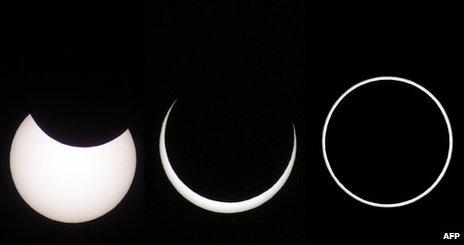
A rare solar eclipse allowing a view of the Sun that is totally or partially blocked by the Moon has taken place.
It was first visible in the southern United States, before sweeping east across the Atlantic Ocean and the African continent.
The US space agency, Nasa, said the greatest total eclipse occurred over the Atlantic Ocean.
One of the best views was in northern Kenya, where tour companies organised trips to view a total blackout.
Local myths there attribute the event to the Moon eating the Sun.
Men and women from the Turkana tribe take part in a ceremony in the Sibiloi national Park in the Turkana region Men and women from the Turkana tribe in Kenya took part in a ceremony ahead of the eclipse
Partial views were available in eastern North America and southern Europe.
Halo
This solar eclipse was a rare occurrence in that it was “hybrid” – switching between an annular and total eclipse.
In a total eclipse, the Moon completely covers the sun, while an annular eclipse occurs when the Moon is at its farthest from the Earth and does not block out the Sun completely, leaving a halo of sunlight still visible around the Moon.
The eclipse event began about 1,000km (620 miles) east of Jacksonville, Florida with an annular eclipse visible for four seconds at sunrise.
Continue reading the main story
Eclipse safety
Looking directly at the sun during a partial or annular eclipse, or the partial phases of a total solar eclipse, can can cause temporary or permanent damage to the retina
Special welder’s glasses or mylar lenses manufactured especially for viewing solar eclipses are recommended
Or you can make a pinhole camera by making a 3mm hole in a sheet of paper, turning your back to the Sun and using the pierced page to project the image of the Sun on to another sheet of paper
Nasa – Eye safety during solar eclipses
As the Moon’s shadow raced east the eclipse switched from annular to total along a narrow corridor.
The greatest total eclipse occurred in the Atlantic Ocean, approximately 330km south-west of Liberia, and lasted for more than one minute.
The eclipse continued across Africa through the Congos until it passed through northern Uganda and northern Kenya, ending in southern Ethiopia and Somalia.
Either side, a partial eclipse was seen within a much broader path including eastern North America, northern South America, southern Europe, the Middle East and Africa.
Experts warned that no-one should attempt to view the Sun with the naked eye.
A safe view of eclipses can be obtained by using special welder’s glasses or a pinhole camera.
http://www.sichosinenglish.org/cgi-bin/calendar?date=08101946
13 Tishrei, 5707 – October 8, 1946
Positive Mitzvah 53: Appearing before HaShem in the Beit HaMikdash
Deuteronomy 16:16 “Three times a year, all your males shall appear”
Three times a year; on Pesach, Shavuot and Sukkot, Jewish males are commanded to present themselves in the Beit HaMikdash.
The revelation of holiness on these occasions inspires everyone in their devotion to HaShem.
The arrival at the Beit HaMikdash is marked by bringing a sacrifice, the Olat Reiyah.
http://www.talkreason.org/articles/Purim.cfm
http://en.wikipedia.org/wiki/Tishrei
Holidays in Tishrei[edit]
1-2 Tishrei – Rosh Hashanah
3 Tishrei – Tzom Gedaliah – (Fast Day) – On Tishrei 4 when Tishrei 3 is Shabbat
10 Tishrei – Yom Kippur – (Fast Day)
15–21 Tishrei – Sukkot/Sukkos
21 Tishrei – Hoshanah Rabbah
Tishrei – The Baal Shem Tov writes that the day after Yom Kippur, is an even greater holiday than Yom Kippur itself, a day called “Bshem HaShem” or in Yiddish “Gott’s Nomen”, literally “The Name of G-d”.
http://shma.com/2013/02/s-blog-bshem-hashem/
B’shem Hashem, elohei Yisrael
B’ymini Michael u-smoli Gavriel
U-milfanai Uriel, me’acharai Raphael
V’al roshi, v’al roshi, Shechinat-El
This song, also known as Reb Shlomo Carlebach’s “Angel Song,” unifies Jews from every corner of the world. The simple words are chanted into a beautiful chorus of harmonies and melodies that invite the immanent presence of God into any room. Usually sung either during Shabbat or before sleeping, this prayer seeks protection as we complete our phases of creation and stress and transcend to a world of stillness and tranquility. Most importantly, however, this “Angel Song” serves as our global Jewish compass, steered by the various angels in our midst.
With four angels leading us in each direction, we encounter four unique qualities that embody God. The first two angels, Michael and Gabriel, sit at our right and left respectively and are Biblical; the last two angels, Uriel and Raphael, sit before and behind us respectively and are derived from the early foundation of Rabbinic Judaism. All together, these four angels provide the blanket of security over our fears, the protective layer over our faith that allows us to store away our doubts.
On our right sits Michael, known in Biblical history as the “archangel” who defeated evil and acts of injustice. Today, we refer to Michael as the angel of mercy, the one who constantly improves our right hand and advocates on our behalf. According to a Midrash, Michael, meaning “Who is like God” was the angel that prevented Abraham from sacrificing his only son and stood beside Moshe after his death, unwilling to take his soul and accept the death of a leader. Powerful and determined, Michael is the right hand we need when we cannot fight injustice alone. Michael is the right arm of Moshe, Miriam, Dr. King, and Mother Theresa. Michael is perhaps our wake up call when our arms are not being used to make this world a safer and more just place.
Lingering on our left side is Gabriel, whose name means “God is my strength.” Gabriel is considered the defender of the Jewish people, the executer of all judgments. Perhaps it is through Gabriel that we learn the pivotal value of resistance that we need during the times we feel spiritually threatened. Represented by fire, this angel is the force of strength and judgment that destroyed a city tainted by its sins and corruption in order to defend the world. Gabriel is the inner fire that enables us to defend the defenseless, to uphold the weak. Gabriel is the fire that complements Michael, the angel of mercy, motivating us to resist injustice for the sake of others and for a better world. Without fire, there would be no change. Without resistance, we would live a life of indifference, which is and forever would be the greatest tragedy of all. Gabriel is the fire within us that serves as constant reminder that we, Jews and non-Jews alike, are responsible for creating a different world, not a world of indifference.
In front of us lies Uriel, the angel of light. While the Bible, Talmud, and all other Jewish sources could surely explain every meaning behind the purpose of light, I only see it as serving one purpose: the illuminate the darkness that envelopes us. Darkness and lightness, both Divinely created, are somehow the two most humanly controlled concepts that exist today. We are so quick to leave a room of darkness for the next person instead of lighting even the dimmest candle of hope. Not only are we obligated to be “Or LaGoyim,” or the light to the other nations, but we must also be the light for another. The phases of darkness that enter our lives will only amplify and overpower us if we allow them to do so; with the guidance of Uriel, we can look in front of us to see darkness defeated by the light we create together during the most challenging of times.
Behind us is Raphael, the angel of healing, the angel that absorbs our deepest pains, diseases, and despair. Raphael, like most medications today, is not the cure for our pain but rather the guarantee that we are not alone in the healing process. Moreover, perhaps as Raphael isolates our illnesses and weaknesses behind us, he allows our gradual healing to surround our every direction and eventually provide us with a new light before our eyes, or Uriel. It takes the deepest pain to recognize the unremitting power of healing, no matter how long it may take. It is the healing guidance of Raphael that will allow us to eventually leave the pain and sorrow of the tragedies in Newtown, Connecticut and Colorado behind us and slowly begin to heal until we see the light once again. The shock of death will remain behind us in the arms of an angel, but the warmth of healing is in the arms and legs of our community
Trough the words of one Shlomo Carlebach prayer, we can point our actions toward distinct directions. We can create a moral Jewish compass that inspires us to follow in the footsteps of our angels. And of course, in between those four pathways and above our heads, the presence of God [Shechinat-El] will dwell
In the name of “the name”, god of Israel
Who is on the right of Michael and on the left of Gabriel
Who is in front of Uriel and behind Refael
And over my head, over my head, there’s the spirit of god
http://www.sichosinenglish.org/cgi-bin/calendar?holiday=tishrei6053
Significantly, a prerequisite for serving as High Priest on Yom Kippur was marriage. [10]
If the High Priest was unmarried, i.e., if he lacked this basic commitment to living within the practical realities of this world, he was considered unfit to intercede on behalf of his brethren.
Yom Kippur and the days that precede it are days of repentance characterized by fear and awe. During this time, the Jewish people fast in order to demonstrate their sincere regret over their transgressions of the previous year. The four days following Yom Kippur are also days of repentance, but now we are in a totally different emotional state. Complete involvement with the mitzvos of sukkah and dalet minim, the four species, shows our tremendous devotion to our beloved King. HaShem responds by extending the atonement that began during Yom Kippur (Shlah HaKodesh, Maseches Sukkah, 193b ).
http://www.torah.org/learning/integrity/fiveDaysYomKippur.html
Oct 5
Tishri 10
Yom Kippur
Oct 10
Tishri 15
Sukkot I
Oct 11
Tishri 16
Sukkot II
Oct 12
Tishri 17
Sukkot III
Oct 13
Tishri 18
Sukkot IV
Oct 14
Tishri 19
Sukkot V
Oct 15
Tishri 20
Sukkot VI
Oct 16
Tishri 21
Sukkot VII/Hoshanah Rabah
http://www.timeanddate.com/calendar/?year=1946&country=34
One of the most spectacular meteor showers visible from Earth was seen after the planet passed through the debris left by Comet Giacobini-Zinner. A greater number of meteors (referred to as Giacobinids or Draconids) burned up in the atmosphere than usual because of a closer approach. The comet and the Earth came within 131,000 miles of each other.[21]
http://en.wikipedia.org/wiki/October_1946
Comet Giacobini–Zinner (official designation: 21P/Giacobini–Zinner) is a periodic comet in the Solar System.
It was discovered by Michel Giacobini from (Nice, France), who observed the comet in the constellation of Aquarius on December 20, 1900. It was recovered two passages later by Ernst Zinner (from Bamberg, Germany) while observing variable stars near Beta Scuti on October 23, 1913.
During its apparitions, Giacobini–Zinner can reach about the 8th magnitude, but in 1946 it underwent a series of outbursts that made it as bright as 5th magnitude. It is the parent body of the Giacobinids meteor shower (also known as the Draconids).
Giacobini–Zinner was the target of the International Cometary Explorer spacecraft, which passed through its plasma tail on September 11, 1985. In addition, Japanese space officials considered redirecting the Sakigake interplanetary probe toward a 1998 encounter with Giacobini–Zinner, but that probe lacked the propellant for the necessary maneuvers and the project was abandoned.
The comet nucleus is estimated to be 2.0 kilometers in diameter.[1]
The October Draconids, in the past also unofficially known as the Giacobinids, are a meteor shower whose parent body is the periodic comet 21P/Giacobini-Zinner. Almost all meteors which fall towards Earth ablate long before reaching its surface. The Draconids are best viewed after sunset in an area with a clear dark sky.
The 1933[1][2] and 1946[2] Draconids had Zenithal Hourly Rates of thousands of meteors visible per hour, among the most impressive meteor storms of the 20th century. Rare outbursts in activity can occur when the Earth travels through a denser part of the cometary debris stream; for example, in 1998, rates suddenly spiked[3][4] and spiked again (less spectacularly) in 2005.[5]
a comet that moves about the sun in an elliptic orbit; a comet that has been seen at two of its approaches to the sun.
Sukkot, Succot or Sukkos (Hebrew: סוכות or סֻכּוֹת sukkōt or sukkos, Feast of Booths, Feast of Tabernacles) is a biblical Jewish holiday celebrated on the 15th day of the month of Tishrei (varies from late September to late October). It is one of the three biblically mandated festivals Shalosh regalim on which Hebrews were commanded to make a pilgrimage to the Temple in Jerusalem. It follows the solemn holiday of Yom Kippur, or the Day of Atonement.
The holiday lasts seven days (eight in the diaspora). The first day (and second in the diaspora) is a sabbath-like yom tov (holiday) when work is forbidden, followed by the intermediate Chol Hamoed and Shemini Atzeret. The Hebrew word sukkōt is the plural of sukkah, “booth or tabernacle”, which is a walled structure covered with schach (plant material such as leafy tree overgrowth or palm leaves).
The sukkah is intended as a reminiscence of the type of fragile dwellings in which the Israelites dwelt during their 40 years of travel in the desert after the Exodus from slavery in Egypt. Throughout the holiday, meals are eaten inside the sukkah and some people sleep there as well. On each day of the holiday, members of the household recite a blessing over the lulav (closed frond of the date palm tree, bound with boughs and branches of the willow and myrtle trees) and etrog (yellow citron) (Four species).[1]
According to the prophet Zechariah, in the messianic era Sukkot will become a universal festival and all nations will make pilgrimages annually to Jerusalem to celebrate the feast there.(Zech 14:16-19)

 Rosamond Press
Leave a reply to Royal Rosamond Press Cancel reply