 I think Rena became the Securing the Peace Goddess, that is in charge of Midwest Agriculture in ‘Gawd’s Country’. Everyone knows there’s been cultural warfare over the Heartland of America, the All American Girl Next Door. Did Rena Easton go over to the other side? Who’s side was she really on? I think she was surrounded by Warriors of the British Empire – the Old Roman Guard when she married Admiral Easton. Did she learn how to make all that brass a good up of English Tea? I would like to think she was torn down the middle as to who’s side she was on – before she married Sir Ian Easton. I could really be fooling myself, here, but……God loves a good story!
Hmmmmmm! How about a story about a goddess being kidnapped and taken to a distant shore, and here they come – a thousand ships full of Greek Warriors praying to the god Ares to give them victory over Paris and the Trojans.
After being rejecged by my Muse, I ended up in that million person anti-war march in Washington where Ian was stationed, he in charge of making sure American Tax Payers wanted to keep paying for THE WAR, and any Ol’ War would do when your “Securing the Peace!”
Well! Well! Well! my dear Muse…..how epic of you! Hail to thee the Beautiful Muse that launched a thousand ships!
In 1971, having made my way down Pennsylvania Ave to a tree near the Capitol, I and a pretty young All American Girl began kissing. We kissed for eight hours! It was the third best kiss in the world, witnessed by tens of thousands. We even got some applause!
“Make love……………………………………………………not war!”
I think I am on someone’s radar. I guess they don’t make British Beauties like they used to, so they come over here and get grabby with our Fair Maidens.
I think Rena has already been to Switzerland, attended a Geneva Peace Talk with her Admiral who thrives on tax-payer money.
As Attache of the British Defense Staff stationed in Washington, and 34 States, Sir Easton my have had a interest in making American Protestors look impotent and mentally ill. something Margaret Thatcher worked close with Ronald Reagan at doing as they degregulated both nations in order to destroy the Unions.
I haven’t seen a good ancient hero movie – in a coon’s age! How about…..The Return of the Son of Peace?
Jon
A Son of Peace
He was the main instigator of the British challenge for the 1987 America’s Cup in Fremantle, Australia. He persuaded Admiral Sir Ian Easton to use his contacts at British Aerospace to raise the required deposit at the eleventh hour, without which there would have been no challenge.
Easton joined the Royal Navy in 1931 and qualified as a pilot at the start of World War II in which he saw active service on aircraft carriers.[1] On 4 January 1941, flying a Fairey Fulmar of 803 Squadron from HMS Formidable during a raid on Dakar he force landed, with his aircrewman Naval Airman James Burkey and was taken prisoner and held by the Vichy French at a camp near Timbuktu until released in November 1942.[2] He was appointed Assistant Director of the Tactical and Weapons Policy Division at the Admiralty in 1960 and was seconded to the Royal Australian Navy as Captain of HMAS Watson in 1962.[1] He went on to be Naval Assistant to the Naval Member of the Templer Committee on Rationalisation of Air Power in 1965, Director of Naval Tactical and Weapons Policy Division at the Admiralty in 1966 and Captain of the aircraft carrier HMS Triumph in 1968.[1] After that he was made Assistant Chief of Naval Staff (Policy) in 1969, Flag Officer for the Admiralty Interview Board in 1971 and Head of British Defence Staff and Senior Defence Attaché in Washington D. C. in 1973.[1] He last posting was as Commandant of the Royal College of Defence Studies in 1976: he commissioned armourial bearings for the College which were which were presented during a visit by the Queen in November 1977.[3] He retired in 1978.[1]
In ancient Roman religion and myth, Mars (Latin: Mārs, Martis) was the god of war and also an agricultural guardian, a combination characteristic of early Rome.[1] He was second in importance only to Jupiter, and he was the most prominent of the military gods in the religion of the Roman army. Most of his festivals were held in March, the month named for him (Latin Martius), and in October, which began and ended the season for military campaigning and farming.
[show]British Aerospace Act 1980
The company was formed in the United Kingdom as a statutory corporation on 29 April 1977 as a result of the Aircraft and Shipbuilding Industries Act. This called for the nationalisation and merger of the British Aircraft Corporation, Hawker Siddeley Aviation, Hawker Siddeley Dynamics and Scottish Aviation. In 1979 BAe officially joined Airbus, the UK having previously withdrawn support for the consortium in April 1969.
Play both videos at same time…..
In accordance with the provisions of the British Aerospace Act 1980 the statutory corporation was changed to a public limited company (plc), British Aerospace Public Limited Company, on 1 January 1981. On 4 February 1981 the government sold 51.57% of its shares. The British government sold its remaining shares in 1985, maintaining a £1 golden share which allows it veto foreign control of the board or company.[2]
On 26 September 1985, the UK and Saudi Arabian governments signed the Al Yamamah contract, with BAe as prime contractor. The contracts, extended in the 1990s and never fully detailed, involved the supply of Panavia Tornado strike and air defence aircraft, Hawk trainer jets, Rapier missile systems, infrastructure works and naval vessels. The Al Yamamah deals are valued at anything up to £20 billion and still continue to provide a large percentage of BAE Systems’ profits. With Alenia Aeronautica, CASA and DASA, BAe formed Eurofighter GmbH in 1986 for the development of the Eurofighter Typhoon. On 22 April 1987 BAe acquired Royal Ordnance, the British armaments manufacturer, for £190 million. Heckler & Koch GmbH was folded into this division when BAe acquired it in 1991. In 1988 BAe purchased the Rover Group which was being privatised by the British government.
In 1991 BAe acquired a 30% interest in Hutchison Telecommunications through a stock swap deal, where Hutchison was given a controlling stake of 65% in BAe’s wholly owned subsidiary – Microtel Communications Ltd.[3][4][5] In August 1991, BAe formed a naval systems joint venture, BAeSEMA, with the Sema Group.[3] BAe acquired Sema’s 50% share in 1998. 1991 also saw BAe begin to experience major difficulties. BAe saw its share price fall below 100p for the first time. On 9 September 1991, the company issued a profits warning and later that week “bungled” the launch of a £432 million rights issue.[6] On 25 September 1991 BAe directors led by CEO Richard Evans ousted the Chairman Professor Sir Roland Smith in a move described by The Independent as “one of the most spectacular and brutal boardroom coups witnessed in many years.”[7] Evans described the troubles as a confluence of events:[8]
“our property company [Arlington Securities] was hit with a lousy market. Sales of the Rover Group sank by about a fifth and losses mounted. The government’s defence spending volumes underwent a major review. Losses in our commercial aerospace division increased dramatically with the recession in the airline industry.”
In 1992 BAe formed Avro RJ Regional Jets to produce the Avro RJ series, an evolution of the BAe 146. In mid-1992 BAe wrote off £1 billion of assets, largely as part of redundancies and restructuring of its regional aircraft division.[9] This was largest asset write-off in UK corporate history. The General Electric Company (GEC), later to sell its defence interests to BAe, came close to acquiring BAe at this time.[9] BAe cut 47% of its workforce (60,000 out of 127,000), 40,000 of which were from the regional aircraft division.
Evans decided to sell non-core businesses (these “non-core” activities included The Rover Group, Arlington Securities, BAe Corporate Jets, BAe Communications and Ballast Nedam). Although the rationale of diversification was sound (to shield the company from cyclical aerospace and defence markets) the struggling company could not afford to continue the position: “We simply could not afford to carry two core businesses, cars and aerospace. At one point Rover was eating up about £2 billion of our banking capacity.”[10] BAe Corporate Jets Ltd and Arkansas Aerospace Inc were sold to Raytheon in 1993. In 1994 the Rover Group was sold to BMW and British Aerospace Space Systems was sold to Matra Marconi Space. In 1998 BAe’s shareholding of Orange plc was reduced to 5%.[4] The Orange shareholding was a legacy of the 30% stake in Hutchison Telecommunications (UK) Ltd when Hutchison exchanged its own shares for a mobile phone company (Microtel Communications Ltd) from BAe.[3][5]
BAeSEMA, Siemens Plessey and GEC-Marconi formed UKAMS Ltd in 1994 as part of the Principal Anti-Air Missile System (PAAMS) consortium. UKAMS would become a wholly owned subsidiary of BAe Dynamics in 1998. In 1995 Saab Military Aircraft and BAe signed an agreement for the joint development and marketing of the export version of the JAS 39 Gripen. In 1996 BAe and Matra Defense agreed to merge their missile businesses into a joint venture called Matra BAe Dynamics. In 1997 BAe joined the Lockheed Martin X-35 Joint Strike Fighter team. The company acquired the UK operations of Siemens Plessey Systems (SPS) in 1998 from Siemens AG. DASA purchased SPS’ German assets.[11][12]
Transition to BAE Systems: 1997 to 1999[edit source]
Defence consolidation became a major issue in 1998, with numerous reports linking various European defence groups – mainly with each other but also with American defence contractors. It was widely anticipated that BAe would merge with Germany’s DASA to form a pan-European aerospace giant. A merger deal was negotiated between Richard Evans and DASA CEO Jürgen Schrempp.[13] However when it became clear that GEC was selling its defence electronics business Marconi Electronic Systems, Evans put the DASA merger on hold in favour of purchasing Marconi. Evans stated that in 2004 that his fear was that an American defence contractor would acquire Marconi and challenge both BAe and DASA. Schrempp was angered by Evans’ actions and chose instead to merge DASA with Aerospatiale to create the European Aeronautic Defence and Space Company (EADS). This group was joined by Spain’s CASA following an agreement in December 1999.
The GEC merger to create a UK company compared to what would have been an Anglo-German firm, made the possibility of further penetration of the United States (US) defence market more likely. The company, initially called “New British Aerospace”, was officially formed on 30 November 1999 and known as BAE Systems.[14]
Under the influence of Greek culture, Mars was identified with the Greek god Ares,[2] whose myths were reinterpreted in Roman literature and art under the name of Mars. But the character and dignity of Mars differed in fundamental ways from that of his Greek counterpart, who is often treated with contempt and revulsion in Greek literature.[3] Mars was a part of the Archaic Triad along with Jupiter and Quirinus, the latter of whom as a guardian of the Roman people had no Greek equivalent. Mars’ altar in the Campus Martius, the area of Rome that took its name from him, was supposed to have been dedicated by Numa, the peace-loving semi-legendary second king of Rome. Although the center of Mars’ worship was originally located outside the sacred boundary of Rome (pomerium), Augustus made the god a renewed focus of Roman religion by establishing the Temple of Mars Ultor in his new forum.[4]
Although Ares was viewed primarily as a destructive and destabilizing force, Mars represented military power as a way to secure peace, and was a father (pater) of the Roman people.[5] In the mythic genealogy and founding myths of Rome, Mars was the father of Romulus and Remus with Rhea Silvia. His love affair with Venus symbolically reconciled the two different traditions of Rome’s founding; Venus was the divine mother of the hero Aeneas, celebrated as the Trojan refugee who “founded” Rome several generations before Romulus laid out the city walls.
The importance of Mars in establishing religious and cultural identity within the Roman Empire is indicated by the vast number of inscriptions identifying him with a local deity, particularly in the Western provinces.
Ares
From Wikipedia, the free encyclopedia
Changes must be reviewed before being displayed on this page.show/hide details
Jump to: navigation, search
Page protected with pending changes level 1
Page protected with pending changes level 1
Page protected with pending changes level 1
This article is about the ancient Greek god. For other uses, see Ares (disambiguation).
Not to be confused with Aries (astrology).
Ares
Ares Canope Villa Adriana b.jpg
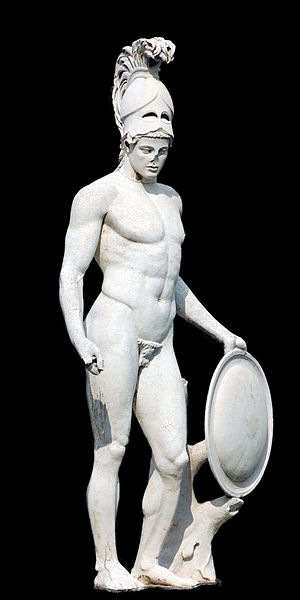
Statue of Ares from Hadrian’s Villa
God of War
Abode
Mount Olympus, Thrace, Macedonia, Thebes, Greece, Sparta & Mani
Symbol
spear, helmet, dog, chariot, boar
Parents
Zeus and Hera
Siblings
Eris, Hebe, Hephaestus, Enyo,and Eileithyia
Children
Erotes (Eros and Anteros), Phobos, Deimos, Phlegyas, Harmonia, and Adrestia
Roman equivalent
Mars
Ares (Ancient Greek: Ἄρης [árɛːs], Μodern Greek: Άρης [ˈaris]), Doric Greek: Ἄρα [ára] was the Greek god of war. He is one of the Twelve Olympians, and the son of Zeus and Hera.[1] In Greek literature, he often represents the physical or violent and untamed aspect of war, in contrast to the armored Athena, whose functions as a goddess of intelligence include military strategy and generalship.[2]
The Greeks were ambivalent toward Ares: although he embodied the physical valor necessary for success in war, he was a dangerous force, “overwhelming, insatiable in battle, destructive, and man-slaughtering.”[3] Fear (Phobos) and Terror (Deimos) were yoked to his battle chariot.[4] In the Iliad, his father Zeus tells him that he is the god most hateful to him.[5] An association with Ares endows places and objects with a savage, dangerous, or militarized quality.[6] His value as a war god is placed in doubt: during the Trojan War, Ares was on the losing side, while Athena, often depicted in Greek art as holding Nike (Victory) in her hand, favored the triumphant Greeks.[7]
Ares plays a relatively limited role in Greek mythology as represented in literary narratives, though his numerous love affairs and abundant offspring are often alluded to.[8] When Ares does appear in myths, he typically faces humiliation.[9] He is well known as the lover of Aphrodite, the goddess of love, who was married to Hephaestus, god of craftsmanship.[10] The most famous story related to Ares and Aphrodite shows them exposed to ridicule through the wronged husband’s clever device.[11]
The counterpart of Ares among the Roman gods is Mars,[12] who as a father of the Roman people was given a more important and dignified place in ancient Roman religion as a guardian deity. During the Hellenization of Latin literature, the myths of Ares were reinterpreted by Roman writers under the name of Mars. Greek writers under Roman rule also recorded cult practices and beliefs pertaining to Mars under the name of Ares. Thus in the classical tradition of later Western art and literature, the mythology of the two figures becomes virtually indistinguishable.
Contents
[hide] 1 Names and epithets
2 Character, origins, and worship 2.1 Ares in Sparta
2.2 Ares in the Arabian Peninsula
3 Attributes
4 Cult and ritual
5 Attendants
6 Founding of Thebes
7 Consorts and children 7.1 List of Ares’ consorts and children
8 Hymns to Ares
9 Other accounts 9.1 Ares and the giants
9.2 The Iliad
10 Renaissance
11 Popular culture
12 See also
13 Notes
14 External links
Names and epithets[edit source]
The etymology of the name Ares is traditionally connected with the Greek word ἀρή (arē), the Ionic form of the Doric ἀρά (ara), “bane, ruin, curse, imprecation”.[13] There may also be a connection with the Roman god of war Mars, via hypothetical Proto-Indo-European *M̥rēs;[citation needed] compare Ancient Greek μάρναμαι (marnamai), “to fight, to battle”, or Punjabi maarna (to kill, to hit).[14] Walter Burkert notes that “Ares is apparently an ancient abstract noun meaning throng of battle, war.”[15] The earliest attested form of the name is the Mycenaean Greek a-re, written in Linear B syllabic script.[16]
The adjectival epithet, Areios, was frequently appended to the names of other gods when they took on a warrior aspect or became involved in warfare: Zeus Areios, Athena Areia, even Aphrodite Areia. In the Iliad, the word ares is used as a common noun synonymous with “battle.”[3]
Inscriptions as early as Mycenaean times, and continuing into the Classical period, attest to Enyalios as another name for the god of war.
Character, origins, and worship[edit source]
Ares was one of the Twelve Olympians in the archaic tradition represented by the Iliad and Odyssey. Zeus expresses a recurring Greek revulsion toward the god when Ares returns wounded and complaining from the battlefield at Troy:
Then looking at him darkly Zeus who gathers the clouds spoke to him:
‘Do not sit beside me and whine, you double-faced liar.
To me you are the most hateful of all gods who hold Olympos.
Forever quarrelling is dear to your heart, wars and battles.
…
And yet I will not long endure to see you in pain, since
you are my child, and it was to me that your mother bore you.
But were you born of some other god and proved so ruinous
long since you would have been dropped beneath the gods of the bright sky.”[17]
This ambivalence is expressed also in the Greeks’ association of the god with the Thracians, whom they regarded as a barbarous and warlike people.[18] Thrace was Ares’ birthplace, his true home, and his refuge after the affair with Aphrodite was exposed to the general mockery of the other gods.[19]
A late-6th-century BC funerary inscription from Attica emphasizes the consequences of coming under Ares’ sway:
Stay and mourn at the tomb of dead Kroisos
Whom raging Ares destroyed one day, fighting in the foremost ranks.[20]
Ares in Sparta[edit source]
In Sparta, Ares was viewed as a masculine soldier: his resilience, physical strength, and military intelligence were unrivaled. Human sacrifices were offered to him.[21] Also, an ancient statue, representing the god in chains, suggested that the martial spirit and victory were to be kept in the city of Sparta.
 Rosamond Press
Leave a comment