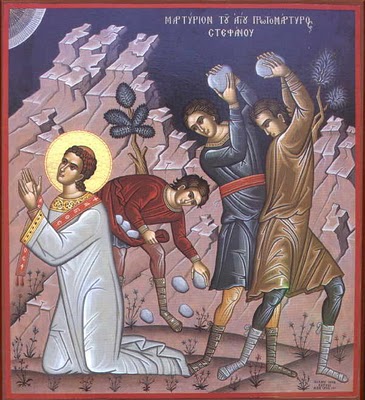
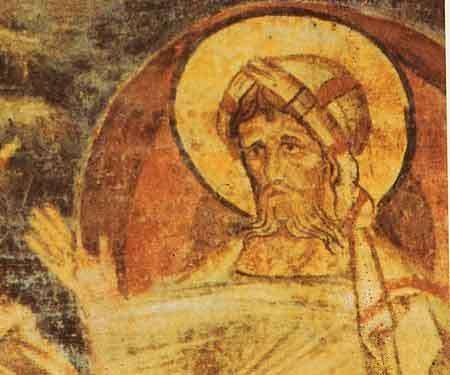
 It is alleged the face of Saint Stephen glowed because he was filled with the light of the Holy Spirit. Are we talking about Halos?
One day while I was studying my friend Marilyn dropped in and gasped because my face was glowing. My white hair was like a neon blue. My blue eyes were intense.
“Go look in the mirror!”
I looked like an angel.
I have seen auras around people most of my life, especially after I died – and came back. Chris Wandel told me embers of the Loading Zone were in awe of me, my eyes glowing as I came down the dark halls of the large Victorian we lived in. A woman who was with my brother-in-law exclaimed upon seeing me for the first time;
“There is a golden aura around that man!”
The persecution of the first Church of Nazarites allegedly began when the Synagogue of Freedmen challenged Stephen about Jesus saying he would tear down Herod’s temple,and rebuild it in three days. All devout Jews who hated the yoke of Roman slavery hated Herod’s temple because the he put a Roman eagle on a gate of this temple. This led to revolutions and a general strike of any Jews, who were slaughtered for their hatred of Herod’s temple. Patriotic Jews chose to practice Judaism in the synagogue System that was set up by Ezra and the Persian priests of Cyrus te Great. The Persia armies were defeating Roman legions in the field and were allied with the Jews. We are talking about A National Liberation From Roman Slavery, an Abolitionist Movement.
The Herodians sent all their royal children to Rome to live with the Flavian family and be taught Roman ways. This account of Stephen’s death has been severely tampered with. These Libertine Freedmen are the Back to God – and Moses Movement! Moses was the Martin Luther King of his day. It is said he was born circumcised, and could walk. A light filled the room when he came from his mother’s womb. John’s parents represented the oldest Levite priestly lineage of Moses and Aaron. I have shown that John spoke and wrote when he was eight days old. Was John surrounded by a halo?
Paul was a Roman citizen who was backed by Rome and the Herodians to put down the Liberty Movement of Freedmen who burned down the debt archives and freed indentured slaves from their contracts. Lady Liberty had come home to the Kingdom of God!
When Jesus announced he would restore the Law of the Jubilee, the desdendents of David – who condoned slavery – tried to shove him over a cliff. The Freedmen loved Jesus – the man! They hated Jesus the Roman god of Paul who became the Pope in Rome. Hail Caesar!
Freedom!
Jon the Nazarite Judge!
Acts of the Apostles: 6:8-15 – 8:1-3
Stephen like the rest of the original seven deacons in the Christian community came from the “Hellenist” background in Judaism, reading the Scriptures in Greek, not taking too seriously the mandates imposed by the Temple authorities, ready and willing to debate all comers on the superiority of his Christian belief. With such an attitude, it is not surprising that he quickly got into conflict with those “HebraVst” Jews who saw any attack on the Temple and its traditions as blasphemy.
Stephen is described as a young man filled with faith and the Holy Spirit. He was also a gifted debater, well schooled in the history and customs of the Old Testament as well as the teachings of Jesus Christ. In public debates he again and again showed the reasonableness of belief in Jesus, that his coming, death and resurrection, had been predicted through century after century of Jewish prophecy. Thus, in the Acts Of The Apostles, we read:
Certain members of the so-called “Synagogue of Roman Freedmen”: (that is, the Jews from Cyrene, Alexandria, Cilicia and Asia) would undertake to engage Stephen in debate but they proved no match for the wisdom and spirit with which he spoke.
Acts 6: 9-10
Losing the debate, some of the strict constructionists among his opponents took direct action:
They persuaded some men to make the charge that they had heard him speaking blasphemies against Moses and God, and in this way they incited the people, the elders, and the Scribes.
Acts 6:10-12
It is interesting that the first accusation against Stephen came not from the Sanhedrin or the Temple Scribes and Pharisees, but from fellow-members in the “Synagogue of Roman Freedmen” (the synagogue established by the “Hellnist” Jews as their place of worship in Jerusalem). It is an indication that the “HebraVsts” (the conservative Jews of strict observance) were not limited to the Jews of Jerusalem. We may assume that Stephen’s opponents, were, like himself Jews of the Diaspora, Jews who lived and worked in the pagan world beyond Jerusalem. Thus, it would be an oversimplification to maintain that the liberal Judaism was restricted to the Jews of the Diaspora and that conservative Judaism was restricted to the Temple in Jerusalem and its environs. As we shall see, this is confirmed by the story of Saul (Paul) who was born in Tarsus but raised as a strict constructionist.
It was Stephen’s opponents in the “Synagogue of Roman Freedman” who
… confronted him, seized him, and led him off to the Sanhedrin. There they brought in false witnesses, who said: “This man never stops making statements against the holy place and the law. We have heard him claim that Jesus the Nazorean will destroy this place and change the customs which Moses handed down to us”.
Acts of the Apostles, 6:12-14
To their credit, the leaders of the Temple did not automatically accept the accusation as being true (unlike the sometime practice today of accepting allegations against religious figures as being equivalent to conviction). In this case, the high priest of the Temple (who ran the investigation) gave Stephen the opportunity to defend himself, asking:
Are these charges true?
Acts 7:1
It was then that Stephen made his fatal (for him) mistake. If he had kept quiet, the authorities may have let him off with a whipping as they had previously done with the Apostles. But, instead of answering the question by saying that the accusations were not true or by simply repeating his belief in Jesus, Stephen gave a lengthy lecture to the leaders of the Temple about the failures of Judaism and its leaders as reported in the pages of the Old Testament.
He concluded by directly condemning his judges with these “unpolitic” words:
You stiff-necked people, uncircumcised in heart and ears, you are always opposing the Holy Spirit just as your fathers did before you. Was there ever any prophet whom your fathers did not persecute? In their day they put to death those who foretold the coming of the Just One; now you in your turn have become his betrayers and murderers. You who received the Law through the ministry of angels have not observed it.
Acts of the Apostles, 7:51-53
The Temple leaders were understandably enraged. They thought to themselves:
If this upstart is allowed to continue preaching like this, there is no telling what will happen to our position in society!
Stephen was indeed a threat not only in Jerusalem but also in foreign lands. He understood the Jews of the Diaspora and the pagan world in which they lived. It was therefore quite likely that his influence would quickly spread to the Jewish communities in foreign cities … cities like Alexandria, Athens, and Rome. It was simply too much to bear. With the approval of the Sanhedrin the raucous crowd seized Stephen, dragged him out of the city, and stoned him to death. The execution was witnessed and approved by a young Pharisee named Saul. He did not throw a stone himself; he only tended the cloaks of those who did.
Stephen was the first Christian to die for his belief in Christ. He would not be the last. Though as “cracked” as the rest of us, through the grace of God he as able to live and die for the sake of Christ. His death was the beginning of the first great persecution of the church in Jerusalem. All except the apostles fled into the country-side of Judea and Samaria. The young Saul enthusiastically pursued them, dragging men and women out of their homes and throwing them in jail. (Acts of the Apostles, 8:1-3)
It was the beginning of the end for the peaceful existence of the Christian community in Jerusalem. It was also the end of the beginning of Christianity in the wider world as its faithful streamed from Jerusalem seeking safety in distant lands and carrying with them the message of Jesus to the Gentile world.
Four centuries later Augustine gave the following reflection on these dramatic events in the infant church:
Because of the needs of the church seven deacons were ordained, among whom Stephen stood out, full of the Holy Spirit. When he was ordained, Saint Stephen’s spirit could not contain itself from preaching the truth. He was bubbling over with fervor, sparkling, on fire. The Jews (filled with jealousy in the hardness of their hearts) battered him to death with hard stones and made a martyr for us … that first martyr who set the martyrdom standard for all martyrs who would follow. Once Stephen had been killed, the church which had been born in Jerusalem suffered persecution and, in accordance with the Lord’s promise, the foundation stones of the church started to be shifted from Jerusalem. A persecution broke out, and the brethren were scattered. From this pile of wood set on fire in Jerusalem burning sticks were scattered over the earth, and wherever they landed, they set it ablaze. In this way Judea was filled with the Gospel, filled too was Samaria; and from there the message of Jesus went out to the nations and reached even to the ends of the world. It was not by being plucked up by the roots, but by growing and spreading through the world, that we observe the Gospel fulfilled.
Sermon 229I 4
6:8–7:1)
8 And Stephen full of grace and power, was performing great wonders and signs among the people. 9 But some men from what was called the Synagogue of the Freedmen, including both Cyrenians and Alexandrians, and some from Cilicia and Asia, rose up and argued with Stephen. 10 And yet they were unable to cope with the wisdom and the Spirit with which he was speaking. 11 Then they secretly induced men to say, “We have heard him speak blasphemous words against Moses and against God.” 12 And they stirred up the people, the elders and the scribes, and they came upon him and dragged him away, and brought him before the Council. 13 And they put forward false witnesses who said, “This man incessantly speaks against this holy place, and the Law; 14 for we have heard him say that this Nazarene, Jesus, will destroy this place and alter the customs which Moses handed down to us.” 15 And fixing their gaze on him, all who were sitting in the Council saw his face like the face of an angel. 7:1 And the high priest said, “Are these things so?”
The Setting of Stephen’s Sermon
(6:8–7:1)
8 And Stephen full of grace and power, was performing great wonders and signs among the people. 9 But some men from what was called the , including both Cyrenians and Alexandrians, and some from Cilicia and Asia, rose up and argued with Stephen. 10 And yet they were unable to cope with the wisdom and the Spirit with which he was speaking. 11 Then they secretly induced men to say, “We have heard him speak blasphemous words against Moses and against God.” 12 And they stirred up the people, the elders and the scribes, and they came upon him and dragged him away, and brought him before the Council. 13 And they put forward false witnesses who said, “This man incessantly speaks against this holy place, and the Law; 14 for we have heard him say that this Nazarene, Jesus, will destroy this place and alter the customs which Moses handed down to us.” 15 And fixing their gaze on him, all who were sitting in the Council saw his face like the face of an angel. 7:1 And the high priest said, “Are these things so?”
The “Hellenistic Jews”—those Jews born outside of Israel who migrated to Israel but who still had a separate language and culture derived from their exile—have already been introduced in Acts. They were those Jews who, at Pentecost, heard the apostles “speaking of the mighty deeds of God” in their own native tongues. It would not be unreasonable to assume that it was some of the “native Hebrews”—those Jews born and raised in Israel who spoke Aramaic or some Semitic language—who thought the sounds they heard (since they could not understand these foreign languages) were the mere mindless babblings of those who had had too much to drink (Acts 2:13).
Not until the neglect of the Hellenistic Jewish widows did this group actually emerge as a distinct entity in Acts. Here, in chapter 6, they had developed strong feelings of resentment toward the native Hebrews whom they held responsible, in some way, for the neglect of those widows from their own (Hellenistic Jewish) group. In the appointing of the seven men who would oversee the feeding of the widows from this point on, Stephen and Philip were selected, and their names were listed first (cf. Acts 6:5) with greater details given about them, especially Stephen.
Stephen was described as a man who was both “full of the Spirit and wisdom” (6:3) and as one who was “full of faith and of the Holy Spirit” (6:5). His ministry to Hellenistic widows seems to have put him in contact with a great many Hellenistic Jews. Among these people especially, and through Stephen, God accomplished many “great wonders and signs” (6:8). Feeding the widows gave Stephen a much greater exposure and the opportunity to function in a way that was similar to the twelve apostles.
The mention of Stephen’s ability to perform “signs and wonders” is very significant. It seems to imply that Stephen was, or at least functioned similarly to, an apostle. Up to this point, only the apostles were said to have worked signs and wonders. Since the twelve apostles would remain in Jerusalem after the church was scattered (Acts 8:1), it would seem that Stephen (here) and Philip (Acts 8) would serve as apostles to a more diverse group.
A Greek-speaking synagogue in Jerusalem involved in instigating the dispute with Stephen (Acts 6:9 ; KJV “Synagogue of the Libertines”). The Greek syntax suggests two groups of disputants. The first consisted of the Synagogue of the Freedmen, composed of Cyrenians and Alexandrians (so NAS, TEV). It is possible that this first group has three parties, the freedmen (freed slaves), the Cyrenians, and Alexandrians. Some early versions have Libyans in place of “libertines,” giving three groups of North African Jews. The second party in the dispute was composed of Greek-speaking Jews of Asia and Cilicia. These may have belonged to the Synagogue of the Freedmen as well (REB). Some have identified the freedmen as the descendants of Pompey’s prisoners of war (63 B.C.).
Persian Imperial Politics and the Origins of the Synagogue
As several scholars have pointed out, most of the activities in the 1st-century synagogue were performed in the city gate prior to the existence of separate public buildings. As to the public reading of Torah, the activity unique to the first-century synagogue, political, social, and religious factors all indicate that this form of worship began in the Persian period when some of the exiled Jews returned to their homeland from Babylonia. The earliest evidence is preserved in the books of Ezra and Nehemiah, where Ezra is said to have read the Law in the city gate (see especially Neh 8-9). The Persians are known to have codified laws of other conquered lands, e.g., Egypt, as part of their colonial strategy, but it is only in Yehud (Judah) that we find evidence of public ritual recitation of law.
This public reading and (re-)interpretation of codified law was motivated by a wish of the Persian imperial government and the Jewish leadership in Jerusalem to perform thoroughgoing social changes in Judah in the middle of the fifth century bce during the reign of the Persian king Artaxerxes I (465-423 bce). The reading and interpretation of law were meant to legitimize the social changes in the province, such as, e.g., the prohibition of mixed marriages. In order that these reforms be reinforced in the province as a whole, public readings of the law were introduced in the already existing public assemblies of towns and cities.
These public assemblies with torah readings were held in the city gates of any given city where such gates existed (i.e., in walled cities; non-walled cities and towns would have other open spaces that would be used for the same purposes). The city gate was the public place where local administration, judicial activities etc. took place (see, e.g., Ruth 4:1-12; Amos 5:10-15; Isa 29:21; Job 29:7-25, cf. Prov 24:7). Since this was a place where people generally would meet, this was also the place where people tended to hang out, gossiping or doing other idle things (e.g., Ps 69:13). Public assemblies would take place at specific times, though. There is some evidence that, in the early periods, ritual readings of Torah would also be done in conjunction with public fasts and festivals.
Though archaeological remains are wanting, at some point in the Hellenistic period, i.e., around the third century bce, when city gates were constructed differently and no longer functioned as places for assemblies, separate public buildings for the activities that previously took place in the city gate were beginning to be built (Levine, 2000). These buildings would have been of the same kind as the buildings we find later in the 1st century bce and ce (e.g., the public buildings at Gamla and Qiryat Sefer), buildings that were then called synagogues (“assembly houses”).
http://www.bibleinterp.com/articles/Runesson-1st-Century_Synagogue_1.shtml

 Rosamond Press
Leave a comment