
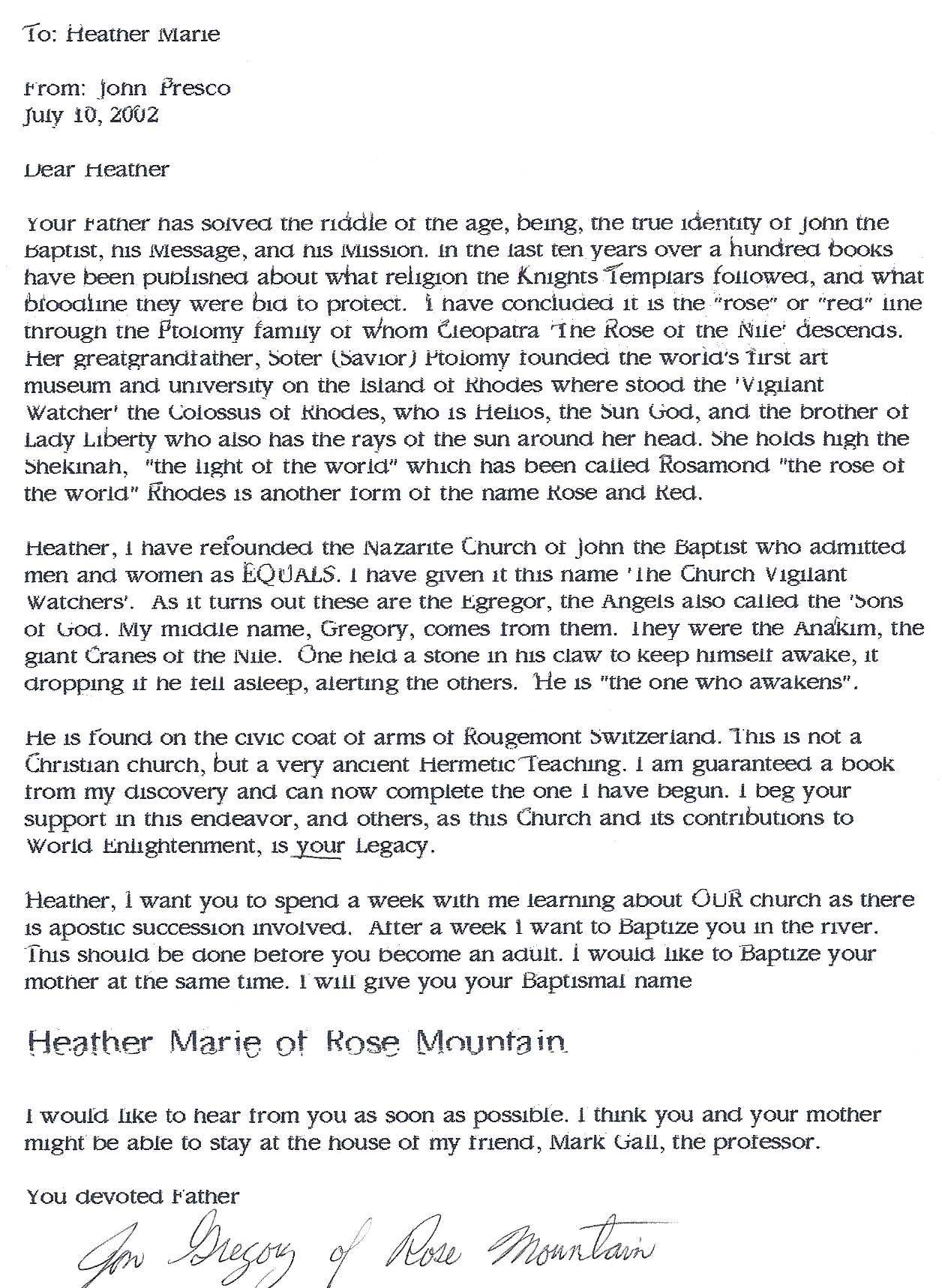
 Above is a letter I sent my daughter, Heather Hanson, on July 10, 2002. This letter will go down in history as the greatest literary betrayal of all time, thanks to Patrice Hanson and Vicki Presco – for starters. In this letter I tell my daughter about the Knight Templars of Rougemont who I have not yet discovered owned the Shroud of Turin. Now that there is no Vicar of Christ sitting on the throne of Peter in the Vatican, then the shroud might be the embodiment of Jesus in the World – until a new Pope is elected.
Heather Marie Hanson is eighteen, or is about to turn eighteen. I believe the latter, for I am desperate to impart my version of The Miracle of our Meeting, because I suspect her mother had her own version that I am not privy to. There was some talk about Heather’s dead grandmother, Patrice asking me if I ran into her during my near-death experience, and was there a transfer of some kind. I suspect Patrice was implying there was an immaculate conception of some kind, that borne Heather, who is the Miracle Child, and does not need any more miracles in her life, but the one she got from mommy, and, to be joined to ‘The Rose of the World’ (my dead sister) so Heather can fulfill her destiny, which is to spread her secret family miracle to others.
I have already posted letters where Patrice identifies herself as being the Angel-Mother who introduces my sixteen year old daughter to me, but, it was my angel, the one that I saw on McClure’s Beach when I was dying. I did a painting of my angel in 1976. She has no wings. She is walking from the sea with a glass Japanese float in her hands that looks like the globe of the world. I told my friends and family she is giving The World back to me, that I lost. A week after Christie drowned in the ocean the rising sun reflected off my brass doorknob and broadcast golden angel wings onto this painting. It was Godly. I said;
“Hello Christine!”
People would ask me who this angel was.
“She is all the woman I have known in the world, and all the woman I will know. You can see my daughter in my angel.
“He is found in the civic coat of arms of Rougemont Switzerland. This is not a Christian Church,but a very ancient hermetic Teaching. I am guaranteed a book from my discovery and can now complete the one I began. I beg your support in this endeavor, and others, as this Church and its contributions to World Enlightenment, is your legacy.”
“Heather, I have refounded the Nazarite Church of John the Baptist who admitted men and women as equals.”
This profound invitation to my daughter to come stay with me a week so I can TEACH her the secrets of the Knight Templars and the Holy Grail, may be the evidence Patrice Hanson was wanting to prove to our daughter I am INSANE, and it was time they called up Vicki Presco and Tom Snyder, to make sure the Patrice’s Miracle Child gets in Rosamond’s biography that is being authored by professionals, not some NUT bent on destroying the rising career of Heather, mommy’s Barbie Doll! The Da Vinci Code would come out a year later.
It was my hope that the New Nazarites would spread a new temperance Movement all over the world, even Russia, that fell due to alcoholism and shortage of Vodka. I had not yet read the Roza Mira prophecy. I have looked at the Good Templars as a model.
George Steven directed Shane and Giant, starring my kindred, Elizabeth Rosemond Taylor. Vicki told me she read the rough draft of the Rosamond story written by Julie Lynch who claims Ronald Schwary bought the option to our family story, that may not include the truth Christine and I were Brother and Sister in Alcoholics Anonymous that was founded upon the truth that when we alcoholics share our stories at meetings, this can lead to those who still suffer to never picking up another drink. Tom Snyder stole my Sober Story, and I believe convinced Heather and Patrice to abandon me.
The point is, Liz and Carrie would want my story to be published, even made into a movie, for they are in my family tree, and they suffered from drug and alcohol abuse. Did they attend AA? Carrie wrote a screenplay a bout my sister and her family, and is in the Peerage.
Because my daughter bonded with a Trophy Drunk, who Patrice approves of, I am transferring My Miracle to my grandson, Tyler Hunt whose life is in danger due to he being encouraged to become an alcoholic by Heather and her drunken lover, Bill Cornwell. My story will not end the way they it to end, because they want one more drink.
Binge drinking amongst teenagers is on the rise, as is alcoholism amongst veterans who I suspect suffer from Survivor’s Guilt. I know God does not want these brave men to carry around guilt they should not own, guilt that takes them further away from their Creation, and God’s Gift of Life in the Light.
Bill Arnold was the love of Christine’s life, though they never kissed. Rosamond never got to tell Bill she loved him to death. After Bill left us, my sister searched for him in other lovers and husbands. Bill never came for her, to take her away from the abuse. That was her Dream. Did she find Bill………..in the end.
Jon Presco
Copyright 2013
http://en.wikipedia.org/wiki/International_Organisation_of_Good_Templars
The IOGT originated as one of a number of fraternal organizations for temperance or total abstinence founded in the 19th century and with a structure modeled on Freemasonry, using similar ritual and regalia. Unlike many, however, it admitted men and women equally, and also made no distinction by race.
In 1850, in Utica, New York, Daniel Cody founded one such organization, the Knights of Jericho. In 1851, a lodge of it in Oriskany Falls (then known as Castor Hollow), a village near Utica, was visited by 13 members of another Utica group. Under the leadership of Wesley Bailey, it was decided that these two lodges form the Order of Good Templars. The motto of the renamed organization was “Friendship, Hope and Charity”.
Giant won the Academy Award for Best Director and was nominated nine other times, twice for Best Actor in a Leading Role (James Dean and Rock Hudson). The other nominations came in the categories of Best Actress in a Supporting Role (Mercedes McCambridge); Best Art Direction–Set Decoration, Color (Boris Leven, Ralph S. Hurst); Best Costume Design, Color; Best Film Editing; Best Music, Scoring of a Dramatic or Comedy Picture; Best Picture; and Best Writing, Best Screenplay – Adapted.[15]
George Stevens (December 18, 1904 – March 8, 1975) was an American film director, producer, screenwriter and cinematographer.[1]
Among his most notable films are A Place in the Sun (1951; winner of six Academy Awards including Best Director), Shane (1953; Oscar nominated), Giant (1956; Oscar for Best Director), and Diary of Anne Frank (1959; nominated for Best Director).
He was born in Oakland, California, and his family included his father Landers Stevens and his mother Georgie Cooper, both stage actors. His uncle was drama critic Ashton Stevens. He also had two brothers, Jack and writer Aston Stevens. He learned about the stage from his parents and worked and toured with them, on his way to filmmaking. He broke into the movie business as a cameraman, working on many Laurel and Hardy short films, such as Night Owls (1930). His first feature film was The Cohens and Kellys in Trouble in 1933.
The Da Vinci Code is a 2003 mystery-detective novel written by Dan Brown. It follows symbologist Robert Langdon and Sophie Neveu as they investigate a murder in Paris’s Louvre Museum and discover a battle between the Priory of Sion and Opus Dei over the possibility of Jesus having been married to Mary Magdalene. The title of the novel refers to, among other things, the fact that the murder victim is found in the Grand Gallery of the Louvre, naked and posed like Leonardo da Vinci’s famous drawing, the Vitruvian Man, with a cryptic message written beside his body and a pentacle drawn on his chest in his own blood.
The novel is part of the exploration of alternative religious history, the central plot point of which is that the Merovingian kings of France were descended from the bloodline of Jesus Christ and Mary Magdalene, ideas derived from Clive Prince’s The Templar Revelation (1997) and books by Margaret Starbird. The book also refers to The Holy Blood and the Holy Grail (1982) though Dan Brown has stated that it was not used as research material.
Actress Suzanne Vale (Meryl Streep) is a recovering drug addict trying to pick up the pieces of her acting career and get on with her life after being discharged from a rehab center to kick a cocaine-acid-Percodan habit; after overdosing while on a date, her mother admitted her to the rehab center from the emergency room.
Fisher has publicly discussed her problems with drugs, her struggle with bipolar disorder, and her overcoming an addiction to prescription medication, most notably on ABC’s 20/20 and The Secret Life of the Manic Depressive with Stephen Fry for the BBC.
http://pages.uoregon.edu/mgall/vita.htm
Edmund John Fisher was born on 10 August 1928 at Philadelphia, Pennsylvania, U.S.A..1 He is the son of Joseph Fisher and Kate Winokur.1 He married, firstly, Debbie Reynolds, daughter of Raymond Francis Reynolds and Maxine N. Harmon, in 1955.1 He and Debbie Reynolds were divorced in 1959.1 He married, secondly, Elizabeth Rosemond Taylor, daughter of Francis Lenn Taylor and Sara Viola Warmbrodt, on 12 May 1959.1 He and Elizabeth Rosemond Taylor were divorced on 6 March 1964.1 He married, thirdly, Connie Stevens, daughter of Peter Ingolia and Eleanor McGinley, in 1967.1 He and Connie Stevens were divorced in 1969.1 He married, fourthly, Terry Richard in 1975.1 He and Terry Richard were divorced in 1976.1 He married, fifthly, Betty Lin in 1993.1
Edmund John Fisher also went by the nick-name of Eddie.1 He fought in the Korean War in 1951.1 He was a singer.1 He wrote the book Eddie: My Life, My Loves, published 1981.1 He wrote the book Been There, Done That, published 1999.1
Children of Edmund John Fisher and Debbie Reynolds
1.Todd Fisher1
2.Carrie Fisher+1 b. 21 Oct 1956
Theodorus “Theo” van Gogh was born on 1 May 1857 in the village Groot-Zundert in the province of Brabant, Netherlands. He was the son of Theodorus van Gogh and Anna Cornelia Carbentus. His elder brother was Vincent van Gogh (1853–1890), who later became a famous painter.
https://rosamondpress.wordpress.com/2012/11/30/the-buriel-place-of-the-lords-of-rougemont/
The Knight Templar Family of Dramelay, De La Roche, and Rougemont
Posted By:
braskewitz
braskewitz
Send Email
Sat Nov 18, 2006 10:28 am |
The Knight Templar Family of Dramelay, De La Roche, and Rougemont
(Images: Knight Templar chapel at Dramelay/Tramelay)
The families of Dramelay/Tramelay, De La Roche, and Rougemont are
joined together by many marriages. They are linked with the Shroud
of Turin and the Knights Templar. In the family tree above we can
more clearly see how they are the premiere Templar family. It is
highly likely Denis de Rougemont descends from this family.
http://www.filmreference.com/film/96/Ronald-L-Schwary.html
One upon a time in the U.S. military, knowing how to hold one’s liquor was as much a part of being a “real soldier” as knowing how to handle one’s weapon. Though the days have long passed when heavy drinking was a glamorized aspect of uniformed life, statistics show that an increasing percentage of troops are attempting to relieve the stresses of battle by reaching for the bottle.
In recent decades, all four major branches of the U.S. military – the Army, Navy, Air Force, and Marine Corps – have undertaken significant efforts to dissuade troops from abusing alcohol and other drugs. Access to alcohol has been minimized on many military installations, with organizations such as the U.S. Army’s Directorate of Morale, Welfare, and Recreation emphasizing leisure options such as organized sports, theater, and cultural programs instead of promoting long nights in smoky bars.
http://explorernews.com/news/article_80b7a2d0-c84f-11e0-971b-001cc4c03286.html
Binge drinking is becoming increasingly common among teenagers in what appears to be a relaxed society, where parents are even allowing their children to drink at home.
The Center for Disease Control estimates about 90 percent of all teenage alcohol consumption occurs in the form of binge drinking, which is categorized as the heavy consumption of alcohol over a period of several hours, or even several days.
According to the U.S. Department of Health and Human Services, by age 18, more than 70 percent of teens have had at least one drink. Twenty percent of those began drinking by age 13.
http://www.aarecovery.com/story.htm
http://www.treatment4addiction.com/blog/addiction/tradition-one-what-marks-alcoholics-anonymous/
Bill Wilson and Dr. Bob’s very first meeting was spent sharing stories of their addictive past, the good and the bad. They spent hours joking and laughing about things they had done while using. They eventually started taking in more alcoholics, and started regular meetings every day or week. They were keeping each other sober by being with other alcoholics that had common past experiences, ultimately, striving to stay sober.
When a college friend discovers he is HIV-positive, hard-drinking, promiscuous artist Josie (Christine Harnos) decides to have an AIDS test herself, prompting her and friends, Jennifer (Brooke Smith) and Elaine (Amy Ryan), to take a second look at the direction of their lives. As they open up and reveal more of their secrets to one another, Josie also tries to reignite a relationship with a former flame, Matt (Bill Sage). Julie Lynch directs.
Julie Lynch
Julie Lynch is currently writing a drama for producers Lou Pitt and Doug Atchison
and a romantic comedy for Alan Henricks.
Last year, she wrote an action-comedy for the Emmy award-winning actor
Armand Assante.
Her biopic on the artist Rosamond was optioned by Oscar-winning producer
Ronald Schwary and her courtroom drama, John Doe V. Butler Hunt, placed
second out of three thousand scripts in the 2007 IndieProducer Screenplay
Contest.
Getting Off: The Back Story
by Julie Lynch
When I had just started writing GETTING OFF, I had the good fortune to meet Eilhys England. I gave her a copy of the very first draft. She liked it and told me she would work with me to get it made. She attached Lizzie Borden to direct. They both critiqued a number of drafts and when we all thought it was ready, Eilhys and I started sending the script to every contact we had.
Stan Wertlieb read it and suggested I send it to Mark Horowitz who was then at Alliance. Mark liked the script and was very friendly with Lizzie – so it seemed like a great match. Mark gave me crucial notes that took about two drafts to accomplish. Once he was happy with it, he gave it to the head of production at Alliance who decided it was too intense. So, in the end, Mark had to pass.
Feeling frustrated, I decided to check out the indie scene. Jim Stark recommended that we team up with Gill Holland. I met with Gill a few days later. He read the script that night and, by the next morning, Gill, Eilhys and I were in pre-production. I was still hoping that Lizzie would direct but once she saw the budget constraints, it no longer made sense for her. I was sad to lose her. She had been an important part of the script’s development.
Joan Crawford (Faye Dunaway) is a driven actress and compulsively clean housekeeper who tries to control the lives of those around her as tightly as the self-control she exhibits. To prepare for a work day at MGM Studios, she rises at 4:00am and engages in a slightly neurotic morning ritual, scrubbing her face with soap and boiling hot water, then plunging her head into a vat of distilled water and ice to close the pores. Joan is obsessed with cleanliness and wants those around her to follow her instructions to the letter. When Helga (Alice Nunn), a new maid, thinks she has Joan’s living room in spotless condition, Joan finds one minute detail that she overlooked and momentarily loses her temper. She clearly intimidates the maid, as well as her live-in personal assistant, Carol Ann (Rutanya Alda).
Joan is in a relationship with Hollywood lawyer Gregg Savitt (Steve Forrest), but her career is in a bit of a downswing. She desperately wants a baby, but is unable to get pregnant; seven pregnancies when she was married to actor Franchot Tone ended in miscarriages. When she is denied an application for adoption, she enlists Gregg’s help to secure a baby. Joan adopts a girl whom she names Christina, and later a boy, Christopher (Jeremy Scott Reinbolt). Joan lavishes Christina (Mara Hobel) with attention and luxuries such as an extravagant birthday party, but also enforces a code of denial and discipline. When Christina is showered with gifts, Joan asks which she likes best, then donates the other gifts to charity.
As Christina rebels against her mother’s demands and standards, a series of confrontations ensues. Joan overtakes Christina in a swimming-pool race and proclaims her victory by crowing to the child, “You lost again!”. Joan becomes enraged when Christina reacts with childish disappointment, locking her in the pool house. When Joan discovers her daughter putting on makeup and imitating her, she hysterically hacks off Christina’s hair.
Her relationship with Gregg becomes a dismal failure; Joan resents Gregg’s allegiance to studio boss Louis B. Mayer and argues with him after a dinner at Perrino’s restaurant. Joan guzzles down glasses of vodka and throws a drink in Gregg’s face after he tells her she is getting old. A physical altercation develops and Gregg breaks up with Joan. The next day, Joan cuts Gregg out of the family photos. Joan’s tantrums grow more bizarre and violent. When Mayer (Howard Da Silva) forces Joan to leave MGM after theater owners brand her “box office poison,” she hacks down her prize rose garden with a pair of large gardening shears and an axe.
http://www.gettingoffthemovie.com/
Independent Order of Good Templars
The Good Templars was founded in 1851 in Utica, New York, as a fraternal temperance society for teetotalers of either sex. It has since spread worldwide and publishes the National Good Templar 10 times a year. In 1994, there were 5,000 members in the United States alone.
The Good Templars promotes total abstinence from alcohol. The founder, Daniel Cady, had been a member of the Sons of Temperance (founded 1842), which had assumed a number of fraternal and benevolent characteristics while trying to reform drunks and keep them reformed. His Knights of Jericho (1850) soon metamorphosed into the Good Templars in 1851, survived schism and reunification the following year (the short-lived Independent Order of Good Templars) and went on to prosper. It always admitted women on the same basis as men, and has, according to its own literature, always been racially mixed. In 1868 the organization spread to England.
At the turn of the century, the Good Templars in the United States boasted about 350,000 members. It has shrunk drastically since then, but seems to be on the rebound from the low of 2,000 quoted by Schmidt in his Fraternal Organizations in 1979.
Its greatest strength is to be found outside the United States, especially in Sweden Lodges also exist in Austria, Canada, Denmark, England, Finland, France, Germany, Greece, Iceland, India, Ireland, Japan, Liberia, the Netherlands, Nigeria, Norway, Scotland, Switzerland, Turkey, Wales, and elsewhere. Membership worldwide is probably between half a million and a million.
Originally, the Good Templars worked three Degrees, namely Heart, Charity, and Royal Virtue. The rituals and regalia were much diminished in the 1970s as the organization tried to make itself more modern and relevant. Now, the initiatory degree of Justice is the only one worked. Initiates are requested to promise to do all in their power “to promote total abstinence of intoxicating beverages both through the enforcement of laws and through [their] own way of life.”


 Rosamond Press
Leave a reply to Royal Rosamond Press Cancel reply