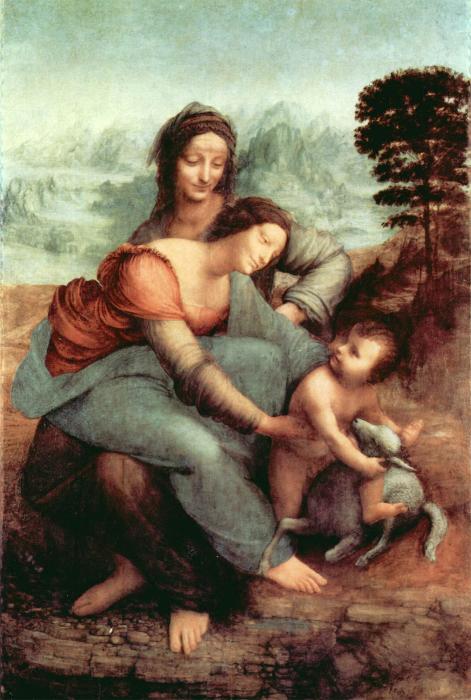
 The idea of an infant being born from the womb of a mother who is without sin stems from the idea that such a child would be able to comprehend Perfect Torah, and thus be a Direct Messenger From God whose Words have been corrupted. The idea that Eve brought Sin and Death to mankind – is a lie! On the eve of electing a new Pope, it is time to die so this great lie shall know death.
Saint Paul replaces the Word of God in his New Testament, with his words. Paul rarely mentions Jesus, the alleged Son of God. Paul is a great sinner in the eyes of God – and in the eyes of this mortal named Jesus – who did not convert Paul on the road to Damascus!
Theologians have been hard pressed to apply the Virgin Birth myth to Mary’s mother for several reasons. One being, she is a Jew and never a Christian. Christianity did not exist when she died. This means she was never “washed in the blood of the lamb” was never converted to Christianity, and would never know eternal life, thus, the holy bloodline of Mary and Jesus is corrupted – forever!
Paul robs the Jews of their own cosmology and applies it to pagans and Roman sinners who are converted in some pagan ritual – and these converts don’t have to read or know any of God’s Words. All they need do is eat of the flesh of the Dead Jesus, and drink his blood. In doing this they are without sin – in theory – and thus are allowed to know eternal life after death. One is allowed to sin, as long as they go to ‘Father’ and confess.
Jon Presco
Anna selbdritt is a subject in Christian art, showing Saint Anne with her daughter, the Virgin Mary, and her grandson Jesus, literally “Anne herself the third,” or if you will “Granny makes three.”[1] This type of depiction has been quite popular in Germany from the 14th century and is known as Anna te Drieën in the neighboring Low Countries or Metterza in Italy.
Contents [hide]
1 Mother and daughter
1.1 Dogma in word and image
2 Byzantine iconography
3 See also
4 References
5 External links
[edit] Mother and daughterThe relationship of St. Anne to the immaculate conception of her daughter is not explicit but her mystical participation is implied in the nested framing of her embrace of her virgin daughter embracing her divine grandson. This should not be confused with the perpetual virginity of Mary or the virgin birth of Jesus. Although the belief was widely held since at least Late Antiquity, the doctrine was not formally proclaimed until December 8, 1854 in the Western Latin Rite, and never explicity so in the Eastern churches, see discussion on dogma below. Similar works featuring mother and daughter resemble that of the Throne of Wisdom, a pairing of mother and daughter known as the Education of the Virgin. Anna Selbdritt is distinct from the triangular composition featuring the infant Jesus yet relates the same mystery: an open book represents the immanence of Logos or Incarnate Word at all times in time and space, even before the common era prior to his Nativity . A trinitarian action of grace is implied: creator Father, redeemer Son, reflexive procession of the Holy Spirit (indicated by the vertically-tiered arrangement with Christ pointing back at his mother and grandmother.
[edit] Dogma in word and imageIn the 13th century the general opinion was that the title Immaculate Conception was appropriately deferential to the Mother of God, but it could not be seen how to resolve the problem that only with Christ’s death would the stain of original sin be removed. The great philosophers and theologians of the West were divided on the subject: the Dominican St. Thomas Aquinas siding with those who declined to defend the doctrine definitively and Blessed Duns Scotus attacked for his novel philosophical definition founded in Christological theology. It took a further five hundred years for this profoundly simply teaching to be proclaimed universally by Pope Pius IX in 1854. The subtle radial arrangement centered on Christ within the superficially vertical art form makes the point more succinctly than many learned words.
The creedal statement “and (from) the Son” adopted in the Christian West expresses a trifold mystery of Divine action: preserving his mother from the effects of sin through the merits of self-emptying obedience of the son to his Father at his passion and death. Grace perfects nature. Eastern Orthodox creedal expressions are not explicit on the mutual participation of the three persons of the Holy Trinity. The mystery of Mary’s immaculate conception was also implied in depictions of her parents’ chaste embrace meeting at the Golden Gate, the threshold of the Holy city of Jerusalem, a convention that symbolizes close proximity to (and participation with) the celestial Kingdom. In Jewish tradition, the Golden Gate this is that through which the Messiah will enter Jerusalem. Duns Scotus also taught the universal primacy of Christ as applied to the redemption of all souls not just that of Mary, the underlying rationale for the feast of Christ the King instituted in 1925.
[edit] Byzantine iconography
Annunciation to Anne, 11th Century mosaic, Chora Church, Istanbul, with Joachim seen reclining at upper-rightEastern depictions of the apocryphal narrative mimic the scriptural account of the annunciation of the Angel Gabriel to Mary and take the form of a reclining Agios Joachim beside a double-vesicled fountain or well,[2] implying Mary’s perpetual virginity flows from the mystery of her Immaculate Conception in the womb of her mother Agia Anna in linear fashion conform with Eastern creedal statements on the procession of the Holy Spirit. Absent modern meteorology, and therefore the scientific knowledge of how surface water is replenished naturally by atmospheric moisture, the early Christian artist was limited by linear symbolism of gravity known in the topography of the region.[3] Dewfall and the phenomenon of manna in the desert would have been known but revered as ineffable.
 Rosamond Press
Leave a comment