 I have been excommunicated by all members of my family for rocking the boat and making waves.
Watching huge wind-driven waves crash on the rocks is a tourist attraction here in Oregon. Every year folks from the Midwest get caught by a big wave, and drown. Living in Pebble Beach for years, Christine has seen the news that tell of another tragedy, where whole families are wiped out, they going in the sea to rescue their loved ones.
In trying to make all the differing accounts, fit, there are several theories that work. Drew and Shamus wake up to see what the rescue guy told me – white caps to the horizon. From the house one can see large waves crashing on the rocks. Shamus wants to watch them, from up close, and takes Drew to the edge. Drew is in the water. Shamus goes running up to the house. Christine runs down to water, she not bothering to put on a jacket, or, she takes it off before she dives in to save her daughter. It is Christine who says “Grab Drew”. Vicki runs down to the edge, and grabs her, just before another large wave came.
If this is what happened, and if this is what was told to Shannon and myself, then, we would blame Vicki’s son, whom she would want to protect from the family wrath – for starters!
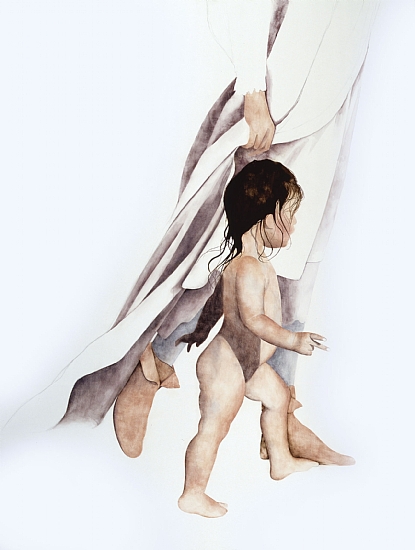
Above are two Rosamond images, one being titled ‘Beach’ that was one of the four images made for the family partnership. That is Christine holding Drew by the hand as they walk along the beach. Christine is dress in whilte, like a Guardian Angel.
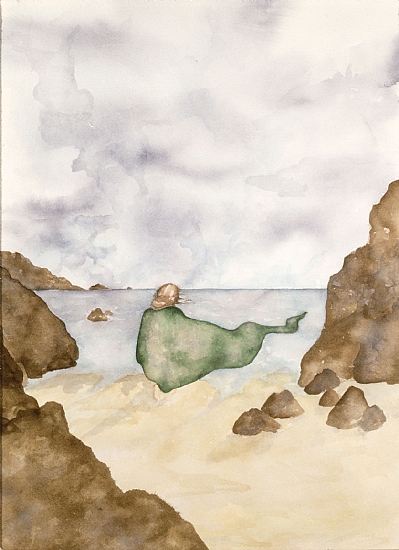
The other image could be Christine sitting by the sea…………awaiting her fate. The wind is blowing her hair, and her cape, but, the surface of the water is like glass. There are no waves, not a one. Eerie!
Jon Presco
Copyright 2013
Making Waves:
How Wind Whips Up the Perfect Swell
by Robin Marks
The scene: aboard a ship in the North Sea during a violent storm. The wind is pummeling the crew on deck as they struggle to control the boat amid the gigantic waves tossing it about like so much driftwood. After a bit, the storm blows over. The wind subsides, and the gigantic, threatening waves are reduced to ripples. Weeks later and a few thousand miles away, happy surfers are riding the very waves that rocked our North Sea sailors.
Eighteen-year-old Olivia Kuljian watched from a beach in northern California as her brother, Gregory, tried to save their dog after he was swept away by a 10-foot wave.
Her parents then went in after him, and all three were swept out to sea.
“She is doing the best she can under the circumstances, but obviously she is devastated,” Kuljian’s uncle, David Scott, said. “To wake up and not have a family anymore, it’s just devastating. I can’t explain it. I hope no one else ever has to go through this.”
The bodies of Howard Kuljian, 54, and Mary Scott, 57, were found on the beach hours later. Sixteen-year-old Gregory Kuljian’s body has yet to be found after a search was called off Sunday.
Scott said he the family is waiting until the 16-year-old’s body is found to make funeral arrangements. He said the family’s friends in Humboldt County, California, have rallied around Olivia Kuljian and the extended family.
“She and her mother and the whole family were loved by the community, and I feel very good in my heart that they’ll take care of Olivia the best they can,” he said. “It’s very traumatic, of course, and I’m very thankful for the friends that have been very supportive. We’ve gotten hundreds of comments and prayers.”
The family’s dog was playing fetch with a stick on the beach when the 10-foot wave came in, Coast Guard. Lt. Bernie Garrigan said.
“The beach is incredibly steep, and we had 10 foot swells… come through there Saturday, and it is really really steep, so the 10 foot waves smashes directly on the beach,” Garrigan said. “They were throwing a stick for the dog, and the dog ran too close to the water and got pulled in.”
After the family was pulled into the water and a witness called 911, Coast Guard life boats and a helicopter rushed to the scene. They were unable to rescue any of the family members, and the search for Gregory Kuljian, also known as Geddie, was called off Sunday to cold, windy weather.
The Coast Guard said the teen would not have been able to survive in the cold water past Sunday.
Important Wave Terms
Period: This is the time between two wave crests at a given point. It’s the equivalent of wave frequency. The longer the period, the faster the waves are moving. Good surfing swells often have a period of 13 to 15 seconds, but the real cruisers can have a period of up to 25 seconds.
The faster a wave is moving, the more energy it has. More energy means that the wave will have a deeper effect, and will actually move more water with it. The important result for surfers is that a faster wave will be larger when it breaks.
Height: This seems like a straightforward concept, but it’s not. Surfers in various regions measure wave height differently, but in all cases, they’re measuring something that’s equivalent to wave amplitude.
Most measure the face of the wave, from crest to trough. But Hawaiians are famous for measuring the back side of a wave, which results in a shorter height. Californians often estimate wave height relative to a body; shoulder-high means 5 feet.
There’s no clear right or wrong way to measure, but it’s important to know what system is used where you’ll be surfing. Otherwise you might find yourself in less friendly waters than you anticipated.
What’s going on?
From the shore, it may seem like a wave is water moving toward you. But in fact, a wave is motion moving through a body of water; most of the water where it is. When wind and water meet, the result is waves—that may seem obvious. But why, exactly, does it happen that way? We can start to answer that question in your bathtub.
Tension and friction
Fill a tub with water and blow gently across the surface. The waves you create are probably smaller than your finger. The smallest waves, ones about that size, arise from the surface tension of water. The molecules on the water’s surface hold together and form a sort of “skin.” You may have seen water bugs skirting around the surface of a pond. These bugs stay afloat because of surface tension. This phenomenom even lets you float a paper clip on the top of a full glass of water! (Read more about surface tension.)
This “skin” makes the surface of water somewhat stretchy. What happens to the smooth surface of a rubber band when you stretch it? It becomes sticky. The same thing happens with water. Blow on your bath water again. As the air passes over the “sticky” surface of the water, it grabs some molecules and pushes them into the ones ahead. Those molecules push on the ones in front of them, and those push on the ones in front of them, and so on, as the wave travels to the opposite side of the tub. If you watch closely, you’ll see that the water stays mostly in the same area; it’s the disturbance caused by your breath that’s moving across the water.
It’s a Long Way from a Bathtub to the Beach Those small waves that you make in your bathtub only mimic the very first stage of big-wave generation. Let’s move from your bathtub to a small lake. If the wind is blowing, you’ll see waves moving across the lake in the same direction as the wind. If there’s a strong wind, the waves become textured, or choppy, and the stronger the wind, the larger the waves. That’s because as the waves move, they run into each other and merge, combining their energy to get bigger and move faster. These waves will merge and become bigger still, as long as they have distance to cover and a way to sustain the energy that keeps them moving.
Now we’re ready to move to the open ocean, where storms churn up miles of choppy, erratic waves. This is the birthplace of the glassy, fast-moving swells that delight surfers. If you could watch the “wind waves” caused during a storm, you’d notice that they’re very choppy, textured, and somewhat haphazard. They may be big and energetic, but they’re not good for surfing—yet.
Waves like this one traveling toward a beach near Santa Cruz, California are created by storms thousands of miles out in the ocean.
Big wind waves move away from the storm that created them, just like the waves in your bathtub move away from you as you blow on the water. As waves move through the water, friction causes them to lose energy. If the storm that caused the waves didn’t impart enough energy or create enough waves, then friction may take all the energy, and the waves will flatten out and dissipate before they get very far.
On the other hand, if a storm is strong enough, it will whip up many waves that will slam into each other, combining their energy. If enough waves come together, their energy will create a swell that can travel fast enough and far enough to survive a trip around the globe. Along the way, the less energetic, choppy elements of the wave will be lost to friction, and a smooth, glassy face will present itself. These are the waves that send surfers running for their boards.
What’s the Recipe for a Swell Swell?
Storms that whip up what will become sweet surfing swells must be able to create lots of energetic waves. There are three factors that contribute to the formation of good surfing swells: how fast the wind is blowing, the surface area of ocean that’s affected by the storm, and the amount of time those winds blow over a given spot on the ocean. Weather forecasters call these three factors “wind velocity,” “fetch” and “duration,” respectively, terms worth knowing if you want to read weather images and make your own surf predictions.
In the best of all possible surfer worlds, the wind would blow extremely hard for days and days over thousands of miles of ocean. That sort of thing rarely happens, but storms that bring good waves aren’t all that uncommon. Surfers can watch for developing storms by following them over the open seas. As Rebecca Roberts describes in her report, there are lots of on-line data banks and tools that can help surfers track storms and waves until they arrive on the nearest beach. With a little effort and a surf of the Internet, riders can even make their own surf forecasts.
Making Waves:
How Wind Whips Up the Perfect Swell
by Robin Marks
The scene: aboard a ship in the North Sea during a violent storm. The wind is pummeling the crew on deck as they struggle to control the boat amid the gigantic waves tossing it about like so much driftwood. After a bit, the storm blows over. The wind subsides, and the gigantic, threatening waves are reduced to ripples. Weeks later and a few thousand miles away, happy surfers are riding the very waves that rocked our North Sea sailors.
Important Wave Terms
Period: This is the time between two wave crests at a given point. It’s the equivalent of wave frequency. The longer the period, the faster the waves are moving. Good surfing swells often have a period of 13 to 15 seconds, but the real cruisers can have a period of up to 25 seconds.
The faster a wave is moving, the more energy it has. More energy means that the wave will have a deeper effect, and will actually move more water with it. The important result for surfers is that a faster wave will be larger when it breaks.
Height: This seems like a straightforward concept, but it’s not. Surfers in various regions measure wave height differently, but in all cases, they’re measuring something that’s equivalent to wave amplitude.
Most measure the face of the wave, from crest to trough. But Hawaiians are famous for measuring the back side of a wave, which results in a shorter height. Californians often estimate wave height relative to a body; shoulder-high means 5 feet.
There’s no clear right or wrong way to measure, but it’s important to know what system is used where you’ll be surfing. Otherwise you might find yourself in less friendly waters than you anticipated.
What’s going on?
From the shore, it may seem like a wave is water moving toward you. But in fact, a wave is motion moving through a body of water; most of the water where it is. When wind and water meet, the result is waves—that may seem obvious. But why, exactly, does it happen that way? We can start to answer that question in your bathtub.
Tension and friction
Fill a tub with water and blow gently across the surface. The waves you create are probably smaller than your finger. The smallest waves, ones about that size, arise from the surface tension of water. The molecules on the water’s surface hold together and form a sort of “skin.” You may have seen water bugs skirting around the surface of a pond. These bugs stay afloat because of surface tension. This phenomenom even lets you float a paper clip on the top of a full glass of water! (Read more about surface tension.)
This “skin” makes the surface of water somewhat stretchy. What happens to the smooth surface of a rubber band when you stretch it? It becomes sticky. The same thing happens with water. Blow on your bath water again. As the air passes over the “sticky” surface of the water, it grabs some molecules and pushes them into the ones ahead. Those molecules push on the ones in front of them, and those push on the ones in front of them, and so on, as the wave travels to the opposite side of the tub. If you watch closely, you’ll see that the water stays mostly in the same area; it’s the disturbance caused by your breath that’s moving across the water.
It’s a Long Way from a Bathtub to the Beach Those small waves that you make in your bathtub only mimic the very first stage of big-wave generation. Let’s move from your bathtub to a small lake. If the wind is blowing, you’ll see waves moving across the lake in the same direction as the wind. If there’s a strong wind, the waves become textured, or choppy, and the stronger the wind, the larger the waves. That’s because as the waves move, they run into each other and merge, combining their energy to get bigger and move faster. These waves will merge and become bigger still, as long as they have distance to cover and a way to sustain the energy that keeps them moving.
Now we’re ready to move to the open ocean, where storms churn up miles of choppy, erratic waves. This is the birthplace of the glassy, fast-moving swells that delight surfers. If you could watch the “wind waves” caused during a storm, you’d notice that they’re very choppy, textured, and somewhat haphazard. They may be big and energetic, but they’re not good for surfing—yet.
Waves like this one traveling toward a beach near Santa Cruz, California are created by storms thousands of miles out in the ocean.
Big wind waves move away from the storm that created them, just like the waves in your bathtub move away from you as you blow on the water. As waves move through the water, friction causes them to lose energy. If the storm that caused the waves didn’t impart enough energy or create enough waves, then friction may take all the energy, and the waves will flatten out and dissipate before they get very far.
On the other hand, if a storm is strong enough, it will whip up many waves that will slam into each other, combining their energy. If enough waves come together, their energy will create a swell that can travel fast enough and far enough to survive a trip around the globe. Along the way, the less energetic, choppy elements of the wave will be lost to friction, and a smooth, glassy face will present itself. These are the waves that send surfers running for their boards.
What’s the Recipe for a Swell Swell?
Storms that whip up what will become sweet surfing swells must be able to create lots of energetic waves. There are three factors that contribute to the formation of good surfing swells: how fast the wind is blowing, the surface area of ocean that’s affected by the storm, and the amount of time those winds blow over a given spot on the ocean. Weather forecasters call these three factors “wind velocity,” “fetch” and “duration,” respectively, terms worth knowing if you want to read weather images and make your own surf predictions.
In the best of all possible surfer worlds, the wind would blow extremely hard for days and days over thousands of miles of ocean. That sort of thing rarely happens, but storms that bring good waves aren’t all that uncommon. Surfers can watch for developing storms by following them over the open seas. As Rebecca Roberts describes in her report, there are lots of on-line data banks and tools that can help surfers track storms and waves until they arrive on the nearest beach. With a little effort and a surf of the Internet, riders can even make their own surf forecasts.

 Rosamond Press
Leave a reply to Royal Rosamond Press Cancel reply