 “It was immediately after Elizabeth’s death that the Stewarts entered upon the English throne, in the reign of the Scot, James I, who was of Rollo stock via the Bruce kings of Scotland.”
The above quote is so CLOSE to the truth. When I reveal my Grail Lineage, I will own Rollo’s Grail, thus, I will put the Sinclairs in my back pocket.
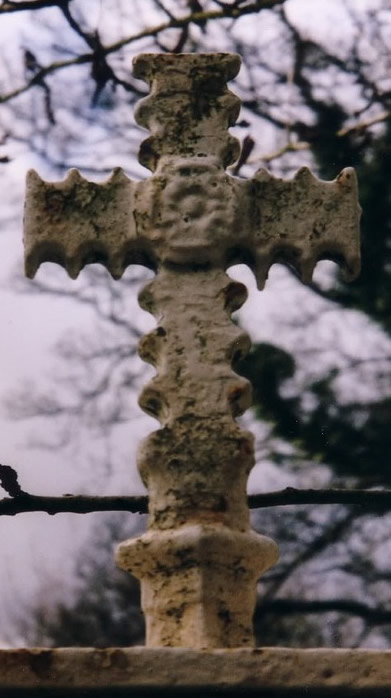
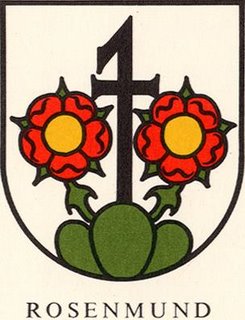
Electric Scotland posted the Rosey rant of Barry Dunford who could have snuck into my rose garden. His site shows the Sinclair cross with a rose at the apex. You could not use a cross in your cote of arms unless your kindred went on Crusade. The Rosenmund cote of arms holds a cross.
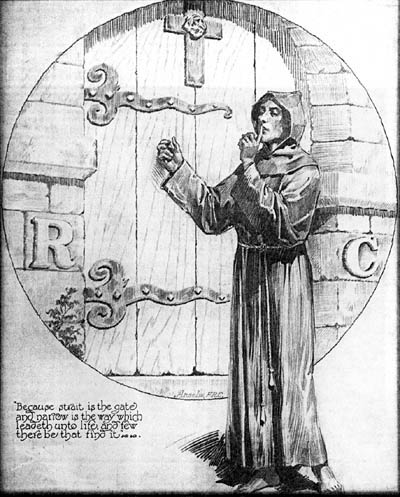
In the image of the monk seen above we see the letters R and C. Do these initials stand for Rollo and Christ, or, Christine Rosamond?
In their need and haste to rape my rose bed, the Sinclairs and Dunford overlooked one special rose………Sub-rosa! Now, I reel them in, like fish caught in a net, into my rosey compost you all go!
Jon Presco
http://www.electricscotland.com/bible/connections2.htm
Sacred Connections
Rosa Templum
The enigmatic arcanum of Rosslyn Chapel
and the Bride of Christ
by Barry Dunford
http://www.sacredconnections.co.uk/holyland/rosatemplum.htm
The Latin phrase sub rosa means “under the rose” and is used in English to denote secrecy or confidentiality, similar to the Chatham House Rule. The rose as a symbol of secrecy has an ancient history.
Contents [hide]
1 History
2 Special Forces usage
3 Hungarian usage
4 References
[edit] HistoryThe rose was the emblem of the god Horus in ancient Egypt.[citation needed] Later, the Greeks and Romans translated the god’s Egyptian name Har-pa-khered as Harpocrates and regarded him as the god of silence. The association of Harpocrates with silence and secrecy originates from a misunderstanding of Egyptian depictions of the god. Heru-pa-khered was represented as a naked youth with a finger-to-mouth gesture–in Egyptian artwork this gesture imitates the hieroglyph for child and is used to represent youth, but was misunderstood by later Greeks and Romans as a gesture for silence.
The rose’s connotation of secrecy dates back also to Greek mythology. Aphrodite gave a rose to her son Eros, the god of love; he, in turn, gave it to Harpocrates, the god of silence, to ensure that his mother’s indiscretions (or those of the gods in general, in other accounts) were not disclosed. Paintings of roses on the ceilings of Roman banquet rooms were also a reminder that things said under the influence of wine (sub vino) should also remain sub rosa.[1] In the Middle Ages a rose suspended from the ceiling of a council chamber similarly pledged all present (those under the rose) to secrecy.[2]
In Christian symbolism, the phrase “sub rosa” has a special place in confessions. Pictures of five-petalled roses were often carved on confessionals, indicating that the conversations would remain secret. The phrase has also been understood to make reference to the mysterious virginal conception of Christ.
In the 16th century, the symbol of Henry VIII of England was the stylised Tudor dynasty rose. A large image of the rose covered the ceiling of the private chamber where decisions of state were made in secret.
In current times, the term is used by the Scottish Government for a specific series of “off the record” meetings.[2]
The Ros Line, if indeed it was a line of ruling Vikings, may have branched out into Kiev via the Varangian Rus. The Varangian ruler in the days of Margaret was Yaroslav, son of the great Vladimir who had followed Rollo’s lead in converting to Christianity for merely political protection. Yaroslav had given four, perhaps five, of his daughters to European kings, one of whom was Harald III Hardraade of the Norwegian Vikings. Prior to finding refuge in Hungary, Margaret was not only protected in Kiev by Yaroslav himself, but before that by Harald III in Norway (not to mention by Olaf II, king of Norway). Clearly, Margaret’s family was an important one to the Vikings, and it could certainly be true that they understood she to be of the Ros Line.
If Margaret’s family was important due to its Rollo blood, so also her brother, Edgar. As heir to the English throne, he was extremely promising in placing Rollo blood in that key position. As it turned out, a duke of Normandy (The Conqueror), with Rollo blood, ended up on the English throne before Edgar could, hereafter Edgar’s bloodline never did become enthroned, anywhere. And so what was Margaret to do but to give her daughter to Henry I in order to reinforce his Rollo blood for her heir?
Henry died without a male heir, wherefore the male line of Rollo comes to an end with him. But Henry’s daughter produced Henry II, etc., until, with the end of the royal Rollo line at the death of Elizabeth I, another Ros Line, from the Varangian Rus, namely, the Drummond clan of Scotland, took its place on the English throne…and has continued there to this day! The Drummond Ros Line and its roots in the Varangian Rus is the subject of a coming chapter, but keep in the back of your mind until then that the pre-tribulation rapture was born in a Drummond cult, whose founder was a major English banker from a banking family in some cahoots with Rothschild banker(s).
Margaret’s blood remained in Scottish kings all the way to, but not including, the Bruce dynasty. The Drummond bloodline entered the line of Scottish kings in the Bruce dynasty, namely, when Annabel Drummond married Robert de Bruce III. Now the Bruce family had been from Normandy and was also related to the Rollo bloodline! Remember this when I say, “Drummond Ros Line” (which I could just as rightly refer to as the “Bruce Ros Line” and/or “Rollo Ros Line”).
The son of Robert III and Annabel was king James I of Scotland, and this dynastic line would continue through successive James’. Because the Stuart, James VI of Scotland, ruled England immediately after Elizabeth I (as James I of England), the Margaret or Roslin Ros Line was replaced just then by the Drummond Ros Line. It is no wonder that the Drummond clan supported the Stuarts. However, Sinclairs were privy counselors to the Scottish James’ and even to Mary Queen of Scots, but in those days, Rosicrucians had infiltrated the royal courts of many European monarchs, not to support them, but to bring them down. Elizabeth I welcomed Rosicrucians into her court even as her spies, but it can be determined that these particular Rosicrucians had been supportive of, if not related by blood to, the Margaret/Roslin Ros Line.

 Rosamond Press
Leave a reply to Royal Rosamond Press Cancel reply