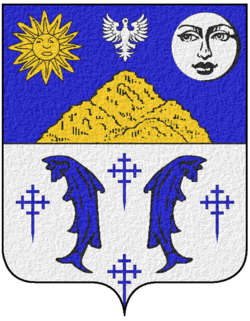
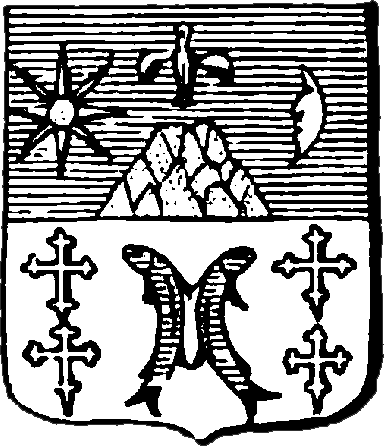
 Cote of arms for Bourmont.
Community of communes of
Country Bourmontais
Country:
France
Azure, three fleurs de lys of gold ordered 2-1.
Region:
Champagne-Ardenne
Azure, on a bend Argent crossroad of two double quoted potencees and contre-potencees of gold. the Chief gules three rakes dismantled gold, ordered 2-1.
Department:
Haute-Marne
Azure on the pale Argent coasted with two double pallets, potencees and contre-potencees of gold.
Cup: 1st, azure, to mont d’Or, topped with a silver and between alérion Sun also gold Dexter and sinister with a full moon also of money; the 2nd of money, two bars backed azure, quartered in saltire of four crosses the foot crosslets listed of the same.
The mount is one which Bourmont is perched.
Before the Revolution that defines the departments, under the Bassigny Bourmont was owned by the Duke of Lorraine from which the alerion.
The second Cup represents the arms of the counts and Dukes of Bar. The colors have been modified to the aesthetics of the arms.
http://fr.geneawiki.com/index.php/Cat%c3%a9gorie:Haute-Marne,_blasons
Origin of the name:
Of town and mount, the village perched on a mountain.
Key figures:
Population:
552 inhabitants
altitude:
-m
Area:
1607 hectares
Web site:
Website of the municipality
Things to see:
St. Joseph’s Church
Historical background:
Bourmont is successively from the XIIth century the count of Champagne and the XIIIth century for the County and Duke of Bar and finally the due of Lorraine in 1431.
In 1353 is created the Bailiwick of the Bassigny which Bourmont became the capital.
The city was partly destroyed by Charles the bold in 1477 just before perishing at the gates of Nancy.
The fortifications will be reconstructed and then demolished in 1671 on order of the Marshal de Créqui, winner of the Lorraine.
In 1766, the death of the Duke of Lorraine Stanislas, Bourmont became French.
In the middle of the 10th century, the territory of Bar formed a dependency of the Holy Roman Empire. The first dynasty of Bar were in fact dukes of Upper Lotharingia out of the house of the counts of the Ardennes, descendants of count palatine Wigeric of Lotharingia. They chose their seat at Bar, which was subsequently called Bar-le-Duc. This Ardennes-Bar dynasty became extinct with Duke Frederick III (died 1033) and his sister Countess Sophia of Bar (died 1093).
In the 11th century the lords of Bar were only counts of Bar. They belonged to the house of Mousson-Montbéliard-Ferrette.
 Rosamond Press
Leave a comment