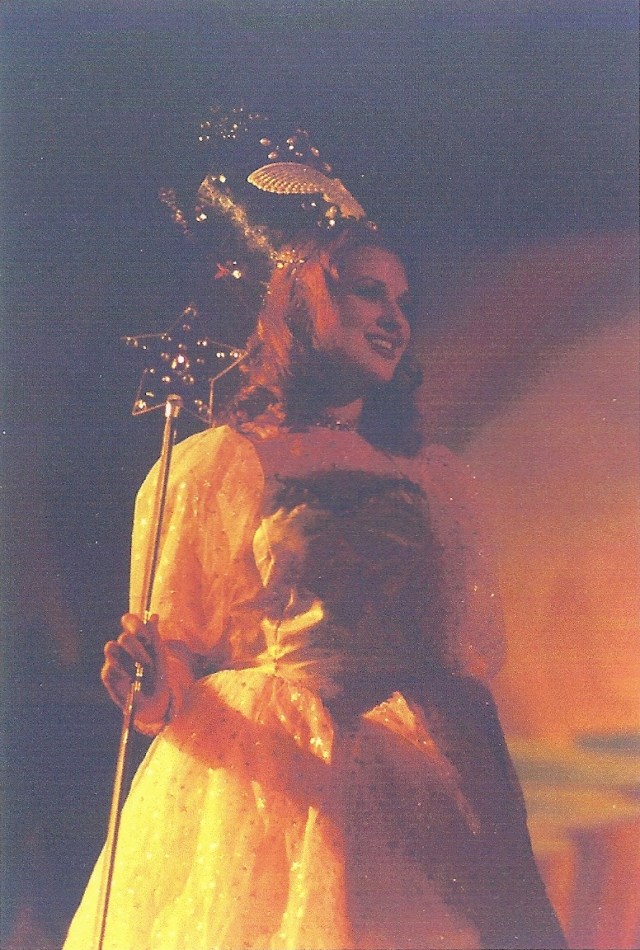
 Above is a photo of my daughter, Heather Hanson, dressed as a Fairy Godmother. Her mother made the costume. Patrice Hanson made other costumes for our daughter who came into my life when she was sixteen, just after this photo was taken. Heather is a thespian, amongst other things. Patrice was a stage mother until she was usurped by her sister, the evil witch of the cocktail hour, who now goes after my seven year old grandson whom I compare to the Changling Child in Shakespeare’s Midsummer’s Nights Dream. The Cocktail Witch demanded I take a blood test when her niece found her father because she was in need of an heir, she not giving birth to a child of her own, she chosing to marry a very old drunken attorney with gobs of money, instead.
Being a (childless) writer who was buried in the Merovingian Bloodline Legends at the time, I couldnt help but wonder who the Story Master was, for, my novel ‘Capturing Beauty’ was writing itself. It’s like I have been chosen to author a labour of love so the Never Ending Story will not die. Already there is a fight over my late sister’s children, and the artistic legacy that Rosamond left to them. The rival author made overtures to Heather and Patrice, this Ghost Writer wanting them in his web so my kindred can be sold as slaves to Hollywood, the Land of Changlings and Child Stars.
When I asked my sixteen year old daughter what her dream was, she told me it was to be a Star one day so she could support her mother in the grand style she always deserved, which meant, I had failed somehow, and, Heather The Child Wonder would save her mother’s dream, grant her all her wishes, make them come true with her Magic Wand.
What was wrong with this, PLOT, was Patrice had put our newborn child in the arms of her brutal husband and told him he conceived Heather, when in truth, his sperm could not sire children. A Child Swap took place so Patrice could mend their marriage, her husband’s Sicilian family saying there was a curse put on the Hansons that made her womb barren. You could say I was the Acid Test Patrice took when she ran away from Randall Delpiano who was convicted twice of impersonating Bob Weir of the Grateful Dead, and was twice sent to San Quintin. You can’t make this shit up. It writes itself.
When my Newfound Star Daughter showed me some of her large video collection, I beheld a fifteen year girl in a green pixie outfit, she looking like Tinkerbdell. I asked her what the occasion was, and Heather told me her mother made this costume from the painting on the wall, and just wanted her to look like that image in the background.
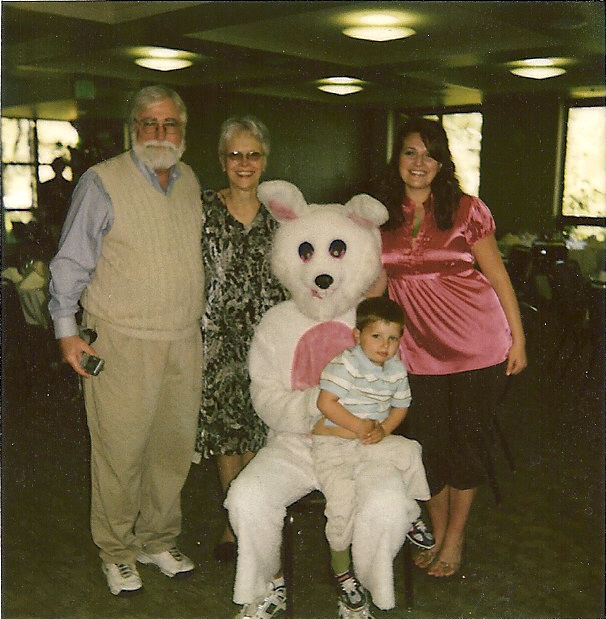
Above is my offspring with a giant rabbit that reminds me of Harvey, who was a Pooka (Puck) in the movie of the same name. When I went to Sonoma to see my daughter for the first time in 2000, I brought a book on the Merovingian Bloodline with me, and told them I was authoring my own book on this subject due to looking at the name Rosamond and our family roots. Patrice gave me a disgusted look, which told me THE PLOT of their movie has already been written, long ago, but for the part that appears in the Story of Rosamond being penned by The Pretenders………….The Child Swappers! I mean, I told them I was on SSI for being coo-coo, mentally unbalanced. The ghost wroter woould diepict Rosamond as a raving lunatic. But, when you own fame and money, being crazy is a blessing, and not a curse.
Oberon is the King of the Elves. This name is also Alberich, a Merovingian King. King Alboin married Queen Rosamund. Alboin means Elf Friend. The more I insisted to my ignorant daughter I was authoring Our Great Story, the crazier she had to believe I am. My grandson looks like the Changling in the 1935 movie. Christine lived in Micky Rooney’s first house he bought when he was no longer a Child Star, and had to live in the real world.
Jon Presco
Copyright 2012
The Old English “puca” is a kind of half-tamed woodland sprite, leading folk astray with echoes and lights in nighttime woodlands
In fairy tales, a fairy godmother (French: fée marraine) is a fairy with magical powers who acts as a mentor or parent to someone, in the role that an actual godparent was expected to play in many societies. In Perrault’s Cinderella, he concludes the tale with the cynical moral that no personal advantages will suffice without proper connections. The fairy godmother is a special case of the donor.
In fairytale and legendActual fairy godmothers are rare in fairy tales, but became familiar figures because of the popularity of the literary fairy tales of Madame d’Aulnoy and other précieuses, and Charles Perrault. Many other supernatural patrons feature in fairy tales; these include various kinds of animals and the spirit of a dead mother.[1] The fairy godmother has her roots in the figures of the Fates; this is especially clear in Sleeping Beauty, where they decree her fate, and are associated with spinning.[2]
Merovingian legend
Oberon’s status as king of the fairies comes from the character of Alberich (from Old High German alb- “elf” and -rîh-, “ruler”, “king”), a sorcerer in the legendary history of the Merovingian dynasty. In the legend, he is the otherworldly “brother” of Merowech, whose name is the eponym of the Merovingians. Alberich wins for his eldest son Walbert the hand of a princess of Constantinople. In the Nibelungenlied, a Burgundian poem written around the turn of the 13th century, Alberich guards the treasure of the Nibelungen, but is overcome by Siegfried.
In the Middle High German Nibelungenlied, Alberich is a dwarf, who guards the treasure of the Nibelungen, but is overcome by Siegfried. News of the gold robbery and ring of power incited gods and giants alike to action. The giants Fafner and Fasolt demanded the ring in payment for building Valhalla, and carried off Freyja as a hostage. In the border, the gods, Odin, Frigg, Loki, Freyr, and Thor all search despairingly for the hidden treasure. * Oberon is the French translation of Alberich (used for the name of the “King of Fairies” in French and English texts).
Oberon is the king of all of the fairies in William Shakespeare’s A Midsummer Night’s Dream who is feuding with his wife Titania, the queen of the fairies. They are fighting over a changeling child that Oberon wants to raise as his henchman. Titania wants to keep the child because he is the child of Titania’s mortal follower who died, and she wants to raise the child for her follower. Because Oberon and Titania are powerful fairies, their arguments affect the weather. Titania describes what happens to nature when they argue, saying:
Beautiful and famous women were followers of Meher Baba, and are connected to him and his teaching. In 1992 I began my autobiography ‘Bonds With Angels’. It began with an account of the angel my sisters saw in their bedroom bathed in a blue light. Rosamond Pinchot acted in the movie ‘The Miracle’ as did Princess Norina Matchabelli. This movie was directed by Max Reinhnardt whose film ‘A Midsummer’s Night Dream’ shows Oberon coming for the Changling Boy who I associate with my grandson, Tyler Hunt.
In the movie Pan’s Labyrinth we behold Puck and Pan.
The Dukes of Athens were the De La Roche (La Rosa) family who were kin to the Rougeonts and were Knights Templar who owned the Shroud of Turin – that awakens atop Rose Mountain.
I will leave the rest up to you – the stringing of the beautiful pearls of the Rose Protection.
Jon Rosamond PrescoAlbion King of the Lombards1 43rd great grand uncle, Morin and Eastman lines
b. before 530, d. 574, #30260
Pop-up Pedigree
Father
**Albion, King of the Lombards1 , d. 565
Mother
**Rolinde1 b. circa 507,
Birth
before 530
Albion was born before 530.1
Marriage
Albion King of the Lombards married Chlothsind, daughter of Chlothar I (Clotaire I) , King of the Franks and Ingunde. Chlothsind was married off by her brothers and father to Albion, King of the Lombards. When she died, her husband married Rosamund.1
Albion, after inheriting the kingdom, in 568 moved from the native homelands to Italy, defeating many barbarian kings and driving out the Eastern Roman Empire from much of the peninsula. After his first wife died, he married Rosamund, daughter of King Cunimund of the Gepids, one of the many kings he defeated and executed..2
ALFWIN
GENDER: Masculine
USAGE: Ancient Germanic
Meaning & History
From the Germanic elements alfa “elf” and win “friend”.
Related Names
See All Relations
Show Family Tree
VARIANTS: Alwin, Alboin
Oberon (also spelled Auberon) is a king of the fairies in medieval and Renaissance literature. He is best known as a character in William Shakespeare’s play, A Midsummer Night’s Dream, in which he is Consort to Titania, Queen of the Fairies.[1]
ChangelingFrom Wikipedia, the free encyclopediaJump to: navigation, search For other uses, see Changeling (disambiguation).
Trolls with the changeling they have raised, John Bauer, 1913.A changeling is a creature found in Western European folklore and folk religion. It is typically described as being the offspring of a fairy, troll, elf or other legendary creature that has been secretly left in the place of a human child. Sometimes the term is also used to refer to the child who was taken. The apparent changeling could also be a stock or fetch, an enchanted piece of wood that would soon appear to grow sick and die. The theme of the swapped child is common among medieval literature and reflects concern over infants afflicted by as-then unknown diseases, disorders, or developmental disabilities.
A human child might be taken due to many factors: to act as a servant, the love of a human child, or malice.[1] Most often it was thought that fairies exchanged the children. Some Norwegian tales tell that the change was made to prevent inbreeding: to give trolls and humans new blood, humans were given children with enormous strength as a reward. In some rare cases, the very elderly of the Fairy people would be exchanged in the place of a human baby, and then the old fairy could live in comfort, being coddled by its human parents.[2] Simple charms, such as an inverted coat or open iron scissors left where the child sleeps, were thought to ward them off; other measures included a constant watch over the child.[3]
Perhaps the changeling myths of this time period reflect the feudal political structure, where inheritance is the only real way to gain personal or political power. A monarch gave the throne to his first surviving son at his own death. When there was any doubt to the legitimacy of the child, the power of the very state could be called into question and a fight for political power could arise. This inherent fear of war caused by political strife could have been mythologized.
The devil steals a baby and leaves a changeling behind, early 15th century, detail of “The legend of St. Stephen” by Martino di BartolomeoContents [hide]
1 Purpose of a changeling
2 Changelings in medieval folklore
2.1 Cornwall
2.2 Ireland
2.3 Lowland Scotland and Northern England
2.4 Malta
2.5 Scandinavia
2.6 Spain
2.7 Wales
3 “Changelings” in the historical record
4 Changelings in other countries
5 Changelings in the modern world
5.1 Neurological differences
5.2 In Nature
6 Changelings in popular culture
6.1 Literary uses
6.2 Drama
6.3 Comics and games
6.4 Film and TV
7 See also
8 References
9 External links
[edit] Purpose of a changelingSome people believed that trolls would take unbaptized children. Once children had been baptized and therefore become part of the Church, the trolls could not take them. One belief is that trolls thought that being raised by humans was something very classy, and that they therefore wanted to give their own children a human upbringing.
Beauty in human children and young women, particularly blond hair, attracted the fairies.[4]
In Scottish folklore, the children might be replacements for fairy children in the tithe to Hell;[5] this is best known from the ballad of Tam Lin.[6] Also, according to common Scottish myths, a child born with a caul (head helmet) across their face is a changeling, and of fey birth.
Some folklorists believe that fairies were memories of inhabitants of various regions in Europe who had been driven into hiding by invaders. They held that changelings had actually occurred; the hiding people would exchange their own sickly children for the healthy children of the invaders.[7]
In other folklore, the changelings are put in place of the child to feed off of the mother of the child. The kidnapped child then becomes food for the changeling’s mother. This is done for the survival of their kind. Once the changeling mother and the changeling have drained the life from the human mother and child, the changeling and its mother begin to search for a new suitable food source. Other sources[2] say that human milk is necessary for fairy children to survive. In these cases either the newborn human child would be switched with a fairy babe to be suckled by the human mother, or the human mother would be taken back to the fairy world to breastfeed the fairy babies. It is also thought that human midwives were necessary to bring fairy babes into the world.
Some changelings might forget they are not human and proceed to live a human life. Changelings which do not forget, however, may later return to their fairy family, possibly leaving the human family without warning. As for the human child that was taken, he or she may often stay with the fairy family forever.
[edit] Changelings in medieval folklore[edit] CornwallThe Mên-an-Tol stones in Cornwall are supposed to have a fairy or pixie guardian who can make miraculous cures. In one case a changeling baby was put through the stone in order for the mother to get the real child back. Evil pixies had changed her child and the ancient stones were able to reverse their evil spell.[8]
[edit] IrelandIn Ireland, looking at a baby with envy – “over looking the baby” – was dangerous, as it endangered the baby, who was then in the fairies’ power.[9] So too was admiring or envying a woman or man dangerous, unless the person added a blessing; the able-bodied and beautiful were in particular danger. Women were especially in danger in liminal states: being a new bride, or a new mother.[10]
Putting a changeling in a fire would cause it to jump up the chimney and return the human child, but at least one tale recounts a mother with a changeling finding that a fairy woman came to her home with the human child, saying the other fairies had done the exchange, and she wanted her own baby.[9] The tale of surprising a changeling into speech – by brewing eggshells – is also told in Ireland, as in Wales.[11]
Belief in changelings endured in parts of Ireland until as late as 1895, when Bridget Cleary was killed by her husband who believed her to be a changeling.
Changelings, in some instances, were regarded not as substituted fairy children but instead old fairies brought to the human world to die.
[edit] Lowland Scotland and Northern EnglandIn the Anglo-Scottish border region it was believed that elves (or fairies) lived in “Elf Hills” (or “Fairy Hills”). Along with this belief in supernatural beings was the view that they could spirit away children, and even adults, and take them back to their own world (see Elfhame).[12][13] Often, it was thought, a baby would be snatched and replaced with a simulation of the baby, usually a male adult elf, to be suckled by the mother.[12] The real baby would be treated well by the elves and would grow up to be one of them, whereas the changeling baby would be discontented and wearisome.[13] Many herbs, salves and seeds could be used for discovering the fairy-folk and ward off their designs.[13] In one tale a mother suspected that her baby had been taken and replaced with a changeling, a view that was proven to be correct one day when a neighbour ran into the house shouting “Come here and ye’ll se a sight! Yonder’s the Fairy Hill a’ alowe.” To which the elf got up saying “Waes me! What’ll come o’ me wife and bairns?” and made his way out of the chimney.[12] At Byerholm near Newcastleton in Liddesdale sometime during the early 19th century, a dwarf called Robert Elliot or Little Hobbie o’ The Castleton as he was known, was reputed to be a changeling. When taunted by other boys he would not hesitate to draw his gully and dispatch them, however being that he was woefully short in the legs they usually out-ran him and escaped. He was courageous however and when he heard that his neighbour, the six-foot three-inch (191 cm) William Scott of Kirndean, a sturdy and strong borderer, had slandered his name, he invited the man to his house, took him up the stairs and challenged him to a duel. Scott beat a hasty retreat.[13]
Child ballad 40, The Queen of Elfan’s Nourice, depicts the abduction of a new mother, drawing on the folklore of the changelings. Although it is fragmentary, it contains the mother’s grief and the Queen of Elfland’s promise to return her to her own child if she will nurse the queen’s child until it can walk.[14]
[edit] MaltaThe ritual impurity[15] of the parturient mother and her child exposed them, according to traditional Maltese belief, to unusual danger especially during the first few days after birth. A changeling child (called mibdul, “changed”) was taken to St Julian’s Bay,[16] where a statue of the saint stands, and given a sand-bath. A cordial was also administered, in attempts to return the being.[17]
[edit] ScandinaviaSince most beings from Scandinavian folklore are said to be afraid of iron, Scandinavian parents often placed an iron item such as a pair of scissors or a knife on top of an unbaptized infant’s cradle. It was believed that if a human child was taken in spite of such measures, the parents could force the return of the child by treating the changeling cruelly, using methods such as whipping or even inserting it in a heated oven. In at least one case, a woman was taken to court for having killed her child in an oven.[18]
Painting by John Bauer of two trolls with a human child they have raisedIn one Swedish changeling tale,[19] the human mother is advised to brutalize the changeling so that the trolls will return her son, but she refuses, unable to mistreat an innocent child despite knowing its nature. When her husband demands she abandon the changeling, she refuses, and he leaves her – whereupon he meets their son in the forest, wandering free. The son explains that since his mother had never been cruel to the changeling, so the troll mother had never been cruel to him, and when she sacrificed what was dearest to her, her husband, they had realized they had no power over her and released him.
In another Swedish fairy tale[20] (which is depicted by the image), a princess is kidnapped by trolls and replaced with their own offspring against the wishes of the troll mother. The changelings grow up with their new parents, but both find it hard to adapt: the human girl is disgusted by her future bridegroom, a troll prince, whereas the troll girl is bored by her life and by her dull human future groom. Upset with the conditions of their lives, they both go astray in the forest, passing each other without noticing it. The princess comes to the castle whereupon the queen immediately recognizes her, and the troll girl finds a troll woman who is cursing loudly as she works. The troll girl bursts out that the troll woman is much more fun than any other person she has ever seen, and her mother happily sees that her true daughter has returned. Both the human girl and the troll girl marry happily the very same day.
[edit] SpainIn Asturias (North Spain) there is a legend about the Xana, a sort of nymph who used to live near rivers, fountains and lakes, sometimes helping travellers on their journeys. The Xanas were conceived as little female fairies with supernatural beauty. They could deliver babies, “xaninos,” that were sometimes swapped with human babies in order to be baptized. The legend says that in order to distinguish a “xanino” from a human baby, some pots and egg shells should be put close to the fireplace; a xanino would say: “I was born one hundred years ago, and since then I have not seen so many egg shells near the fire!”.
[edit] WalesIn Wales the changeling child (plentyn cael (sing.), plant cael (pl.)) initially resembles the human it substitutes, but gradually grows uglier in appearance and behaviour: ill-featured, malformed, ill-tempered, given to screaming and biting. It may be of less than usual intelligence, but again is identified by its more than childlike wisdom and cunning.
The common means employed to identify a changeling is to cook a family meal in an eggshell. The child will exclaim, “I have seen the acorn before the oak, but I never saw the likes of this,” and vanish, only to be replaced by the original human child. Alternatively, or following this identification, it is supposedly necessary to mistreat the child by placing it in a hot oven, by holding it in a shovel over a hot fire, or by bathing it in a solution of foxglove.[21]
[edit] “Changelings” in the historical recordChildren were thought taken to be changelings by the superstitious, and therefore abused or murdered.
Two 19th century cases reflected the belief in changelings. In 1826, Anne Roche bathed Michael Leahy, a four-year-old boy unable to speak or stand, three times in the Flesk; he drowned the third time. She swore that she was merely attempting to drive the fairy out of him, and the jury acquitted her of murder.[22]
In the 1890s in Ireland, Bridget Cleary was killed by several people, including her husband and cousins, after a short bout of illness (probably pneumonia). Local storyteller Jack Dunne accused Bridget of being a fairy changeling. It is debatable whether her husband, Michael, actually believed her to be a fairy – many believe he concocted a “fairy defence” after he murdered his wife in a fit of rage. The killers were convicted of manslaughter rather than murder, as even after the death they claimed that they were convinced they had killed a changeling, not Bridget Cleary.[23]
[edit] Changelings in other countriesThe ogbanje (pronounced similar to “oh-BWAN-jeh”) is a term meaning “child who comes and goes” among the Igbo people of eastern Nigeria. When a woman would have numerous children either stillborn or die early in infancy, the traditional belief was that it was a malicious spirit that was being reincarnated over and over again to torment the afflicted mother. One of the most commonly prescribed methods for ridding one’s self of an ogbanje was to find its iyi-uwa, a buried object that ties the evil spirit to the mortal world, and destroy it.
Many scholars now believe that ogbanje stories were attempting to explain children with sickle-cell anemia, which is endemic to West Africa and afflicts around one-quarter of the population. Even today, and especially in areas of Africa lacking medical resources, infant death is common for children born with severe sickle-cell anemia.
The similarity between the European changeling and the Igbo ogbanje is striking enough that Igbos themselves often translate the word into English as “changeling”.
Aswangs, a kind of ghoul from Filipino folklore, are also sometimes said to leave behind duplicates of their victims made of plant matter. Like the stocks of European fairy folklore, the Aswang’s plant duplicates soon appear to sicken and die.
[edit] Changelings in the modern world[edit] Neurological differencesThe reality behind many changeling legends was often the birth of deformed or developmentally disabled children. Among the diseases with symptoms that match the description of changelings in various legends are spina bifida, cystic fibrosis, PKU, progeria, Down syndrome, homocystinuria, Williams syndrome, Hurler syndrome, Hunter syndrome, regressive autism, Prader-Willi Syndrome, and cerebral palsy. The greater proneness of boys to birth defect correlates to the belief that boy babies were more likely to be taken.[24]
As noted, it has been hypothesized that the changeling legend may have developed, or at least been used, to explain the peculiarities of children who did not develop normally, probably including all sorts of developmental delays and abnormalities. In particular, it has been suggested that children with autism would be likely to be labeled as changelings or elf-children due to their strange, sometimes inexplicable behavior. This has found a place in autistic culture. Some autistic adults have come to identify with changelings (or other replacements, such as aliens) for this reason and their own feeling of being in a world where they do not belong and of practically not being the same species as the other people around them.[25]
[edit] In NatureParasitic cuckoo birds regularly practice brood parasitism, or non-reciprocal offspring-swapping. Rather than raising their young on their own, they will lay their egg in another’s nest, leaving the burden on the unsuspecting parents which are of another species altogether. More often than not, the cuckoo chick hatches sooner than its “stepsiblings” and grows faster, eventually hogging most nourishment brought in and may actually “evict” the young of the host species by pushing them off their own nest.
[edit] Changelings in popular culture[edit] Literary usesThe changeling theme has frequently appeared in literature, especially in the genres of fairy tale and fantasy. Notable appearances of changelings in literature include the following:
Scarlett, the sequel to Margaret Mitchell’s Gone With The Wind. Cat, Scarlett O’Hara’s illegitimate daughter by Rhett, is thought to be a changeling.
The Stolen Child (1889) a poem by William Butler Yeats, is about a boy replaced by a changeling.
Bortbytingen (The Changeling) (1915) by Selma Lagerlöf. Modern translation by Sylvia Söderlind.
The Changeling (1916), poem by Charlotte Mew (1869–1928), written from the point of view of a changeling.
Pickman’s Model (1927), short story by H.P. Lovecraft. The story alludes to Pickman being the descendant of a changeling from a subterranean race.
The Broken Sword (1954), novel by Poul Anderson. A mortal child, Skafloc, is captured by the elves and exchanged for a changeling named Valgard. Although near-identical in appearance to the original, the changeling is a moody loner prone to fits of the rage.
The Changeling (1970) by Zilpha Keatley Snyder. Shy Martha befriends Ivy, a classmate from a no-account, criminal family. Ostracized at school and abused at home, Ivy distances herself from reality by convincing herself and Martha that she is a changeling.
The Omen (1976). After a child apparently dies at birth, their father Robert Thorn is convinced to substitute them with a child whose mother has just died, without telling his wife Katharine. The child, Damien, is later revealed to be the Antichrist.
“The Changeling” (1978) by Joy Williams
Changeling (1981) by Roger Zelazny. The novel describing the adventures of both changelings, maladapted in their respective new worlds.
Outside Over There (1981) a children’s story by Maurice Sendak, in which goblins replace Ida’s baby sister with a changeling made of ice, which melts.
Faerie Tale by Raymond E. Feist (1988) The discovery of a fairie mound in upstate New York leads to dangerous contact between the human and fairie worlds, including a changeling exchange
The Iron Dragon’s Daughter (1993) by Michael Swanwick. Jane, the heroine, is a changeling who was stolen by the fairies to work in a factory.
The Moorchild (1997) by Eloise McGraw. The protagonist of this Newbery Honor-winning novel is a fairy-born child who is forced to become a changeling.
Confessions of an Ugly Stepsister (1999) by Gregory Maguire. Clara is believed to be a changeling.
Tithe : A Modern Faerie Tale (2002) by Holly Black. The protagonist, Kaye, discovers that she is a changeling who has been magically made to look like a human.
Low Red Moon (2003), “So Runs the World Away”, “The Dead and the Moonstruck” (both in To Charles Fort, With Love, 2005), and Daughter of Hounds (2007) by Caitlín R. Kiernan. Changelings are referred to as the Children of the Cuckoo and are raised to serve a subterranean race of ghouls called the ghul or the Hounds of Cain.
The War of the Flowers (2003) by Tad Williams. Theo is revealed to be a changeling.
 Rosamond Press
Leave a comment