
“Plaintiff, 63 years of age, engaged in buying and selling oil
and gas leases, was driving a 1941 Chevrolet automobile in a westerly
direction, and defendant, Robert Poole, 28 or 29 years of age, an
employee of defendant, Reed Roller Bit Company, was driving a 1952
Chevrolet automobile, owned by said defendant company, in an easterly
direction.”
Frank (Royal) Rosamond Has An Accident
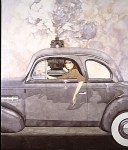
(Images: Rosamond’s ‘The Crossing’. 1941 Chevrolet Coupe)
http://www.oscn.net/applications/oscn/DeliverDocument.asp?CiteID=26062
On the morning of May 31, 1953, my grandfather, Frank Rosamond, had a
head on collison. He was driving a 1941 Chevrolet. If it was a coupe,
then Frank could have been driving the same car my late sister posed
in for her painting ‘The Crossing’. Shortly after she completed this
foreboding work she asked me if I had seen it, she saying this is how
she dealt with Bill’s death. Bill was a fellow artist, my childhood
friend who got killed by a train after his car stalled on the
railroad tracks in Ogden Utah. He was eighteen. After Christine
Rosamond’s death, The Crossing was put in the window of the Rosamond
gallery in Carmel as if to suggest Fate had played a hand. If this is
the truth, then Fate has taken a real toll on the creative folk in my
family. Christine did not know her grandfather, or anything about his
accident – including what kind of car he owned!
Frank, a published writer, was making a living selling oil and gas
leases. Crippled due to this accident, he took a job selling
newspapers on a corner in Oklahoma City. I doubt he had insurance. I
believe he was at fault for my grandfather was a Dreamer and a Poet,
and it looks like he was looking at the beautiful scenery rolling by.
“plaintiff was driving his vehicle to the south of the center line of
the highway and was looking to the south ”
Bill’s son, Shane, was born seven months after his death. Shane will
never know his father. Frank was buried in a unmarked grave, never
knowing his grandchildren.
Jon Presco
Copyright 2007
“On the morning of May 31, 1953, plaintiff and defendants were
involved in a head on collision of their automobiles on Highway 59,
just immediately east of St. Louis, Oklahoma. The accident occurred
on a blacktop highway 22 feet in width. At the place of collision the
road was straight, though hilly, and was immediately opposite two
driveways, one leading from the highway north to a church, the other,
almost directly opposite leading from the highway south by a private
home. Plaintiff, 63 years of age, engaged in buying and selling oil
and gas leases, was driving a 1941 Chevrolet automobile in a westerly
direction, and defendant, Robert Poole, 28 or 29 years of age, an
employee of defendant, Reed Roller Bit Company, was driving a 1952
Chevrolet automobile, owned by said defendant company, in an easterly
direction. The collision occurred just north of the center line of
the paved road. The plaintiff sustained severe injuries as a result
of the accident. ”
Christine Rosamond Presco, a ‘Rose of the World’ was born October 24,
1947 in Vallejo California. Christina was the third child of Victor
and Rosemary, our mother one of four beautiful daughters born to the
writer and poet, Royal Rosamond, and Mary Magdalene Wieneke. Royal
and Mary met in Los Angeles where Mary went to live after leaving her
father’s farm in Iowa. Seeking her independance, as a young woman
Mary worked as a seamtress in Downtown L.A. The Wienekes were said to
have owned castles in Germany. Mary was a frequent guest at
Krishnamurti’s retreat in the Ojai Valley where her brother had a
farm and may have delved in the philosophy of the Theosophic Society.
Royal wrote stories for ‘Out West’ the ‘Arcadian’ and several Romance
magazines, he sailing to the Anacapa Islands with is friend, Dashiel
Hammet, the author of the ‘Maltese Falcon’, a mystery novel that was
made into a movie about the search for a golden falcon once belonging
to the Knights Templars. Royal taught Earl Stanley Gardner the
rudiments of writing. Royal’s poem ‘Your Name’ could well acompany
Rossetti’s painting of the young man writing his lover’s name in the
sand. Living by the sea in Ventura California, Rosemary, and her
sister, Lillian, were courted by the famous actor, Errol Flyn, thus,
there was a powerful sense of the Romantic in our household that
would influence both Christine’s and my work.
All the Rosamond women were beautiful, they the arhetypes for the
rosy women that began to peer gracefully from their canvases in the
early seventies at a changing world, their beauty and strength
heralding in the Woman’s Movement, the very idea women could now own
their own Creation and Creations. In the words of Swineburne’s Fair
Rosamond; “But that I am Part of the perfect witness for the world.”
My dear sister drowned off the Coast of Carmel on March 26,1994. The
legacy this complex person left behind is an important one as we were
both influenced by the Pre-Raphaelite artists who are at the core of
Grail Mysteries that have surfaced once again in the Quest for
Religious and Spiritual pertinence. The name Rosamond means ‘Rose of
the World’ and is one of the names applied to the Shekinah which is
the ‘Light of the World’ that I believe is found at the center of the
Labyrinth, like the one King Henry the second built for the love of
his life, Fair Rosamond. He also built a Well and Arcadia for her
after the story of Tristan and Isolde. A Grail Cup entwined in a vine
was engraved on her tomb. She has been compared to Mary Magdalene by
some authors, and a Catholic Bishop upon seeing how she was being
worshipped by Knights about to go on Crusade, had her remains removed
from the Nunnery at Glascow, and scattered to the wind; he calling
her a whore. Christine gave me credit for being her teacher, my art
touring the world in a Red Cross show when I was twelve, and then
again when I was sixteen.
In 1970 I discovered Dante Gabriel Rossetti and the Pre-Raphaelite
Brotherhood, they modeling their movement after the Nazarene artists
of Germany, a guild dedicated to bringing back a spritual base to
Germany’s fine art. The Rossetti family were all gifted. Christina
Rossetti was an extraordinary poet and was considered a member of the
Pre-Raphaelite Brotherhood. Her father translated ‘Dante’s Inferno’
and owned a Publishing firm that her brother Michael opperated.
Dante was a close friend of the famous poet, Algernon Swineburne,
whose poem ‘The Queen Mother and Fair Rosamond’ became a model and
inspiration for all the Pre-Raphaelites who resurected themes from
the Grail Romances, breathing new life into the Knights and Fair
Maidens of our Ancient Dawn, raising a new light in the search for
the Truth. Many genealogist claim King Henry Plantagenet married Fair
Rosamond Clifford, who like his uncle, Robert Guisgard, King of
Sicily, was allowed more then one wife, as they are of the Seed of
King David, a theme of one of Rossetti’s paintings, who also painted
a painting titled ‘Fair Rosamond’. New information has surfaced that
the Rosamond name comes from Rougemont Switzerland, there a
Rougemont/Rosamond family crest depicting a cross surrounded by
roses, which is the discription of the crest belonging to Rosenkrantz
the founder of the Knights of the Rose Cross.
Rosamond passed into another Realm on her first sober birthday in AA,
we both sharing a Program that gives its Brothers and Sisters a coin
that says this upon it; “Unto they own self be true.” Christina and I
were Brother and Sister in Recovery, and in this Quest that has come
full circle, I see how we did climb the Spiritual Mountain together,
with Courage and Imagination so that we may own the very awakening
Rose of our soul. Like an errant Knight who has made his way through
the heavy thorns, roses taking bloom as I go forward, I now find
myself before the Tower of Beauty. And she assures me as she hands me
my reward: “Spiritual Courage, will be me with, Spiritual Courage.”
Royal Rosamond My grandfather, Royal Rosamond, authored several
books, numerous short stories, and countless poems that were
published in ‘Out West’ ‘Liberty Magazine’, and several Romance
magazines. He was good friends of Dashiel Hammet according to my
mother Rosemary, and my Aunt Lillian recalls falling asleep to the
sound of her father, and the author Earl Stanley Gradner, typing away
in their home in Ventura California, they honing up on their literary
skills. Dashiel and Earl were members of the ‘Black Mask’ a society
of mystery writers. Royal was born in a log cabin on the Missouri
River, the only known child of William Rosamond and Ida Louisiana
Rose. He met my grandmother, Mary Magdalene Wienke while working in
Brakey’s Cash Bizaar in Ojai, and would later own the first general
store in Ventura. A short biography of Royal is found in my link to
my newspaper ‘Royal Rosamond Press’.
Royal was a good friend of Otto Rayburn, the Ozark historian, they
meeting when Royal returned to the Ozarks to become a Regional
writer. Royal published in Rayburn’s ‘Arcadian Magazine’ “A Journal
of the Well-flavored Earth” printed in Eminence Missouri. Royal would
later found ‘Gem Publishing’ in Oklahoma City, and publish his
books ‘Bound in Clay’ and ‘Ravola of Thunder Mountain’. I have
corespondence between Royal and Otto. I wonder if he met the Regional
artist, Thomas Hart Benton, who was also good friends of Otto
Rayburn, there photographs of both men in Volume 1. of
Rayburn’s ‘Enchanted Ozarks’ an archives of Ozark Folk Life found at
the University of Arkansas. That the offspring of these men, were
destined to meet is quite extraordinary. Benton and Rosamond have
done much to make Folk Art, Folk Music, and Folk Lore, the Gemstones
of our American Tradition.
My sister, the world famous artist ‘Rosamond’, married Garth Benton,
the grandnephew of Thomas. Garth is an accomplished artist and
muralist. My niece, Drew Benton, has shown she has inherited a real
gift, and her artwork can be seen on my link to her mother’s page, my
late sister founding ‘Rosamond Publishing’.
My daughter, Heather Marie, is also a very talented artist, singer,
actress, and aspiring songwriter. We co-wrote a Country Western song
together. Royal lost his mother when he was nine, and his father
abandoned him when he was ten. Thomas Benton grew up in boarding
schools, and Heather did not know her father until she was sixteen.
From these uprooted beginnings has risen some true Gifts who have
established a Literary and Artistic Legacy that hopefully will last
many lifetimes, and be there for members of Rosy’s family to enjoy.
Christine Rosamond’s gallery is still flourishing in Carmel
California, and ‘Royal Rosamond Press’ will be publishing her
biography, as well as my fifteen year study of the Arcadian and Grail
Legends that are associated with the name Rougemont, a family from
Switzerland who are related to the Habsburgs, who along with the de
Anjou, Gonzaga, and Medici family, have done much to promote Art,
Music, and Literature. Christine and Garth were good friends of the
J. Paul Getty family whose Museum and Foundation are mainstays in
American Fine Art.
My niece, Shannon, and Garth completed a large mural in the Getty
mansion. On other webpages, that are linked in a circle to this one,
I compare the Rosamond family legacy with that of the Dante Gabriel
Rossetti family, whose siblings were also at the core of the Pre-
Raphaelite art movement, Michael and Christine Rossetti publishing
in ‘The Germ’, they taking over their father’s printing company. In a
record of immigrant names, Rossetti, in French, is Rosemond.
Christine and I were inspired by the Pre-Raphaelites, several of them
Knighted Artists of England where lived other Royal and Rosy people
that are now being linked to our Family Tree, a Rose Bush if you
will, for alas in the finding of my lost daughter, the roses now
harken to the legend of ‘Sleeping Beauty’ who lay aspleep in her
bower at the center of a hedgerow of thorns. May this family of the
Royal Rose restore the Forsaken Garden.
1 On the morning of May 31, 1953, plaintiff and defendants were
involved in a head on collision of their automobiles on Highway 59,
just immediately east of St. Louis, Oklahoma. The accident occurred
on a blacktop highway 22 feet in width. At the place of collision the
road was straight, though hilly, and was immediately opposite two
driveways, one leading from the highway north to a church, the other,
almost directly opposite leading from the highway south by a private
home. Plaintiff, 63 years of age, engaged in buying and selling oil
and gas leases, was driving a 1941 Chevrolet automobile in a westerly
direction, and defendant, Robert Poole, 28 or 29 years of age, an
employee of defendant, Reed Roller Bit Company, was driving a 1952
Chevrolet automobile, owned by said defendant company, in an easterly
direction. The collision occurred just north of the center line of
the paved road. The plaintiff sustained severe injuries as a result
of the accident.
¶2 In his petition plaintiff alleged that defendants were negligent
in that the defendant driver failed to keep a proper lookout for
vehicles upon the highway; failed to keep his vehicle under proper
control; was driving at an excessive and dangerous speed; was driving
at a rate of speed greater than would permit him to bring his vehicle
to a stop within the assured clear distance ahead; and that he failed
to keep to the right of the center of said paved road, operating his
vehicle on the north or wrong side of the road.
¶3 He testified that he was driving west at not to exceed 30 miles
per hour; that he first saw defendants’ automobile as it was coming
down the long hill coming out of St. Louis; that it went out of his
vision by reason of a small intervening hill; that he next saw said
vehicle as it came over the small intervening hill; that its left
wheels were then on the north or wrong side of the center line of the
highway; that he was on his side of the center line of said highway
and pulled his vehicle further to the north side of the road; that he
did not apply his brakes; that he remembered nothing more until about
10 days later in the hospital at Shawnee.
¶4 Defendant driver denied that he had been driving on the north or
wrong side of the road prior to the immediate time of the collision;
that when he came over the small hill he was driving his vehicle at
approximately 50 miles per hour; that he observed plaintiff’s vehicle
when it was approximately 400 feet away; that plaintiff was driving
his vehicle to the south of the center line of the highway and was
looking to the south; that he thought plaintiff was intending to make
a left turn; that he tapped his brakes to break the speed of his car
in order to permit plaintiff to get across in front of him; that
plaintiff’s car continued on toward his car instead of making a left
turn and he braked his car hard and attempted to pull across the
highway to the north in order to go to the left of plaintiff; that
when he applied the brakes hard, plaintiff looked up and pulled his
car sharply to the left and the cars collided; that when he began
applying his brakes all wheels of the vehicle he was driving were to
the south and right side of the center line; that, in attempting to
avoid the collision, he pulled to the north and wrong side of the
road.
¶5 The cause was submitted to a jury which returned a verdict for
defendant.
Beowulf and the Rosesmont Family of Foundlings Message List
Reply | Delete Message #140 of 493
Beowulf and the Rosesmont Family of Foundlings
I am now exsploring the real possibility the wolf names found in the
Roesmont family of Brambant may stem from King Hrolf, of the Saga of
King Hrolf kraki. Hrolf is found in the Beowolf sagas that are the
source of the Lohengrin, Swan Knight, legend.
“When I published by webpage ‘Royal Rosamond Press’ I dedicated it to
my grandfather and author, Royal Rosamond, who grew up in a log cabin
on the Missouri river, collected quilts and played the fiddle. I
titled my family “A family of Foundlings”. Huck Finn was a
Foundling. To have found Philip hiding in our family tree, completes
the destiny I foresaw in my Quest, and Christine’s, to found a Family
Dynasty of Artistic souls. That Quest is now complete. Here is real
American History as made by the Creative Ones, the lover’s of Beauty.”
Jon Presco
Copyright 2007
http://rougeknights.blogspot.com/
Thus Hroðmund is a Wulfing through his maternal line, through Queen
Wealhtheow, who, as Newton says, ‘may herself have been regarded as
an East Anglian dynastic ancestor’ (104). In the Scandinavian
tradition, Hrólfr (=OE Hroþulf) seems to be the slayer of Rørik (=OE
Hreðric) in an internecine struggle for the Danish throne, after
Hroðgar’s death (in Saxo, Gesta Danorum, Book 2.62–see further
discussion in: Malone, ‘Hrethric’, pp.275-282; Chambers,
Introduction, pp.25-7; Newton, Origins, pp.77-104). As well, from
dark hints within Beowulf itself, we can feel confident that the
poem’s audience knew a story of later strife amongst the Scyldings,
after Hrothgar’s death, when Hrothulf seized the throne from his
nephews, Hrethric and Hrothmund:
“The kernel of this legend seems to be an old genealogical myth, such
as that told of Scyld in “Beowulf”. A mysterious stranger arrives in
a rudderless ship among a people becomes their ruler and the ancestor
of the reigning house. When his time is fulfilled, he departs as
mysteriously as he has come. Such a myth was current among Germanic
tribes inhabiting the sea-coast. Possibly the mysterious stranger
originally was a solar deity and the swan a symbol of the cloud. The
story was designed to show the divine descent of the ruling house.
Its origin, whether Celtic or Germanic, is in dispute. The theme of
the Lohengrin legend, the union between a supernatural being and a
mortal, is of frequent recurrence in mythology and folk-lore.
This legend, embodied by Wagner in Lohengrin, has its roots in the
Anglo-Saxon, Danish, and Longobardian legend of Sceaf. An Anglo-Saxon
story says: “A ship once arrived on the coast of Scandia without
rudder or sail. In it lay a boy asleep upon his arms. The natives
took and educated him, calling him Scild, the son of Sceaf (the
skiff). In course of time he became their king.” In Beowulf it is
added that Scild reigned long, and when he saw that he was about to
die, he bade his men lay him, fully armed, in a boat, and commit him
to the sea. Other legends say that the boat which bore him away was
drawn by swans. He forbade questions to be asked about his home, but
his wife heeded not his hest.
In 145o the Roesmonts came to own Wolfhouse, an ancient estate in
Holland. Is this the source of the wolf coat of arms seen in the
Rebleuten guild, and in the captain seals in Bosch? Did members of
the Roesmont family found a guild at Wolfhouse?
The wolf name is found in two generation of Roesmonts.
Rudolph Godsclack Roesmont Son of : Godscalck Roesmont & NN moeder –
Huwt/Marr W : Mechteld
/Children ;1: Godschalck Roelofs Roesmont ( * = , + = 1411 )
2: Hadewich Rodolphus Roesmont (*/+)
The name Rudolf consists of the old-high-German
words „hrōd “, „hruod “for fame, honour and „wolf “for wolf. Thus
Rudolf means as much as „the honorable wolf “, „the fame-rich wolf “.
Hrólfs saga kraka, the Saga of King Hrolf kraki, is a late legendary
saga on the adventures of Hrólfr Kraki and his clan, the Skjöldungs.
The events can be dated to the late 5th century and the 6th century.
It is believed to have been written in the period c. 1230 – c. 1450.
44 manuscripts survive, but the oldest one of them is from the 17th
century, although a manuscript is known to have existed c. 1461 at
the monastery of Möðruvellir in Iceland.
The saga elaborates on the same matter as several other sagas, and
chronicles, in Scandinavian tradition, and also in the Anglo-Saxon
poems Beowulf and Widsith. In Beowulf and Widsith, many of the same
characters appear in their corresponding Old English forms: Hrólfr
Kraki appears as Hroðulf, his father Helgi as Halga, his uncle Hróarr
as Hroðgar, his grand-father Halfdan as Healfdene and their clan, the
Skjöldungs, as the Scyldings. Moreover, some of their enemies also
appear: Fróðo as Froda and king Aðils of Sweden as the Swedish king
Eadgils. For a more thorough treatment, see Origins for Beowulf and
Hrólf Kraki.
Both Godfrey de Bouillon and Robert de Bruce are kin to the Counts of
Louvain. Godeschalc de Roesmont was the Master at Louvain and good
friend of Pope Adrien.
“The first arms borne in England by the Bruce family – the azure lion
of Louvain – shout as loudly as anything could of their connection
not only with Flanders but with Queen Maud’s grandfather, Count
Lambert of Lens, who was the heir of his mother, Maud de Louvain.
Maud de Louvain, who married Count Eustace I of Boulogne was the
granddaughter of Count Lambert I of Louvain.”
The Roesmont cote of arms depicts a dancing wolf and the place of
origin, the Bois Le-Duc which means the “forest of the Dukes” the
Dukes of Brabant from whom the Counts of Louvain spring.
The Roesmonts married into the Roover family who owned Montfoort
castle. Did the Roesmont/Roover go on crusade with Robert the
Frisian, or Godfrey de Bouillon? Why did the Counts of Hainault
(Holland) become the first Kings and Queens of Jerusalem?
“Brabant
In the tenth century the region was divided into two Duchies of Upper
and Lower Lorraine. The latter was bestowed by the Emperor Otto 11 on
Charles, a brother of the descendants of Charlemagne. His son was
childless, but one of his daughters married Lambert, Count of
Louvain, and one of his granddaughters married Gerard, Duke of
Lorraine. Another granddaughter married the Count of Boulogne, whose
grandson Godfrey de Bouillon founded the kingdom of Jerusalem.
Probably somehwere in Lorraine and around this date, the story of the
Swan Knight which finds a mature expression in Wagner’s Lohengrin.
Many of the descendant of the Counts of Louvain and Boulogne used the
swan as a badge both in England and the Continent. An Order of the
Swan was founded in 1443 by Margrave Frederick 11 of Brandenburg
whose ancestry led back to the daughter of the first landgrave of
Hesse.”
“Frodo still called Bilbo, “Uncle,” now and then; it had become too
ingrained a habit. But, following suit, Rosamunda suggested Frodo
might call her, “Rosa,” or, “Rosamunda.” Frodo forgot, and called
her, “Auntie,” many times, but, within the space of anafternoon
tea, “Rosa,” she became.” (see below)
http://rougeknights.blogspot.com/2006/04/rosamund-guild-masters-on-
one-of.html
http://rougeknights.blogspot.com/2006/09/princess-rosamond-and-
serpent-rouge.html
“And still he went farther, and all was so quiet that he could hear
his own breathing, and at last he came to the tower, and went up the
winding stair, and opened the door of the little room where Rosamond
lay. ”
Dan Brown, Margaret Starbird, Laurence Gardner and others, claim
the ‘Sleeping Beauty’ legend is a Grail Quest for a Holy and Rosy
Bloodline. Princess Rosamond is associated with the Priory de Sion,
Rennes Chateau, the Serepent Rouge, the Sacred Feminine, and Fair
Rosamond who dwelt in a Labyrinth and was discovered by the clue of a
rouge thead, and thus is associated with Ariadne.Is it just a
coincidence that my sister, Christine Rosamond Presco, her mother,
Rosemary Rosamond, and her mother Mary Magdalene Rosamond, loved to
sew? After I located the unmarked grave of my grandfather, Royal
Rosamond, and placed a marker there of two roses, did the existance
of my sixteen year old daughter become known to me – for sure. Have I
cut through the roses and thorns and awakened a sleeping kingdom of
rosy weavers, or, has a troupe of Grail Writers found their way into
my Rosy Family Labyrinth and found the kingdom protected by roses –
and the needles of the rose?
For his first birthday I promised my Grandson, Tyler Hunt, a kingdom.
American Democracy has awoken from the demonic spell put upon it. Let
the celebration begin!
Jon Presco
http://rougeknights.blogspot.com/2006/04/rosamund-guild-masters-on-
one-of.html
This James (or Jacob, for these names were once interchangeable) was
the son of Hans Ulrich Rosemond, born 1623, a weaver; who was a son
of Hans, a weaver, born 1581; who was a son of Fred Rosemond, born
1552, a weaver, member of town council and a local captain; who was
the son of another Hans whose date of birth is not known, but he too,
was a weaver and became a citizen of Basle in 1534. His father was
Erhart de Rougemont who bought in 1495 “the house called Rebleuten-
Zunft in Basle in the Freistrasse.’
Before I discuss the EE Rebleuten-Zunft guild, here is what may
constitute the Rosenmund Family Grail. It is found amongst the
treasure of the EE Gerber-Zunft
http://www.gerbernzunft.ch/index.php?id=23
http://www.gerbernzunft.ch/index.php?id=19
Rosamunda Bolger (née Took) was the mother of Fredegar “Fatty” Bolger
and Estella Brandybuck. She was married to Odovacar Bolger and was
known as Rosamunda Took prior to the marriage. They lived in
Budgeford in Bridgefields in the Eastfarthing of the Shire. Rosamunda
and Odovacar both attended the Bilbo’s Farewell Party in 3001 along
with their children.
Fredegar “Fatty” Bolger
Norman Cates as Fatty Bolger from a Decipher Card designed by Weta
Friend of Frodo Baggins. Fredegar Bolger, called Fatty, was born in
2980 to Odovacar Bolger and Rosamunda Took Bolger. He had a sister
Estella who married Merry Brandybuck. Fatty’s great-great-grandfather
on his mother’s side was Gerontius, the Old Took, who was also the
great-great-grandfather of Merry and of Pippin Took. Fatty’s family
was from Budgeford in Bridgefields in the Eastfarthing.
http://members.ozemail.com.au/~sdgeard/hccnum.html
It is interesting to find out why Tolkien had paid so much special
attention to the tales and legends about the people of the
Longobards, why he would make its main characters the prototypes of
characters in his own myths and tales… Why the Longobards out of
all other existing peoples?!
Philip Boileau’s portrait of a young boy in tattered hat, reminds me
of the images we grew up with of Tom Sawyer and Huck Finn. Here are
three artists and a writer who lived “a Huck Finn-like childhood.”
k
http://genforum.com/rosamond/messages/10.html
http://tinyurl.com/38hghr
http://genforum.genealogy.com/roseman/messages/182.html
http://genforum.genealogy.com/roseman/messages/183.html
http://groups.yahoo.com/group/Rennes-le-Hoax/message/19
http://groups.yahoo.com/group/Templar-de-Rosemont/message/1244
http://groups.yahoo.com/group/Rennes-le-Hoax/message/3370
http://genforum.genealogy.com/rosamond/messages/9.html
h
Lohengrin, the Knight of the Swan
In Wolfram’s Parzival”, where a brief outline of the story of
Lohengrin is given at the close, the legend appears as a part of the
Grail cycle, and therefore also of the Arthurian cycle. But
originally it was wholly independent of both. In the oldest literary
versions, the French poems of the “Chevalier au cygne” (the earliest
dates from the beginning of the thirteenth century), the tale of the
Knight of the Swan is connected with Godfrey of Bouillon, and the
French poems themselves are part of an epic cycle dealing with the
Crusades. How this connexion came about is not known. But it was
certainly well known by the end of the twelfth century, as is proved
by an allusion to it in the history of the Crusades written by Bishop
William of Tyre (d. about 1184). The purpose was evidently to glorify
the House of Bouillon by ascribing to it a supernatural origin. The
story as given in the French poems is as follows: before Emperor Otto
holding court at Nymwegen the Duchess of Bouillon pleads for justice
against the Saxon Duke Renier, who has made grave charges against
her. She cannot find a champion to prove her innocence in single
combat, when suddenly an unknown knight appears in a skiff drawn by a
swan. He defeats her opponent and marries her daughter Beatris. But
he imposes the condition that his wife must never ask his name or
lineage. When, after seven years of wedded life, she breaks this
command, the unknown knight leaves her. A daughter named Ida has
resulted from this union. She marries Count Eustache of Boulogne and
becomes the mother of Godfrey of Bouillon.
The kernel of this legend seems to be an old genealogical myth, such
as that told of Scyld in “Beowulf”. A mysterious stranger arrives in
a rudderless ship among a people becomes their ruler and the ancestor
of the reigning house. When his time is fulfilled, he departs as
mysteriously as he has come. Such a myth was current among Germanic
tribes inhabiting the sea-coast. Possibly the mysterious stranger
originally was a solar deity and the swan a symbol of the cloud. The
story was designed to show the divine descent of the ruling house.
Its origin, whether Celtic or Germanic, is in dispute. The theme of
the Lohengrin legend, the union between a supernatural being and a
mortal, is of frequent recurrence in mythology and folk-lore.
With the tale of the swan-knight was combined an old Germanic fairy
tale of some children changed into swans by the evil arts of a wicked
stepmother. Only the little girl escapes and becomes the means of
rescuing her brothers. this story is familiar to readers of Grimm’s
fairy tales. In the French poems on this subject, the children are
the offspring of a union between a king and a fairy, and the king’s
mother plays the villain’s part. Their transformation into swans is
the result of their being deprived of the necklaces which they had
when they were born. When these are restored they regain their human
form, all but one, who has lost his necklace. He remains a swan and
henceforth draws the skiff of his brother, who is therefore called
the knight of the swan. It is clear that this story was added to
account for the mysterious origin of the hero.
The characteristic features of the Lohengrin saga–the disappearance
of the divine hero in the same mysterious fashion in which he has
arrived; the transference of mythical motifs from the life of the
older hero to a younger one bearing the same name (a universal
process in myth formation)–are likewise embodied in the Anglo-
Lombard saga of Sceaf, who reappears in the Prelude to the Anglo-
Saxon Beowulf, the oldest Teutonic epic. Here, he is called Scyld the
Scefung (meaning “son of Sceaf”) and his origin as a foundling is
referred to. The older legend tells that he received his name because
as a very young boy he was cast ashore, as a stranger, asleep in a
boat on a sheaf of grain (Anglo-Saxon: sceaf) . The waves of the sea
carried him to the coast of the country he was destined to defend.
The inhabitants welcomed his arrival as a miracle, raised him, and
later on made him their king, considering him a divine emissary. 1
What was told of the father now is
p. 64
transferred in the Beowulf epic to his son, also called Scyld. 1 His
body is exposed, as he had ordered before his death, surrounded by
kingly splendor, upon a ship without a crew, which is sent out into
the sea. Thus he vanished in the same mysterious manner in which his
father arrived ashore, this trait being accounted for, in analogy
with the Lohengrin saga, by the mythical identity of father and son.
The consecrated wafer shared by Lohengrin and the swan on their
voyage is one of the more obvious means taken by the poet to give the
tale the character of an allegory of the .relations between Christ,
the Church and the human soul. The story was followed closely in its
main outlines by Richard Wagner in his opera Lohengrin. The French
legend of the knight of the swan is attached to the house of
Bouillon, and although William of Tyre refers to it about 1170 as
fable, it was incorporated without question by later annalists. It
forms part of the cycle of the chansons de geste dealing with the
Crusade, and relates how Helyas, knight of the swan, is guided by the
swan to the help of the duchess of Bouillon and marries her daughter
Ida or Beatrix in circumstances exactly parallel to the adventures of
Lohengrin and Elsa of Brabant, and with the like result. Their
daughter marries Eustache, count of Boulogne, and had three sons, the
eldest of whom, Godefroid (Godfrey), is the future king of Jerusalem.
But in French story Helyas is not the son of Parzival, but of the
king and queen of Lillefort, and the story of his birth, of himself,
his five brothers and one sister is, with variations, that of “the
seven swans” persecuted by the wicked grandmother, which figures in
the pages of Grimm and Hans Andersen. The house of Bouillon was not
alone in claiming the knight of the swan as an ancestor, and the
tradition probably originally belonged to the house of Cleves.
http://www.1911encyclopedia.org/Lohengrin
AGNER’S opera Lohengrin was the work which first made the young and
enthusiastic King of Bavaria a warm and devoted admirer of the so-
called Music of the Future. Of this remarkable friendship Wagner
himself wrote: “In the year of the first performance of Tannhäuser, a
Queen bore me the good genius of my life, who raised me from the
direct necessity to the highest joy. When but fifteen years of age,
he witnessed a performance of Lohengrin, and since then he has
belonged to me. He calls me his teacher, the dearest for him on
earth. He was sent to me from Heaven. Through him I am, and
understand myself.”
That young poet-minded king would stand on the balcony of his
favorite residence, the mountain castle Hohenschwangau, and gaze at
the clear moonlit lake below him while a courtier sang the Swan Song;
and it is the same Hohenschwangau that is one of the legendary homes
of the Swan Knight—an alpine paradise, and almost as inaccessible as
the fabled Monsalvat. The swan is the legendary bird of the
Schwangau, and flocks of them may be seen sailing in all the pride of
their beauty and dignity of the deep blue lake that lies at the foot
of the hill on which Hohenschwangau is perched. The beautiful birds
undoubtedly gave the name to the valley and the castle; and in course
of time the Swan-legend was transplanted from the Scheldt to Bavaria.
The first performance of Lohengrin [click on thumbnail to the left]
was given under the direction of Franz Liszt at Weimar on August 28,
1850, the anniversary of Goethe’s death. In 1871 it was performed for
the first time in Italy, the home of opera, at Bologna. It was then
taken to New York, and although it had been heard there before in the
original German, it was given at the Academy of Music in Italian.
Afterward, it went to London where the role of princess Elsa was
performed by Mademoiselle Albani at Covent Garden and by Madame
Nilsson at Drury Lane.
THE LEGEND: In the dark ages there lived in the castle of Schwanstein
(now Hohenschwangau) a princess of the purest and noblest character,
mistress of the castle and the valley. One day she stood upon the
parapet of the Schloss and looked far into the valley. Her eye rested
upon the Swan lake. There she saw a snow-white swan, gracefully
sailing over the waters, and drawing after it a golden boat in which
a handsome knight lay asleep.
When the knight awoke and stepped on shore, he greeted the princess
in such friendly wise that she immediately conceived great confidence
in him, and asked him to protect her against her enemies, especially
against her wicked uncle, who had accused her before the Emperor of
unbecoming conduct, and on this ground had claimed her wealth. The
Emperor commanded that the uncle should do battle with any champion
the young lady could procure. The day of the tournament arrived, and
the Swan knight appeared in the arena to uphold the cause of the
lady, and slew the avaricious uncle on the spot. In great
thankfulness the princess chose the knight to be her lord, and he
accepted the honor on one condition, namely, that she should never
seek to find out who he was or whence he came, otherwise their bliss
would at once come to an end. But curiosity was ever the weak point
of the daughters of Eve. Irresistibly inquisitive to know something
about her knight, she asked him about his descent. Immediately on
hearing these words he became silent and moody, and without more ado
hurried to the lake. The swan was in waiting with the golden boat;
the knight stepped into the fragile shell, and while the princess
stood wringing her hands in agony on the turret, her mysterious lord
was swept over the sad waters, out of sight forever.
This legend, embodied by Wagner in Lohengrin, has its roots in the
Anglo-Saxon, Danish, and Longobardian legend of Sceaf. An Anglo-Saxon
story says: “A ship once arrived on the coast of Scandia without
rudder or sail. In it lay a boy asleep upon his arms. The natives
took and educated him, calling him Scild, the son of Sceaf (the
skiff). In course of time he became their king.” In Beowulf it is
added that Scild reigned long, and when he saw that he was about to
die, he bade his men lay him, fully armed, in a boat, and commit him
to the sea. Other legends say that the boat which bore him away was
drawn by swans. He forbade questions to be asked about his home, but
his wife heeded not his hest. The legend is related of many places
and noble families in Germany. Says one chronicler about this
time: “Otto, Emperor of Germany, held court at Neumagen, there to
decide between Clarrissa, Duchess of Bouillon, and the Count of
Frankfort, who claimed her duchy. It was decided that their right
should be established by single combat, provided some doughty warrior
would do battle for the lady. But none would meddle with the affair.
In answer to her prayer, however, the Swan Knight appeared. Lords and
ladies were scattered along the banks of the Meuse. The knight is
Helias, who overcomes the Count of Frankfort, and becomes the Duke of
Bouillon.”
The story is very ancient and popular. It is told of Lohengrin,
Loherangrin, Salvuis, and Gerhard the Swan, while the lady is
Beatrice of Cleves, a princess of Hohenschwangau, or Else of Brabant.
[The white swan was the badge of the House of Cleves, which professed
to be descended from the “Knight of the Swan.” When Ann of Cleves
went to England there was a play given in her honor in which the
appearance of a knight drawn in a boat by a swan caused great
astonishment. Lord Berners wrote a novel in the sixteenth century
called “The Knight of the Swan.”]
http://www.vaidilute.com/books/mythology/macculloch-25.html
http://www.primitivism.com/swan-maidens.htm
http://www.newadvent.org/cathen/09121a.htm
Scylding
From Wikipedia, the free encyclopedia
Jump to: navigation, search
Old English Scylding (plural Scyldingas) and Old Norse Skjöldung
(plural Skjöldungar), meaning in both languages Shielding, refers to
members of a legendary royal family of Danes and sometimes to their
people. The name is explained in many text by the descent of this
family from an eponymous king Scyld/Skjöld. But the title is
sometimes applied to rulers who purportedly reigned before
Scyld/Skjöld and the supposed king Scyld/Skjöld may be an invention
to explain the name. There was once a Norse saga on the dynasty, the
Skjöldunga saga, but it only survives in a Latin summary by Arngrímur
Jónsson.
[edit] From Skjöld to Halfdan
The number, names, and order of the Skjöldung kings vary greatly in
different texts until one comes to Halfdan/Healfdene.
All Old English texts call Scyld’s son and successor Beaw or some
similar name. (The name was expanded to Beowulf in the poem Beowulf,
probably in error by a scribe who thought it was an abbreviation for
the name of the poem’s hero, who is quite a different person).
Halfdan/Healfdene seems to be the direct son of Beaw in the poem. But
all Scandinavian sources that mention both Skjöld and Halfdan put
Halfdan some generations after Skjöld and make no mention of King
Beaw (save for a genealogy in the Prologue to Snorri Sturluson’s Edda
which is taken from English traditions).
According to Saxo Grammaticus’ Gesta Danorum (Book 1), Skjöld was
succeeded by a son named Gram. Since gram is also a simple adjective
meaning “fierce” and a common kenning for “king”, it might be that
Saxo or a source has misunderstood some account referring to Beaw as
being gram or a gram and wrongly taken it here as a personal name.
Saxo has much to tell of this Gram who becomes the father of Hadingus
of whom he has even more to relate, Hadingus in turn becomes the
father of a king Frotho I who is father of Haldanus I.
Snorri Sturluson in his Edda, along with some other Old Norse texts,
makes Skjöld to be father of Fridleif father of Fróði under whose
reign the world was at peace. Snorri mentions this Fróði son of
Fridleif in the Ynglinga saga also. But in this work Snorri also
introduces a second, later Fróði, said to be son of certain Dan
Mikilláti. The second Fróði is known both as Fróði Mikilláti and
Fróði the Peace-lover and looks suspiciously like a duplicate of the
other peaceful Fróði. Snorri makes this second Fróði the father of
Halfdan and of another son named Fridleif.
Saxo in Books 4–5, long after the reign of Halfdan and the fall of
the Skjöldung dynasty, also introduces a king named Dan, the third
king with that name in his account, whose son is Fridleif whose son
is Fróði under whose reign the world achieves peace. This Fróði is
also the father of a son named Fridleif according to Saxo.
There are other differing accounts of Halfdan’s ancestors. The names,
number, and order of legendary Danish kings are very inconsistent in
extant texts and it would appear that different writers and story
tellers differently arranged what tales of legendary Danish kings
they knew in whatever order seemed best to them.
[edit] Halfdan and his descendants
In all accounts Halfdan is father of Helgi (called Halga in Beowulf)
and Hróar (called Hrothgar in Beowulf). Helgi is father of the famous
Hrólf Kraki (called Hrothulf in Beowulf). In Beowulf, another son of
Healfdene/Halfdan named Heorogar is father of Heoroweard who
corresponds to Hjörvard in the Old Norse accounts where Hjörvard’s
parentage is not told. The Old Norse accounts make Hjörvard to be the
husband of Hrólf’s sister and tell how Hjörvard rebelled against King
Hrólf and burned him in his hall. But Hjörvard was himself soon slain
and with him the rule of the Skjöldung dynasty ended. See also
Origins for Beowulf and Hrólf Kraki.
http://en.wikipedia.org/wiki/Scylding
Hrólfr Kraki, Hroðulf, Rolfo, Roluo, Rolf Krage (6th century[1]) was
a legendary Danish king who appears both in Anglo-Saxon and in
Scandinavian tradition. His name would in his own language (Proto-
Norse) have been *Hrōþiwulfaz[2] (famous wolf).
Both traditions describe him as a Danish Scylding, the nephew of
Hroðgar and the grandson of Healfdene. The consensus view is that
Anglo-Saxon and Scandinavian traditions describe the same people[3].
Whereas Beowulf and Widsith don’t go further than treating his
relationship with Hroðgar and their animosity with Froda and Ingeld,
the Scandinavian sources expand where the Anglo-Saxon sources end,
i.e. on his life as the king at Lejre.
Scandinavian sources also expand on his relationship with Halga, King
Hroðgar’s brother. In Beowulf and Widsith, it is never explained how
Hroðgar and Hroðulf are uncle and nephew
The poem Beowulf introduces Hroðulf[4] as Hroðgar’s supporter and
right-hand man; and we learn that Hroðulf is Hroðgar’s nephew and
that “each was true to the other”[5]. Hroðgar and his brothers
Heorogar and Halga, and their unnamed sister, are presented as the
children of Healfdene[6]. They belong to the royal clan, known as the
Scyldings[7].
The poem does not explain whether it was Heorogar or Halga who was
Hroðulf’s father. The common piece of information that it was Halga
who was Hroðulf’s father is taken from Scandinavian tradition (see
sections below).
Hroðgar and queen Wealhþeow had two young sons, Hreðric and Hroðmund,
and Hroðulf would be their guardian in case Hroðgar dies. It appears,
though, as though the queen does not trust Hroðulf and suspects that
Hroðulf might claim the throne for himself:
–Ic minne can
glædne Hroðulf, þæt he þa geogoðe wile
arum healdan, gyf þu ?r þonne he,
wine Scildinga, worold ofl?test;
wene ic, þæt he mid gode gyldan wille
uncran eaferan, gif he þæt eal gemon,
hwæt wit to willan and to worð-myndum
umbor wesendum ?r arna gefremedon.[8]
–For gracious I deem
my Hrothulf, willing to hold and rule
nobly our youths, if thou yield up first,
prince of Scyldings, thy part in the world.
I ween with good he will well requite
offspring of ours, when all he minds
that for him we did in his helpless days
of gift and grace to gain him honor![9]
No existence of any Hreðric or Hroðmund, sons of Hroðgar, has
survived in Scandinavian sources (although, Hreðric has been
suggested to be the same person as Hroerekr/Roricus[10]), which
suggests that Hroðulf was indeed not to be trusted.
The Scyldings were in conflict with another clan or tribe named the
heaðobards lead by their king Froda and his son Ingeld. It is in
relation to this war that Hroðulf is mentioned in the other Anglo-
Saxon poem where he appears, Widsith.
The Chronicon Lethrense (and the included Annales Lundenses) tell
that Haldan (Healfdene) had two sons, Helghe (Halga) and Ro
(Hroðgar). When Haldan died of old age, Helghe and Ro divided the
kingdom so that Ro ruled the land, and Helghe the sea. One day,
Helghe arrived in Halland/Lolland[11] and slept with Thore, the
daughter of one of Ro’s farmers. This resulted in a daughter named
Yrse. Much later, he met Yrse, and without knowing that she was his
daughter, he made her pregnant with Rolf. Lastly, Helghe found out
that Yrse, with whom he had slept, was his own daughter, and out of
shame, he went east and killed himself.
Both Helghe and Ro being dead, the Swedish king Hakon/Athisl[12]
(i.e. Eadgils) forced the Daner to accept a dog as king. The dog king
was succeeded by Rolf Krage.
Rolf Krage was a big man in body and soul and was so generous that no
one asked him for anything twice. His sister Skulda was married
against Rolf’s will to Hartwar/Hiarwarth[13] (Heoroweard), a German
earl of Skåne, but reputedly Rolf had given Skulda to him together
with Sweden.
This Hartwar arrived in Zealand with a large army and said that he
wanted to give his tribute to Rolf, but killed Rolf together with all
his men. Only one survived, Wigg, who played along until he was to do
homage to Hartwar. Then, he pierced Hartwar with a sword, and so
Hartwar was only king one morning. However, according to a
reputation, it was instead an Ake who killed Hartwar and so became
king.
http://en.wikipedia.org/wiki/Hr%C3%B3lf_Kraki
Not only does the East Anglian pedigree contain Hroðmund, but based
on Bede’s records, the founder of the East Anglian royal line was
Wuffa, ‘a quo reges Orientalium Anglorum Uuffingas appellant’ (“from
whom the kings of East Anglia are called Wuffings”). Further, as
Newton argues, ‘the name Wuffa appears to be a diminutive variant of
Wulf, and can thus be translated as ‘Little Wolf’. The patronymic
form Wuffingas seems similarly best explained as a variant of
Wulfingas, “the kin of the wolf”, a folk-name which is mentioned in
both Beowulf and Widsith’ (Newton 105-6; see also O’Loughlin 4).
Newton also shows that the Wulfingas of Beowulf are more central
to the poem then might appear at first blush:
‘[Queen Wealhþeow] is described…in the poem as ides
Helminga, ‘the Helming lady’ (l.620b). Helmingas must be her family
name, the eponym of which is listed in Widsith: “Helm (wéold)
Wulfingum”, ‘”Helm (ruled) the Wulfings”‘ (l.29b)…the implication
arising from Widsith is that Helmingas was an alternative name for
Wulfingas in Old English poetic tradition. The epithet ides Helminga
thus can be interpreted as being synonymous with ides Wulfinga and
Wealhþeow thus can be identified as a Wulfing princess’. (Newton 122,
124)
‘Hróðmund is listed as the tenth name on Ælfwald’s ancestral tally, a
position well beyond the pedigree’s horizon of historical
credibility. The name occurs there in the exact form as that borne by
a Scylding prince in Beowulf. …apart from the place-name Rodmundes
Dæn, …in the description of a Hampshire estate boundary in a
suspicious tenth-century charter, the only other known Old English
instance of this royal compound-name is that belonging to the son of
Hroðgar in Beowulf’. (Newton 79)
The pedigree of King Ælfwald of East Anglia (r. ca.713-749) in
British Library MS Cotton Vespasian B.vi (early ninth century):
Ælfwald’s pedigree:
1. Aelfwald alduulfing
2. Alduulf eðilricing
3. Eðilric ening
4. Eni tyttling
5. Tyttla wuffing
6. Wuffa wehing
7. Wehha wilhelming
8. Wilhelm hryping
9. Hryp hroðmunding
10. Hroðmund trygling
11. Trygil tyttmaning
12. Tyttman casering
13. Caser wodning
14. Woden
Thus Hroðmund is a Wulfing through his maternal line, through Queen
Wealhtheow, who, as Newton says, ‘may herself have been regarded as
an East Anglian dynastic ancestor’ (104). In the Scandinavian
tradition, Hrólfr (=OE Hroþulf) seems to be the slayer of Rørik (=OE
Hreðric) in an internecine struggle for the Danish throne, after
Hroðgar’s death (in Saxo, Gesta Danorum, Book 2.62–see further
discussion in: Malone, ‘Hrethric’, pp.275-282; Chambers,
Introduction, pp.25-7; Newton, Origins, pp.77-104). As well, from
dark hints within Beowulf itself, we can feel confident that the
poem’s audience knew a story of later strife amongst the Scyldings,
after Hrothgar’s death, when Hrothulf seized the throne from his
nephews, Hrethric and Hrothmund:

 Rosamond Press
Leave a comment