


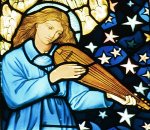
5 Afterward you will come to [a]the hill of God where the Philistine garrison is; and it shall be as soon as you have come there to the city, that you will meet a group of prophets coming down from the high place with harp, tambourine, flute, and a lyre before them, and they will be prophesying.
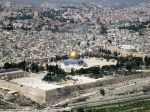
Is this the temple mount where the Philistine’s have put armed guards? Why? Are they there to prevent the Israelites from performing a religious function, such as erecting the Tabernacle, the house for the Ark of the Covenant?
When I read this passage twenty three years ago, I had a vision of LONG-HAIRED angels. Why are these musicians – prophets? I then considered rock-and roll stars who are prophets in their own right. I then wondered if these musicians were singing Psalms. Then I read about the controversy over Solomon building his temple, and David forsaking Hebron. God did not allow David to build a temple on the mount, because he was too bloody of a man.
Then it came to me in a vision, that the great choirs of the Israelites were placed on the surrounding hills because this place was a natural amphitheatre. The Chosen Children of God would then fill the Kidron Valley to hear angels sing. and then, on the Jubilee, the Ark would be brought out of the Tabernacle tent, and upon it would sit THE LORD – and not Jesus – who is not God and is not worthy of all this insipid praise. I believe in ONE GOD and not two gods. I do not believe in the Anti-Christ, another member of the false Christian pantheon that INSISTS the Anti-Christ must build the third temple! Over my dead body!
I suspect the Nazarites were the prophetic singers coming down from the mount – that could also be the Mount of Olives! Consider the sleeping Saints that rise from their tombs in Matthew 27:53. Professional singers do no eat grapes because it affects their voice. The Nazarites could not eat grapes or drink wine.
Some Christians claim the Freemasons want to build the third temple. My kindred are famous Masons. I will surround the temple with long-haired Nazarite Saint who will sing out upon the hills! We will bring down the evil temple of the false Christian Anti-Christ – who works for the false Jesus of Satan Saul – the snake!
The mount was intended for the Tabernacle – a tent only, and not a permanent structure. Solomon built his temple in order to capture the Ark so the people would never behold it, and their Lord. His offspirng did away with the Jubilee, later on, that John the Savior came to restore.
Jon Presco
Copyright 2012
The Duties of the Singers and Musicians
The singers and musicians were selected and set apart to their assigned function. There were a total of 288 singers (1 Chronicles 25:7-31) and 4,000 musicians (1 Chronicles 23:5). They were also divided into 24 courses. Therefore each course had 12 singers and more than 160 musicians. Unlike the singers, the 160 musicians were coming from several families. The ministry was subdivided among the families, and only one family of 20 to 30 musicians accompanied the 12 voice choir.
The real service of praise in the Temple was only with the voice. The instrumental music served only to accompany and sustain the song. The musical instruments used were mainly the Nevel (harp) and the Kinnor (lyre). The silver trumpets used in the Temple, blown by priests only, were not part of the instrumental music, but were intended for assembling Israel to worship at the Temple. The other musical instrument mentioned was the cymbal. But this “sounding brass” and “tinkling cymbal” also formed no part of the Temple music itself, and served only as the signal to begin that part of the service.
The Gershonites were one of the four main divisions among the Levites in Biblical times. The Bible claims that the Gershonites were all descended from the eponymous Gershon, a son of Levi,[1] although biblical scholars regard this as a postdictional metaphor providing an aetiology of the connectedness of the clan to others in the Israelite confederation;[2][3] according to biblical scholars, Levite was originally just a job title, deriving from the Minaean word lawi’u meaning priest, rather than having been the name of a tribe[4]
The Bible ascribes a specific religious function to the Gershonites, namely care of the curtains, hangings, and ropes, of the sanctuary.[5] This differentiation of religious activity between the Gershonites and other Levites, in particular the Aaronids, is found only in the Priestly Code, and not in passages that textual scholars attribute to other authors.[6][7]
According to the Book of Joshua, rather than possessing a continuous territory, the Gershonites possessed several cities scattered throughout the geographic regions of Galilee and Bashan:[8]
in the territory of Manasseh: Golan, and Beeshterah
in the territory of Issachar: Kishon, Dabareh, Jarmuth, and En-gannim
in the territory of Asher: Mishal, Abdon, Helkath, and Rehob
in the territory of Naphtali: Kedesh, Hammoth-dor, and Kartan
The narrative in Joshua argues that the territory was taken by the Levites right after Joshua’s conquest of Canaan, but this cannot be correct,[3] as it is contradicted not only by archaeological evidence, but also by narratives in the Book of Judges, Books of Samuel, and Books of Kings;[9][10] Kedesh, for example, appears to have actually remained as a shrine to deities other than Yahweh.[3] The conclusion of most biblical scholars is thus that the whole system of Levite cities, in the Torah and deuteronomic history, is an attempt to explain the fact that important early sanctuaries existed at these locations, and thus were places where members of the priesthood naturally came to reside in large numbers;[3] scholars believe that the priesthood was originally open to any tribe, but gradually became seen as a distinct tribe to themselves – the Levites.[3][11]
http://www.freemasons-freemasonry.com/masonic-apron-rosette.html
http://mbpresco.blogspot.com/2008/08/christian-god-is-evil-god.html
http://www.levitt.tv/media/watch/177
Attempts to re-establish a Jewish Presence on the Temple Mount
In August 1967 after Israel’s capture of the Mount, Rabbi Shlomo Goren the chief rabbi of the IDF (and later chief rabbi of the State of Israel) began organizing public prayer for Jews on the Temple Mount. Rabbi Goren was also well known for his controversial positions concerning Jewish sovereignty over the Temple Mount. On August 15, 1967, shortly after the Six-Day War, Goren led a group of fifty Jews onto the Temple Mount, where, fighting off protesting Muslim guards and Israeli police, they defiantly held a prayer service.[2] Goren continued to pray for many years in the Makhkame building overlooking the Temple Mount where he conducted yearly High Holiday services. His call for the establishment of a synagogue on the Temple Mount has subsequently been reiterated by his brother-in-law the Chief Rabbi of Haifa, She’ar Yashuv Cohen.
Goren was sharply criticized by the Israeli Defense Ministry, who, noting Goren’s senior rank, called his behaviour inappropriate. The episode led the Chief Rabbis of the time to restate the accepted laws of Judaism that no Jews were allowed on the mount due to issues of ritual impurity. The secular authorities welcomed this ruling as it preserved the status quo with the Waqf, the Islamic authority. Disagreeing with his colleagues, Goren continually maintained that Jews were not only permitted, but commanded, to ascend and pray on the mount.
Goren repeatedly advocated or supported building a Third Temple on the Temple Mount from the 1960s onward, and was associated with various messianic projects involving the site. In the summer of 1983, Goren and several other rabbis joined Rabbi Yehuda Getz, who worked for the Religious Affairs Ministry at the Western Wall, in touring a chamber underneath the mount that Getz had excavated, where the two claimed to have seen the Ark of the Covenant. The tunnel was shortly discovered and resulted in a massive brawl between young Jews and Arabs in the area. The tunnel was quickly sealed with concrete by Israeli police.[3] The sealed entrance can be seen from the Western Wall Tunnel, which opened to the public in 1996.
The Chief Rabbis of Israel, Isser Yehuda Unterman and Yitzhak Nissim, together with other leading rabbis, asserted that “For generations we have warned against and refrained from entering any part of the Temple Mount.”[4] A recent study of this rabbinical ruling suggests that it was both “unprecedented” and possibly prompted by governmental pressure on the rabbis, as well as “brilliant” in preventing Muslim-Jewish friction on the Mount.[5] Rabbinical consensus in the Religious Zionist stream of Orthodox Judaism continue to hold that it is forbidden for Jews to enter any part of the Temple Mount[6] and in January 2005 a declaration was signed confirming the 1967 decision.[7]
[edit] Role in Conservative Judaism
Conservative Judaism believes in a Messiah and in a rebuilt Temple, but does not believe in the restoration of sacrifices. Accordingly, Conservative Judaism’s Committee on Jewish Law and Standards has modified the prayers. Conservative prayerbooks call for the restoration of Temple, but do not ask for resumption of sacrifices. The Orthodox study session on sacrifices in the daily morning service has been replaced with the Talmudic passages teaching that deeds of loving-kindness now atone for sin.
In the daily Amidah prayer, the central prayer in Jewish services, the petitions to accept the “fire offerings of Israel” and “the grain-offering of Judah and Jerusalem” (Malachi 3:4) are removed. In the special Mussaf Amidah prayer said on Shabbat and Jewish holidays, the Hebrew phrase na’ase ve’nakriv (we will present and sacrifice) is modified to read to asu ve’hikrivu (they presented and sacrificed), implying that sacrifices are a thing of the past. The prayer for the restoration of “the House of our lives” and the Shekhinah to dwell “among us” in the weekday Torah reading service is retained in Conservative prayer books, although not all Conservative services say it. In Conservative prayer books, words and phrases that have dual meaning, referring to both Temple features and theological or poetic concepts, are generally retained. Translations and commentaries, however, generally refer to the poetic or theological meanings only. Conservative Judaism also takes an intermediate position on Kohanim and Levites, preserving patrilineal tribal descent and some aspects of their roles, but lifting restrictions on whom Kohanim are permitted to marry.
In 2006, the Committee on Jewish Law and Standards adapted a series of responsa on the subject of the role of Niddah in Conservative Judaism, in which it discussed Conservative Judaism’s view of the role of Temple-related concepts of ritual purity in contemporary Judaism. One responsum adopted by a majority of the Committee held that concepts of ritual purity relevant to entry into the Temple are no longer applicable to contemporary Judaism and accepted a proposal to change the term “family purity” to “family holiness” and to explain the continuing observance of niddah on a different basis from continuity with Temple practices.[8][9] Another responsum, also adopted by a majority of the Committee, called for retaining existing observances, terminology, and rationale, and held that these Temple-related observances and concepts continued to have contemporary impact and meaning.[10] Thus, consistent with Conservative Judaism’s philosophy of pluralism, both views of the continuing relevance of Temple-related concepts of ritual purity are permissible Conservative views.
[edit] Role in Reform and Reconstructionist Judaism
Reform and Reconstructionist Judaism do not believe in the rebuilding of a central Temple or a restoration of Temple sacrifices or worship. They regard the Temple and sacrificial era as a period of a more primitive form of ritual which Judaism (in their view) has evolved out of and should not return to. They also believe a special role for Kohanim and Levites represents a caste system incompatible with modern principles of egalitarianism, and do not preserve these roles. Furthermore, there is a Reform view that the shul or synagogue is a modern Temple; hence, “Temple” appears in numerous congregation names in Reform Judaism. Indeed, the re-designation of the synagogue as “temple” was one of the hallmarks of early Reform in 19th century Germany, when Berlin was declared the new Jerusalem, and Reform Jewry sought to demonstrate their staunch German nationalism. The Anti-Zionism that characterized Reform Judaism throughout much of its history subsided somewhat with the Holocaust in Europe and the later successes of the modern state of Israel. The belief in the return of the Jews to the Temple in Jerusalem is not part of mainstream Reform Judaism.
[edit] Ancient attempts at rebuilding
[edit] Bar Kochba revolt
The forces of Shimon ben Kosiba, more commonly known as Simon bar Kokhba, captured Jerusalem from the Romans in AD 132, and construction of a new temple began, as well as renewed temple services. The failure of this revolt led to the writing of the Mishna, as the religious leaders believed that the next attempt to rebuild the temple might be centuries away and memory of the practices and ceremonies would otherwise be lost.
[edit] Julian
There was an aborted project by the Roman emperor Julian (361–363) to allow the Jews to build a “Third Temple”, part of Julian’s empire-wide program of restoring/strengthening local religious cults. Rabbi Hilkiyah, one of the leading rabbis of the time, spurned Julian’s money, arguing that gentiles should play no part in the rebuilding of the temple.[citation needed]
According to various sources of that time, including Sozomen (c. 400–450) in his Historia Ecclesiastica and the pagan historian and close friend of Julian, Ammianus Marcellinus,[11] the project of rebuilding the temple was aborted because each time the workers were trying to build the temple, using the existing substructure, they were burned by terrible flames coming from inside the earth and an earthquake negated what work was made:
Julian thought to rebuild at an extravagant expense the proud Temple once at Jerusalem, and committed this task to Alypius of Antioch. Alypius set vigorously to work, and was seconded by the governor of the province; when fearful balls of fire, breaking out near the foundations, continued their attacks, till the workmen, after repeated scorchings, could approach no more: and he gave up the attempt.
—[12]
The failure to rebuild the Temple has been ascribed to the Galilee earthquake of 363, and to the Jews’ ambivalence about the project. Sabotage is a possibility, as is an accidental fire. Divine intervention was the common view among Christian historians of the time.[13] Shortly thereafter, Julian was killed in battle, and the Christians reasserted control over the empire.
“In its previous appearances in Scripture the beast has always been the total focus of attention, and invariably presented alone. Now, however, it now appears with a rider on its back. That alone would dare, much less be able, to mount such an incredible beast seems beyond imagination. Yet there she sits, quite at ease and obviously in control, astride a world devouring creature defying description. She? Yes, she. A woman rides the beast!”Here I expected Mr. Hunt to introduce the beast and give some history of it, to explain it or give some ideal of who or what it is, how it came to be. But than on page 14 Mr. Hunt states:
“The beast represents both the revived Roman Empire [ Satan’s worl
dwide counterfeit of God’s kingdom] and the satanically empowered anti-Christ who will it…”
The beast and the anti-Christ are not the same entity,
the beast itself is Jewish origin, but the Catholic Church have been their enemies since Constantine out-maneuvered them it and took control of the beast’s power. How can the beast and the Catholic church be one and the same when it is the beast and anti-Christ who will destroy the woman [The Catholic Church]. If the beast and the woman were one and the same, the beast would destroy itself when it destroys the woman. That is the trick, it is used to get you to focus all your attention on the woman, [the Catholic Church] blame her for everything while the actual beast goes unnoticed, and grow stronger. This beast is growing stronger ever day and is influencing all segments of society, it has taking over Hollywood Ca. in fact it is the religion of the Hollywood Stars, it is called the Cabbalism. The same Babylonian religion that was set up in the Temple of God when Christ was ousted. And is of Jewish origin and not Roman, nor is it of the Greek pagans, it is of God’s own people. “and His own received Him not.” [John 1:11]
THE THIRD TEMPLE BUILT AS A HOME FOR THE ANTI CHRIST BY THE ANTICHRIST
by Roy Francois
Where in scripture does it states that man is to build a third temple? God commanded the construction and reconstruction of the first temple. This third temple is to be built by apostate Jews, for their long awaited messiah, the antichrist. How can they build a temple for Christ’s return when they don’t believe He will return? Christ have nothing to with this new temple they are trying to build. This new temple is to do away with the blood sacrifice of Jesus. To show that they don’t believe in the blood sacrifice of God, they will reinstate the slaughter of animals for the atonement of sin. The bible makes it perfectly clear there is no other way to salvation except to the blood sacrifice of the Son of God. This includes Jew and Gentile! Just before Jesus gave up the ghost on the cross, He said it is finished, the price had been paid for the remission of sin. The sinner was purchased with the Holy Blood of Heaven, no higher price could have been paid, nothing is to be added to that. Jesus’ blood, plus the blood of slaughtered animals? It’s very foundation is built on sand. From it’s conception, it’s anti-Christ that’s why it will be destroyed like the other two. The true temple is to be built by God and come down from he
On July 19, 2010, ARUTZT SHEVA published the results of a poll showing that 49% of the Israeli public wants the Third Temple to be built. 42% of resident Jews believe the Third Temple WILL be built. These numbers are quickly growing. But the critical question is, “Will the Third Temple actually be built?”
I believe the answer to that question is an unequivocal “YES!”
Will Government Favor Construction of Third Temple?
The nation of Israel underwent radical changes of power in its government in the 1996 elections that were favorable to the building of the Third Temple. The “land-for-peace” trades that characterized the former governments of Shimon Peres and Yitzak Rabin were replaced by the “no compromises” hard-line tactics of Benjamin Netanyahu, then 49 year-old Prime Minister of Israel.
aven. JESUS IS TO BUILD THIS TEMPLE, NOT MAN!
FERVENT MASONIC DESIRE TO REBUILD SOLOMON’S TEMPLE IS THE DRIVING FORCE BEHIND THE EVENTS OF THE MID-EAST TODAY. ONCE COMPLETED, END TIMES’ PROPHECY WILL BE FULFILLED!
Subtitle: Illuminized Western Freemasonry has long desired to rebuild Solomon’s Temple on the Temple Mount. Masonic forces of the United Kingdom, United States, and Israel are absolutely determined to rebuild Solomon’s Temple. This plan will bring about World War III, Antichrist, and the beginning of the Tribulation.
The New World Order is coming! Are you ready? Once you understand what this New World Order really is, and how it is being gradually implemented, you will be able to see it progressing in your daily news!!
Learn how to protect yourself, your loved ones!
Stand by for insights so startling you will never look at the news the same way again.
YOU ARE NOW ON
THE CUTTING EDGE
Genuine Born Again Christians have normally not given King Solomon’s Temple much thought, for we realize that Jesus Christ fulfilled all the types and shadows of the Old Testament law, of which the Temple was an integral part. Jesus foretold in Matthew 24 that the glorious Herodian Temple, which was modeled after the Solomon Temple, would be totally destroyed. Listen:
“And Jesus went out, and departed from the temple: and his disciples came to him for to show him the buildings of the temple. And Jesus said unto them, See ye not all these things? verily I say unto you, There shall not be left here one stone upon another, that shall not be thrown down.” [Matthew 24:2; Parallel Bible, KJV/Amplified Bible Commentary]
History records that this Temple which had so impressed Jesus’ disciples was destroyed in A.D. 70. It was destroyed by the Roman Army that had laid siege to the city; further, even though the soldiers were under strict orders to not destroy the Temple, they set fire to it, and caused that fire to burn so hot for so long, and so thoroughly, that the stones heated hot enough to turn the gold liquid, flowing out of even the mortars of the bricks. When the fire cooled, Jesus’ prophecy was exactly fulfilled..
In New Testament Epistles, neither Paul nor any other Apostle emphasized the Temple; in fact, they virtually ignored it! The writer to the Hebrews made it quite clear that the Covenant of Jesus Christ completely abolished the First Covenant of which the magnificent Temple was such an important part. Listen to Hebrews:
“Now if perfection (a perfect relationship between God and the worshipper) had been attainable by the Levitical priesthood — for under it the people were given the Law — why was it further necessary that there should arise another, and different kind of Priest, one after the order of Melchizedek, rather than one appointed after the order and rank of Aaron? For when there is a change in the priesthood, there is of necessity an alteration in the law [concerning the priesthood) as well.” [Hebrews 7:11-12; Parallel Bible, KJV/Amplified Bible Commentary]
This passage makes it quite obvious that God considered the First Covenant to be defective, and in dire need of replacement! And, when you change the covenant, you change the priesthood, and the Law concerning the priesthood. It does not take too much imagination to realize that, if God was going to change the First Covenant and abolish its priesthood, He would abolish the Temple as well. For this reason, we read of God’s action taken when Jesus was hanging on the cross, immediately after He “gave up the ghost”:
“And, behold, the veil of the temple was rent in twain from the top to the bottom.” [Matthew 27:51; Parallel Bible, KJV/Amplified Bible Commentary]
God supernaturally ripped the Temple curtain separating the Holy Place from the Holy of Holies, while the sanctuary was filled with parishioners worshipping during the annual sacrifice for the sins of the Israel. Suddenly, they must have been filled with shock and fear as God abruptly ripped the curtain, throwing the Holy of Holies wide open. Many of them must have feared death, for no one could enter the Holy of Holies and live, except for the High Priest, and he only once a year. Tearing the curtain in two was God’s signal that the First Covenant, with its Temple and priesthood, was now irrelevant, and was now to be replaced by His Second Covenant through Jesus Christ.
The writer to the Hebrews picks up this very theme:
“In keeping with [the oath’s greater strength and force], Jesus has become the Guarantee of a better (stronger) agreement [a more excellent and more advantageous covenant].” [Hebrews 7:22; Ibid.]
Again, Hebrews says: “When God speaks of a new [covenant or agreement], He makes the first one obsolete (out of use). And what is obsolete (out of use and annulled because of age) is ripe for disappearance and to be dispensed with altogether.” [Hebrews 8:13; Ibid.]
Did you catch that? “… ripe for disappearance and to be dispensed with altogether.”
Therefore, genuine Christians have virtually ignored the Solomon and Herodian Temples, except to arrive at a proper understanding of the Old Testament Covenant. We certainly understand that God destroyed the Temple because He had instituted the superior Second Covenant through the new superior High Priest, Jesus Christ. To us, the Solomon Temple is just an interesting piece of Ancient History!
But, not so with the pagan Freemasons. In their religion, the Temple plays a very, very important role.
MASONS DECLARE FREEMASONRY TO BE A RELIGION!
Let us stop here for a moment, to dispense with the current Masonic lie that their organization is not a religion. Let us review some quotes:
“Every Masonic Lodge is a temple of religion, and its teachings are an instruction in religion.” [“Morals and Dogma”, Albert Pike, p. 231-L]
“It [Masonry] is the universal, eternal, immutable religion, such as God planted it in the heart of universal humanity.” [Ibid., p. 219-M]
“But the Masonic organizations in which these legends were cherished, like Masonic Lodges today, were religious bodies.” [The Holy Bible: The Great Light In Masonry”, King James Version, Temple Illustrated Edition, A.J. Holman Company, 1968, p. 26]
“… Masonry may rightfully claim to be called a religious institution.” [“A New and Revised Edition: An Encyclopaedia of Freemasonry and Its Kindred Sciences”, by Albert Mackey, M.D., 33º, Volume II, p. 618.
Do not be deceived; Freemasonry is a religion!
THE SOLOMON TEMPLE IS THE HEART AND SOUL OF FREEMASONRY!
Now that we have amply demonstrated that the genuine Christian has no close affinity to Solomon’s Temple, because He destroyed it and annulled the Levitical Priesthood that accompanied it, let us examine how important this temple is to the practice of the Masonic religion.
“Of all the objects which constitute the Masonic science of symbolism, the most important, the most cherished, by the Mason, and by far the most significant, is the Temple of Jerusalem. The spiritualizing of the Temple is the first, the most prominent and the most pervading, of all symbols of Freemasonry … Take from Freemasonry its dependence on the Temple; leave out of its ritual all references to that sacred edifice, and to the legends and traditions connected with it, and the system itself would at once decay and die … ” [“Encyclopaedia of Freemasonry”, by Albert Mackey, MD, 33º and Charles T. McClenachan, 33º, Revised Edition, by Edward L. Hawkins, 30º and William J. Hughan, 32º, Volume II, M-Z, published by The Masonic History Company, Chicago, New York, London, 1873, A.G. Mackey, 1927, by the Masonic History Company.]
Let us repeat the critical understanding that the noted 33º Masonic author, Albert Mackey, has just given us:
“Take from Freemasonry its dependence on the Temple; leave out of its ritual all references to that sacred edifice, and to the legends and traditions connected with it, and the system itself would at once decay and die … ”
Therefore, the first understanding we want you to grasp is that Freemasonry is absolutely, completely, 100% devoted to the Solomon Temple, without which the entire structure and foundation of Freemasonry would die! Thus does Masonry stand in stark contrast to genuine, Biblical Christianity. In other words, Freemasonry is rooted at its deepest foundation to the First Covenant of the Old Testament, while Biblical Christianity is rooted to the Second Covenant of Jesus Christ as delineated in the New Testament!
Mackey makes this fact quite clear also: “Masonry has derived its temple symbolism, as it has almost all its symbolic ideas, from the Hebrew type …” [Ibid] Since the Old Testament was written originally in the Hebrew, and the New Testament in the Greek, Mackey is clearly stating that Freemasonry is rooted in the Old Testament!
In the Masonic Bible, quoted above, the Temple Illustrated Edition, the author of the Foreword sheds some further light upon the importance of Solomon’s Temple to Freemasonry.
“The traditions and romance of King Solomon’s Temple are of great interest to everyone who reads the Bible. They are of transcendent importance to Masons. The Temple is the outstanding symbol in Masonry, and the legendary story of the building of the Temple is the fundamental basis of the Masonic rule and guide for conduct in life … The cream of Masonic historical and philosophical writing has been drawn upon for his description of the Temple and its relation to Masonic ritual.” [The Holy Bible: The Great Light In Masonry”, King James Version, Temple Illustrated Edition, A.J. Holman Company, 1968, Forward entitled, “The Bible and King Solomon’s Temple in Masonry”, by John Wesley Kelchner].
Let us review the important segment:
“The traditions and romance of King Solomon’s Temple … are of transcendent importance to Masons.”
The word, “transcendent”, is used by genuine Biblical Christianity to describe God Himself. Just as the dictionary explains, God is truly “transcendent”, “to pass beyond the limit that humans can grasp”; “to exist above and independently of material experience or the universe”. In other words, Solomon’s Temple is to the Freemason what God is to the genuine Christian!
Thus, belief in Solomon’s Temple transcends all of Freemasonry itself, existing above and independently of it. Masonry has placed its “transcendent” faith in a building that the True God Himself destroyed, not once, but twice!
SPIRITUALIZING SOLOMON’S TEMPLE
Starting at the end of the quote from the Temple Illustrated Edition Bible, above, we read:
“… In all the rich symbolism of Ancient Craft Masonry two symbols, or symbolic themes, predominate. One is the search for light; the other is the labor of building. The source of light is the Holy Bible, and the grand representation of the builder’s art is King Solomon’s Temple …. It was natural that imaginative stone Masons, long before the development of anything like our modern fraternity, should have felt a kinship with the great builders of all ages. It was natural also that they should have acknowledge a peculiar attraction for the most famous and glorious of all building enterprises, King Solomon’s Temple and Citadel. Interest and attraction for the wonderful structure on Mt. Moriah have increased rather than diminished … until today the Temple of Solomon is the spiritual home of every Mason.” [Masonic Holy Bible, Temple Illustrated Edition, A.J. Holman Co., 1968, p. 11-14]
A short while later, these authors explain: “King Solomon’s Temple was the perfect architectural expression of the religious faith of a people.” [P. 25] “Perhaps Masonic interest also increased from a more or less incidental notice of the Temple to a final preoccupation with it as a symbol of spiritual man. [P. 29; Emphasis added]
Indeed, Masonic leadership has spiritualized the meaning of the Temple in the life of each and every Mason. Albert Mackey explains: “To the Master Mason, the Temple of Solomon is truly the symbol of human life … it becomes a fit symbol of human life occupied in the search after Divine Truth, which is nowhere to be found … Such is the symbolism of the first Temple, that of Solomon, as familiar to the class of Master Masons.” [“Encylopaedia of Freemasonry, Mackey, p. 774; Emphasis added]
However, while Solomon’s Temple is the symbol of mortal human life to the Master Mason, a higher class of Masons ascribe a different interpretation to yet another Temple. Listen to Mackey explain:
“But there is a second and higher class of the Fraternity, the Masons of the Royal Arch, by whom this temple symbolism is still further developed. This second class, leaving their early symbolism, and looking beyond this Temple of Solomon, find in Scriptural history another Temple, which years after the destruction of the first one, was erected upon its ruins; and they have selected the second Temple, the Temple of Zerubbabel, as their prominent symbol. And, as the first class of Masons find in their Temple the symbol of mortal life, limited and perishable, they, on the contrary, see in this second Temple, built upon the foundations of the first, a symbol of life eternal, where the lost truth shall be found, where new incense shall arise from a new altar, and whose perpetuity their great Master had promised when, in the very spirit of symbolism, he exclaimed, ‘Destroy this temple, and in three days I will raise it up’.”
“And so to these two classes or Orders of Masons the symbolism of the Temple presents itself in a connected and continuous form. To the Master Mason, the Temple of Solomon is the symbol of this life; to the Royal Arch Mason, the Temple of Zerubbabel is the symbol of the future life. To the former, his Temple is the symbol of the search for truth; to the latter, his is the symbol of the discovery of truth; and thus the circle is completed and the system made perfect.” [Ibid., Pages 774-775; Emphasis added]
The Temple is so very important to the Mason that he took the final step to spiritualize its meaning. Master Masons look upon Solomon’s Temple as their symbol of human life, while Royal Arch Masons consider the inferior Temple of Zerubbabel as their symbol of eternal life! The two symbols, taken together, form a spiritual circle, thus “perfecting” the Masonic symbolic system!
Now, you can understand how the Temple of Solomon became such a “transcendent” issue for the Mason!
LOGICAL CONCLUSION OF THIS TRANSCENDENT BELIEF IN SOLOMON’S TEMPLE
Since Freemasonry reverences Solomon’s Temple so very much, and since this Temple holds such a pre-eminent position in all of Freemasonry, from its foundation to its very roof, is it much of a stretch to understand that Freemasons might fervently desire to re-build Solomon’s Temple on the only place on earth it can possibly be built — the Temple Mount in Jerusalem?
Let us examine some of these writings to see the fervent desire of Freemasons to rebuild Solomon’s Temple!
“The Freemasons have, at all events, seized with avidity the idea of representing in their symbolic language the interior and spiritual man by a material temple … The great body of the Masonic Craft, looking only to this first Temple erected by the wisdom of King Solomon, make it the symbol of life; and as the great object of Masonry is the search after truth, they are directed to build up this temple as a fitting receptacle for truth …” [“Encyclopaedia of Freemasonry”, by Albert Mackey, MD, 33º and Charles T. McClenachan, 33º, Revised Edition, by Edward L. Hawkins, 30º and William J. Hughan, 32º, Volume II, M-Z, published by The Masonic History Company, Chicago, New York, London, 1873, A.G. Mackey, 1927, by the Masonic History Company, p. 774]
The word, “avidity” is defined as “eagerness, greed”. Therefore, we can see that they are “directed to build up this temple” with eagerness and greediness! Mackey then goes on to talk about this new temple and some of its new fixtures.
“… new incense shall arise from a new altar, and whose perpetuity their great Master had promised when, in the very spirit of symbolism, he exclaimed, ‘Destroy this temple, and in three days I will raise it up’.” [Ibid.]
“New incense” arising from a “new altar”, in a Temple that Mackey has just associated with the “great Master Mason”, Jesus Christ! In other words, Mackey has linked the new Temple with a Christ or Messianic figure. In another book, Masonic author, Edward Waite, is even more explicit. Listen:
“The Temple of Masonry is hence forward the house of Christ’ … [Edward Waite, p. 486-7, “A New Encyclopedia of Freemasonry and of Cognate Instituted Mysteries: The Rites, Literature and History”, Volume II, reprinted in 1970 by Weathervane Books., p. 314]
The new Solomon Temple is henceforth to be called the “house of Christ”. The naive might think Waite is referring to Jesus Christ, but Waite did not say that, did he? Do you know that the term “Christ” literally means the “office of the promised Messiah”? Jesus fulfilled that office when He lived and ministered among men, and He was recognized as having fulfilled that Messianic office. Listen:
“And Simon Peter answered and said, Thou art the Christ, the Son of the living God.” [Matthew 16:16] Notice Peter said “Thou are the Christ”; in other words, Peter recognized that Jesus was the Divine/human fulfillment of this office of Messiah.
“And the high priest answered and said unto him, I adjure thee by the living God, that thou tell us whether thou be the Christ, the Son of God.” [Matthew 26:63] The high priest asked Jesus point blank if He was the fulfillment of that Messianic office.
“… the people were in expectation, and all men mused in their hearts of John, whether he were the Christ, or not” [Luke 3:15] Even the common Jew understood this distinction between the office [“the Christ”] and the man Who would fill it.
However, the Bible says that another Christ shall arise, and he shall be the Antichrist, or one who comes in the guise of Christ, pretending to be the Messiah. Unfortunately, most the people living at that time will be deceived into believing him to be Messiah, and will enthusiastically follow him [Revelation 13:3b-4].
Since Masonry is a counterfeit Christianity, it seems logical that Mackey and Waite might be talking about Antichrist, not Jesus Christ. Therefore, Waite really said:
“The Temple of Masonry is hence forward the house of [anti-]Christ”.
If plans are really afoot to rebuild Solomon’s Temple, it will be for Antichrist, not Jesus Christ. And the Bible foretells just this kind of event, does it not? Listen:
“And many false prophets will rise up and deceive many into error [Verse 11] … “So when you see the appalling sacrilege [the abomination that astonishes and makes desolate], spoken of by the prophet Daniel, standing in the Holy Place ….” [Matthew 24:15; Parallel Bible, KJV/Amplified Bible Commentary]
Jesus is quoting Daniel 9:27, 11:31, and 12:11, in which Antichrist will go into the Holy of Holies and commit the “Abomination that Causes Desolation”. The Apostle Paul gives us more insight as to why Antichrist’s actions are so offensive to God.
“… and the man of lawlessness (sin) is revealed, who is the son of doom (of perdition), who opposes and exalts himself so proudly and insolently against and over all that is called God or that is worshipped [even to his actually] taking his seat in the Temple of God, proclaiming that he himself is God.’ [2 Thessalonians 2:3b-4; Parallel Bible, KJV/Amplified Bible Commentary]
Matthew 24:15 suddenly depicts Antichrist walking into the Holy of Holies to declare himself to be God, and proudly demanding that he be worshipped as God. Revelation 13:15 tells us that Antichrist will actually erect an image created in his likeness; this image will not only be able to speak, but will possess the supernatural power to kill anyone who does not worship it!
Now we understand. Antichrist will walk into a rebuilt Temple standing on the Temple Mount in Jerusalem, declare himself to be God, demand to be worshipped as such, and erect a talking image made in his likeness!
Therefore, the re-built Temple of which Jesus foretells is directly linked to Antichrist! Why should we be surprised to learn from Waite that “The Temple of Masonry is hence forward the house of Christ”? This planned new temple shall be the Temple of Antichrist, in complete fulfillment of Scripture.
BUILDING ANOTHER TEMPLE IN JERUSALEM
“… in the High Grades [of Masonry] we hear of a secret intention to build yet another temple at Jerusalem.” [Author, Edward Waite, p. 486-7, “A New Encyclopedia of Freemasonry and of Cognate Instituted Mysteries: The Rites, Literature and History”, Volume II, reprinted in 1970 by Weathervane Books].
In the late 1800’s, Masonic author and authority, Edward Waite, boldly stated that a secret plan does exist within Freemasonry to “build yet another temple at Jerusalem”. This poses a problem, does it not? In the mid-600’s, the Muslim Dome of the Rock was built squarely on the Temple Mount in Jerusalem. Therefore, any “secret intention” of the top Masonic leadership to rebuild Solomon’s Temple at Jerusalem must necessarily include a plan to remove the existing Dome of the Rock!
Thus we read of just such a plan being executed, in New World Order author, Peter Lemesurier, writing in his book, The Armageddon Script: “… it may be possible for the New David to ride into Jerusalem in all his resplendent majesty. Note the word ‘ride’ … on a donkey as predicted in Zechariah 9:9 … it would seem advisable for the new Messiah to repeat it, donkey and all … The processional route will, of course, lie directly across the Kidron ravine, as close as possible to the Temple Mount … he must be duly enthroned and anointed with oil (in token of Psalm 45:6-7) amid the rubble of the dome of the Rock …” [P.. 233-35]
Thus, you see clearly the plan to reduce the Dome of the Rock to rubble so Solomon’s Temple can be rebuilt; further, Lemesurier ties this destruction of the Dome of the Rock to the appearance of the “New David”, the New Age Christ — the Masonic Christ actually, whom the Bible calls Antichrist.
Adding to the declaration of the fervency of this “secret intention to build yet another temple at Jerusalem”, we read:
“Perhaps Masonic interest also increased from a more or less incidental notice of the Temple to a final preoccupation with it as a symbol of spiritual man.” [Masonic Holy Bible, Temple Illustrated Edition, 1968, P. 29]
To Reiterate:
Masons are “preoccupied” with King Solomon’s Temple.
They are so “preoccupied” that they have gone to great lengths to justify building a new Solomon’s Temple on the Temple Mount in Jerusalem. Listen:
“Concerning the building of this temple, the Zohar teaches that Solomon’s Temple was not built according to the original plans … In a word, the Lord did not build the House, and they laboured in vain that built it … There is a time, however, to come, when the Holy One shall remember His people, Israel, and the Lord shall build the House.” [Author, Edward Waite, p. 486-7, “A New Encyclopedia of Freemasonry and of Cognate Instituted Mysteries: The Rites, Literature and History”, Volume II, reprinted in 1970 by Weathervane Books

 Rosamond Press
Leave a comment