
As heir to the Protestant Reformation, I hereby delcare Ratzinger ‘The Heretic’ the enemy of the original Christian church, called ‘The Church of God’ that Saint Paul hunted down, and all but destroyed!
In Matthew 27:53 Jesus completes his mission, which is to raise Nazarite Saints from their tomb at the moment of his death – as a Nazarite! These ressurected Saints went into Jerusalem and ministered to the multitude – and prepared THE WAY for the Lord! That Lord came into the body of Jesus – and walked the earth…….for a little while.
Paul tortured the Nazarites in order to get them to denounce “THEIR LORD” that was disapeared, along with the Arc – the SEAT OF GOD!
Repent!
Jon the Nazarite
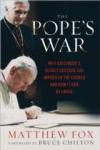
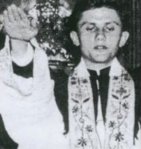
The Pope’s War begins with a young Joseph Ratzinger as a member of the Hitler Youth, chronicling his rise as the champion of an absolutist papacy. Matthew Fox reminds readers that God is the author of genuine Spirit-filled renewal within the ecumenical umbrella of a catholic church in his newly published book The Pope’s War: Why Ratzinger’s Secret Crusade Has Imperiled The Church And How It Can Be Saved (New York: Sterling Ethos, 2011. 279 pgs.). It would be easy to neglect his conclusions after several chapters describing a “dysfunctional organization” led for the most part by “religious thugs.”
How John Paul II and Benedict XVI Destroyed Vatican II
Fox takes the reader back to the pontificate of Pope John XXIII and the Vatican council’s emphasis on the role of the laity. For the church, it represented a breath of fresh air, an opening of windows now reclosed by Benedict and his predecessor. Much of the book details this conservative hard-line effort by Cardinal Joseph Ratzinger, the modern-day Inquisitor filled with rage.
Fox demonstrates how Liberation Theology became the byword for Marxism in under-developed countries like Peru and Brazil during the 1980s, equating social justice with social revolution. His examples are many, from the expulsion of the Maryknolls in Peru to the murder of Archbishop Oscar Romero.
Ads by Google
Watch Full Episodes Turn Your Computer into a TV! Watch Full TV Episodes Online. http://www.TelevisionFanatic.com
Earn an Evangelism Degree Top Online Schools with Programs in Evangelism and Church Planting! EarnMyDegree.com/Religious_StudiesIn a particularly painful chapter, Fox describes the extensive work of Father Jim Callan’s Corpus Christie Parish in Rochester, New York, shut down because of its inclusivity. Fox also recounts the silencing of Bishop Pedro Casaldaliga in the jungles of the Amazon. Writing about the bishop, Fox states that, “…he supports strongly the indigenous peoples of the rain forest and, of course, in doing so alienates those powerful forces bent on raping the rain forest for their personal and corporate profit.”
Roman Catholic Secrecy and Absolutism
Dan Brown’s Da Vinci Code (Doubleday, 2003) may have introduced millions of readers to Opus Dei, but Fox’s treatment explores the vast reaches of the ultra-secret organization and alleges a CIA connection. Fox writes about the “cultic worship” of its founder, Father Escriva, and comments that:
“There is a restriction of reading materials and no discussion of world religions. Mail is opened and confiscated. Surveillance of members was common, and microphones were placed in various rooms of residences, which were connected to Escriva’s room.” Yet Opus Dei was championed by John Paul II and Cardinal Ratzinger.
In another chapter, Fox explores the scandals and financial dealings of the Legion of Christ and its founder, Father Maciel. Once again, it was Cardinal Ratzinger who held up investigations for several years despite documented evidence of serious allegations forwarded to Rome on behalf of several victims. Fox also writes about Boston’s Cardinal Law, now an archpriest in Rome, who would probably have been indicted in Massachusetts had he not been posted to the Vatican with full immunity.
Read This Next
Hitler’s Youth: Joseph Ratzinger-Pope Benedict XVI Pope Benedict XVI Turns 81 Hitler, Pope Pius XII and the Rise of Nazi Germany The Need for another Reformation
Readers familiar with history may wonder if Benedict views himself as the 21st Century incarnation of Pope Innocent III – yet even Innocent recognized the true spirituality of St Francis, something Benedict would not, according to the book’s many examples.
In an interview with Spiegel (September 21, 2011), theologian Hans Kung states that, “Ratzinger’s predecessor, John Paul II, launched a program of ecclesiastical and political restoration, which went against the intentions of the Second Vatican Council.” This, in essence, is the neo-absolutism Fox details in The Pope’s War.
Fox proposes several reasons for Benedict’s reach into the medieval past, including “intellectual envy” and personal ambition. Fox asks, “Was Torquemada a theologian? He was a policeman, just like Ratzinger who will not be remembered as a theologian…”
Critics will argue that Fox, like Kung and many others, was silenced. That, however, does not lessen the impact of the examples used by Fox to prove his thesis. The book was written for all audiences – not merely Catholic theologians. It will appeal to people of all faiths and help to construct a rationale for the bizarre decisions of a modern pope who insists on functioning in a bygone century.
The Seeds of Reformation
Fox ends his book with observations, recommendations, and a return to “authentic” Christianity. In many ways, his final chapters act as a testament for the church; if the hierarchy does not confront and embrace change, it may not survive. This includes ending celibacy as a mandate, opening up the priesthood to women, and de-Romanizing the church itself.
Above all, Fox reminds readers that Christians are not part of an empire but are “in Christ.” No trappings of an absolute monarchy can substitute for the simplicity of the Gospel. Implicit in this reality is the challenge to be courageous despite threats of silencing or excommunication. The Gospel was never spread by timid disciples.
Matthew Fox was a Roman Catholic in the Dominican order; after his silencing by the Church and the loss of his ability to publish, he converted to Anglicanism and is a priest within that faith tradition. Fox, however, maintains his contacts and friendships within the circle of Catholic theologians and teachers.
Reference:
Martin Doerry, Ulricch Schwarz and Peter Wensierski, “A Putinization of the Catholic Church,” Interview with theologian Hans Kung on Pope Benedict, Spiegel, September 21, 2011
Read more at Suite101: The Pope’s War by Matthew Fox: a Review | Suite101.com http://michael-streich.suite101.com/the-popes-war-by-matthew-fox-a-review-a389907#ixzz1lWcHt9wC
Jon the Nazarite

 Rosamond Press
Leave a comment