 Racist Traitors claim slavery is ordained by God. When was this done?
The Celts enslaved fellow Celts – before they believed in God and Jesus. Black folks were not in the picture until Celtic slaves were dragged to Rome against their will. Here is Hill complaining about bad press just like Maggot Newt! Southerners have to believe folks don’t like them and their belive while only lifestyle because the press in controlled by minorities seeking entitlements.
“Hill’s league started out complaining about the media treatment of white Southerners, but quickly developed into a racist group calling for secession, attacking egalitarianism, calling antebellum slavery “God-ordained,” opposing racial intermarriage, and defending segregation as a policy designed to protect the “integrity” of both the black and the white races.”
So, when did God ordain the owning of slave by white devils who worshipped Pagan gods?
The only thing God ordained was that I study the Bible, and my sister marry into the Benton family who co-founded the Republican Abolitionist Party – that proved God did not ordain Slavery! Hill and Gingrich pretend to be scholars and historians. They are Born Liars that support a Church of Traitors bent on ruling America in the name of Jesus – Celtic Slave Owner!
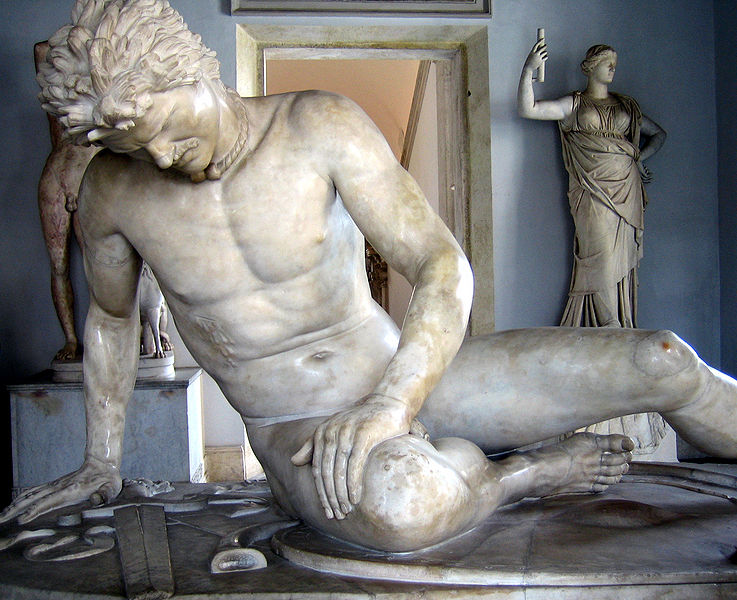
Above is the famous stature ‘The Dying Gaul’ who is a warrior-king taken hostage by Satanic Rosman Slave Masters.
Jon the Nazarite
Slavery, as practised by the Celts, was very likely similar to the better documented practice in ancient Greece and Rome.[64] Slaves were acquired from war, raids, and penal and debt servitude.[64] Slavery was hereditary[citation needed], though manumission was possible. The Old Irish word for slave, cacht, and the Welsh term caeth are likely derived from the Latin captus, captive, suggesting that slave trade was an early venue of contact between Latin and Celtic societies.[64] In the Middle Ages, slavery was especially prevalent in the Celtic countries.[65] Manumissions were discouraged by law and the word for “female slave”, cumal, was used as a general unit of value in Ireland.[66]
The league envisioned a seceded South that would be run, basically, as a theocratic state marked by medieval legal distinctions between different types of citizens, with white males at the top of the hierarchy.
Hill described the Pledge of Allegiance as “nationalist propaganda [meant] to indoctrinate” children with socialist ideas about government.
In light of another thread on the Druids, there was some debate as to whether Celts had slaves. From my understanding, Celts did have slaves. That said, reliable resources regarding the Celts are far and few between, but I have managed to pull a few sources that suggest that slaves were in fact a part of Celtic societies.
The distribution of Roman wine amphoras in Gaul has led to the belief that the Gauls sold their own people into slavery in the late second and first centuries B.C. in exchange for wine. In this way, possibly as many as 15,000 free Celts became slaves each year so that their families might indulge.
Source: Bradley, K. R., p.22 Slavery and Rebellion in the Roman World 140 B.C. – 70 B.C.
The Celts were organized loosely in tribes. Each tribe had a chief, nobles, freemen, and slaves. Usually they lived in a fortified village, often built on a hilltop, with fields and pastures outside. The tribes often fought each other. If one tribe conquered several others, its chief took the title of king.
Source: http://www.britannica.com/eb/article-9031248/Druid
The nobleman supported the client with gifts, that required repayment by loyal service. Unlike some societies, where slavery was hereditary, and there was no chance of future generations becoming free,the Celts’ slaves were captive foreigners without civil rights. They could always be freed, to become the client of the noble who had freed them.
Source: http://www.celticcallings.com/resources/index.htm
The greater part, when they are pressed either by debt, or the large amount of their tributes, or the oppression of the more powerful, give themselves up in vassalage to the nobles, who possess over them the same rights without exception as masters over their slaves. But of these two orders, one is that of the Druids, the other that of the knights.
Source: http://www.perseus.tufts.edu/cgi-bin/ptext?lookup=Caes.+Gal.+6.13
As you can see from the sources cited here, Celts appear to have engaged in the act of slavery, which is not really surprising, given social norms of the times.
To the extent that sources are available, they depict a pre-Christian Celtic social structure based formally on class and kingship. Patron-client relationships similar to those of Roman society are also described by Caesar and others in the Gaul of the 1st century BC.
In the main, the evidence is of tribes being led by kings, although some argue that there is also evidence of oligarchical republican forms of government eventually emerging in areas which had close contact with Rome. Most descriptions of Celtic societies portray them as being divided into three groups: a warrior aristocracy; an intellectual class including professions such as druid, poet, and jurist; and everyone else. In historical times, the offices of high and low kings in Ireland and Scotland were filled by election under the system of tanistry, which eventually came into conflict with the feudal principle of primogeniture in which succession goes to the first born son.
Little is known of family structure among the Celts. Patterns of settlement varied from decentralised to urban. The popular stereotype of non-urbanised societies settled in hillforts and duns,[62] drawn from Britain and Ireland (there are about 3,000 hill forts known in Britain)[63] contrasts with the urban settlements present in the core Hallstatt and La Tene areas, with the many significant oppida of Gaul late in the first millennium BC, and with the towns of Gallia Cisalpina.
Archaeological evidence suggests that the pre-Roman Celtic societies were linked to the network of overland trade routes that spanned Eurasia. Archaeologists have discovered large prehistoric trackways crossing bogs in Ireland and Germany. Due to their substantial nature, these are believed to have been created for wheeled transport as part of an extensive roadway system that facilitated trade.[67] The territory held by the Celts contained tin, lead, iron, silver and gold.[68] Celtic smiths and metalworkers created weapons and jewellery for international trade, particularly with the Romans.
The myth that the Celtic monetary system consisted of wholly barter is a common one, but is in part false. The monetary system was complex and is still not understood (much like the late Roman coinages), and due to the absence of large numbers of coin items, it is assumed that “proto-money” was used. This is the collective term used to describe bronze items made from the early La Tene period onwards, which were often in the shape of axeheads, rings, or bells. Due to the large number of these present in some burials, it is thought they had a relatively high monetary value, and could be used for “day to day” purchases. Low-value coinages of potin, a bronze alloy with high tin content, were minted in most Celtic areas of the continent and in South-East Britain prior to the Roman conquest of these lands. Higher-value coinages, suitable for use in trade, were minted in gold, silver, and high-quality bronze. Gold coinage was much more common than silver coinage, despite being worth substantially more, as while there were around 100 mines in Southern Britain and Central France, silver was more rarely mined. This was due partly to the relative sparcity of mines and the amount of effort needed for extraction compared to the profit gained. As the Roman civilisation grew in importance and expanded its trade with the Celtic world, silver and bronze coinage became more common. This coincided with a major increase in gold production in Celtic areas to meet the Roman demand, due to the high value Romans put on the metal. The large number of gold mines in France is thought to be a major reason why Caesar invaded.
The Dying Gaul, a Roman marble copy of a Hellenistic work of the late 3rd century BC Capitoline Museums, RomeThere are only very limited records from pre-Christian times written in Celtic languages. These are mostly inscriptions in the Roman and sometimes Greek alphabets. The Ogham script, an Early Medieval alphabet, was mostly used in early Christian times in Ireland and Scotland (but also in Wales and England), and was only used for ceremonial purposes such as inscriptions on gravestones. The available evidence is of a strong oral tradition, such as that preserved by bards in Ireland, and eventually recorded by monasteries. The oldest recorded rhyming poetry in the world is of Irish origin[69] and is a transcription of a much older epic poem, leading some scholars to claim that the Celts invented rhyme. Celtic art also produced a great deal of intricate and beautiful metalwork, examples of which have been preserved by their distinctive burial rites.

 Rosamond Press
Leave a comment