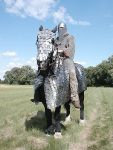



“When you see a Parthian charger tied up to a tomb-stone in Palestine, the hour of the Messiah will be near”.
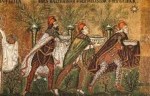
The Roman wolves and slave masters were enslaving the world. King Cyrus the Great was titled a Messiah by the Jews, this king of kings having his own vision of a One World that included the building of the temple. Mithradates had made an alliance with the rulers of China, from where some of the Magi hail? Is the Pope in Rome all for the building of a new temple?
Roman dogs were defeated by the Parthian calvary, forcing the wolves to form their own calvary. Why didn’t Jesus of Nazareth take on the enemies of the abolitionist God of the Jews like Bar Kohba did? His coin depicts a bright star over the temple he built after Rome destroyed the temple in 70 A.D.
The evangelicals depict Jesus as a bringer of death and destruction, he coming back to slaughter tens of thoudands of folks who the evangelicals point out as their enemy – after they have been rendered politically impotent in the the world’s most successful democracy.
“The tomb of Esther and Mordechai still stands to this day in Hamadan, the site of the ancient city of Ecbatana, a city that has hosted Jews for over 2500 years. The Persian king Xerxes himself was married to a Jewish queen named Esther.”
Jon Presco
The greatness of Mithradates II the Great can be judged from the attitude of the other great empires towards him. About 115 BCE he received an embassy from the Emperor of China and the two rulers concluded a treaty designed to facilitate the movement of international commerce, in which Iran, as a transit state, formed a vitally important link. He also brought back Armenia within the Iranian sphere of influence. The parts played by Mithradates I and Mithradates II in the Iranian Empire may be likened respectively to those of Cyrus the Great and Darius the Great. The former ruler was responsible for its territorial expansion, while the latter consolidated and organised what had been won. Mithradates II the Great made Iran back into a world power, and its relations with Rome in the west and China in the east show the importance of the position it occupied in the political and economic life of the contemporary world. Emperor Mithradates II gave formal expression to the increase in his power by assuming the title of Shahanshah “King of Kings”;
The Iranians were entered into negotiations with Rome and accepted to be neutral in the Roman wars against Armenia. However, the Romans, in their pride and ignorance, continued to show little regard for the Parthian Emperors, who had kept their pledges scrupulously. Pompey violated the Parthian-Roman peace treaty, seized the western provinces of Parthia, intrigued with its vassal princes and insulted the Parthian emperor, Phraates II, the Romans behaved unscrupulously and without shame. For example, when after the death of Phraates II, Mithradates III wanted to seize the Parthian throne from Orodes II, Gabinius agreed to assist him in return for a large sum of money. However, he turned against him because he accepted the offer of a larger amount of money from another pretender.;
The greed of the Roman leaders reached its apogee when Crassus was made pro-consul of Syria. It is true that the Roman senate had no desire for a war with Iran. Crassus, on the other hand, believed that the conquest of Iran would be an easy victory and would yield a rich booty. Thus was joined the battle between the Romans and the Iranians. The Iranian heavy cavalry commanded by Eran-Espahbet Rostaham Suren-Pahlav, smashed the Roman army and killed and captured three-quarters of the forces of Crassus. Crassus himself paid for the disaster with his own life and that of his son. In this battle, fought at Carrhae in 53 BCE, the combined Iranian forces of heavy cavalry and mounted bowmen carried the day and proved superior to the Roman army, which had no mounted formations. The Battle of Carrhae forced Rome to introduce cavalry into its army, just as nearly a thousand years earlier the first Iranians to reach the plateau had induced the Assyrians to introduce a similar reform.
The shock of the Iranian victory opened the eyes of Rome to the real strength of Iran – a superpower whose policy was defensive rather than offensive. The Iranians carried away the Roman eagles of the legions of Crassus, and these remained only in the Arsacid temples. Once again Iran had forcibly thrown back from its frontiers the Hellenism to which the Romans claimed to be the heirs. The consequence was that for a whole century the Iranian frontiers on the Euphrates remained inviolate, and not only the Iranians, but the western Semitics, such as the Jews of Palestine, the Nabateans of Damascus, the Arabs of the desert, and the inhabitants of Palmyra, looked with hope to Iran where the Parthian dynasty appeared as true successors of the Achaemenians. They felt that they were to have their revenge on the Romans through the Iranian horsemen, whose coming to defeat the Roman beast was foretold in the Apocalypse.
Except the Zoroastrian religion the Iranians were worshipping the two deities; Anahita (Ânâhitâ) and Mithra. Anahita, who enjoyed most popularity beyond the western frontiers of Iran, which her cult spread to Lydia, where she was called ‘the lady of Bactria’, to Pontus, Cappadocia and Armenia. But Mithra, was even more popular than Anahita, which the pirates captured by Pompey took to Rome, whence it was carried by the Roman armies as far as the Rhine, Danube and Brittany.
Arsacid dynasty, who like the Kushans, sprang from the nomadic Iranian peoples of Central Asia, were very tolerant of foreign religions. In Mesopotamia, they adopted the cults of the country they conquered, though they modified them and gave them a slightly different aspect. They do not seem to have encouraged proselytising among the conquered peoples. Among the many sanctuaries excavated at Dura-Europos in Syria, which long remained an advance post of the Iranian Empire, not a single fire temple was discovered, although there was an important Iranian territory in this trading centre. The tolerance of the Iranians was particularly evident in their relations with the Jews. Having been oppressed by the Seleucids and the Romans, they believed that Iran was the only great power capable of delivering them from the foreign yoke, as it had done once before in the Achaemenian period. The Parthian dynasty role in the liberation of the Jews gave rise to the well-known saying:
“When you see a Parthian charger tied up to a tomb-stone in Palestine, the hour of the Messiah will be near”.
When Cyrus defeated King Nabonidus of Babylon, he officially declared the freedom of the Jews from their Babylonian captivity. This was the first time in history that a world power had guaranteed the survival of the Jewish people, religion, customs and culture. Cyrus allowed the Jews to rebuild their Temple and provided them with funds to do so. The empire continued that support as indicated by a decree by Darius the Great in 519-518 BC by allowing the Jews to complete the reconstruction of the Jerusalem Temple (Ezra, 4:1). Cyrus’ magnanimity is reflected in the Old Testament where he is cited as Yahweh’s anointed (See Book of Ezra 1). Koresh (Hebrew for Cyrus), was hailed as a Messiah by the Jews. Isaiah cites Cyrus as “He is my Shepherd, and he shall fulfill all my purpose” (Isaiah, 44.28; 45.1). The Biblical characters Ezra, Daniel, Esther and Mordecai played historically important roles in the Persian court. The tomb of Esther and Mordechai still stands to this day in Hamadan, the site of the ancient city of Ecbatana, a city that has hosted Jews for over 2500 years. The Persian king Xerxes himself was married to a Jewish queen named Esther.

 Rosamond Press
Leave a comment