
What is God doing? What is his motive in having John KNOW THE WORD while in his mother’s womb, thus, HE KNOWS LIFE BEFORE BIRTH! If there is life before birth, then there is life after death? Who on earth has ever asked this question? Surely the Pope’s priests cite these paasages when they make holy laws against abortion? Then – maybe not!
Did not my father claim I was a bastard? All members of my family who have cast me out of my family, do not believe in God. However, they want what I have, they percieving their is a heavenly spirit in me, but, they do not want the Word of God. So they take the gift I brought, and made me an orphan in the world……….for my light broadcast their sins.
Here is Meher Baba’s message via an alphabet board he observing silence until he speaks THE WORD.
Jon Presco
“Why did Jesus say different things? Owing to the time and the people, according
to their readiness to listen and understand. What Jesus meant was to leave all
and follow him. That means to know him, see him, experience him.
The teachings that are being followed by Christians are not the real teachings
Christ gave. The priests have altered his words, added to his teachings, and
spoiled them.”
Does not it stand to reason the Aaronoid and Mosaic Priests pray for a immaculate and pur birth via the Holy Spirit that dwell in the Holy of Holies to GIFT them with a pure child that can SPEAK PERFECT TORAH just after birth so no elder priest can have a chance to spoil the Unspoiled Words of God, as they art written and spoken in heaven? What a perfect way to lay to rest acient arguments so there might be Peace on Earth amongs the Children of God.
Was I born to speak perfect Torah?
Jon the Nazarite
23 August 1925, Meherabad, LM3 p752
If poor God were only to sit in heaven like a thief, then he must be pitied. If
Jesus said that God is in heaven, then he was not the Christ. But I know that he
was Perfect and divine, God incarnate, and never meant that.
What did Jesus really say? To the multitude, he said, ‘God is in heaven. Try to
go there.’ And to reach that end, he said to overcome certain temptations and
sufferings.
To his followers, he said, ‘God is everywhere. Try to see him.’ And he gave
explanations to that effect.
To the close circle of apostles, he said, ‘God is in me, and in you too,’ and
actually revealed this to them.
Why did Jesus say different things? Owing to the time and the people, according
to their readiness to listen and understand. What Jesus meant was to leave all
and follow him. That means to know him, see him, experience him.
The teachings that are being followed by Christians are not the real teachings
Christ gave. The priests have altered his words, added to his teachings, and
spoiled them.
From July 10, 1925 until his death in 1969, Meher Baba was silent.[6][32] He communicated first by using an alphabet board and later by unique hand gestures which were interpreted and spoken out by one of his mandali, usually by his disciple Eruch Jessawala.[5] Meher Baba said that his silence was not undertaken as a spiritual exercise but solely in connection with his universal work.
Man’s inability to live God’s words makes the Avatar’s teaching a mockery. Instead of practicing the compassion he taught, man has waged wars in his name. Instead of living the humility, purity, and truth of his words, man has given way to hatred, greed, and violence. Because man has been deaf to the principles and precepts laid down by God in the past, in this present Avataric form, I observe silence.[33]
From 1925 until 1954 Meher Baba communicated by pointing to letters on an alphabet board.
Meher Baba often spoke of the moment “that he would ‘break’ his silence by speaking the ‘Word’ in every heart, thereby giving a spiritual push forward to all living things.”[34]
When I break My Silence, the impact of My Love will be universal and all life in creation will know, feel and receive of it. It will help every individual to break himself free from his own bondage in his own way. I am the Divine Beloved who loves you more than you can ever love yourself. The breaking of My Silence will help you to help yourself in knowing your real Self.[35]
Meher Baba said that the breaking of his silence would be a defining event in the spiritual evolution of the world.
When I speak that Word, I shall lay the foundation for that which is to take place during the next seven hundred years.[36]
ELIZABETH and the definition of this name “the
oath of God”.
Elizabeth was the wife of Zachariah and the mother of John the
Baptist. Elizabeth, or Elisheba, was the wife of Aaron. It is being
deduced that John was conceived on Yom Kippur `The Day of Atonement’
or just after. Zachariah was in the temple on Yom Kippur when an
angel appear to him and told him Elizabeth’s womb that was shut,
would now be opened. If the childless Elisheba’s womb were opened at
the moment Israel was forgiven of its collective sins, then, John
would be BORN WITHOUT SIN, even the original sin. To make sure this
was the case, the angel bid EVERYONE who came near John to observe
silence, take a OATH of silence. This was done because John was going
to be born on Passover, the day it was foretold Elijah would be BORN
AGAIN.
Every Jewish male born is a candidate for the SECOND COMING of
Elijah. For this reason the eight day old child is circumcised
in `Elijah’s Chair’. It was believed that while in the womb an angel
teaches the unborn child the Torah, and just before birth, the angel
touches the child’s lips with his forefinger, and the child forgets
all knowledge of the Torah. But, this would not be the case with the
return of Elijah who will emerge from his mother’s womb with perfect
understanding of the Torah, not only in its written form, but in the
spoken form known as the Talmud. It was for this reason Zachariah,
the priest, took a vow of silence, and his wife and kin, as John’s
parents are descended from Aaron and Moses, and thus the Levite
priesthood. Elisheba is titled a “daughter of Aaron”. For the reason
the Torah has been altered, and some very important meanings lost, it
was concluded the only hope of SALVATION for the Lord’s chosen
children, was the RESTORATION of the true Torah.
One has to inquire as to why priests would come to name Zachariah’s
son. A child is usually named after a deceased relative. When the
name John is given, a priest remarks “there is no one in your family
with that name.” There is an argument of sorts, which is crucial, for
I believe it is the newborn child WITHOUT SIN who names himself. I
believe he SIGNED with his fingers, then wrote on a slate “I am
Elijah”. This done, this child began to interpret Talmud, then
prophesize.
After I described the contents of the apple to my daughter Heather, I
told her that she knew I was a father long before I did. I told her I
bought this apple in a Goodwill store around 1997 in the hope the
three Seers at the Berkeley Psychic institute told me in 1987 I had
two children. I had four months sobriety. In 1990 I wrote on a piece
of paper “I am a Nazarite”. I then Baptized myself in the McKenzie
River near Blue River Oregon. John the Baptist was a Nazarite for
life, he filled with the Holy Spirit while in Elizabeth’s womb. Here
is Elizabeth’s full name; ELISHEBA-MIRIAM.
This name means “God’s oath of the bitter waters.” This name was
given because Elisheba descends from a long line of NAZARITE WOMEN
who married LEVITE PRIESTS and begot them goodly, even Godly sons.
One could call them “SONS OF GOD” for they were born of women who
were advanced in years and had their shut wombs opened after they
took the Nazarite vow. In some cases (if not all) they took the test
of the Sotah, a woman accused of adultery so as to clear their name.
The name of God was written in dust or on a piece of paper, then
dissolved in a cup of water. The accused woman would swear SEVEN
OATHS that she was innocent. If she was not, her belly would burst
and she would die.
The mother of Samuel the Nazarite swore seven oaths and drank the
BITTER WATERS. She knew she was faithful to her husband, but dearly
wanted a child. She tricked a priest into administering the test of
the Sotah, for if a barren and childless woman took the test, and was
found innocence, then God in His mercy would beget her with child. As
I have already revealed, the SAVIOR administered this test to a woman
accused of adultery. I hereby identity this woman as Mary Magdalene.
who swore SEVEN OATHS, rather then seven demons or devils.
My mother told me since I can remember that I was born on Yom Kippur
during a star-shower. Two years ago I Googled in search of this star-
shower, and found the Dracnoids that caused thousands of stars to
fall to Earth on October 8, 1946, three days after Yom Kippur.
Next, I will take you to the scene of Moses being born out of the
water after being hid from the Pharough who threatened to kill all
the Jewish male children. Mary and Elizabeth are said to have hid
their newborn sons from King Herod after one of the Magi told him of
the star and the prophecy. There is much evidence this never took
place. However, this is very applicable to John and his Levite
liniage which had every intnention of borning a Savior of the Levite
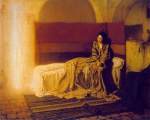
Priesthood, which Jesus ignores. Did an angel really visit Jesus’
mother? Did Jesus really exist, or is he a usurping myth?
Jon Presco
Copyright 2006
1. Jesus’ cousin, John the Baptist, was conceived shortly after Yom Kippur (the Day of Atonement, Tishri 10) and born approximently 40 weeks later in the Jewish (lunar) month of Tammuz (June/July).
2. John’s father (Zacharias) was a Levite who was assigned to serve in the temple during the course of “Abia,” (Luk 1:5) the 8th of 24 courses (1Ch 24:10). Each course served for one week, Sabbath to Sabbath. Thus, each priest served twice a year, plus at each of the three Pilgrimage Feasts (the red feasts in the figure, above).
1. During the First Century, the cycle of service was such that the first course served in the second week of Av, thus the actual time the 8th course was serving was during the second week of Tishri (on the Jewish lunar calendar, months average 29.5 days long).
2. This places Zacharias’ service in the Temple as during the High Holiday of Yom Kippur (Sep/Oct), and this agrees with the description given about how Gabriel spoke to Zacharias in the narrative (Luk 1:8-23).
3. It is written that John was conceived shortly after this tour of duty (Luke 1:23-4), in the third week of Tishri, perhaps even on 17 Tishri. Therefore, John the Baptist would have been born on (approx.) the 13th of Tammuz (June/July).
4. Jesus was conceived near the beginning of Nisan (Mar/Apr), and born 40 weeks later during late December.
5. Jesus was conceived in the sixth month of Elizabeth’s pregnancy (Luke 1:24-27, 36). This could have been anywhere from late-Adar to late-Nisan (March). Early tradition places Mary’s conception on 17 Nisan / March 20, but this is only proverbial. (The Catholic Church still celebrates it as the Annunciation, on March 25.) Nine Months later, Jesus was born — in mid-Tevet / late December.
The angel Gabriel appeared to the priest Zechariah as he was burning incense in the Temple and announced to the old priest that his wife was to bear a son in her old age who would be filled with the Holy Spirit from his mother’s womb (Luke 1:8-11). It was shortly after this announcement that St. John the Baptist, the precursor of Christ, was conceived. Many biblical scholars, both ancient and modern, believe Zechariah’s service in the Temple was associated with an Old Covenant feast day of national repentance called Yom Kippur (Day of Atonement) and that he was the officiating High Priest offering the incense when the angel announced the birth of St. John. St. John’s mission was to call the covenant people to national repentance and he began his mission on or near his 30th birthday. Only the anointed High Priest was to offer the sacrifices on Yom Kippur, but it was unlikely that Zechariah was the officiating High Priest during the Feast of Yom Kipper in the year 4/3 BC since there are comprehensive lists of all the ordained High Priests who served in the Jerusalem Temple from the 2nd century BC to the destruction of the Temple in 70AD, and a priest named Zechariah is not listed. It is, however, likely that Zechariah was the officiating priest performing the rite of burning the sacred incense on the golden Incense Altar in front of the Holy of Holies during the daily service of the sacrifice of the Tamid lambs on the day of Yom Kippur or near to the time of Yom Kippur (the High Priest offered the incense at only one service).
In the 1st century BC, at the time the priest Zechariah, father of John the Baptist, lived and served Yahweh in his priestly duties, there were about 20,000 priests throughout the country’far too many to minister in the Temple at one time. Since the time of King David, the chief priests had been divided into twenty-four separate groups called “courses” that may have been twenty-four families or clans, all of whom were descended from Aaron, the first High Priest. Each group, according to King David’s directions (1 Chronicles 24:3-19) took turns serving for a week in the Temple with the exception of the three pilgrim feasts (Exodus 23:14-19; Deuteronomy 16:16; 2 Chronicles 8:13) when the service of all the courses of the chief priests and the Levites (lesser ministers) were required at the Temple. During the two regular daily worship services, lots were drawn to assign the priestly duties. The priest Zechariah was a member of the Abijah division, on duty that eventful day recorded in the Gospel of St. Luke chapter 1. Each morning and afternoon (their “evening” was our afternoon since their day ended at sundown) a priest was to enter the Holy Place in the Temple and burn incense during the daily liturgy of the Tamid sacrifice (Exodus 29:36-42). The third daily lot cast decided who would enter the sacred room, and on this particular day the lot fell to Zechariah.
The drawing of the lot to burn the sacred incense was a once in a life time opportunity for Zechariah. Only a priest who had never been chosen to burn the incense could participate in the drawing of the third lot, but Zechariah’s selection was not a chance occasion. God was guiding the events of history to prepare the way for Jesus, the last lamb of sacrifice, the final sacrifice of atonement, to come to earth and to offer Himself for the sins of mankind. And that brings us to the phrase in the Gospel of St. Luke that reads …all the assembled worshipers were praying outside (Luke 1:10). Some scholars assume that this phrase refers to the gathering of the faithful at the Temple during the offering of the incense on Yom Kippur, but this assumption ignores the fact that twice a day in the Temple, during the most holy part of the worship service, the priest chosen for the honor burned the incense. As the holy smoke carried their prayers to heaven, the congregation gathered in the courtyard prostrated themselves facing the Sanctuary and prayed in silence.
Some biblical scholars focus on the day of Yom Kippur in association with Zechariah’s revelation because it was the only Jewish annual feast when the High Priest offered both incense and sacrificial blood on the Altar of Incense. But this assumption ignores the fact that Yom Kippur was not the only day a priest burned incense on the Altar of Incense, and St. Luke’s account does not identify Zechariah as an anointed High Priest nor does the Gospel record mention Zechariah smearing blood on the horns of the Incense Altar. On the day of Yom Kippur a great crowd of worshipers would be praying outside the Temple and facing the Holy Place as the anointed High Priest offered incense and smeared the blood of the sacrificed animal on the horns of the golden altar of incense (Leviticus 16:2-4, 11-17). These scholars are assuming that Zechariah was the anointed High Priest officiating on Yom Kippur. But, as we have noted since there are lists of the Jewish High Priests from the time before the reign of King Herod to the destruction of the Temple in 70AD, and Zechariah is not listed as an anointed High Priest on any of those lists, it is unlikely that he was offering incense as the High Priest. Instead, it is more likely that Zechariah was offering incense during either the morning or the afternoon daily liturgy of the Tamid sacrifice. In the offering of the daily Tamid lamb (one in the morning liturgical service and a second at an afternoon worship service at about 3PM), when the incense was offered the people turned toward the Sanctuary and prostrated themselves in prayer as a profound silence filled the Temple. With the exception of the offering of incense during Yom Kippur, there was no other time when a priest came into such close proximity with the presence of God in the Jerusalem Temple. Perhaps Zechariah was offering incense during the daily Tamid worship service either immediately before or immediately after the liturgical service on the annual day of Yom Kippur, or he was offering the incense during a daily liturgy on a day that was near to Yom Kippur. No matter how important an annual feast, it could not take precedence over the Tamid sacrifice which had to be offered twice daily so long as the Sinai Covenant between God and Israel endured (Numbers 28:11; Mishnah: Yoma, 2:4). If John was conceived in the early fall, around the time of Yom Kippur, his birth would be nine months later in the summer.
Biblical scholars have noted that St. John’s statement that he must grow less as Jesus grew greater in John 3:30 was illustrated in the traditional dates which the Church celebrates as the dates of their births, with St. John’s birth coming after the summer solstice as the days of the year grow shorter and Jesus’ birth coming just after the winter solstice as the days of the year grow longer. If this is a clue from St. John recorded in John 3:30 that could be applied to their births, John’s conception had to occur nine months earlier in the fall and Jesus’ conception six months later in the spring.
Linking Yom Kippur to the announcement of John’s birth is significant. The Old Covenant feast day of atonement is a time of national repentance. This was to be John the Baptist’s mission; he was to prepare the way for the Messiah by calling the entire covenant people to a baptism of repentance for sin. In the book of Leviticus, Yahweh commanded that this feast was …to be a lasting ordinance for you: On the tenth day of the seventh month you must deny yourselves and not do any work…[..]. Because on this day atonement will be made for you to cleanse you. Then, before Yahweh, you will be clean from all your sins (Leviticus 16:29-30). According to the Jewish liturgical calendar this day of national repentance had to fall prior to the autumn equinox; the next Jewish feast, the Feast of Tabernacles (Sukkot), had to fall five days after Yom Kippur during the full moon either on or the first full moon after the autumnal equinox (the date of the autumn equinox is September 23rd according to our modern calendar). Since it has long been a tradition in the Church that the angel came to the priest Zechariah at a time association with the Old Covenant feast of Yom Kippur, it is interesting that the Church has for centuries celebrated the feast of St. John the Baptist on the day of his birth which the Church has determined is June the 24th (only St. John, Jesus, and the Virgin Mary have feast days associated with their births). If John’s birth occurred on June 24th, according to the Church’s liturgical calendar, then his conception would have been nine months earlier in September, near the time of the observance of the Feast of Tabernacles and just after Yom Kippur.
But how does that information help to determine the birth of Jesus? When the angel Gabriel came to Mary he informed her that her cousin Elizabeth was already six months with child: Even Elizabeth your relative is going to have a child in her old age, and she who was said to be barren is in her sixth month (Luke 1:36). Six months from the autumnal equinox on September 23rd, by our calendar, gives us a date of March 23rd . The Church celebrates the Annunciation March 25th, very close to the spring equinox. When you add nine months to March 25th you have December 25th as the birth of our Savior. Is it a coincidence that all these significant dates associated with St. John and Jesus fall near the year’s four divisions? No, our seasons and the momentous events associated with the coming of our Savior are all part of God’s great plan since the creation of the world. Our seasonal divisions were established after the Flood (see Genesis 8:22) and the cycles of the moon determined the Old Covenant liturgical calendar.(1)
There is one more piece of evidence that may support the theory that the Church used this information to determine the birth of Jesus. According to the Fathers of the Church there was a tradition that Jesus died on the cross on the same day of the year that he was conceived by the Holy Spirit. Jesus died on the Feast of Passover, which falls during the first full moon after the spring equinox (end of March or early April is the yearly spread in calculating the date according to the moon’s cycle), and the Feast of the Annunciation has always celebrated in the Church on March 25th!
If the Church has determined that Jesus was born December 25th, why is it that the beginning of our civil calendar year, calculated by a Catholic Abbot in the 6th century AD (our liturgical year begins at Advent in early December), begins on January 1st? In 525AD mathematician, Abbot Dennis the Short, rejected the old Roman calendar which was dated from the founding of the pagan city of Rome and established a new calendar, which he dated from what he calculated as the year of the birth of Christ (designated as year 1 Anno Domini= “in the year of our Lord”). He decided to date the beginning of the civil calendar year with Jesus’ entrance into the Old Covenant faith according to the Old Covenant Law. This event was commanded, since the time of God’s covenant with Abraham, to take place eight days after the birth of a male child (Genesis 17:9-12; 21:2-4). Counting December 25th as day one, which was the ancient custom since there was no concept of 0-place value, the eighth day was January 1st.(2)
It is a shame that the calculations Dennis used to date the year of Jesus’ birth no longer survive. Other Christian scholars disagreed with Dennis’ year of birth calculations for Christ, supporting instead the testimony of Fathers of the Church like St. Clement of Alexandria (3rd century AD) and Bishop St. Eusebius of Caesarea in the Holy Land (4th century AD). Both these early Church Fathers agreed that Jesus was born three years earlier (see Clement of Alexandria’s Stomata, I and Eusebius’ History of the Church chapter 5). Eusebius wrote in his Church History: It was in the forty-second year of the reign of Augustus and the twenty-eighth after the subjugation of Egypt and the death of Antony and Cleopatra. These calculations place Jesus’ birth in 3BC (BC = Before Christ). Eusebius was dating Augustus’ reign from the death of Julius Caesar, in our time = 44BC and the deaths of Antony and Cleopatra in 30AD, our time. Dates before the year 1BC and 1AD (the year designated by Dennis the Short as the year of Christ’s birth) are counted in greater numbers counting backward from Christ’s birth and in greater numbers counting forward from His birth. There is no year 0. In calculating the dates of ancient times it is important to remember that it was not until the Middle Ages that the mathematical concept of a 0-place value was introduced into the West, and this concept was not employed in Jesus’ time, therefore, in counting sequences in ancient times the count always including the first in the sequence as #1. This was why Sacred Scripture records Jesus was in the tomb for three days instead of two days from Friday to Sunday (Luke 24:7, 46; Acts 10:40).

 Rosamond Press
Leave a comment