
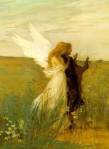
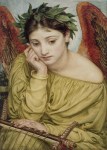
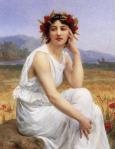
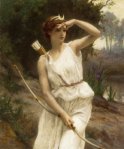
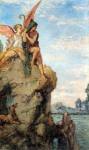
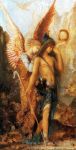
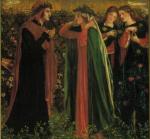

When Christine and Vicki bonded with the Dundon brothers, I knew what they really wanted. They wanted to be healed of their family wounds and began to employ my sisters to that end. They ripped our bonds appart. As sucessful as Christine was, she never left the distructive dynamics of her family, because she was wounded. She brought our father and mother into her Art Business in order to be incontrol of the family chaos that had all but destroyed her. Art saved her – my art…………………My Healing Muse!
In 1969 I discovered the Pre-Rapahelits and the Rossetti family. I was looking for a Spritual Vehicle for my Art, that I was considering giving up for a spiritual Life. I was considering going to India. When Rena Christiansen walked into my life, I had found my Great Muse, my Pre-Raphaleite Lady, that would help me find the Holy Grail, for the Grail was a common subject of the Pre-Raphaelites, and the Nazarene Artists who inspried them. I let my hair grow long, as Rossetti and his good freind, Swineburne, had in emulating the Nazarites. I considered myself a Nazarite-Nazarne Pre-Raphaelite.
The firt paiting I did of Rena was done in Boston in 1979 in the Pre-Raphelite style. When Christine saw the second painting I did of Rena in 1971, she was inspired to take up art.
When I brought my beautiful girlfreind, Gloria Ehlers to meet Vic, he took a liking to her. He began to call late when he was drunk. Gloria had trouble sleeping, and was the one to answer the phone. A month later, Gloria tells me I have to stop my father from calling, because he is coming on to her. The next time he called, I had Gloria wake me. I told him his behavior was abusive.
“What are you going to do – kick your old man’s ass? You’re not man enough!”
“I’ll be right there!”
I will speak of the time I almost got shot by the Deputy Sherrif as I crawled in my fahtwer’s window, he not man enough to come outside so I could kick his ass.
I have always sought, and found my Muse outside my family, for these wounded women had taken me hostage, and would not let me go. My mother and father never met Rena. Rosemary beat up Marilyn when she tried to break my mother’s hold on me. The meeting of Rena and Rosamary will now take place in a Kingdom I must return to, for she calls to me, she knowing, that in this cruel world, I am all alone!
My beloved sister Christine no longer has need for my Muse, for she has gone to their Great Museum. However, my nieces need to make a bond with their Healing Muse – and take our great endeavor, forward
Jon Presco
2011
Rossetti’s Muse
As Siddal came from a working-class family, Rossetti feared introducing her to his parents. “Lizzy” was also the victim of harsh criticism from Rossetti’s sisters. The knowledge that the family would not approve the wedding contributed to Rossetti putting it off. Siddal also appears to have believed, with some justification, that Rossetti was always seeking to replace her with a younger muse, which contributed to her later depressive periods and illness.
Rossetti’s relationship with Siddal is also explored by Christina Rossetti in her poem “In an Artist’s Studio”:
One face looks out from all his canvases,
One selfsame figure sits or walks or leans:
We found her hidden just behind those screens,
That mirror gave back all her loveliness.
A queen in opal or in ruby dress,
A nameless girl in freshest summer-greens,
A saint, an angel — every canvas means
The same one meaning, neither more nor less.
He feeds upon her face by day and night,
And she with true kind eyes looks back on him,
Fair as the moon and joyful as the light:
Not wan with waiting, not with sorrow dim;
Not as she is, but was when hope shone bright;
Not as she is, but as she fills his dream.
From Wikipedia, the free encyclopedia
Jump to: navigation, search
Proserpine, by Dante Gabriel Rossetti
The Pre-Raphaelite Brotherhood (also known as the Pre-Raphaelites) was a group of English painters, poets, and critics, founded in 1848 by William Holman Hunt, John Everett Millais and Dante Gabriel Rossetti. The three founders were soon joined by William Michael Rossetti, James Collinson, Frederic George Stephens and Thomas Woolner to form a seven-member “brotherhood”.
The group’s intention was to reform art by rejecting what they considered to be the mechanistic approach first adopted by the Mannerist artists who succeeded Raphael and Michelangelo. They believed that the Classical poses and elegant compositions of Raphael in particular had been a corrupting influence on the academic teaching of art. Hence the name: Pre-Raphaelite. In particular, they objected to the influence of Sir Joshua Reynolds, the founder of the English Royal Academy of Arts, whom they called “Sir Sloshua”. To the Pre-Raphaelites, according to William Michael Rossetti, “sloshy” meant “anything lax or scamped in the process of painting … and hence … any thing or person of a commonplace or conventional kind”.[1] In contrast, they wanted to return to the abundant detail, intense colours, and complex compositions of Quattrocento Italian and Flemish art.
The Pre-Raphaelites have been considered the first avant-garde movement in art, though they have also been denied that status[citation needed], because they continued to accept both the concepts of history painting and of mimesis, or imitation of nature, as central to the purpose of art. However, the Pre-Raphaelites undoubtedly defined themselves as a reform-movement, created a distinct name for their form of art, and published a periodical, The Germ, to promote their ideas. Their debates were recorded in the Pre-Raphaelite Journal.
Contents
1 Beginnings of the Brotherhood
2 Early doctrines
3 Public controversies
4 Later developments and influence
5 List of artists
5.1 The Pre-Raphaelite Brotherhood
5.2 Associated artists and figures
5.3 Loosely associated artists
6 Collections
7 Portrayal in popular culture
8 Books
9 See also
10 Notes
11 References
12 External links
[edit] Beginnings of the Brotherhood
Illustration by Holman Hunt of Thomas Woolner’s poem “My Beautiful Lady”, published in The Germ, 1850
The Pre-Raphaelite Brotherhood was founded in John Millais’s parents’ house on Gower Street, London in 1848. At the initial meeting, John Everett Millais, Dante Gabriel Rossetti, and William Holman Hunt were present. Hunt and Millais were students at the Royal Academy of Arts. They had previously met in another loose association, a sketching-society called the Cyclographic Club. Rossetti was a pupil of Ford Madox Brown. He had met Hunt after seeing his painting The Eve of St. Agnes, which is based on Keats’s poem.[2] As an aspiring poet, Rossetti wished to develop the links between Romantic poetry and art. By autumn, four more members had also joined, to form a seven-member-strong Brotherhood. These were William Michael Rossetti (Dante Gabriel Rossetti’s brother), Thomas Woolner, James Collinson, and Frederic George Stephens.[2] Ford Madox Brown was invited to join, but preferred to remain independent. He nevertheless remained close to the group. Some other young painters and sculptors were also close associates, including Charles Allston Collins, Thomas Tupper, and Alexander Munro. They kept the existence of the Brotherhood secret from members of the Royal Academy.
[edit] Early doctrines
The Brotherhood’s early doctrines were expressed in four declarations:
1. to have genuine ideas to express
2. to study Nature attentively, so as to know how to express them
3. to sympathise with what is direct and serious and heartfelt in previous art, to the exclusion of what is conventional and self-parodying and learned by rote
4. most indispensable of all, to produce thoroughly good pictures and statues
These principles are deliberately non-dogmatic, since the Brotherhood wished to emphasise the personal responsibility of individual artists to determine their own ideas and methods of depiction. Influenced by Romanticism, they thought that freedom and responsibility were inseparable. Nevertheless, they were particularly fascinated by medieval culture, believing it to possess a spiritual and creative integrity that had been lost in later eras. This emphasis on medieval culture was to clash with certain principles of realism, which stress the independent observation of nature. In its early stages, the Pre-Raphaelite Brotherhood believed that their two interests were consistent with one another, but in later years the movement divided and began to move in two directions. The realist-side was led by Hunt and Millais, while the medievalist-side was led by Rossetti and his followers, Edward Burne-Jones and William Morris. This split was never absolute, since both factions believed that art was essentially spiritual in character, opposing their idealism to the materialist realism associated with Courbet and Impressionism.
The Pre-Raphaelite Brotherhood was greatly influenced by nature and they used great detail to show the natural world using bright and sharp focus techniques on a white canvas.In their attempts to revive the brilliance of colour found in Quattrocento art, Hunt and Millais developed a technique of painting in thin glazes of pigment over a wet white ground. They hoped that in this way their colours would retain jewel-like transparency and clarity. This emphasis on brilliance of colour was in reaction to the excessive use of bitumen by earlier British artists, such as Reynolds, David Wilkie and Benjamin Robert Haydon. Bitumen produces unstable areas of muddy darkness, an effect that the Pre-Raphaelites despised.
[edit] Public controversies
The first exhibition of Pre-Raphaelite work occurred in 1849. Both Millais’s Isabella (1848–1849) and Holman Hunt’s Rienzi (1848–1849) were exhibited at the Royal Academy, and Rossetti’s Girlhood of Mary Virgin was shown at the Free Exhibition on Hyde Park Corner. As agreed, all members of the Brotherhood signed works with their name and the initials “PRB”. Between January and April 1850, the group published a literary magazine, The Germ. William Rossetti edited the magazine, which published poetry by the Rossettis, Woolner, and Collinson, together with essays on art and literature by associates of the Brotherhood, such as Coventry Patmore. As the short run-time implies, the magazine did not manage to achieve a sustained momentum. (Daly 1989)
Christ In the House of His Parents, by John Everett Millais, 1850
In 1850 the Pre-Raphaelite Brotherhood became controversial after the exhibition of Millais’s painting Christ In The House Of His Parents, considered to be blasphemous by many reviewers, notably Charles Dickens.[3] (Dickens considered Millais’ Mary to be ugly.[4] Interestingly enough, Millais had actually used his sister-in-law Mary Hodgkinson as a model for the Mary in his painting). Their medievalism was attacked as backward-looking and their extreme devotion to detail was condemned as ugly and jarring to the eye.[5] According to Dickens, Millais made the Holy Family look like alcoholics and slum-dwellers, adopting contorted and absurd “medieval” poses. A rival group of older artists, The Clique, also used their influence against the Pre-Raphaelite Brotherhood. Their principles were publicly attacked by the President of the Academy, Sir Charles Lock Eastlake.
Following the controversy, Collinson left the Brotherhood. They met to discuss whether he should be replaced by Charles Allston Collins or Walter Howell Deverell, but were unable to make a decision. From that point on the group disbanded, though their influence continued to be felt. Artists who had worked in the style still followed these techniques (initially anyway) but they no longer signed works “PRB”.
Ophelia, by John Everett Millais
However, the Brotherhood found support from the critic John Ruskin, who praised their devotion to nature and rejection of conventional methods of composition. The Pre-Raphaelites were influenced by Ruskin’s theories. As a result, the critic wrote letters to The Times defending their work, later meeting them. Initially, he favoured Millais, who travelled to Scotland in the summer of 1853 with Ruskin and Ruskin’s wife, Effie, to paint Ruskin’s portrait.[6] Effie’s increasing attachment to Millais, among other reasons (including Ruskin’s non-consummation of the marriage[7]) created a crisis, leading Effie to leave Ruskin, have the marriage annulled on grounds that it had not been consummated, and marry Millais,[8] which caused a public scandal. Millais abandoned the Pre-Raphaelite style after his marriage, and Ruskin often savagely attacked his later works. Ruskin continued to support Hunt and Rossetti. He also provided independent funds to encourage the art of Rossetti’s wife Elizabeth Siddal.
[edit] Later developments and influence
Medea by Evelyn De Morgan, 1889, in quattrocento style
Artists who were influenced by the Brotherhood include John Brett, Philip Calderon, Arthur Hughes, Gustave Moreau, Evelyn De Morgan,[9] Frederic Sandys (who came into the Pre-Raphaelite circle in 1857),[9] and John William Waterhouse. Ford Madox Brown, who was associated with them from the beginning, is often seen as most closely adopting the Pre-Raphaelite principles. One follower who developed his own distinct style was Aubrey Beardsley, who was pre-eminently influenced by Burne-Jones.[9]
After 1856, Dante Gabriel Rossetti became an inspiration for the medievalising strand of the movement. Dante Gabriel Rossetti became the link to the two different types of Pre Raphaelite painting (nature vs. Romance) after the PRB became lost in the late 1800s. Rossetti, although the least committed to the brotherhood, continued the name and changed the Brotherhoods style drastically. He began painting versions of femme fatales using models like Jane Morris, in paintings such as: Proserpine, the blue silk dress, La Pia de’ Tolomei, etc. His work influenced his friend William Morris, in whose firm Morris, Marshall, Faulkner & Co. he became a partner, and with whose wife Jane he may have had an affair. Ford Madox Brown and Edward Burne-Jones also became partners in the firm. Through Morris’s company the ideals of the Pre-Raphaelite Brotherhood influenced many interior designers and architects, arousing interest in medieval designs, as well as other crafts. This led directly to the Arts and Crafts movement headed by William Morris. Holman Hunt was also involved with this movement to reform design through the Della Robbia Pottery company.
After 1850, both Hunt and Millais moved away from direct imitation of medieval art. Both stressed the realist and scientific aspects of the movement, though Hunt continued to emphasise the spiritual significance of art, seeking to reconcile religion and science by making accurate observations and studies of locations in Egypt and Palestine for his paintings on biblical subjects. In contrast, Millais abandoned Pre-Raphaelitism after 1860, adopting a much broader and looser style influenced by Reynolds. William Morris and others condemned this reversal of principles.
The movement influenced the work of many later British artists well into the twentieth century. Rossetti later came to be seen as a precursor of the wider European Symbolist movement. In the late twentieth century the Brotherhood of Ruralists based its aims on Pre-Raphaelitism, while the Stuckists and the Birmingham Group have also derived inspiration from it.
Birmingham Museum & Art Gallery has a world-renowned collection of works by Burne-Jones and the Pre-Raphaelites that, some claim, strongly influenced the young J.R.R. Tolkien,[10] who would later go on to write his novels, such as The Hobbit and The Lord of the Rings, with their influence taken from the same mythological scenes portrayed by the Pre-Raphaelites.
In the twentieth century artistic ideals changed and art moved away from representing reality. Since the Pre-Raphaelites were fixed on portraying things with near-photographic precision, though with a distinctive attention to detailed surface-patterns, their work was devalued by many painters and critics. In particular, after the First World War, British Modernists associated Pre-Raphaelite art with the repressive and backward times in which they grew up. In the 1960s there was a major revival of Pre-Raphaelitism. Exhibitions and catalogues of works, culminating in a 1984 exhibition in London’s Tate Gallery, re-established a canon of Pre-Raphaelite work.[11]
[edit] List of artists
[edit] The Pre-Raphaelite Brotherhood
James Collinson (painter)
William Holman Hunt (painter)
John Everett Millais (painter)
Dante Gabriel Rossetti (painter, poet)
William Michael Rossetti (critic)
Frederic George Stephens (critic)
Thomas Woolner (sculptor, poet)
[edit] Associated artists and figures
John Brett (painter)
Ford Madox Brown (painter, designer)
Richard Burchett (painter, educator)
Edward Burne-Jones (painter, designer)
Charles Allston Collins (painter)
Frank Cadogan Cowper (painter)
Fanny Cornforth (artist’s model)
Henry Holiday (painter, stained-glass artist, illustrator)
Walter Howell Deverell (painter)
Arthur Hughes (painter, book illustrator)
Robert Braithwaite Martineau (painter)
Jane Morris (artist’s model)
Louisa, Marchioness of Waterford (painter and artist’s model)
May Morris (embroiderer and designer)
William Morris (designer, writer)
Christina Rossetti (poet)
John Ruskin (critic)
Anthony Frederick Augustus Sandys (painter)
Thomas Seddon (painter)
Frederic Shields (painter)
Elizabeth Siddal (painter, poet and artist’s model)
Simeon Solomon (painter)
Marie Spartali Stillman (painter)
Algernon Charles Swinburne (poet)
Henry Wallis (painter)
William Lindsay Windus (painter)
 Rosamond Press
Leave a comment