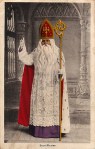
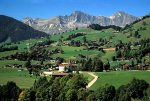

All the great Samaclauses in history have been born in Rougemont (red Mountain) Switzerland, and christened in the Priory Rougemont founded by Swiss Cheese makers, who descend from Samuel the Nazarite Prophet, and thus the saying;
“Blessed are the cheese makers, for they shall inherit the earth.”
We Samaclauses do not have fathers, but only uncles, because we believe our true father was Able, who was murdered by his brother Cain, and thus the saying;
“Our fathers, who art in heaven.”
In this video the Cluny Monks of Rougemont are saying “hello” to our divine mothers, who art in heaven, also!
Hello, mother!
Above is a painting of Wicked Uncle Samaclause who went over to the dark side and began eating bad people who refused to be good. His offspring would go on to produce many wicked Republican leaders who took over the Abolitionist party co-founded by my kin, John Fremont, who was the first Republican candidate for President before the Devil One came.
Uncle Samaclause
His spear shaft was like a weaver’s rod, and its iron point weighed six hundred shekels. His shield bearer went ahead of him.
Guillaume, the first Earl of Gruyere, together with his nephew canon Ulrich founded the Cluniac Priory of Rougemont. A charter set up in 1115 granted the Priory certain privileges like being supplied with cheeses produced in the Gruyere Alps. The abbey was supposed to provide the material: vats, sieves, cheese wheels … In the alpine cottages the milk from the cow herds of Gruyere was made into cheese, but only during the growing season.
In Fribourg the cheese trade is said to have started in 1249. The sons of Rodolphe de Gruyere freed their subjects from Gessenay from the charter of 1115. They set up a document that mentions the production of a “fatty cheese” in those alpine areas for exports, which allowed people of that place to earn some money from their trade. Another document dated July 1328 also speaks of the Gruyere cheese: It was Earl Peter III’s will.
Cluny thus owes a notable share of its development in Rodolphiens;
the abbots of Cluny thus carried the title of abbots of Romainmôtier
and of Payerne until the medium of XIe S., before these two houses
were not reduced to the row of priory ” This print rodolphienne is
found in the chart of the establishments clunisiennes of
Switzerland, limited to a Geneva-Bern-Basle triangle; certain
foundations however, whose significant priory of Saint-Alban in
Basle, are posterior with the disappearance of the kingdom of
Burgundy
.
The current Swiss territory included/understood nine priories placed
under the immediate dependence of Cluny; four of them, Saint-Alban,
Saint-Victor, Payerne and Romainmôtier, formed true networks of
secondary priories: they held twenty-five of them, scattered of
Alsace in Savoy. Two houses, Rüeggisberg and Hettiswil, had two
priories each one. Rougemont, the island of Saint-Pierre and
Münchenwiler, are on the other hand solitary. The nuns of Feldbach
(Alsace), Istein and Sölden (Bade) depended temporarily on Saint-
Alban, but no female priory was created in Switzerland “.
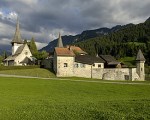
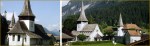
Rougemont Church was built around 1080 A.D. by Cluny monks. This priory is the first and only convent in the Lake Geneva Alps. The sanctuary is dedicated to Saint Nicolas de Myre, a martyr of the 4th century, the patron saint of children, who is celebrated on 6 December. The church was built in the Romanesque style according to the classic Cluniac layout: it has the shape of a Latin cross. The nave rests on the side aisles. The choir comprises three apses. A square tower built on the transept holds the bells. During the Bernese reign, the priory was demolished and a castle for the bailiffs put in its place. The Burgundy roofs were replaced by a steeper roof that was better suited to the climate. Major restoration work from 1919 to 1926 uncovered the stones of the building that had hitherto been hidden by five layers of plaster. The ceiling of the nave was remade with wooden beams. The paintings were made by Correvon, based on 13th century motifs.
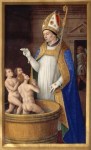
Saint Nicolas de Myre
His spear shaft was like a weaver’s rod, and its iron point weighed six hundred shekels. His shield bearer went ahead of him.
In Europe, the rituals associated with the onset of winter are ancestral. Au Moyen Âge , l’Église catholique décide de remplacer les figures païennes par des saints. In the Middle Ages , the Catholic Church decided to replace the figures with pagan saints. Par le nom de « saint Nicolas », elle désigne Nicolas de Myre , un personnage qui vécut au IV e siècle au sud de la Turquie actuelle près d’ Antalya , contemporain de la dernière vague de persécutions et du concile de Nicée , moment important du christianisme . By the name of “Saint Nicolas”, it means Nicolas of Myra , a character who lived in the fourth century in southern Turkey now close to Antalya , a contemporary of the last wave of persecution and the Council of Nicaea , the important time Christianity . Au XI e siècle , sa dépouille est volée par des marchands italiens, mais ils laissent sur place un morceau de crâne et de mâchoire. In the eleventh century , his remains were stolen by Italian merchants, but they leave behind a piece of skull and jaw. Rapportée à Bari en Italie, la relique produirait des miracles. Reported to Bari in Italy, the relic would produce miracles. Selon la légende, il aurait ressuscité trois enfants trucidés par un horrible boucher. According to legend, he would have raised three children done to death by a horrible butcher. Il est alors présenté comme le saint protecteur des tout-petits. It is then presented as the patron saint of toddlers. C’est pourquoi, en sa mémoire, le 6 décembre de chaque année, principalement dans les pays d’ Europe du Nord et de l’Est (notamment dans l’Est de la France en Alsace , à Metz , à Nancy et à Saint-Nicolas-de-Port ), la coutume veut qu’un personnage, habillé comme on imaginait que saint Nicolas l’était (grande barbe, crosse d’évêque, mitre , grand vêtement à capuche), va alors de maison en maison pour offrir des cadeaux aux enfants sages. Therefore, in his memory, the December 6 each year, mainly in the countries of Northern Europe and East (especially in eastern France in Alsace , at Metz , to Nancy and Saint -Nicolas-de-Port ), the custom is that a character dressed as one imagined that St. Nicolas was (big beard, a bishop, miter , large hooded clothing), then goes from house to house for giving gifts to good children. C’est au XVI e siècle , que la légende du saint s’enrichit avec le personnage du père Fouettard qui punit les enfants désobéissants (selon certaines traditions, celui-ci serait en fait le boucher de légende). It is in the sixteenth century , the legend of the saint is enriched with the character of the bogeyman that punishes disobedient children (according to some traditions, it would actually be the butcher of legend). Ce personnage disparaît lors du passage au mythe de Santa Claus . This character disappears in the transition to the myth of Santa Claus. En France, à partir du XII e siècle également, le vieux qui présidait ce cortège, est par la suite appelé « Noël ». In France, from the twelfth century also, the old man who presided over the procession, was later called “Christmas.”
 Rosamond Press
Leave a comment