


On this day, October 5, 2011, I christen the Wall Street Demonstrators the NEW WALLOONS! With the entering of the Unions into the New Walloon Revolt, let the first order of business be a NATIONAL BOYCOTT OF WAL-MART that give primarily to the Republican Party.
It is tim the REFORM the roots of our Democracy. It is obvious the reason our Founding Fathers did not free the slave, is because there would have been ten time the slave-owning Loyalists, who took their slaves to Canada. Only when my kin, John Fremont emancipate the slaves of Missouri, was the Great Lie addressed – seventy five year later!
Our Democracy was born terribly flawed. It is time to REBORN America, raise it from the dead! Let us look to the Walloon and Huguenot Weavers for a RENEWED MODEL of what the True Dream of America – was!
The ultra-rich got that way by shipping our WEAVING JOBS overseas! It is time to bring these jobs home, and bring these TRAITORS down – beginning with Wal-Mart – THE SERPENT! We New WEavers must chop this Satan into thirteen pieces – and raise the Nehushtan that Moses carried before the God’s Chosen People in the Wilderness!
“Make straight paths for the Lord! Let my weaving people go!”
Did the Jews weave fine silk for the Egyptians?
Jon the Nazarite
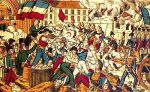
On November 21, 1831, several hundred weavers toured the then independent commune of Croix-Rousse. They forced the few weavers still at work to close their workshops, hassling the National Guard. Soon after they erected barricades and marched to Lyon under the black flag.
On November 22 in Lyon, the workers took hold of the fortified police barracks at Bon-Pasteur, pillaging the arsenaland stealing weapons in the process. Several units of the military guard and the national guard were attacked. The infantry attempted to stop them, but was forced to fall back under a hail of tiles and bullets. The national guard, most of which was recruited from amongst the canuts, changed sides, joining the insurgents.
After a bloody battle which caused around 600 casualties(100 dead, 263 injured on the military side, 69 dead, 140 injured on the civilian side), the insurgents took hold of the town.[2]During the night of November 22 to November 23, General Roguet, commander of the 7th division and mayor Victor Prunellefled the town.
The insurgents occupied the town hall, though they allegedly did not loot the town at all. At this point, the leaders of the workers were unsure as to the further course of action, having started the strike with the sole intention of making sure the fixed rate on silken goods was being applied correctly. A few republicans in the group insisted on using the momentum to form a governmental committee. The committee did not make any tangible decisions, due to a lack of agenda. Not helping the committee’s effectiveness was the canuts’ refusal to have their uprising twisted to political ends.
It has rocketed to No. 2 among top campaign givers in the 2004 federal elections. Four years ago, it didn’t rank in the top 100, says the Center for Responsive Politics, a non-partisan watchdog group.
Republican candidates are the big winners in this year’s election. They received about 85% of the company’s contributions, including those of its political action committee, employees and children of founder Sam Walton.
Wal-Mart’s rise is significant because of the impact it might have on congressional debates about health care, labor and other hot-button regulatory issues, says Larry Noble, the center’s executive director. “They’re clearly making a move,” he says.
The company has more than $250 billion in annual revenue. (No. 2 is General Motors, with $187 billion in annual revenue.) Wal-Mart is also the USA’s biggest private employer, with 1.2 million workers.
But unions say Wal-Mart’s push to keep costs low is driving thousands of factory jobs overseas. It’s facing a potentially costly sex discrimination lawsuit from female workers. Plus, a federal grand jury is investigating claims that Wal-Mart cleaning companies used illegal immigrants.
Wal-Mart denies the sex discrimination claims. It says it is innocent in the case of illegal immigrants. Still, the growing criticism has tarnished the company’s image, and helped spur its leap into Washington. “Our voice wasn’t there to be heard,” says company spokesman Jay Allen.
It’s now being heard through:
•Campaign donations.Wal-Mart’s political action committee and employees have given about $1 million in the 2004 elections so far — almost entirely to congressional candidates. Just $5,000 went to President Bush, and none to Democrats seeking the White House — a trend underscored Monday in campaign finance data released by the center. Bush’s No. 1 donor to date: Merrill Lynch’s (MER)PAC and employees. They gave $432,104 of the $132 million Bush raised. Wal-Mart gives to pro-business candidates, without expectations, Allen says. “There are no quid pro quos,” he says
The term Walloon is derived from walha, a Germanic term used to refer to Celtic and Latin speakers.[4]
Walloonoriginated in Romance languagesalongside other related terms, but it supplanted them. Its oldest written trace is found in Jean de Haynin’s Mémoires de Jean, sire de Haynin et de Louvignies in 1465, where it refers to Roman populations of the Burgundian Netherlands
In Holland, the street’s name is believed to refer to the Walloons, a general term by the Dutch for all French-speaking people. By 1630 the total population of New Netherland was about 300, many being French-speaking Walloons. It is estimated about 270 lived in the area surrounding Fort Amsterdam, primarily working as farmers. The Dutch word for Walloon is Waal, thus “De Waal Straat” or “Wall Street.”
1. In 1925 William Sam Rosamond did a relatively complete genealogy. His research indicated that we were In Holland, the street’s name is believed to refer to the Walloons, a general term by the Dutch for all French-speaking people. By 1630 the total population of New Netherland was about 300, many being French-speaking Walloons. It is estimated about 270 lived in the area surrounding Fort Amsterdam, primarily working as farmers. The Dutch word for Walloon is Waal, thus “De Waal Straat” or “Wall Street.”
descended from a Huguenot born in France sometime in the mid to late 1600s. He discovered that his earliest traceable ancestor was a “Sergeant” Rosamond who left France following the Revocation of the Edict of Nantes on 22nd October 1685. He found that Sergeant Rosamond supposedly travelled to Holland where he joined the army of William III, went to England, and from there went with William’s army to Ireland. He fought in the Battle of the Boyne on 1st July 1690 (by the old calendar – 12th July by the new calendar) and then remained in County Leitrim, Ireland. (There is still a family of Rosamonds in County Leitrim.) He had three sons, two of whom went to the American colonies and settled in the mid-Atlantic region. One of the sons’ names was either John or Thomas Rosamond. Current researchers have not been able to confirm this connection. It appears probable that the American branch of the family are descended from John “The Highwayman” Rosamond who arrived in Annapolis, Maryland in 1725. He was sentenced to be transported into 14 years servitude for robbery from the Oxford Assizes. This John could be the son of Sergeant William Rosamond, and the mix up in names likely stems from the fact that his father-in-law’s name was Thomas Wilson.
2.
Fournier Street was the last to be built on the Wood-Michell estate in Spitalfields, London. The houses mainly date from the 1720s and together form one of the most important and best preserved collections of early Georgiandomestic town-houses in Britain. Built for French Huguenotmaster silk-weavers and mercers, the houses of Fournier Street were fitted out with fine wooden panelling and elaborate joinery such as carved staircases, fireplaces and highly detailed door-cases by the master craftsmen of the day
An estimated 50,000 Protestant Walloons and Huguenots fled to England, about 10,000 of whom moved on to Ireland around the 1690’s.[when?] In relative terms, this could be the largest wave of immigration of a single community into Britain ever.[40] Andrew Lortie (born André Lortie), a leading Huguenot theologian and writer who led the exiled community in London, became known for articulating Huguenot criticism of the Holy See and transubstantiation.
Of the refugees who arrived on the Kent coast, many gravitated towards Canterbury, then the county’s Calvinist hub, where many Walloon and Huguenot families were granted asylum. Edward VI granted them the whole of the Western crypt of Canterbury Cathedral for worship. This privilege in 1825 was reduced to the south aisle and in 1895 to the former chantry chapel of the Black Prince. Services are still held there in French according to the Reformed tradition every Sunday at 3pm. Other evidence of the Walloons and Huguenots in Canterbury includes a block of houses in Turnagain Lane where weavers’ windows survive on the top floor, and ‘the Weavers’, a half-timbered house by the river (now a restaurant – see illustration above). The house derives its name from a weaving school which was moved there in the last years of the 19th century, resurrecting the use to which it had been put between the 16th century and about 1830. Many of the refugee community were weavers. Others practised the variety of occupations necessary to sustain the community distinct from the indigenous population, as such separation was the condition of the refugees’ initial acceptance in the City. They also settled elsewhere in Kent, particularly Sandwich, Faversham and Maidstone – towns in which there used to be refugee churches.
The Netherlands
Some Huguenots fought in the Low Countries alongside the Dutch against Spain during the first years of the Dutch Revolt (1568–1609). The Dutch Republic rapidly became a destination for Huguenot exiles. Early ties were already visible in the “Apologie” of William the Silent, condemning the Spanish Inquisition, which was written by his court minister, the Huguenot Pierre L’Oyseleur, lord of Villiers. Louise de Coligny, daughter of the murdered Huguenot leader Gaspard de Coligny, married William the Silent, leader of the Dutch (Calvinist) revolt against Spanish (Catholic) rule. As both spoke French in daily life, their court church in the Prinsenhof in Delft held services in French. The practice has continued to the present day. The Prinsenhof is one of the 14 active Walloon churches of the Dutch Reformed Church. The ties between Huguenots and the Dutch Republic’s military and political leadership, the House of Orange-Nassau, which existed since the early days of the Dutch Revolt, helped support the many early settlements of Huguenots in the Dutch Republic’s colonies. They settled at the Cape of Good Hopein South-Africa and New Netherland in North America.
Stadtholder William III of Orange, who later became King of England, emerged as the strongest opponent of king Louis XIV after the French attacked the Dutch Republic in 1672. William formed the League of Augsburgas a coalition to oppose Louis and the French state. Consequently, many Huguenots considered the wealthy and Calvinist Dutch Republic, which led the opposition to Louis XIV, as the most attractive country for exile after the revocation of the Edict of Nantes. They also found many French-speaking Calvinist churches there.
After the revocation of the Edict of Nantes, the Dutch Republic received the largest group of Huguenot refugees, an estimated total of 75,000 to 100,000 people. Amongst them were 200 clergy. Many came from the region of the Cévennes, for instance, the village of Fraissinet-de-Lozère.[39]This was a huge influx as the entire population of the Dutch Republic amounted to ca. 2 million at that time. Around 1700, it is estimated that nearly 25% of the Amsterdam population was Huguenot. In 1705, Amsterdam and the area of West-Frisia were the first areas to provide full citizens rights to Huguenot immigrants, followed by the Dutch Republic in 1715. Huguenots intermarried with Dutch from the outset.
One of the most prominent Huguenot refugees in the Netherlands was Pierre Bayle. He started teaching in Rotterdam, where he finished writing and publishing his multi-volume masterpiece, Historical and Critical Dictionary. It became one of the 100 foundational texts of the US Library of Congress. Some Huguenot descendants in the Netherlands may be noted by French family names, although they typically use Dutch given names. Due to the Huguenots’ early ties with the leadership of the Dutch Revolt and their own participation, some of the Dutch patriciateare of part-Huguenot descent. Some Huguenot families have kept alive various traditions, such as the celebration and feast of their patron Saint Nicolas, similar to the Dutch Sint Nicolaas (Sinterklaas) feast.
Landing of the Walloons, Landing of Dutch in New York by Carl Emil Doepler, lithograph
There are varying accounts about how the Dutch-named “de Waal Straat”[11]got its name. A generally accepted version is that the name of the street name was derived from an earthen wall on the northern boundary of the New Amsterdam settlement, perhaps to protect against English colonial encroachment or incursions by native Americans. A conflicting explanation is that Wall Street was named after Walloons — possibly a Dutch abbreviation for Walloon being Waal.[12]Among the first settlers that embarked on the ship “Nieu Nederlandt” in 1624 were 30 Walloon families.
In the 1640s, basic picket and plank fences denoted plots and residences in the colony.[13]Later, on behalf of the Dutch West India Company, Peter Stuyvesant, using both African slaves[14] and white colonists, collaborated with the city government in the construction of a more substantial fortification, a strengthened 12-foot (4 m) wall.[15]In 1685 surveyors laid out Wall Street along the lines of the original stockade.[15] The wall started at Pearl Street, which was the shoreline at that time, crossing the Indian path Broadway and ending at the other shoreline (today’s Trinity Place), where it took a turn south and ran along the shore until it ended at the old fort. In these early days, local merchants and traders would gather at disparate spots to buy and sell shares and bonds, and over time divided themselves into two classes—auctioneers and dealers.[16] The rampart was removed in 1699.[12]
Wal-Mart’s Shirts of Misery – Walmart In Bangladesh
(The Following Information on Walmart was Obtained from the National Labor Committee Web-site)
When you purchase a shirt in Walmart, do you ever imagine young women in Bangladesh forced to work from 7:30 a.m. to 8:00 p.m., seven days a week, paid just 9 cents to 20 cents an hour, who are denied health care and maternity leave; screamed at to work faster; with monitored bathroom

 Rosamond Press
Leave a reply to Prince Corey Cancel reply