

Smoky is the literary heir of Royal Rosamond and his Black Mask friends seen her on Santa Cruz Island. Why didn’t Frank Weseley Rosamond, try his hand at Pulp Fiction? Why did he go on his Hillbilly craze? Frank taught Erl Stanley Gardener to write, and Chandler said he studied his style in order to become a writer. Did Royal teach Raymond – too – and when his students became famous, and he didn’t, he had enough and went home to Hillbilly kind.
John Presco
https://en.wikipedia.org/wiki/Raymond_Chandler
https://rosamondpress.com/2018/08/01/kingdom-of-california/
https://rosamondpress.com/2012/07/19/camping-with-the-gypsy-boho/
https://rosamondpress.com/2012/07/19/25-cent-pay-radio/
In straitened financial circumstances during the Great Depression, Chandler turned to his latent writing talent to earn a living, teaching himself to write pulp fiction by analyzing and imitating a novelette by Erle Stanley Gardner. Chandler’s first professional work, “Blackmailers Don’t Shoot”, was published in Black Mask magazine in 1933. According to genre historian Herbert Ruhm, “Chandler, who worked slowly and painstakingly, revising again and again, had taken five months to write the story. Erle Stanley Gardner could turn out a pulp story in three or four days—and turned out an estimated one thousand.”[14]
His first novel, The Big Sleep, was published in 1939, featuring the detective Philip Marlowe, speaking in the first person. In 1950, Chandler described in a letter to his English publisher, Hamish Hamilton, why he began reading pulp magazines and later wrote for them:
Wandering up and down the Pacific Coast in an automobile I began to read pulp magazines, because they were cheap enough to throw away and because I never had at any time any taste for the kind of thing which is known as women’s magazines. This was in the great days of the Black Mask (if I may call them great days) and it struck me that some of the writing was pretty forceful and honest, even though it had its crude aspect. I decided that this might be a good way to try to learn to write fiction and get paid a small amount of money at the same time. I spent five months over an 18,000 word novelette and sold it for $180. After that I never looked back, although I had a good many uneasy periods looking forward.[15]
His second Marlowe novel, Farewell, My Lovely (1940), became the basis for three movie versions adapted by other screenwriters, including the 1944 film Murder My Sweet, which marked the screen debut of the Marlowe character, played by Dick Powell (whose depiction of Marlowe Chandler reportedly applauded). Literary success and film adaptations led to a demand for Chandler himself as a screenwriter. He and Billy Wilder co-wrote Double Indemnity (1944), based on James M. Cain‘s novel of the same title. The noir screenplay was nominated for an Academy Award. Said Wilder, “I would just guide the structure and I would also do a lot of the dialogue, and he (Chandler) would then comprehend and start constructing too.” Wilder acknowledged that the dialogue which makes the film so memorable was largely Chandler’s.
Chandler’s only produced original screenplay was The Blue Dahlia (1946). He had not written a denouement for the script and, according to producer John Houseman, Chandler agreed to complete the script only if drunk and attended by round-the-clock secretaries and drivers, which Houseman agreed to. The script gained Chandler’s second Academy Award nomination for screenplay.
Chandler collaborated on the screenplay of Alfred Hitchcock‘s Strangers on a Train (1951), an ironic murder story based on Patricia Highsmith‘s novel, which he thought implausible. Chandler clashed with Hitchcock to such an extent that they stopped talking, especially after Hitchcock heard Chandler had referred to him as “that fat bastard”. Hitchcock reportedly made a show of throwing Chandler’s two draft screenplays into the studio trash can while holding his nose, but Chandler retained the lead screenwriting credit along with Czenzi Ormonde.
In 1946 the Chandlers moved to La Jolla, California, an affluent coastal neighborhood of San Diego, where Chandler wrote two more Philip Marlowe novels, The Long Goodbye and his last completed work, Playback. The latter was derived from an unproduced courtroom drama screenplay he had written for Universal Studios.
I’ve never been a huge fan of crime fiction, but I’ve found I can’t resist Raymond Chandler, the king of the detective novel, because he can turn a phrase like no one else. Sit down with one of his classics–Farewell, My Lovely or The Long Goodbye, for example–and you’ll soon find yourself on the hunt for “Chandlerisms” like “as conspicuous as a tarantula on a slice of angel food.” His dialogue and similes are so crazy and over the top I want to memorize them and use them in my own conversation.
 Beyond the similes, you start to recognize in Chandler’s work all of the hallmarks of “hard-boiled” and “noir” detective fiction–the shadowy scenery, the sleazy criminals, and Phillip Marlowe, the epitome of the tough and surprisingly idealistic private eye. The dialogue, the setting, and the characters are all as familiar as the nose on a washed-up boxer’s ugly mug, but it was Chandler who created them and, in the process (along with fellow crime writers Dashiell Hammett and James M. Cain), pioneered a uniquely American literary genre and style.
Bogie and Bacall brought his hard-boiled characters to life on the big screen and his stories have been the subject of parody by everyone from Woody Allen to Steve Martin to Garrison Keillor. As Paul Auster, a modern crime writer, says, “Raymond Chandler invited a new way of talking about America, and America has never looked the same to us since.”

The Los Angeles area of the 1930s and 1940s was rife with organized crime, greed, and celebrity scandals. In particular, daily life in Santa Monica, the beachfront town on the western edge of Los Angeles where Chandler lived for a time and which appears as Bay City in his books, offered plenty of material from which to draw his stories.
If you visit Santa Monica and the Los Angeles area, it’s fun to read Chandler’s books and those of his crime fiction contemporaries and picture the area as it was then. He described it as a place with “lots of churches and almost as many bars.” It’ll add a little depth to your understanding of the area, beyond Hollywood and UCLA/USC football. Esotouric offers literary tours of Los Angeles including one focused on Raymond Chandler and another on James M. Cain. You might also enjoy their podcasts. In addition, the Santa Monica Conservancy offers walking tours that cover Santa Monica history.
Santa Monica’s “mean streets” have been replaced by glamorous shopping streets such as Montana Avenue and the Third Street Promenade. Yet, enough of the old Bay City remains today to get your imagination moving, including the famous Santa Monica Pier and Main Street’s deco-era City Hall, the scene of many of Phillip Marlowe’s coming and goings. Of course, there’s still the harbor and “beyond it the huge emptiness of the Pacific, purple-gray, that trudges into shore like a scrubwomen going home.”
Arhtur K. Barnes and John K. Butler
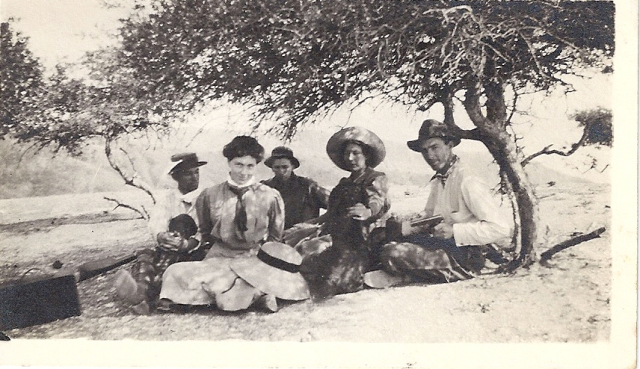
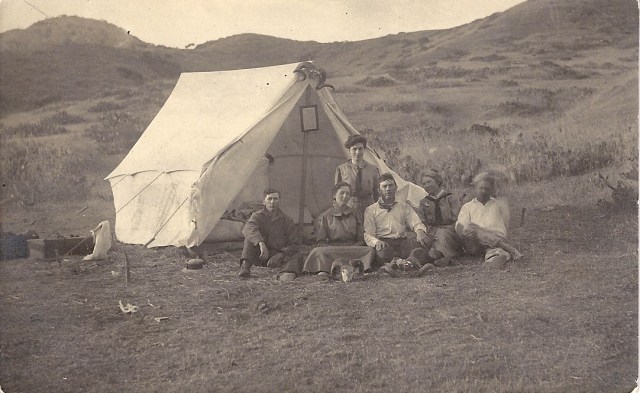
I am almost certain Arthur K. Barnes and John K. Butler are in these two photographs with my grandmother. I will tie Barnes and Butler to C.S. Lewis, Tolkien, and Ian Flemming. Add Dashiell Hammet to the mix. He would go camping on Anacapa Island with my grandfather, Royal Rosamond.
Elizabeth Rosemond Taylor is my only Muse. Liz, Christine, and I, are the only family members I want to be associated with. I am going to found a California Cultural Reserve in order to survive The Moron of Dark Tower and his Neo-Confederate Thunder Turds.
John Presco
http://www.thrillingdetective.com/trivia/john_k_butler.html
https://en.wikipedia.org/wiki/The_Space_Trilogy
John K. Butler
(1908–64)
 Author JOHN K. BUTLER is best-known, at least in our little neck of the woods, for the numerous stories he pounded out for such pulps as Black Mask, Detective Fiction Weekly, Double Detective and especially Dime Detective.
His best known series character, of course, was Steve Midnight, the trouble-prone hack for the Red Owl Cab Company of Los Angeles, who appeared in nine stories in Dime Detective, but he was also responsible for the adventures of police detective Rex Lonergan and undercover cop Tricky Enright. but his forté seemed to be tough, competent sleuths with unlikely professions, such as Midnight, or hard-boiled phone company inspector Rod Case. Butler even penned at least one story about Sandy Taylor of the Harbor Police.
Butler was also one of the most prolific writers of B-pictures, eventually cranking out over fifty screenplays, mostly for Republic Pictures, more than half of them westerns, and many of them featuring Roy Rogers. Okay, so they were mostly B-flicks, but among his screen credits are such classic — and occasionally alternative classics — as Ambush at Cimarron Pass, Drums Along the River, My Pal Trigger, The Vampire’s Ghost and– get this — Post Office Investigator, about a hard-boiled, um, post office inspector. A nitrate print of it survives in the UCLA Film and Television Archives but is not listed for preservation.
In the fifties, Butler moved on to television, again favouring westerns, although he also wrote for shows like The New Adventures of Charlie Chan, The Adventures of Dr. Fu Manchu and 77 Sunset Strip.
Butler was also a bit of a wingnut, dressing up in cowboy drag and galloping through Griffith Park on his horse Prince. You might even say he died in the saddle — he broke his back during a ride in 1964.
SHORT STORIES


- “Murder Alley” (April 1, 1935, Dime Detective; Rex Lonergan)
- “The Corpse Parade” (June 1, 1935, Dime Detective; Rex Lonergan)
- “Fog Over Frisco” (July 1, 1935, Dime Detective; Rex Lonergan)
- “The Stairway to Hell” (November 1, 1935, Dime Detective; Rex Lonergan)
- “‘G’ Heat” (November 1935, Black Mask)
- “Guns for a Lady” (March 1936, Black Mask)
- “Seven Years Dead” (January 1936, Dime Detective; Tricky Enright)
- “Dark Return” (May 1936, Black Mask; Mark Dana)
- “Blood on the Buddha” (May 1936, Dime Detective; Rex Lonergan)
- “Parole for the Dead” (August 1936, Dime Detective; Rex Lonergan)
- “You Can’t Bribe Bullets” (August 1936, Black Mask)
- “The Mad Dogs of Frisco” (October 1936, Dime Detective; Rex Lonergan)
- “No Rest for Soldiers” (October 1936, Black Mask)
- “The Lady in the Grave” (October 31, 1936, Detective Fiction Weekly)
- “Federal Bullets” (November 1936, The Feds)
- “Celluloid Doom” (December 1936, Ten Detective Aces)
- “The Mirror Maze” (February 1937, Ten Detective Aces)
- “The Walking Dead” (February 1937, Dime Detective; Rex Lonergan)
- “Reunion on River Street” (March 6, 1937, Argosy)
- “The Blood Barrier” (March 1937, Ten Detective Aces)
- “Death on the Hook” (March 1937, Headquarters Detective; Sandy Taylor)
- “Gallows Ghost” (April 1937, Dime Detective; Tricky Enright)
- “I Killed a Guy” (April 1937, Black Mask)
- “The Parole Pawn” (May 1937, Ten Detective Aces)
- “A Coffin for Two” (July 1937, Dime Detective; Rex Lonergan)
- “Death in the Dust” (September 4, 1937, Detective Fiction Weekly)
- “A Ticket to Tokyo” (September 18, 1937, Detective Fiction Weekly)
- “A Street in Singapore” (September 25, 1937, Argosy)
- “The Secret of the Wax Lady” (September 1937, ; Tricky Enright)Dime Detective
- “Sierra Gold” (November 20, 1937, Argosy)
- “Death Rides the Wires” (November 20, 1937, Detective Fiction Weekly)
- “The Pied Piper of Frisco” (November 1937, Dime Detective Magazine; Rex Lonergan)
- “Legend of Boulder Gap (1937)
- “The Black Widow” (January 1938, Double Detective)
- “Defender of the Doomed” (May 7, 1938, Detective Fiction Weekly)
- “Why Shoot a Corpse?” (May 1938, Dime Detective; Tricky Enright)
- “Over the Wall” (August 1938, Double Detective)
- “Hard to Kill” (November 1938, Double Detective)
- “Big Mike’s Christmas Carol” (December 24, 1938, Detective Fiction Weekly)
- “The Last Hideout” (January 1939, Double Detective)
- “County Cleanup” (February 1939, Dime Detective; Tricky Enright)
- “Murder in Mexico” (April 1939, Double Detective)
- “The Headless Man in Hangar 3” (July 1939, Double Detective)
- “The Man from San Quentin” (August 1939, Double Detective)
- “The Man Who Liked Ice” (October 1939, Double Detective)
- “Country Cop” (November 4, 1939, Detective Fiction Weekly)
- “The Policeman Writes a Ticket” (December 1939, Double Detective)
- “The Doctor Buries His Dead” (December 1939, ; Stan Denhart, M.D.)
- “I Died Last April” (January 1940, Double Detective)
- “The Lady and the Snakes” (March 1940, Double Detective)
- “The Autumn Kill” (May 25 1940, Detective Fiction Weekly)
- “The Dead Ride Free” (May 1940, Dime Detective; Steve Midnight)
- “The Man from Alcatraz” (July 1940, Dime Detective; Steve Midnight)
- “Cop from Yesterday” (September 28, 1940, Detective Fiction Weekly)
- “Hacker’s Holiday” (October 1940, Dime Detective; Steve Midnight)
- “Brass Knuckles” (October 19, 1940, Detective Fiction Weekly)
- “The Saint in Silver” (January 1941, Dime Detective; also The Hardboiled Dicks; Steve Midnight)
- “Don’t Make It Murder” (February 1941, Black Mask)
- “The Killer was a Gentleman” (March 1941, Dime Detective; Steve Midnight)
- “We Sell Murder” (Summer 1941, Exciting Murder)
- “Dead Man’s Alibi” “July 1941, Dime Detective; Steve Midnight)
- “Death Has My Number” (August 1941, Black Mask; Rod Case)
- “Blitz Kill” (September 1941, G-Men Detective)
- “The Hearse from Red Owl” (September 1941, Dime Detective; Steve Midnight)
- “Murder for Nickels” (December 1941, Black Mask; Rod Case)
- “Death and Taxis” (January 1942, Dime Detective; Steve Midnight)
- “Cops Have Nine Lives” (February 1942, Street & Smith’s Detective Story Magazine)
- “Funeral — C.O.D.” (February 1942, Detective Tales)
- “The Mark of the Monterey Kid” (February 1942, Western Tales)
- “The Corpse That Couldn’t Keep Cool” (March 1942, Dime Detective; Steve Midnight)
- “Never Work at Night” (March 1942, Black Mask; Rod Case)
- “Death Goes Dancing” (May 1942, Street & Smith’s Detective Story Magazine)
- “The Pen is Not for Punks” (Fall 1942, The Masked Detective)
- “Dead Letter” (September 1942, Black Mask; Rod Case)
- “The Last Man to Hang” (October 1942, Detective Tales)
- “Legend of Boulder Gap” (February 1950, Max Brand’s Western Magazine)
- “The Man Who Knew Cochise” (December 1952, Western Story Magazine)
- “So-Long, Tombstone!” (June 1953, Western Story Magazine)
- “A Man with a Gun” (June 1955, Best Western)
COLLECTIONS
- At the Stroke of Midnight (1998; Steve Midnight) ..Buy this book
- The Complete Cases of Steve Midnight (2016; Steve Midnight).. Buy the book
RELATED LINKS
John K. Butler captured on film, along with a few of his partners in crime!
Respectfully submitted by Kevin Burton Smith.
interplanetary Huntress
the gerry carlyle stories
of arthur k barnes

When you read a great and famous author, delight comes without surprise. But when an obscure writer gives us a book which turns out to be a lot better than expected, the pleasure is laced with the extra tang of astonishment. This is what we get from the tales of roving Gerry “Catch ’em alive” Carlyle, the huntress in the misleadingly titled collection Interplanetary Hunter. Her vocation is to capture exotic alien creatures for the London Interplanetary Zoo, and this theme allows many attractive branchings.
Gerry herself is a likeable, headstrong character, living on her nerves, very capable, yet vulnerable to the threat of what she cannot afford – namely, defeat.
…This day was to be one of many surprises for Tommy Strike and perhaps the greatest shock of all came when he stood beside the sloping runway leading into the brightly lighted belly of the ship. For, awaiting him there, one hand outstretched and a cool little smile on her lips, stood the most beautiful girl he had ever seen.

“Mr Strike,” said Barrows, “this is Miss Gerry Carlyle.”
The trader stared, thunderstruck. In those days of advanced plastic surgery, feminine beauty wasn’t rare but even Strike’s unpracticed eye knew that here was the real thing. No synthetic blonde baby-doll here but a natural beauty untouched by the surgeon’s knife – spun-gold hair, intelligence lighting dark eyes, a hint of passion and temper in the curve of the mouth and arch of nostrils…
But Miss Carlyle’s voice was an ice-water jet to remind the trader of earthside manners.
“You don’t seem enthusiastic over meeting your temporary employer, Mr Strike…”

Stid: Old-fashioned stereotype here, eh? Wilful female eventually tamed by male who knows best…
Zendexor: I’d say, as a matter of fact, that the relationship between hero and heroine is particularly well handled. In action-adventure you don’t want anything too subtle, but let me summarize the writer’s achievement in this regard, by saying that we end up by accepting both Tommy Strike and Gerry Carlyle as real people. The man is quietly competent and content to allow the woman the starring role. The woman lives on her nerves, under great pressure to succeed in a man’s world.
Stid: A “man’s world” – in the interplanetary age? There you have it.
Zendexor: You mean, it’s stereotypical because it’s out of date? Don’t see why the one implies the other. Even if it did – every period of history generates its own rich crop of stereotypes, and isn’t it a relief to take a holiday from ours, once in a while? But this is a digression. Actually, stereotypophobes have nothing to fear from this book. As the two main characters grow to love and respect each other, the reader can share their mutual regard, as well as appreciating with zest the mutual double-crossing of the subsidiary characters, Van Zorn and Quade.

Harlei: It’s fiction, Stid, in case you hadn’t noticed. Pulp-era fiction. Explain to him what historical context means, Zendexor.
Zendexor: Yes, well, the stories are old-fashioned, no doubt about that. Arthur K Barnes wrote them in the late 1930s and early 1940s. But they still have the power to entertain us with the unexpected originality of their ideas, the fresh vigour of their old-fashioned characters, and above all the inventiveness of their portrayal of alien creatures.
Cross the colour and thought-provoking variety of Weinbaum‘s interplanetary adventures with the frontier wonderment of Campbell’s Penton and Blake saga, and you might get some idea of what awaits you with Barnes’ series.

Though I hasten to add that Barnes writes much, much better than Campbell. Only in the realm of ideas, of pure concepts, may Campbell equal him; but I hesitate even to say this. And it is Barnes who is by far the better at world-building.
…She sniffed noting what all newcomers to Venus learn. Although the view is a drab almost colorless one, an incredible multiplicity of odors assails the nostrils – sweet, sharp, musklike, pungent, spicy, with many unfamiliar olfactory sensations to boot.
Strike explained. On Earth flowering plants are fertilized by the passage of insects from one bloom to another, they develop petals of vivid colors to attract bees and butterflies and other insects. But on Venus, where perpetual mist renders impotent any appeal to sight, plants have adapted themselves to appeal to the sense of smell, therefore give off all sorts of enticing odors…
Such passages help promise the reader, that the story will rest upon logical foundations. So, when the heroine faces a mighty challenge, the reader is reassured that the author won’t cheat – that it won’t all be fixed by some lazy trick.
The challenge, in the Venus story, is provided by the ‘Murris’.

…Gerry Carlyle’s temper flared.
“What is the mystery about this Murri, anyhow? Everywhere I go, on Venus, back on Earth among members of my own profession, if the word Murri is mentioned everyone scowls and tries to change the subject. Why?”
No one answered. The Carlyle party shifted uneasily, their boots making shucking sounds. Presently Strike offered, “The fact is, you’ll never take back a Murri alive. But you wouldn’t believe me if I told you the reason, Miss Carlyle. I – ”
“Why not? What’s the matter with them? Is their presence fatal to a human in some way?”
“Oh, no.”
“Are they so rare or shy they can’t be found?”
“No, I think I can find you some before you take off.”
“Then are they so delicate they can’t stand the trip? If so, I can tell you we’ve done everything to make hold number three an exact duplicate of living conditions here.”
“No, it isn’t that either,” the trader sighed.
“Then what is it?” she cried. “Why all the evasions and secretive looks?…”
I certainly didn’t guess the mystery. This author, in my view, really does deliver the goods. The stories – all of them – are unpredictable yet always manage to make their own kind of sense. We’re taken to several varied worlds: Venus, Amalthea, Triton, a comet, Saturn and Titan. Each time we’re given a starkly different kind of native life, with biological inventiveness to match that of Stanley G Weinbaum.
Harlei: Just a moment, Zendexor – you’ve said some good things about the book but I want you to praise it some more, in a different way. I’m a bit worried that some prospective readers might get the wrong impression from what you’ve said so far. I can imagine some of them thinking: well, maybe the stories are colourful and inventive, but still, they’re likely to be a bit repetitive, if each and every one of them is mainly concerned with the heroine capturing some difficult beast… I mean to say, if that’s the only structure the stories have –
 more stuff to come, apparently
Zendexor: I get the point. But – no need to worry: Gerry’s plans run into plenty of other problems. It’s not just about catching beasts! There are alien intelligences too. Not that she is out to ensnare intelligent species, of course, but, unsuspecting, she meets some nonetheless, on Titan and on Almussen’s Comet. Also, the plot can hinge upon hostile action by her human enemies, for she has plenty of trouble from her own species, and these crises mingle with the simultaneous dangers from alien beasts and environments. Think of what happens on Triton and on Jupiter Five.
Stid: So, you’re giving it all the thumbs-up.
Zendexor: Look, such tales have the virtues and limitations of frontier adventures. They won’t give you what you get from Burroughs, Hamilton, Brackett, or from Clark Ashton Smith in The Immortals of Mercury and Vulthoom, namely the thrill of wandering among the ancient mysteries of exotic civilizations. Nevertheless if you follow Gerry and her “Ark” you will get the thrill of discovery, like in Smith’s other interplanetary masterpiece, The Immeasurable Horror. Although one must admit that Barnes is not a match for Smith stylistically, he’s still good enough, and his achievement will be appreciated by old-style OSS fans.
To sum up, this book is much, much better than it looks. And the Emshwiller illustrations are a delightful bonus. I have given only the Venus ones on this page; there are many more from the other worlds visited in the stories.
Arthur K Barnes, Interplanetary Hunter (1956).
See the Amalthea page for the visit to that moon, including a reference to the fearsome Cacus.
See the Triton page for the adventure set on that moon.
Extracts: Grounded on Titan – Shape-shifters on Almussen’s Comet.
 Rosamond Press
Leave a comment