The Milesians came to worship on Skellig Michael. In July I bid the Orange Lodge and Red Hand of the Scarlet Branch, to take Britain and bring he back into the folds of the European Union.
https://rosamondpress.com/2012/01/31/ohart-red-hand/
“Skellig Michael was uninhabited before its monastery was founded. Folklore holds that Ir, son of Míl Espáine, was buried on the island,”
Almost everyday I hear my enemies and family scoff and defame me, and wish me mad!
Jon ‘The Prophet’

British Israel students among my readers will know that the Red Hand
is the symbol of the Zarah line from Judah, reunited in the purpose
of God with the Pharez line of the Davidic monarchy through the
marriage of Milesius the Heremon, of the Zarah line, with David’s
descendant Tea Tephi, of the Pharez line, in Ireland. This Heremon
was a king of the Scarlet-thread branch of Judah and his genealogy
can easily be proved through study. The symbol of this branch of
Judah is the Red Hand, symbolising the scarlet thread placed round
the wrist of Zarah by the midwife (see Genesis 38).
According to O’Hart’s account, Milesius had four sons, Heber, Ir, Heremon, and Amergin, who were involved, along with their uncle Ithe, in the invasion of ancient Ireland; Milesius, himself, had died during the planning. Because Amergin died during the invasion, he died without issue. It is from the four other invaders–Heber, Ir, Heremon, and Ithe–that the Irish are alleged to descend. These. according to O’Hart, are the four lines from which all true Irish descend.
http://www.cityam.com/250847/german-defence-minister-warns-uk-against-messing-eu
I highly suggest members of the Orange Lodge, found all over the British Commonwealth, March in the streets, take back the Government, put Cameron back in power, and declare the Brexit vote null and void. This will be done in the name of William of Orange and those devoted to his cause, which was to save Protestant England that is on the brink of total collapse. William of Holland founded the first European Union when he invaded England. His ancestor was a Swan Brethren in Holland, as were my kindred. The Rougemont name connects us to the Knight Templars and Denis de Rougemont a co-founder of the European Union. The Rougemont Templars owned the Shroud of Turin.
For the reason the Orange Order associates itself with Jewish Tribes in the Diaspora, that were dispersed all over Europe and the World. let there be a purging of all bigotry and racism, even from the Lodge itself, so the world can own a true example of how to live a quality life – for all!
The Commonwealth served Britain before a true Democracy arrived in 1918. Let us return to the precedent of ruling for the Common Good, and, hold another vote if necessary.
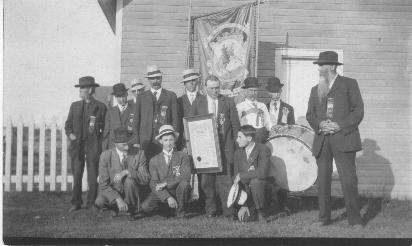
Above is my kindred, Bennett Rosamond, Grand Master of the Orange Lodge in Canada. In one days march, things will be rendered as they were. Only the Orange Order can turn back the hands of time – and restore order! Revive the Glorious Revolution on this day.
July 5th.
Make it so! Play all videos at same time.
Jon Presco
http://en.wikipedia.org/wiki/Orange_Order
Above is a photograph of Bennett Rosamond the Grand Master of the Orange Order in Canada. Bennett is with members of Lodge 389 in Lanark, or, Almonte. The image on the banner is that of William of Orange who is carried in Orange Parades. That is Bennett on the far right, looking like Gandalf, or, a Levite Prophet.
According to the History of the Rosemond Family by Leland Rosemond, the Rosamond family were members of the Orange Order in Leitrim Ireland, and fled to Canada after a Rosamond son killed a Catholic lad who was invading the Rosamond home with a gang bent on doing my kindred harm.
Bennett may have been a Freemason as well – and an Oddfellow. There is a long history of the Rosamonds belonging to Guilds. They were members of the Swan Brethren.
My grandparents, Royal and Mary Magdalene Rosamond, begat my mother, Rosemary Rosamond, and her sisters, Lilian, Bonnie, and June Rice.
Jon Presco
Representation of the People Act 1918 Prior to the passage of this act only 60% of British men had the right to vote and women had no right to vote at all. And even this previously existing bare approximation of representative democracy dated only to 1884 with the passage of Representation of the People Act 1884 which built on theSecond Reform Act of 1867 which extended the male franchise from its previous 20% level to 40%. Which means that during almost the entirety of the time that England was the dominant world political and economic power, power that was largely driven by the Industrial Revolution itself, and prided itself on its centuries old system of Representative government as expressed in the House of Commons in Parliament, it was considered right, proper and natural that only 1 man in 5 even had the smallest voice in selecting the political leadership of even that part of Government that represented the people. And this doesn’t even touch the role of the Monarchy and of the unreformed House of Lords which didn’t even pay lip service to democracy.
Commonwealth is a traditional English term for a political community founded for the common good. Historically it has sometimes been synonymous with “republic“.
The English noun “commonwealth” in the sense meaning “public welfare; general good or advantage” dates from the 15th century. The original phrase “the common-wealth” or “the common weal” (echoed in the modern synonym “public weal”) comes from the old meaning of “wealth”, which is “well-being”, and is itself a loose translation of the Latin res publica (republic)
The Reformed theologian Loraine Boettner writes “It is estimated that of the three million Americans at the time of the American Revolution, nine hundred thousand were Scotch or Scotch-Irish origin,” or Presbyterians.
Further Boettner writes that “Presbyterians took a very prominent part in the American Revolution.” Quoting Bancroft, he writes “The Revolution of 1776, so far as it was affected by religion, was a Presbyterian measure.” Further, Boettner states “So intense, universal, and aggressive were the Presbyterians in their zeal for liberty that the war was spoken of in England as ‘The Presbyterian Rebellion.’ An ardent supporter of King George III wrote home that he fixed all the blame for these extraordinary proceedings upon the Presbyterians. The prime minister of England, Horace Walpole said in Parliament that ‘Cousin America has run off with a Presbyterian parson,’ referring to John Witherspoon, signer of the Declaration of Independence.”
Last, Boettner quotes a J.R. Sizoo who tells us that “when Cornwallis was driven back to ultimate defeat and surrender at Yorktown, all of the colonels of the Colonial army but one were Presbyterians elders. More than one-half of all the soldiers and officers of the American Army during the Revolution were Presbyterians.”
Loraine Boettner concludes by simply stating “The United States of America owes much to that oldest of American Republics, the Presbyterian Church.”
British Israel students among my readers will know that the Red Hand
is the symbol of the Zarah line from Judah, reunited in the purpose
of God with the Pharez line of the Davidic monarchy through the
marriage of Milesius the Heremon, of the Zarah line, with David’s
descendant Tea Tephi, of the Pharez line, in Ireland. This Heremon
was a king of the Scarlet-thread branch of Judah and his genealogy
can easily be proved through study. The symbol of this branch of
Judah is the Red Hand, symbolising the scarlet thread placed round
the wrist of Zarah by the midwife (see Genesis 38).
Genesis 38:27-30 tells the story of Judah and Tamar’s birth of twins that would split the Judah tribe into two different Judah historical time lines.
In the story of Judah, Tamar bore twins for Judah. The first born, Zarah revealed his right hand, a scarlet thread or cord was tied around the wrist, but his brother Pharez would steal his brother’s birthright by coming out of the womb first. Pharez becomes the messianic bloodline, the golden lion nation of Judah and Zarah becomes the Gaelic Christian bloodline or scarlet (red) lion nations of Judah. This breach that took place within Judah wouldn’t be healed for 2500 years when these two blood lines of Judah would come together again in North Ireland in a planned marriage that would reunite the crown over one Judah and prepare for all the commonwealth nations to come.
http://www.mylordmysavior.com/King%20Lineage%20(Blood%20Lines).htm
Ancient Irish histories indicate there were two prominent eastern ladies—both of whom appear to have been daughters of Zedekiah—who were later connected with the people of Ireland: SCOTA and TAMAR TEPHI.
1) SCOTA was apparently the older of the two celebrated women, and some biblical scholars believe Scota was one of Zedekiah’s daughters. Scotch-Irish records explain that this eastern lady, Scota, had previously married Niul—one of Pharaoh Hophra’s mercenary soldiers—while she was living as a royal refugee (a “daughter”) under the adoptive protection of the Pharaoh Hophra, who had a royal “house” or palace at Tahpanhes, Egypt (see Jer. 33:9; 44:30). It was this Scota whose name the people of Ireland later adopted—as Ireland was subsequently called “Scotia” until the 10th century AD (Moore’s History of Ireland, vol. 1). Later that name, Scota, was applied to North Britain (i.e. Scotland) and still later Scota was applied to a province in Southeastern Canada called NOVA SCOTIA.
Notice the following account of what happened to “JACOB’S PILLOW STONE” in connection with King Zedekiah’s daughters: TEA TEPHI and SCOTA— “It [this “Pillow Stone” or “Stone of Destiny”] was saved from destruction with the Temple, was cherished as a palladium by the Jews; and, after the death of Zedekiah, was carried by a migrating colony, with ‘SCOTA the King’s daughter’ under the leadership of the Prophet Jeremiah…. It was taken to ‘The Isles of the Sea,’ and preserved as a Stone of Destiny, by the ‘People of Scota’…. Finally, it was ‘stolen’ by Edward, King of England, and placed in the Coronation Chair at Westminster Abbey where it still is” (THE STONE OF DESTINY, by F. Wallace Connon, p. 15).
The Voyage of Zarah is a historical research paper that re-examines the lost history and roots of western civilization. Zarah is a person and he is the father to the Gaelic tribes of Western Europe. Zarah’s voyage starts when he was born as a twin in 1883BC to the tribe of Judah. Genesis 38:27-30
Zarah was the first born son of Judah but his brother Pharez would breach his birthright and come out of the mother’s womb first. Pharez becomes the bloodlines of the Jews and kings over Judah and the other tribes of Israel. Zarah on the other hand was the first born but has a whole other history timeline, but remember Zarah is connected right back to this main bloodline with Judah and right back through to Jacob-Isaac – and Abraham.
Zarah are the tribes that make-up all the Gaelic – Celtic – Saxon – Norsemen tribe’s that cultivated Europe’s first civilized people and nations.
And the sons of Ju’dah; Er, and O’nan, and She’lah, and Pha’rez, and Za’rah: . Er and O’nan died in the land of Ca’naan. Genesis 46:12.
The tribe of Judah will come back into the story with the Zarah tribes starting in 583BC and different times with the connection with the Irish, Scot, Welsh and English Saxon. Also, the other tribes of Israel come into the confused story in the British Islands from about 400 BC onward in different times to our present day.
The story of the Voyage of Zarah is about the Zarah Hebrew tribes of Judah, and not about the Jews and the tribes of Israel before and after the great exodus out of Egypt. That is the history and journey of Zarah’s twin brother Pharez of Judah and the times of Moses, and onward down to David and Jesus and other 11 tribes of Israel.
TAMAR TEPHI was apparently the second of King Zedekiah’s “daughters.”
Tamar means Palm. When Tamar is combined with Tephi (Heb. “beautiful”) it means palm beautiful—that is, “Beautiful Palm.” In Irish history, Tamar Tephi was also known by the name Tea Tephi. When “Tea” (Heb. wanderer) is combined with “Tephi” (Heb. “beautiful”), we get Tea Tephi (Beautiful Wanderer). We shall soon see why this beautiful princess was called a “Beautiful Wanderer.”
Along with the Sinclairs, the Stewarts have been titled a Rex Deus family meaning they are kin to Jesus and a divine ruling lineage. In the Ulster Red Branch Knight legends, there is a lineage that descends from a Davidian King and a Egyptian princess. This legend existed hundreds of years before Dan Brown and others came along. With the revelation that the Preston family in America descends from the Stewart line that was involved in the plantations of Ulster, comes a true prophecy that brings together under one banner my fourteen year genealogical investigation that begins with these words.
“In 1825, in the village of Fenagh in county Leitrim in Ireland, a gang of Catholic youths attacked the Rosamond home. The Rosamonds were staunch Protestants. James, aged 20 (born 1805) and his brother Edward, aged 15, attempted to protect their mother. A shot was fired by Edward and a youth was dead. The boys fled to Canada. James went
to Merrickville where he worked for James Merrick as a weaver. Edward, still fearing arrest, worked his way eventually to Memphis, Tennessee.”
Almonte’s Oldest Citizen Goes To His Reward
From the Almonte Gazette
A week or two ago we announced the illness of James Rosamond, Sr., little expecting we would so soon be called upon to chronicle the news of his death which took place on Wednesday morning. The old gentleman attended the Orange gathering here on the 12th July and owing to the dampness of the day contracted a cold which was followed by an attack of bronchitis and other troubles and after the wear of so many years his constitution had not the vitality to withstand the attack of the disease and shortly after midnight the end came calmly and peacefully.
Mr. Rosamond was born near Ballinamore, County Leitrim, Ireland on the 14th Feb., 1805. His parents were Bennett and Fanny Rosamond and his father followed the three fold occupation of reed maker and linen weaver and farmer. The subject of this sketch came to Canada in 1827 with his brother. The latter died at Prescott seven or eight years ago. For about two years after coming to Canada, Mr. Rosamond lived at Ogdensburg, New York where he learned the distillery business. In 1830 he removed from New York to Carleton Place. In 1831 he was married to Margaret Wilson of Ramsay, a lady who although of naturally an amiable and retiring disposition, has proved a faithful wife and helpmate for one who has led such an active life as her husband. Some years ago Mrs. Rosamond met with an accident from which she suffered considerably for some time and which prevented her from going out much among her friends but she is still hale and hearty although beyond the allotted three score and ten years. Their marriage has been blessed with seven children, four of whom survive namely Bennett, Mary Ann (Mrs. A. Bell), William (of Cobourg), James and Rosaline (Mrs. De Hurd).
After coming to Carleton Place, Mr. Rosamond was engaged in the distilling business for about three years and then went into the sawmill and gristmill business in partnership with John McEwen. Their mill was the only one in this section of the country at that time. This partnership lasted for four years when it was dissolved and a new one formed with Messrs. R. Bell and Company. The new firm determined to extend their business and had a carding and cloth – dressmaking establishment also the only one in this part of the province. The firm rented the mills in Carleton Place from Mr. Bolton for 16 or 17 years and continued for that time in business in that village, which was then known as “Morphy’s Falls”. In the course of time Mr. Rosamond went into the spinning, weaving and manufacturing of such goods as satinettes, etoffes, etc. These enterprising early manufacturers kept constantly adding to their machinery and increasing their business and towards the close of their lease wanted to buy or rent the water power but the owner Mr. McLaren of Beckwith would do neither. Just then an employee of Mr. Rosamond came to Almonte—at that time called “Waterford”—and succeeded in forming a company known as the Ramsay Woolen Manufacturing Company. Among those who held stock in this company were John Scott and the late John Patterson who about the year 1853 or 1854 one year after the company was formed, went to California but before going, disposed of their shares in the company to Mr. Rosamond. The mill was burned shortly afterwards.
In 1856 Mr. Rosamond moved to Almonte and bought his present residence from Edward Mitcheson. After the mill was burned, a sale was called and the site—the one on which the #2 mill is built—was knocked down to the late Albert Tesky for about 90 pounds. Mr. Tesky afterwards repented of his bargain and sold the water power to Mr. Rosamond who built the #2 mill on it moving his machinery from Carleton Place to Almonte in 1857. The #2 mill was built in 1856 and additions were made to it afterwards by Messrs. Bennett and William Rosamond who put in more machinery and gradually increased its capacity. In 1861, too close applications to business beginning to tell on Mr. Rosamond’s health, he leased the business to his sons Bennett and William and afterwards sold to them. In 1860, Mr. Rosamond and his sons formed a joint stock company with capital of $100,000 to build a large mill which resulted in the erection of #3 mill. When Mr. Rosamond retired from active business he retained an interest in the #1 mill and at the time of his death was still a share holder in it. He was also fro some time in the tanning business his tannery being situated on the site of the present dye room of #1 mill. Although always widely and actively engaged in business, Mr. Rosamond did not forget his obligations as a citizen and was always ready to assume his share of public duties. He was a member of the Carleton Place School Board from 1833 until he removed to Almonte. He has been an active and useful member of the Almonte School Board for about 35 years and occupied a seat there ever since he came to town, with the exception of a year and a half (about the year 1869) when he moved to Vineland, New Jersey for the benefit of his health. He has filled the position of Justice of the Peace for the County of Lanark continuously for over a half century. He was also a life long member of the board of the Ottawa Protestant Hospital. Shortly after Mr. Rosamond took up residence in Almonte, he took an active interest in the union Sunday school which was attended by churches of all denominations. Later on he founded St. Paul’s Sunday school of which he was superintendent for over twenty years. He has always been a devoted member of the Anglican Church and was for many years church warden or lay representative to the Synod for St. Paul’s Church. He was an enthusiastic Orangeman, a strong Conservative in politics and a great admirer of the late Sir John MacDonald. Though Mr. Rosamond attained to a ripe old age he retained to a wonderful degree the use of his mental as well as physical faculties, his mind to the last being clear.
http://roughian.tripod.com/BennettRosamond.html
Bennett Rosamond
Bennett Rosamond was born on May 10, 1833 at Carleton Place, Ontario. At the age of 26 he joined the family business, the Victoria Woolen Mills at Almonte and in 1862 he took over the business from his father. He served on the township council, served as Reeve and was elected mayor of Almonte. He was elected as the federal Conservative member of parliament for the riding of North Lanark in 1892 and sat in the House of Commons until 1904.
Rosamond was a major employer at Almonte and voting days saw his employees turn out en masse to vote for him. As a major benefactor of the town he donated the money to build a hospital in Almonte which was named after him. He died on May 18, 1910 in England while preparing to return to Canada. Rosamond was a member of L.O.L. No. 389, located at Almonte and had served as master of the lodge. He also served as County Master of Lanark for a number of years.
Rosamond Memorial Hospital, Almonte, Ontario c. 1910
The Perth Courier – October 18, 1962
Lanark Orangemen Heard Sir John A. Talk Confederation In District Lodges
Local Lodge One Of Oldest In Ontario East
Sir John A. Macdonald, Canada’s first Prime Minister and “Father of Confederation” first campaigned for Confederation in the Orange lodges of Lanark and Leeds Counties. Confederation was the union of British colonies in North America as a buffer to U.S. expansionism or “manifest destiny”, which saw all North America as one great American country.
Sir John, a resident of Kingston, was an ardent Orangeman who saw the possibility of having one Federal Parliament and separate Provincial Legislatures modelled on the Orange Association, which eight years prior to Confederation had decided on such a constitution for itself.
What the Orangemen had been able to do inspired him to attempt, Sir John gladly admitted, “for the sake of the future of Canada.” Thus, Confederation was born when the Orange Order boasted 1,400 lodges and tens of thousands of members. The year was 1867.
Perth One of Oldest
Perth was there with one of the oldest Orange Lodges in Canada, L.O.L. No. 7, at Drummond Centre. Old records show how politicians stumped up-and-down the rural routes selling ideas in lodgeroom, on the street, over the fence, in parlor and country store. Only five [six] older lodges exist, LOL No. 1 at Brockville, LOL No. 2 at Pine Hill, North Leeds County, LOL No.3 at Foxboro in South Hastings, [LOL No. 4 at Toronto] LOL No. 5 in Peel County and LOL No. 6 at Kingston [the lodge Sir John joined in 1841].
Minutes of these lodges show that Canada’s first Prime Minister or his representative spoke in them all. The first Orange Grand Lodge in North America was founded in Brockville, just 40 miles from Perth, by an immigrant Irishman Ogle R. Gowan, who rose to become Member of Parliament and Colonel of Militia. He was also Grand Master of British America in 1830 – 1846, 1854 – 1855 and 1856.
Although Orange lodges existed in Canada from Wolfe’s conquest of Quebec in 1759, the first Grand Lodge warrant was only granted on April 23, 1832, signed by Field Marshal, Ernest Duke of Cumberland, Grand Master of the Empire. The warrant was brought home to Brockville and given great display about the countryside. The first Grand Secretary of the first Grand Lodge of British America was Alexander Matheson of Protestant Hill, Perth.
Thus almost 140 years after the founding of the Orange Confederacy in 1688, the Orange influence reached into the Perth area. This influence was strongest in the United Empire Loyalist, Army and Navy settlements throughout Canada, the Order having been founded on military lines to protect Protestant interests in troubled Ireland. Perth was a military settlement.
Ruling body for Lanark County Orangemen is the Imperial Grand Council of the World, with Captain Sir George A. Clark, Bart., DL, of Ireland, the Grand Master. Next comes the Grand Lodge of British America with eleven provincial bodies, of which the Grand Lodge of Ontario East is one with 25 county jurisdictions.
The Orange Association of the County of Lanark is part of Ontario East and boasts three districts with 13 primary lodges. The primary lodge is the basic unit of the Orange Order. The lodge in Perth is LOL 115 which meets at the Orange Hall on Gore Street East. Lodge Master is Herbert Campbell and secretary James Kirkham, both of Perth.
cont…..
The Grand Lodge of Ontario East has met nine times in Lanark County since 1830, in Peth 1865, 1933, 1943, in Smiths Falls 1890, 1902, 1911, 1922, 1945, in Carleton Place in 1929. His Honor Judge J.A. Scott of Perth was Grand Master of British America in 1911 – 1914. Reverend Canon J. W. R. Meakin of Almonte, currently is Honorary Grand Chaplain of Ontario East, while Lieutenant Colonel Hon. T. Ashmore Kidd of Kingston, has been Imperial Grand Master of the World, and Grand Master of British America in 1930 – 1933 and 1940 – 1947.
County Master Roy Haveron, of Perth notes a trend to larger lodges in Lanark County which prove more efficient and active. Biggest problem today is lack of publicity and dedicated organizers with the time to devote to the demands of ritual and degree work.
LOL No. 90 of Lombardy won the Duncan Alexander MacLeod trophy for the largest increase in membership – 47 per cent this year. LOL No. 1 Brockville remains the largest lodge in Eastern Ontario with over 150 members. The Orange Order has exerted an influence in Lanark far in excess of its numbers, although its numbers have never been large. It’s a grass roots movement with “few aristocrats” or people with “aristocratic notions” included in its membership. The rural influence has a leveling effect, so it seems.
What do Orangemen do? First, they support the reformed faith. Next comes strong support of British democratic ideals and parliamentary government. The Bill of Rights of 1689 is the Order’s Bible. “Equal rights for all and special privileges for none,” has been the battlecry of the Order for ages. Prime Minister John Diefenbaker used an abbreviated form of this slogan in his 1957 general election campaign.
Orangemen support benevolent causes, including two Orange homes for children. There is an active insurance program and many bands. Perth, Smiths Falls and Carleton Place boast OYB [Orange Young Briton] bands.
District Masters and Officials
District Masters: Kenneth Leacock, Smiths Falls; Wm. Evans, Pakenham; W. H. Shaw, RR 2, Perth; Secretaries, Lyle Jordan, Smiths Falls; W. A. Fulton, Pakenham; Roy Haveron, Perth.
Primary Lodges: [master and secretary], LOL 7 Drummond Centre, Edward Wright, D. A. Devlin; LOL 88 Smiths Falls, Harvey Leacock, Ken Leacock, LOL 92 Innisville, George Gardiner, Gordon James. LOL 115 Perth, Herbert Campbell, James Kirkham. LOL 190 Montague Corners, John Kidd, Elmer Fox. LOL 202 Fallbrook, Cecil Ennis, Russell Fair. LOL 378 Almonte, Glen Ireton, M. Giles. LOL 381 Franktown, Glen Irvine, Milton McCaul. LOL 512 Montague, Russel Burchill, W. Rice. LOL 529 Rusenham, Forbes Evans, E. A. Connery. LOL 749 Wemyss, Carl Larmon, L. J. Patterson. LOL 788 2nd Line of Drummond, O. P. Dowdall, J. B. Hands.
Lanark is bordered by North Leeds with three districts and eleven lodges, Carleton with eight districts and 33 lodges, Lennox and Addington with two districts and 13 lodges, Renfrew with four districts and 21 lodges.
William Henry Boulton
William Henry Boulton was born on April 19, 1812 in York [Toronto], Upper Canada, the son of D’Arcy and Sarah Ann Boulton [nee Robinson, daughter of Sir John Beverley Robinson]. Boulton was born into one of the most prominent families of Upper Canada; his grandather, D’Arcy Boulton Sr. Was chief justice of Upper Canada and his uncles included John Beverley Robinson. Boulton studied to be a lawyer and was called to the bar of Upper Canada at the age of twenty-three.
Boulton was to become one of the social leaders of early Toronto, his estate “The Grange” being the setting for many of the young city’s most prominent social gatherings. As a member of parliament for Toronto from 1844 to 1853, Boulton supported conservatives William Henry Draper and Henry Sherwood. As a member of one of the old established families he was a strong defender of the privileged position of the Anglican Church with regards to the clergy reserves and education.
Aside from provincial politics Boulton was heavily involved with Toronto affairs. He served as an alderman for St Patrick’s Ward from 1838 until 1842 and after a two year absence from municipal politics he again served as alderman for the same ward from 1844 to 1847. During this time he was elected mayor of Toronto for three successive terms, from 1845 – 1847. After his terms as Mayor Boulton continued to sit on council as an alderman in 1852 and 1858, again being elected Mayor of the city in 1858.
During his term as mayor an agreement had been made between the province and the city over the distribution of judicial powers. The Mayor and aldermen had now ceased to act as magistrates and cases were heard by police magistrates. Boulton got into a fierce argument with the chief constable of Toronto, Samuel Sherwood, and resigned as mayor. He then ran again for Mayor in 1859 in the first election that was held by popular vote, but lost to Adam Wilson.
He then retired from politics and lived at the grange. After his death on February 15, 1874, his wife continued to live there and she later married author Goldwin Smith in 1875. Today “The Grange” is owned by the Art Gallery of Ontario. Boulton had served as the Master of Enniskillen L.O.L. 387 in 1858 and was the Deputy Grand Master of Canada in 1854.
LANARK’S ORANGE LODGE.
It was in the fifties too that the first secret fraternity unfurled its Orange banner in this village. An elevated site was chosen for the Lodge room of the Loyal Orange Lodge, the exact spot being near where Mr. William Spalding’s storehouse now stands. The lodge succeeded in gathering beneath its colors a large and flourishing membership and it looked for a time at least that this was one of Lanark’s permanent institutions. But something happened one night that stopped a lodge career. From Buffam’s tavern to the lodge room the brethren cleaved the air with their discontent. An eye-witness says it was certainly a rough night and obviously he was not referring to the weather. When you hear a brother shout “Paice, bhoys, paice and brotherly love,” while he belabors you with a drum stick it is high time to call a halt and that is exactly what the Orangemen of Lanark did. They held no more meetings, the building fell into disuse and later was removed to its present stand where it serves the public faithfully day after day and is known as Darou’s bakery. The Buffam’s Tavern referred to stood where the residence of Mr. R.F. Robertson is now. At one time this building was occupied by the McLaren family as a store, the scene of many boyhood experiences of the Hon. Peter McLaren, of Perth, whose father was the merchant.
Denis de Rougemont was titled ‘The Prince of European Culture’. He was at the first Bilderberg meeting, and is considered a co-founder of the European Union. Frederich the Great granted the Rougemonts of Neufchatel a title of old nobility when he came to this area in Switzerland.
Rougemont was the Director of Congress of Cultural Freedom that employed Writers and Artists against the Soviet Block. There is a creative subconscious that may have created a psychic force that brought many to a vortex that a core group created, and was like a psychic internet. The Roza Mira of Russian is sustained outside this Western Vortex, but, subliminal messages are being exchanged by what you might call Art Angels.
Jon Presco
http://monthlyreview.org/1999/11/01/the-cia-and-the-cultural-cold-war-revisited
http://modernhistoryproject.org/mhp?Article=Kulturkampf
Rougemont, Denis (de)
8.09.1906, Couvet (Neuchâtel) – 6.12.1985, Geneva
Source Fondation Denis de Rougemont
next article
Denis de Rougemont
Biography
Denis de Rougemont was born on on September 8th, 1906 in Couvet in the Canton from Neuchâtel in Switzerland. His/her father is Pasteur. He continues studies of letters at the University of Neuchâtel between 1925 and 1930. In parallel, it starts its first voyages and remains in particular in Vienna, in Hungary and Souabe.
In 1930, it settles in Paris and becomes, within the Esprit movements and the Order New one of the founders of Personalism, at the sides of Emmanuel Mounier, Arnaud Dandieu, Robert Aron, Henri Daniel-Rops and Alexandre Marc. They were called “the nonconformists of the Thirties”. Rejecting as well Hitler as Stalin, just as nationalism and individualism, they preach the idea of an political organization, economic and social which is with the service of the Person designed like a unit at the same time distinct (the individual) and connected to the Community (the citizen), at the same time free (as an individual) and person in charge (as a citizen).
The Federalism appears the model to them which makes it possible best to link the People without giving up their diversity, and this is why they preach it. On the other hand, they reject the State-Nation centralized like mode of organization of the company.
During the years 1930, Denis de Rougemont develops the topics of Personalism through two works: Policy of the Person (1934), To think with the Hands (1936). In 1935-1936, it remains in Germany like French reader at the University of Francfort-sur-le-Main and brings back from there a very negative testimony on the Nazism, which it delivers in his Newspaper of Germany (1938). In 1939 appears the Love and the Occident which shows the influence D `a certain number of accounts mythical (of which Tristan and Iseult) on the typically Western design of an impassioned love and finally destructor, that the author opposes to the true charity.
In 1940, it is mobilized in the Swiss army and, with other personalities, it founds the League of Gothard which aims at stimulating the spirit of resistance to Hitler. Its positions being considered to be not very compatible with Swiss neutrality, it is sent on mission of conferences to the United States. Installed in New York, it publishes the share of the devil into 1942 who is a reflection on the disorders of the modern world, limed in totalitarianism and the materialism. It binds with many writers or European artists in exile (Saint-Exupéry, André Breton, Max Ernst, Marcel Duchamp, Saint-John Perse, Wystan Auden). After Hiroshima and Nagasaki, it shows, in its Letters on the atomic bomb (1946), that the nuclear weapon places the men in front of a world danger which must encourage them to exceed the idea of national sovereignty.
Returned definitively to Europe in 1947, it takes part, at the sides of the federalists, the efforts to link Europe. On August 26th, 1947, he makes the inaugural speech of the first Congress of the European Union of the Federalists (the federalistic attitude). At the time of the Congress of $the Hague (7 May 10th, 1948), he is at the same time rapporteur of the cultural Commission and writer of the Final declaration (Message to Europeans). During this Congress, the cultural Commission proposes the creation of a Center European of the Culture, tries whose seizes itself Denis de Rougemont who to this end organizes the first European Conference of the Culture (Lausanne, 8 December 12th, 1949). The Center European of the Culture is finally made up in Geneva in 1950 and placed under the direction of Denis de Rougemont.
At the same time, it is mobilized with other intellectuals against Stalinist propaganda conveying the idea of a culture to the service of the class struggle, within the Congress for the Freedom of the Culture of which he becomes President in 1952 (he will occupy this function until 1966).
In charge of the Center European of the Culture, Denis de Rougemont provided the foundations, in December 1950, of an organization gathering the European scientists working on nuclear energy: it will be the CERN. He was at the origin of the first association joining together the very first Institutes of European Studies, which was drawn up in Geneva in 1951 (it existed until 1991), as well as European Association of the Festivals of Music. In the sides of Robert Schuman, it took part in the creation of the European Foundation of the Culture (Geneva, December 16th, 1954) which was transported to Amsterdam in 1957 when it always continues its activities.
He undertakes a deliberation on the cultural features which characterize the Occident compared to other civilizations. It is the topic of its work the Western Adventure of the Man (1957) and the think tank on the “dialog of the cultures” (formulates begun again later by UNESCO) which it organizes as from 1961. This same year, it publishes a work on the history of the European idea entitled Twenty-eight centuries of Europe. In 1963, it founds in Geneva the Institute of European Studies which will be incorporated in the University in 1992.
From the years 1960, its activity will concentrate on two topics: the rise of the areas and the transborder areas which carries out it towards the idea of a federalism being combined to the ideal of “Europe of the Areas”; destruction of the environment which leads it to call in question the finalities of our companies. He sees in the emergence of areas to human size at the same time an alternative to the State-Nation and the chance to reintroduce in our companies the concept of responsibility so essential to safeguarding for the environment. Ecology and areas are in the center of its last two major works: Open letter with Europeans (1970), the Future is our business (1977).
One will also raise permanence of his reflection on the technical development and his consequences, since his work on the atomic bomb going back to 1946 until data processing (article “Information is not to know” in 1981), via civil nuclear energy (the CERN).
Denis de Rougemont dies in Geneva on on December 6th, 1985.
The Foundation Denis de Rougemont
One finds on the site of the Foundation Denis de Rougemont of the many information on the writer, in particular of the reference books, the images and bibliography.
The Idea of Europe in the work of Denis de Rougemont and the French non-conformists
09/03/2009 Leave a comment
Denis de Rougemont was a main thinker of the so-called non-conformistes des années trente, a movement of young intellectuals that appeared in France at the beginning of the turbulentcover 1930s, in opposition to both the individualism of liberalism and the collectivism of the Soviet Russia. [1] The main bulk of their work was published between 1930-34 and was concentrated around three separate currents:
◾ The founders and members of L’Ordre nouveau. An intellectual movement established by the Russian migrant Alexandre Marc (born in 1904 in Odessa as Aleksander Markovitch Lipiansky), its goal was to prepare the conditions for a ‘spiritual rebirth’ of the European culture. Its effort was concentrated on going beyond such dualistic divisions as nationalism-internationalism and capitalism-communism. Its inspirations came, among other sources, from the Christian existentialism of Kierkegaard, the federalism of Proudhon, the great critique of Modernity Nietzsche, or from the historicism of Péguy. The thinkers who were a part of L’Ordre nouveau also included Robert Aron, Arnaud Dandieu, Daniel-Rops, Jean Jardin and finally Denis de Rougemont.
◾The Catholic revue L’Esprit of Emmanuel Mounier, founded in 1932. From the beginning it evolved in tight collaboration with L’Ordre nouveau. In reaction to the events of the Second World War it radically shifted to the political left , in order to slowly move back to more moderate positions of the ‘New Left’, under which it still publishes to this date.
◾Young thinkers of Jeune Droite, who were mostly dissidents of the French reactionary and monarchistic right Açtion française. These thinkers included Jean de Fabrègues, Jean-Pierre Maxence and Thierry Maulnier.
Furthermore, Ferdinand Kinsky also includes among them those thinkers, from whom the non-conformists drew their inspiration: Stern, Blondel, Buber, Nédoncelle, Karl Barth, Gabriel Marcel, Jacques Maritain or Nicholas Berdiaeff.[2]
Although the non-conformists came from different backgrounds and their thinking took on some issues rather opposing positions, they all subscribed to the doctrine of ‘personalism’, and, consequently, to federalism. The non-conformists converged on the point that
‘man was above all not an “individual.” He is a “person,” that is both responsible and free, committed and autonomous, a being in himself, but related to his fellowmen by his responsibility’.[3]
As a person, human being is not a lonely monad, not even a rational being, which could exist outside of society, but a social entity whose nature is fulfilled only by sharing his life in common with others. To live within a society does not mean to be enclosed in a ‘homogeneous’ nation-state, but to be a part of multiple and overlapping ‘intermediary’ communities, which are most naturally formed around family, territory, or profession. For the non-conformists/personalists, these intermediary communities both historically and philosophically ultimately share the common European ‘well’ from which they draw their actual particular ideas and traditions. Europe and its culture for them necessarily precede nations and nation-states. The thinkers such as the Schlegels or Herder constructed the idea of a self-sufficient nation from already present, primordial European philosophical and historical traditions. The English historian Christopher Dawson best summarises this position in his 1932 work The Making of Europe, when he notes that
‘The evil of nationalism does not consist in its loyalty to the traditions of the past or in its vindication of national unity and right of self determination. What is wrong is the identification of this unity with the ultimate and inclusive unity of culture which is a supernatural thing.
The ultimate foundation of our culture is not the national state, but the European unity’.[4]
The nation-state was thus only one realised possibility of the European culture. A peculiar thing about nationalist movements was that they consciously denied the notion of their own continuity and grounding in the common European history and philosophical thought. Martin Heidegger would say this was a perfect manifestation of the ‘metaphysics of subjectivity’ – they picked up one particular set of characteristics out of their European heritage and by intellectual sleight of hand, suppressing the memory of their nations continuity with other European sources,[5] argued for their ‘homogeneity and cultural self-sufficiency’.
The French thinker Alain de Benoist recently argued from the same perspective, when he distinguished our ‘objective’ history as ‘a pile of representations of identity of past times and past protagonists’,[6] from our actual-assumed identity, whose dimension is always political since it is based on the projection of our past towards the future. In other words, our actual identity (in the 19th and 20th c., it was that of nations and nation-states), always grounds the collective ‘I’ in the past, based on values and necessities of the present and possibilities of the future. As Alain de Benoist adds, ‘memory screens [our timely, historical identity] and retains what conforms to its idea of the past and to the image it wants to give in order to give it a meaning’.[7]
Diversity of European identities
The purpose of Denis de Rougemont’s book The Idea of Europe is precisely to rip off our identity from the grip of the present and selective memory of nation-states and ground it in the timely and space-bound objective narrative of Europe. Rougemont’s preface to the book also forms the general leitmotif that weaves through the whole work:
‘ Europe is much older than the European nations. Their lack of unity and their ever more illusory claims to absolute sovereignty endanger its very existence. If only they could unite, Europe would be saved, and with it all that remains valuable in its richly creative diversity’.[8]
titian_rape_of_europa
The Rape of Europa by Titian
‘from that time onward the name of Europe and the concept of Europe will recur in even more solemn contexts down to the Carolingian Empire, in apostrophes to the Pope, in ecclesiastical panegyrics, in prose and verse chronicles, and in the lives of the saints’.[12]
The final step was taken with Charlemagne, whose dominium was called ‘Europe vel Regnum Caroli’ and on whom his court poet Angilbert bestowed the titles of ‘head of the world . . . summit [or tiara] of Europe . . . supreme father’.[13] Europe thus becomes a political entity, which is not merely constructed as one of the contemporary three divisions of the map of the world (Europe, Libya or Africa, Asia), it is finally an ‘autonomous entity, endowed with spiritual virtues’.[14]
As we know however, this was a premature spring and the fragmentation of Charlemagne’s empire under his three sons soon followed, as if in the anticipation of the things to come in the period from the 17th to 20th century. On 434 pages, Denis de Rougemont continues to recount various conceptualisations of Europe that followed. Nevertheless, what is probably the most intriguing section of the book is part seven,[15] where he tries to mend together various 20th century historians and thinkers to give us an idea what ‘European identity’ means, if it went through such diverse historical manifestations.
Rougemont’s conceptualisation of European identity
First of all, through his overview of different conceptualisations of Europe, Rougemont lead us to reject the idea that there could be one ‘ true’ atemporal European essence, which could be taken as the lowest ‘common denominator’ of everything European.[16] Europe is above all the totality of its representations – and a European is in the first instance the one who finds in its diversity something that resonates with his ‘present I’. The first step in the formation of any identity is thus conscious self-identification, finding one’s possibilities not by ‘returning to the sources’, but by resorting to the sources in order to discover how do they fit into one’s present and future. It might be therefore said that there are ‘two Europes’, the one which is philosophical and historical, i.e., the one which provides us through its totality with different representations of what it has meant to be a European, and the other which is inherently bound to politics. The latter is dependent on the way one answers the question of what one wants Europe to be – 0n the way how does one ‘chooses’ one’s identity from the possible sources. In other words, in one way Europe (‘unconsciously’) already ‘is’, but in the other way it is still dormant, waiting to be appropriated as a political project – consciously adopted as a part of our own present identity. Only when Europe materialises through the political process as a cultural entity, it will be possible to ‘grasp’ it and built upon it in our social life in new ways.
This idea of ‘two Europes’ is in fact very close to the constitutive or expressivist theory of language of Herder. Its importance was recently recognised by the Canadian communitarian thinker Charles Taylor.[17] Herder, and through him Taylor, argued that the language not only describes the reality (‘what is already there’, on the background), as such theorists as Condillac claimed, but also constitutes and recreates it anew, under a different perspective. For Condillac or Locke, linguistic expression was always linked to some pre-existing content, to the idea that ‘at each stage of [linguistic] process, the idea precede[d] its naming, albeit its discriminability results from a previous act of naming’.[18] Herder, however, adds to the language a new, ‘expressive’ dimension, claiming that the interlocution not only describes, but that ‘it also open[s] possibilities for us which would not be there in its absence’.[19] In other words, by saying something, we do not only describe what is already there, but also shape it to a new dimension. By creating a political Europe, we do not only re-represent what is already there, but we are giving Europe a new dimension by the creative process itself.
Perhaps this was also a reason why Heidegger in his later thought credited the poetry for allowing us to temporally ascend to the ‘authentic’ Being. As one of Heidegger’s interpreters Richard Polt notices, ‘if Heidegger is right, then our most authentic relation to language is poetic. Instead of using language as a tool for representation, we should respect it as a rich source of poetic revelation’.[20] The poet thus represents an authentic existence – instead of using old words and worn out meanings, he ‘appropriates’ the reality in relation to his own person. Does it mean that all great minds who try to build Europe politically are also poets?
The Abduction of Europa by Rembrandt (1632)
The Abduction of Europa by Rembrandt (1632own person.
This excurse to the theory of language might help us appreciate what Denis de Rougemont is ultimately suggesting in his search for ‘the’ European identity. Although there are undeniable sources of European culture such the ancient Greece, Rome and Christianity, the Celts, or the ancient German tribes, what Europe is for us will in the last instance depend on what do we want it to be. It is true that the most of the European thought arose as the positive or negative reaction to the ancient Greeks, be it the Romans with their sombre gravitas who unsuccessfully tried to emulate the joyous Greek spirit, or the Christians who upheld the rational Apollo at the expense of Dionysos. Nevertheless, in the last instance it always depends on ourselves whether we identify with these sources or not. Paul Valéry for instance felt closest to the Greeks, claiming that
‘what we owe to Greece is perhaps what has most profoundly distinguished us from the rest of humanity. To her we owe the discipline of the Mind, the extraordinary example of perfection in everything. To her we owe the method of thought that tends to relate all things to man, the complete man. Man became for himself the system of reference to which all things must in the end relate. He must therefore develop all the parts of his being and maintain them in a harmony as clear and even as evident as possible. He must develop both body and mind’.[21]
Denis de Rougemont would have certainly agreed with Valéry. One might even argue that personalism itself – with its conception of a person as against the liberal idea of a self-sufficient individual, is the conscious adoption of the Greek heritage on the part of the non-conformists. Rougemont keenly notices that our Greek heritage has become in the recent years more important, arguing that
‘the revival of our interest in things Greek is reflected in the twentieth century by the most varied symptoms: discovery of the pre-Socratic philosophers . . . the vogue for mythology (Freud’s Oedipus complex, the Ulysses of Joyce or Kazantzakis, Spitteler’s Prometheus, Gide’s Theseus, Cocteau’s Orpheus, etc); revival of the themes and titles of Greek tragedy by many playwrights, poets, and composers (“Choephores and Eumenides,” by Claudel and Darius Milhaud, to mention only one example, re-created the sacred thrill of the ancient drama, of which a poet like Racine retained only the plot); rediscovery of the secret of the Doric style; passionate researches into the mystery religions . . .[22]‘.
Philosophically and historically, as Denis de Rougemont shows us in The Idea of Europe, we therefore already are Europeans. Politically and in our memory, some still consider themselves to be enclosed within ‘homogeneous’ national entities and deny their shared European roots. Only the future will shows us, however, whether we will also manage to appropriate our identity politically.

 Rosamond Press
Leave a comment