 After Elizabeth says her eight year old son will be named John, her husband, Zachariah recites ‘Hanna’s Prayer’ that is tradtionally a song sung by Jewish WOMEN – and not MEN!
Zachariah is a Jew, and never was a Christian. This is true of Elizabeth who calls her son Jehoannan ‘the grace of Jehova’ Hannah and Anna means “grace” and are found in the name Jehoannan. Hannah, Anna, and Jehoannan, were Nazarites, filled with the Holy Spirit. So was Samuel, the son of Hannah, when he was a child.
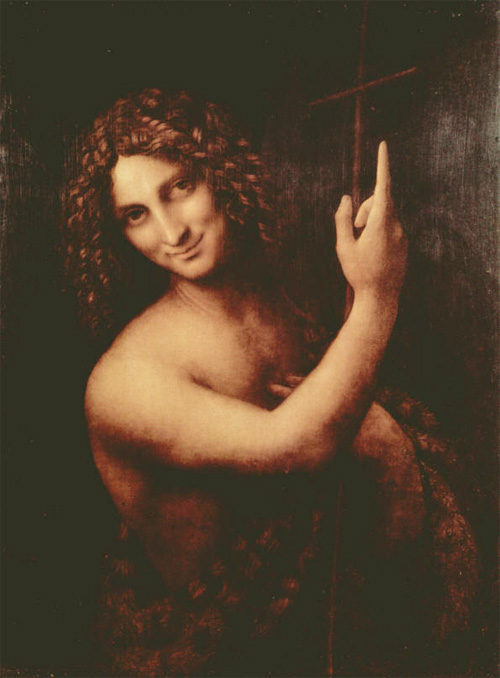
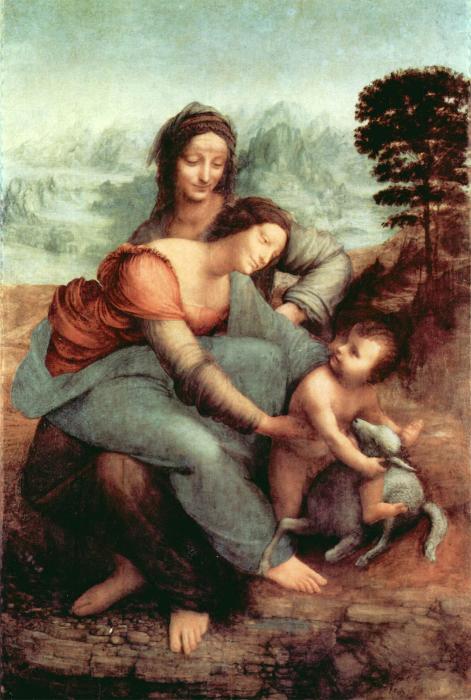
Leonardo Da Vinci was a Jehoanite, who believed John was the real Messiah, and Jesus is an invention. Anna looks like his rendering of John the Baptist. Did John have a wife, and any children?
Mary is seated on her mother’s lap, like a wife. Is this John and his wife and child?
Since I was a teenager I wondered if I was the reincarnation of Leonardo Da Vinci. God surrounded me with beautiful models.
Why doesn’t Elizabeth recite the ‘Mother’s Prayer’ like her cousin Mary does? Why didn’t Zachariah marry Mary who was not “old in years” like her cousin, Liz. Zacahriah served in the Holy of Holies, while Joseph made wooden chairs. Mary married beneath her. Not so Liz – who must have noticed! Most cousins are around the same age. What’s the big deal about Mary’s son? Surely Zacahriah believes he will ammount to nothing.
The term ‘Virgin Birth’ is applied to women old in years who never cborn a child. God had shut their womb, even though they had intercourse. When these Virgin Nazarite Women took the Vow of the Nazarite – God opened their wombs!
One scholar suggested Leonardo’s Mona Lisa – was a man!
Jon Presco
Copyright 2013
Was the Mona Lisa a man?
ROME—An Italian researcher says the main influence and model for the “Mona Lisa” was a male apprentice of the artist Leonardo da Vinci.
Gian Giacomo Caprotti, known as Salai, worked with Leonardo for years starting in 1490. Art historian Silvano Vinceti said Wednesday that several Leonardo works, including “St. John the Baptist,” were based on Salai and that similarities with the “Mona Lisa’s” nose and mouth were evident.
This is one of many theories surrounding the identity of the “Mona Lisa,” ranging from a self-portrait to a Florentine merchant’s wife.
It is not the first time Salai’s name has been mentioned as a possible model. Vinceti insists there were various sources of inspiration at various stages and that the painting is full of symbolic meanings.
1 SAMUEL 2:1-10 – HANNAH’S SONG
Summary
Hannah’s song of praise introduces several themes that will appear in the books of Samuel. The song serves as a model for the Magnificat in Luke 1:46-55.
Analysis
Hannah’s song, a later poetic piece, has been inserted into the narrative. This poem, a national thanksgiving, is only tangentially related to Hannah’s situation in verse 5b, where “the barren has borne seven.” The reference to “his king” (v. 10) also indicates that the poem is later than its setting.
Nevertheless, this marvelous song beautifully expresses Hannah’s transformation by contrasting her sad song, lamenting her childlessness (1:10-11), with this glad song, praising God for the gift of her son. This movement from sad song to glad song, lament to praise, is foundational to the Psalter and, indeed, to biblical theology as well. The source of her joy is found in the Lord throughout the song. It is the Lord who has triumphed, and the Lord who brings about the reversal of situation that will form the backbone of the following narrative.
Hannah’s song should also be seen in its relation to two other scriptural songs:
1. David’s song (2 Samuel 22), coming near the end of 2 Samuel, and Hannah’s song form an inclusio or framework around the books of Samuel, attesting to their original unity. Among the similarities are the following:
• both begin with the Hebrew word “horn” as a metaphor for “strength,” call God “Rock,” and speak of God’s “deliverance” (1 Samuel 2:1-2; 2 Samuel 22:2-3)
• both have references to “the grave/Sheol” (1 Samuel 2:6; 2 Samuel 22:6) and “thunder” (1 Samuel 2:10; 2 Samuel 22:14)
• both end by juxtaposing “his king” with “his anointed” (1 Samuel 2:10; 2 Samuel 22:51)
2. The Magnificat (Luke 1:46-55), whether sung by Mary or Elizabeth, also strongly echoes Hannah’s song:
• Hannah, Mary, and Elizabeth all became pregnant in miraculous ways
• all three dedicated their sons (Samuel, Jesus, and John the Baptist) to God’s service
• the songs were offered in response to God’s gift of these sons
• of more significance, however, is the repeated theme of God’s reversal of fortune by bringing down the powerful and raising up the lowly (1 Samuel 2:4-5, 7-8; Luke 1:52-53).
The Magnificat (Latin: [My soul] magnifies) — also known as the Song of Mary or the Canticle of Mary — is a canticle frequently sung (or spoken) liturgically in Christian church services. It is one of the eight most ancient Christian hymns and perhaps the earliest Marian hymn.[1][2] Its name comes from the first word of the Latin version of the canticle’s text.
The text of the canticle is taken directly from the Gospel of Luke (Luke 1:46-55) where it is spoken by the Virgin Mary upon the occasion of her Visitation to her cousin Elizabeth.[1] In the narrative, after Mary greets Elizabeth, who is pregnant with the future John the Baptist, the child moves within Elizabeth’s womb. When Elizabeth praises Mary for her faith, Mary sings what is now known as the Magnificat in response.
Within Christianity, the Magnificat is most frequently recited within the Liturgy of the Hours. In Western Christianity, the Magnificat is most often sung or recited during the main evening prayer service: Vespers within Roman Catholicism and Lutheranism, and Evening Prayer (or Evensong) within Anglicanism. In Eastern Christianity, the Magnificat is usually sung at Sunday Matins. Among Protestant groups, the Magnificat may also be sung during worship services.
Contents
[hide]
• 1 Context
• 2 Text
o 2.1 Greek
o 2.2 Latin
o 2.3 English
2.3.1 Douay-Rheims
2.3.2 Book of Common Prayer
2.3.3 The Divine Office
2.3.4 The Liturgy of the Hours (ICEL)
2.3.5 Common Worship
2.3.6 Lutheran Divine Service
• 3 Liturgical use
• 4 Musical settings
• 5 Society and politics
• 6 See also
• 7 References
• 8 External links
[edit] Context
Mary’s Magnificat, celebrated only in Luke’s Gospel, is one of four hymns, distilled from a collection of early Jewish-Christian canticles, which complement the promise/fulfillment theme of Luke’s infancy narrative. These songs are Mary’s Magnificat; Zechariah’s Benedictus (1:67-79); the angels’ Gloria in Excelsis (2:13-14); and Simeon’s Nunc Dimittis (2:28-32).In form and content, these four psalms are patterned on the “hymns of praise” in Israel’s Psalter. In structure, these songs reflect the compositions of pre-Christian contemporary Jewish hymnology. The first stanza displays graphically a characteristic feature of Hebrew poetry—synonymous parallelism—in ascribing praise to God: “my soul” mirrors “my spirit”; “proclaims the greatness” with “has found gladness”; “of the Lord” with “in God my Savior.” The balance of the opening two lines bursts out into a dual magnificat of declaring the greatness of and finding delight in God. The third stanza again demonstrates parallelism, but in this instance, three contrasting parallels: the proud are reversed by the low estate, the mighty by those of low degree, and the rich by the hungry. [3]
Although there is some scholarly discussion of whether the historical Mary herself actually proclaimed this canticle, Luke portrays her as the singer of this song of reversals and the interpreter of the contemporary events taking place. Mary symbolizes both ancient Israel and the Lucan faith-community as the author/singer of the Magnificat.[3]
The canticle echoes several Old Testament biblical passages, but the most pronounced allusions are to the Song of Hannah, from the Books of Samuel (1Samuel 2:1-10). Scriptural echoes from the Torah, the Prophets and the Writings complement the main allusions to Hannah’s “magnificat of rejoicing” in l Samuel 2:1-10.[3] Along with the Benedictus, as well as several Old Testament canticles, the Magnificat is included in the Book of Odes, an ancient liturgical collection found in some manuscripts of the Septuagint.
LUKE 1:46-55
New International Version (NIV)
MARY’S SONG
46 And Mary said:
“My soul glorifies the Lord
47 and my spirit rejoices in God my Savior,
48 for he has been mindful
of the humble state of his servant.
From now on all generations will call me blessed,
49 for the Mighty One has done great things for me—
holy is his name.
50 His mercy extends to those who fear him,
from generation to generation.
51 He has performed mighty deeds with his arm;
he has scattered those who are proud in their inmost thoughts.
52 He has brought down rulers from their thrones
but has lifted up the humble.
53 He has filled the hungry with good things
but has sent the rich away empty.
54 He has helped his servant Israel,
remembering to be merciful
55 to Abraham and his descendants forever,
just as he promised our ancestors.”
Hannah praises Yahweh, reflects on the reversals he accomplishes, and looks forward to his king.
Verses 4-5 contains three reversals. Stanley D. Walters notes that one is a “reversal of macho male prowess”, one a “reversal of female longing” and one is “gender-neutral and universal”.[1]
There is a movement in this song from the particular to the general. It opens with Hannah’s own gratitude for a local reversal, and closes with God’s defeat of his enemies – a cosmic reversal.[2]
Through the theme of reversal, the Song of Hannah functions as an introduction to the whole book. Keil and Delitzsch argue that Hannah’s experience of reversal was a pledge of how God “would also lift up and glorify his whole nation, which was at that time so deeply bowed down and oppressed by its foes.”[3]
The reference to a king in verse 10 has provoked considerable discussion. A. F. Kirkpatrick argues that this does not imply a late date for the song, since “the idea of a king was not altogether novel to the Israelite mind” and “amid the prevalent anarchy and growing disintegration of the nation, amid internal corruption and external attack, the desire for a king was probably taking definite shape in the popular mind.”[4]
Walter Brueggemann suggests that the Song of Hannah paves the way for a major theme of the Book of Samuel, the “power and willingness of Yahweh to intrude, intervene and invert.”[5]
[edit] Identity of persons referred to in the song
[EDIT] SAMUEL
According to some contributors to the Classical Rabbinical literature, the first half of the poem was a prophecy, predicting Samuel’s later role as a prophet, that her great grandson would be a musician in the Jerusalem Temple, that Sennacherib would destroy the Kingdom of Israel, that Nebuchadnezzar would fall from power, and that the Babylonian Captivity would come to an end.[6]
[EDIT] SAUL
This section needs additional citations for verification. Please help improve this article by adding citations to reliable sources. Unsourced material may be challenged and removed. (March 2008)
According to some textual scholars,[citation needed] the Song of Hannah actually refers to the birth of Saul, with Samuel’s name having been substituted awkwardly for Saul in the preceding narrative; the text is sometimes considered by biblical scholars to be more likely to have originally been a song of praise directed at a king than a prayer referring to the birth of a prophet. Its seemingly non-prayer-like nature was noticed by classical scholars, who believed that Hannah’s prayer was silent and unrecorded, and that the Song of Hannah was what was said afterwards.[7]
[EDIT] DAVID
Although the “king” of verse 10 is left unspecified, the blessing to the king and to the anointed forms a clear parallel with 2 Samuel 22, which finishes with Yahweh being a tower of salvation to his king, and showing mercy to his anointed (2 Samuel 22:51).
[edit] Use
In Judaism the song of Hannah is regarded as the prime role model for how to pray, and is read on the first day of Rosh Hashanah as the haftarah. The poem has several features in common with the Magnificat, which was sung in early Christian circles (and continues to be regularly sung or said in many Christian denominations). These common features include the themes, and the order in which they appear; many textual scholars believe that the Magnificat is essentially just a copy of the Song of Hannah, together with part of a previous prayer of Hannah referring to herself as a handmaiden (1 Samuel 11a), which have been paraphrased to be more succinct.
The Song of Hannah is also known as the “Canticle of Anna”, and is one of seven Old Testament canticles in the Roman Breviary. It is used for Lauds on Wednesdays.[8]

 Rosamond Press
Leave a comment