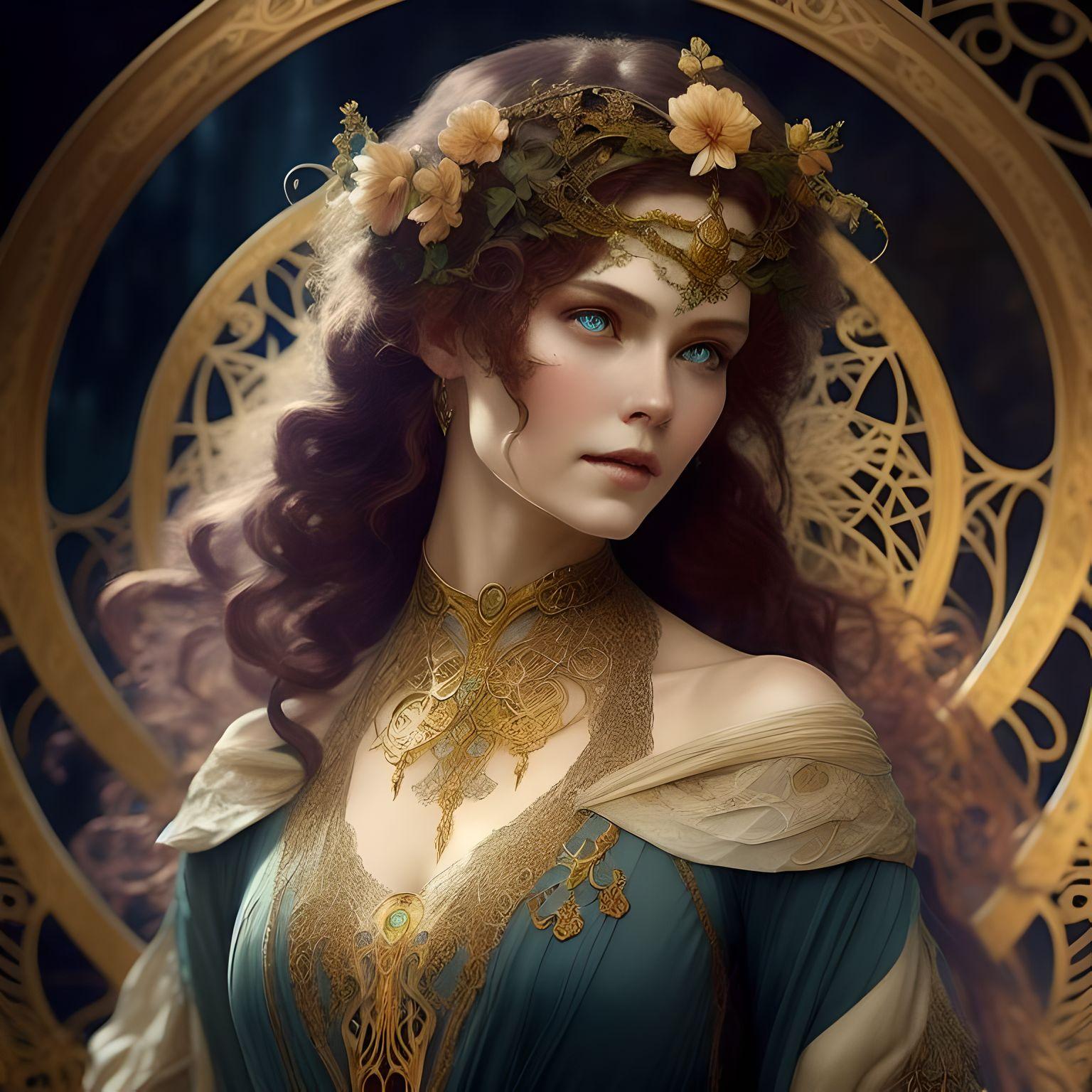
Rosamond – Rose of the World – AI by John Presco 2024
My novel ‘The Royal Janitor’ was pointing towards Trump and his Zionist Christians as being the Real Enemy of the United Kingdom!
The woman in my painting is….Rosamunde! She is carrying a crystal ball that is
ROSAMUNDI
Dreamer Jon
Rosamond, 1631-? BC (the Frisians in Western Europe revolted and became the Celts)
Finn Folcwalding, (semi-legendary)
Audulf, 600
Adgillus I (Aldegisel I), ?-680
Radbod I (Redbad I), 680-719
Poppo, 719-734
Adgillus II (Aldegisel II)
Gundebold
Radbod II (Redbad II)
Britain is facing the most severe energy shock since the early 1970s, but have no fear: the government has a plan. Details of said plan are still a little sketchy, but will be unveiled in the fullness of time. No need to panic. Keep calm and carry on.
The Rose of the World: Rosamund Clifford
One of the most enigmatic royal mistresses in English history was Rosamund Clifford, the favorite and long-time mistress of King Henry II of England. But she has always been surrounded in mystery, and her life and relationship with the king and his jealous wife, Eleanor of Aquitaine, has always been the stuff of legends.
Often called “the Fair Rosamund” or “the Rose of the World”, Rosamund Clifford was famed for being both very beautiful and desirable. She was born sometime in 1150, one of the six children of a marcher lord named Walter de Clifford and his wife Margaret de Tosny. The family resided at the Clifford Castle in Herefordshire, England, and it was here on a visit that King Henry met the teenage Rosamund for the first time. From there, a passionate affair began between England’s king and the beautiful Rosamund.
Rise up – my Wolfen People of the North!
Seer Jon
Icelandic Tale of Jon and Rosamunda
Posted on June 12, 2018 by Royal Rosamond Press
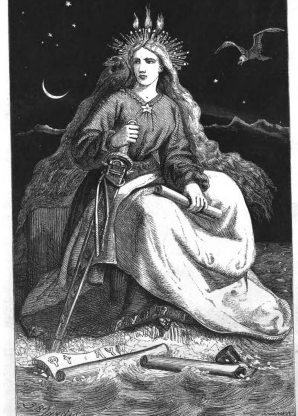
I have come by a rare book of Icelandic Tales. Two of these stories are about Jon and Rosamunda. This books shows me the Riddles of the Runes and how to invoke enchanting spells that are linked to the early church. You can see just a part of these magic spells washed up on the shore at the feet of the woman who will go unnamed. She sits on a rock by the sea. She knows the story of how Jon and Rosamond died on the seashore. They were reborn so this tale would never be lost. J.R. Tolkien was inspired by Icelandic Lore. We will live…..forever more!
Add to this the story of Jon and Rosamond in the Oera Linda Books, then, Tolkien’s dream of an Atlantian People, has come true. We will always – be! We are the Keepers of the Book. All good tales must come through us from here on. We will be bigger than Amazon. I own the Lost Code, and I can see the future in dreams and day dreams, as I have told you. I am Dream Jon.
Yes, that is Queen Rosamunda holding a scroll of my chivalric tale. She is my muse. This is why I need a winged muse to help me see. Now do you believe me! Her dress is blue.
I found Dream Jon after my last post. Amazing!
Jon Presco a.k.a. ‘Dream Jon’
Copyright 2018
Drauma-Jóns saga
From Wikipedia, the free encyclopedia
Jump to navigation Jump to search
Drauma-Jóns saga (the story of Dream-Jón) is one of the medieval Icelandic chivalric sagas, written in Old Norse around the early fourteenth century.[1] It is a comparatively short work compared to others of the genre, and is really more an exemplum than a saga, similar in this respect to the chivalric saga Clarus saga and the ævintýri (‘exempla’) associated with Jón Halldórsson.[2] The work has been attributed to the monk Bergr Sokkason, abbot of Munkaþverá; at any rate it seems characteristic of the work of the North Icelandic Benedictine School.[3] It was a very popular story, to judge by the number of surviving manuscripts discovered: five on parchment and 45 on paper, with one prominent manuscript being AM 510 4to.[4] The tale may have Oriental origins.[5]
Contents
[hide]
Synopsis[edit]
Kalinke and Mitchell summarise the saga thus:
The saga relates the fortunes of Jón, a young farmer, who has the gift not only of interpreting dreams, but of divining the dreams of others before they are told. Earl Heinrekr of Saxland, who also interprets dreams, envies Jon’s superior ability. By eating Jón’s heart, the earl hopes to acquire Jón’s gift, so he commands his wife Ingibjǫrg to murder Jón in his sleep, cut out his heart, and prepare it as food for a meal. Ingibjǫrg spares Jón, however, and substitutes the heart of a dog. A waxen image of Jón is buried in his stead. The earl’s treachery comes to light when his brother-in-law, the emperor of Saxland, arrives seeking interpretation of an unusual dream. He learns the truth about Jón from Ingibjǫrg. Subsequently, the earl is banished, while Jón receives the earldom and weds Ingibjǫrg.[6]
Manuscripts[edit]
The three earliest manuscripts of the saga, all dating from c. 1400, are AM 335 4°, AM 567 4°, and AM 657 4°. All appear to derive independently from an earlier version of the saga, as do many of the later manuscripts. A complete stemma has not been formulated.[7] Kalinke and Mitchell identified the following manuscripts of the saga:[8]
The famed author of The Lord of the Ringstrilogy and other subsequent novels about the same fantasy world, J. R. R. Tolkien, was very much inspired by Iceland. Aspects of the landscape, the language, folk tales, and Norse mythology were influential in shaping the legendary fantasy world of Middle Earth. Tolkien had an Icelandic nanny from the West Fjords who lived with the author and his family in the early 1930s in Oxford, England. It was through the nanny that the author became further acquainted with Icelandic folk tales and mythology and was able to practice Icelandic. The author began writing The Hobbitduring this time.


The famed author of The Lord of the Rings trilogy and other subsequent novels about the same fantasy world, J. R. R. Tolkien, was very much inspired by Iceland. Aspects of the landscape, the language, folk tales, and Norse mythology were influential in shaping the legendary fantasy world of Middle Earth. Tolkien had an Icelandic nanny from the West Fjords who lived with the author and his family in the early 1930s in Oxford, England. It was through the nanny that the author became further acquainted with Icelandic folk tales and mythology and was able to practice Icelandic. The author began writing The Hobbit during this time.
We now come to the History of Jon.
Jon, Jôn, Jhon, Jan, are all the same name, though the pronunciation varies, as the seamen like to shorten everything to be able to make it easier to call. Jon—that is, “Given”—was a sea-king, born at Alberga, who sailed
p. 92 p. 93
from the Flymeer with a fleet of 127 ships fitted out for a long voyage, and laden with amber, tin, copper, cloth, linen, felt, otter-skins, beaver and rabbit skins. He would also have taken paper from here, but when he saw how Kalta * had destroyed the citadel he became so angry that he went off with all his people to Flyburgt, and out of revenge set fire to it. His admiral and some of his people saved the lamp and the maidens, but they could not catch Sijrhed (or Kalta). She climbed up on the furthest battlement, and they thought she must be killed in the flames; but what happened? While all her people stood transfixed with horror, she appeared upon her steed more beautiful than ever, calling to them, “To Kalta!” Then the other Schelda people poured out towards her. When the seamen saw that, they shouted, “We are for Min-erva!” from which arose a war in which thousands were killed.
At this time Rosamond the mother, who had done all in her power by gentle means to preserve peace, when she saw how bad it was, made short work of it. Immediately she sent messengers throughout all the districts to call a general levy, which brought together all the defenders of the country. The landsmen who were fighting were all caught, but Jon with his seamen took refuge on board his fleet, taking with him the two lamps, as well as Minerva and the maidens of both the citadels. Helprik, the chief, summoned him to appear; but while all the soldiers were on the other side of the Scheldt, Jon sailed back to the Flymeer, and then straight to our islands. His fighting men and many of our people took women and children on board, and when Jon saw that he and his people would be punished for their misdeeds, he secretly took his departure. He did well, for all our islanders, and the other Scheldt people who had been fighting were
p. 94 p. 95
transported to Britain. This step was a mistake, for now came the beginning of the end.
Frya, ?-2194 BC (eponymous ancestress of the Frisians, who supposedly inhabited all of Northern and Western Europe)
Fasta, 2194-after 2145 BC (appointed by Frya when the latter ascended to the stars during a terrible flood)
Medea
Thiania
Hellenia
(unknown)
Minna, fl. 2013 BC (faced an invasion of Finns from the east, who settled in the Frisian lands in Scandinavia)
(unknown)
Rosamond, 1631-? BC (the Frisians in Western Europe revolted and became the Celts)
Finn Folcwalding, (semi-legendary)
Audulf, 600
Adgillus I (Aldegisel I), ?-680
Radbod I (Redbad I), 680-719
Poppo, 719-734
Adgillus II (Aldegisel II)
Gundebold
Radbod II (Redbad II)
FROM GODDESS TO KING
A History of Ancient Europe from the
OERA LINDA BOOK
By Anthony Radford
CHAPTER 7
KALTA AND THE ORIGINS OF THE CELTS
Thischapter is the story of Rosamond, Kalta and the early years of Minerva however standard history has very little to say about these historical personages. Their influence on the course of Europe and the Mediterranean was enormous, affecting everything that has followed for thousands of years. Of Rosamond nothing is known except for a namesake, Fair Rosamond, the mistress of King Henry II who has been endowed with many legends and dubious stories beyond her station. Kalta is not remembered but the Celts who were named after her have various “historical” descriptions. The Celtic language is divided into the Gaulish or continental version, that was largely supplanted and Latinized by the Roman occupation, and the various branches that are still spoken in parts of the British Isles; Irish, Gaelic, Welsh, Cornish and Breton. The Celtic religion was presided over by the Druids and reflects an ancient Indian culture, strengthening the belief in the Indo-European connection. Their origins have been variously placed somewhere in the east, through ancient German invasions as though a politically important people who rose to common language and power against the Romans, who are our only historical source, have to have a migratory, tribal beginning rather than an indigenous one.
One could then question that indigenous land in the east, but the truth is as in most cases, a blend of the various theories. The theories are not wrong but neither can they be applied to all peoples. The examiners of the archaeological evidence assume that ancient peoples did not know of, or trade with each other, shared little development and were more tribal than regional. There are many descriptions of these various peoples toward the end of the Book but now comes very early information about some beginnings lost in time.
In this account we have the second correlation between the way Fryas people recorded dates and the Christian chronology. Given an accurate rather than an approximate date, the sinking of Atland would then be set as 2163 BC (1600 + 563 = 2163). This transcribing was obviously done in Christian times. To be able to date the foundation of Greek independence from their overlords in either Asia Minor or Crete to 1600 BC is momentous. It is a time before Homer and Minos of the latter Greek myths. There were no Greeks at this time but what we now know of as Greece, was inhabited by “cliffhangers” (Hellingers) and agriculturists. It was a time before the geological disturbances in the Mediterranean that permitted Aegean independence from Crete and the destruction of Thera, another maritime trading city. When a major geological event occurred in mans early-civilized history, it was not recorded like even a minor military campaign because the destruction removed the potentates who built the monuments. Mythology has many references to catastrophes but proud monuments have few.
When the old Earth Mother died she named Rosamond as her successor but she also named Minerva, a well liked priestess of Walhallagara on the Rhine, as next in line and Sijred, the Burgtmaid of Flyburgt as next or third choice. Minerva was also called Nyhellenia, a first name of respect that has become Helen, a Greek name. We shall see how Hellas, the Greek name for Greece, and Minerva, the Roman name for Pallas Athena, the goddess of wisdom, handicrafts and arts, later war, are from the same Rhine maiden. There is an account of the seamen naming the Greeks, Hellingers because they clung to the cliffs like goats and there is also the Germanic derivation of the word “Greek” as being related to the same root as our word “agriculture.”
The other maiden Sijred was given the name Kalta by the seamen because of her devious ways. Land dwellers took it as a title and eventually she gave us the Celtic name and heritage. She wanted to be Earth Mother and was such a poor looser that by her treachery, Gaul and Britain were lost to the Mother. She was driven out of the Rhine but founded a new citadel in Britain and even managed to win Cadiz in Spain to her influence with the help of the Golen.
When the principles of Frya were being violated Rosamond had both the compassion of a true earth mother and the strength to act decisively. She would not tolerate a popular sea-king taking independent action even if he thought it was justified at the time. Apparently the sea-king Jon had a hotter blood and was too quick too act for the fair Rosamond and the consequences were enormous; the Celts, the Ionians and much of history was seeded at this time including the eventual fall of the unifying force of the Earth Mother.
Commerce is again stressed as important enough to cause wars, this time the agricultural production of flax and the subsequent manufacture of paper or writing linen. This was the primary foreign trade item of the Scheldt region but ships were required to carry it and bring back the products of distant countries. In the Rhine mouth region a way had been found to process pumpkin leaves into paper that apparently satisfied the shipping needs at that time. Conflict resulted with far reaching consequences that has now turned up side down our present representation of the history of this region. We are discovering remnants of a primitive Celtic civilization in Western Europe little realizing that they were the renegade offshoots of a longer established mature civilization.
Now We Will Write About the War Between the Burgtmaid Kalta and Minerva And how we thereby lost all our southern lands and Britain to the Gauls:
Near the southern mouth of the Rhine and the Scheldt there are seven islands, named after Fryas seven virgins of the week. In the middle of one island is the city of Walhallagara and on the walls of this city the following history is inscribed. Above it are the words, “Read, learn, and watch.”
Five hundred and sixty-three years after the submersion of Atland – that is, 1,600 years before Christ – a wise town priestess presided here, whose name was Minerva – called by the sailors Nyhellenia. This name was well chosen, for her counsels were new and clear above all others.
On the other side of the Scheldt, at Flyburgt, Sijred presided. This maiden was full of tricks. Her face was beautiful, and her tongue was nimble; but the advice that she gave was always conveyed in mysterious terms. Therefore the mariners called her Kalta, and the landsmen thought it was a title. In the last will of the dead Mother, Rosamond was named first, Minerva second, and Sijred third in succession. Minerva did not mind that, but Sijred was very much offended. Like a foreign princess, she wished to be honored, feared, and worshipped; but Minerva only desired to be loved. At last all the sailors, even from Denmark and Flymeer, did homage to her.
This hurt Sijred, because she wanted to excel Minerva. In order to give an impression of her great watchfulness, she had a cock put on her banner. So then Minerva went and put a sheep dog and an owl on her banner. “The dog,” she said, “guards his master and his flock, and the owl watches that the mice shall not devastate the fields; but the cock in his lewdness and his pride is only fit to murder his nearest relations.”
When Kalta found that her scheme had failed she was still more vexed, so she secretly sent for the Magyars to teach her conjuring. When she had had enough of this she threw herself into the hands of the Gauls; but all her bad practices did not improve her position.
When she saw that the sailors kept more and more aloof from her, she tried to win them back by fear. At the full moon, when the sea was stormy, she ran over the wild waves, calling to the sailors that they would all be lost if they did not worship her. Then she blinded their eyes, so that they mistook land for water and water for land, and in this way many a good ship was totally lost. At the first war-feast, when all her countrymen were armed, she brought casks of beer, which she had drugged. When they were all drunk, she mounted her war-horse, leaning her head upon her spear. Sunrise could not be more beautiful. When she saw that the eyes of all were fixed upon her, she opened her lips and said:
“Sons and daughters of Frya, you know that in these last times we have suffered much loss and misery because the sailors no longer come to buy our paper, but you do not know what the reason of it is. I have long kept silence about it, but can do so no longer. Listen, then, my friends, that you may know on which side to show your teeth. On the other side of the Scheldt, where from time to time there come ships from all parts, they make now paper from pumpkin leaves, by which they save flax and outdo us. Now, as the making of paper was always our principal industry, the Mother willed that people should learn it from us; but Minerva has bewitched all the people – yes, bewitched, my friends – as well as all our cattle that died lately. I must come out with it. If I were not Burgtmaid, I should know what to do. I should burn the witch in her nest.”
As soon as she had uttered these words she sped away to her citadel; but the drunken people were so excited that they did not stop to weigh what they had heard. In mad haste they hurried over the Sandval, and as night came on they burst into the citadel. However, Kalta again missed her aim; for Minerva, her maidens, and her lamp were all saved by the alertness of the seamen.
Here included in the Book is an anecdote the ancient writer felt like including. It is a measure of the character of these people.
War had come to an end, but famine came in its place. There were three men who each stole a sack of corn from different owners, but they were all caught. The first owner brought his thief to the judge, and the maidens said everywhere that he done right. The second owner took the corn away from his thief and let him go in peace. The maidens said he has done well. The third owner went to the house of the thief, and when he saw what misery was there, he went and brought a wagon load of necessaries to relieve their distress. Fryas maidens came around him and wrote his deed in the eternal book, and wiped out all his sins. This was reported to the Earth Mother, and she had it made known over the whole country.
Welsh history-mythology records the invasion of the southern plains of Britain by the iron age Belgi whose god Odin had emancipated himself from the White Goddess Freya for a more warlike patronage of kings and priests with the old priesthood being driven north; an alternative version of these ancient histories.
2/24/2026
Radbod of “The Way”
Where Art Thou?
by
John Presco
ALL RIGHTS RESERVED
I awoke wondering if Radbod was a Long-haired Nazarite who knew the Baptism of John the Baptist – who did not prepare THE WAY for Jesus. I suspect he was THE BAPTIZER of the Meomgovomg Lond-hir Kings, who let their hair grow long – after being baptized!
Radbod says he is concerned about his dead ancestors being in hell. But, his real concern, his children will not be practicing “The Way”. The Franks – want his…..BLOODLINE! Why? Why would they want Pagan DNA – in their…..Holy Blood? It must not be – that Holy. Perhaps they took Paul’s Fake Baptism of the Holy Spirit – that the Corinthians rejected – along with the lie Jesus only spoke through him.
Paul admits to hunting down the people of THE WAY, locking them up, torturing them them, then murdering the,. Jesus did not intervene, because – they were not Jews! Jewish authorities allowed this genetic, because they hated to tall, long face, blue-eyed Danes amongst them – who destined from Samson whose mother is not name, and the angel who bids them to build an alter – that is contrary to the one that housed the Ark
I suspect it is true, the Tribe of Dan are the Sea Peoples from Daneland, who fought with Egypt, and were defeated. Did they GO HOME, or settle in Canaanland, before it was conquered by Joshua – which is not true, either. I suspect Joshua targeted the peoples – that stood out – the strong as Samson Warriors – and longhaired Kings who took the Baptism of the Sea Peoples – who I believe are my ancestors.
Consider the People of Galatia! WAKE UP! Follow me! I know,,,,
THE WAY!
“Radbod was a man with a heart of stone, who became infuriated when he discovered that Willibrord had desecrated a holy well
devoted to the god Fosite on the island of Helgoland”
Where was John the Baptist taken after he was circumsized? Where was Jesus – in the missing yeats?
Am I……The End Time Elijah as seen by Herbert Armstong”
John ‘The Nazarite
Around this time there was an Archbishopric or bishopric of the Frisians founded for Willibrord[3] and a marriage was held between Grimoald the Younger, the oldest son of Pepin, and Thiadsvind, the daughter of Radbod in 711.[4]: 794
Paul in Ephesus
19 While Apollos was at Corinth, Paul took the road through the interior and arrived at Ephesus. There he found some disciples 2 and asked them, “Did you receive the Holy Spirit when[a] you believed?”
They answered, “No, we have not even heard that there is a Holy Spirit.”
3 So Paul asked, “Then what baptism did you receive?”
“John’s baptism,” they replied.
4 Paul said, “John’s baptism was a baptism of repentance. He told the people to believe in the one coming after him, that is, in Jesus.” 5 On hearing this, they were baptized in the name of the Lord Jesus. 6 When Paul placed his hands on them, the Holy Spirit came on them, and they spoke in tongues[b] and prophesied. 7 There were about twelve men in all.
8 Paul entered the synagogue and spoke boldly there for three months, arguing persuasively about the kingdom of God. 9 But some of them became obstinate; they refused to believe and publicly maligned the Way. So Paul left them. He took the disciples with him and had discussions daily in the lecture hall of Tyrannus. 10 This went on for two years, so that all the Jews and Greeks who lived in the province of Asia heard the word of the Lord.
The theory that the “Lost Tribe of Dan” settled in Denmark is a form of Nordic Israelism (British-Israelism) that suggests northern tribes migrated to Europe after 721 BC. Proponents often cite the phonetic similarity between “Dan” and “Danmark” (Denmark), along with early 17th-century historical claims linking the two. However, this connection is generally considered speculative, a form of historical fantasy, or not supported by mainstream academic history.
The Galatians (Ancient Greek: Γαλάται, romanized: Galátai; Latin: Galatae, Galati, Gallograeci; Greek: Γαλάτες, romanized: Galátes, lit. ‘Gauls’) were a Celtic people dwelling in Galatia, a region of central Anatolia in modern-day Turkey surrounding Ankara during the Hellenistic period.[1] They spoke the Galatian language, which was closely related to Gaulish, a contemporary Celtic language spoken in Gaul.[2][3]
The Galatians were descended from Celts who had invaded Greece in the 3rd century BC. The original settlers of Galatia came through Thrace under the leadership of Leogarios and Leonnorios c. 278 BC. They consisted mainly of three Gaulish tribes, the Tectosages, the Trocmii, and the Tolistobogii, but there were also other minor tribes. In 25 BC, Galatia became a province of the Roman Empire, with Ankara (Ancyra) as its capital.
In the 1st century AD, many Galatians were Christianized by Paul the Apostle‘s missionary activities. The Epistle to the Galatians by Paul the Apostle is addressed to Galatian Christian communities in Galatia and is preserved in the New Testament.
From Wikipedia, the free encyclopedia
| Radbod | |
|---|---|
| King (or Duke) of Frisia | |
| Embroidery depicting the legend in which the Frisian king Radbod is ready to be baptized by Wulfram (in this embroidery replaced by Willibrord), but at the last moment refuses. From the Museum Catharijneconvent, Utrecht | |
| Reign | c. 680 – 719 |
| Predecessor | Aldgisl |
| Successor | Bubo |
| Born | c. 648 |
| Died | 719 |
| Religion | Germanic paganism |
Radbod (died 719) was the king (or duke) of Frisia from c. 680 until his death. He is often considered the last independent ruler of Frisia before Frankish domination. He defeated Charles Martel at Cologne. Eventually, Charles prevailed and compelled the Frisians to submit. Radbod died in 719, but for some years his successors struggled against the Frankish power.
King or duke
What the exact title of the Frisian rulers was depends on the source. Frankish sources tend to call them dukes; other sources[which?] often call them kings.[citation needed]
Reign
While his predecessor, Aldgisl,[1] had welcomed Christianity into his realm, Radbod attempted to extirpate the religion and gain independence from the kingdom of the Franks. In 689, however, Radbod was defeated by Pepin of Herstal in the battle of Dorestad[2] and compelled to cede Frisia Citerior (Nearer Frisia, from the Scheldt to the Vlie) to the Franks.
Between 690 and 692, Utrecht fell into the hands of Pepin. This gave the Franks control of important trade routes on the Rhine to the North Sea. Some sources say that, following this defeat, Radbod retreated, in 697, to the island of Heligoland. Others say he retreated to the part of the Netherlands that is still known as Friesland.
Around this time there was an Archbishopric or bishopric of the Frisians founded for Willibrord[3] and a marriage was held between Grimoald the Younger, the oldest son of Pepin, and Thiadsvind, the daughter of Radbod in 711.[4]: 794
On Pepin’s death in 714, Radbod took the initiative again. He forced Saint Willibrord and his monks to flee and advanced as far as Cologne, where he defeated Charles Martel,[5] Pepin’s natural son, in 716. Eventually, however, Charles prevailed and compelled the Frisians to submit. Radbod died in 719,[6]: 90 but for some years his successors struggled against the Frankish power.
As an example of how powerful King Radbod still was at the end of his life, the news that he was engaged in assembling an army was reportedly enough to fill the Frankish kingdom with fear and trembling.[4]: 794
Relation with Christianity
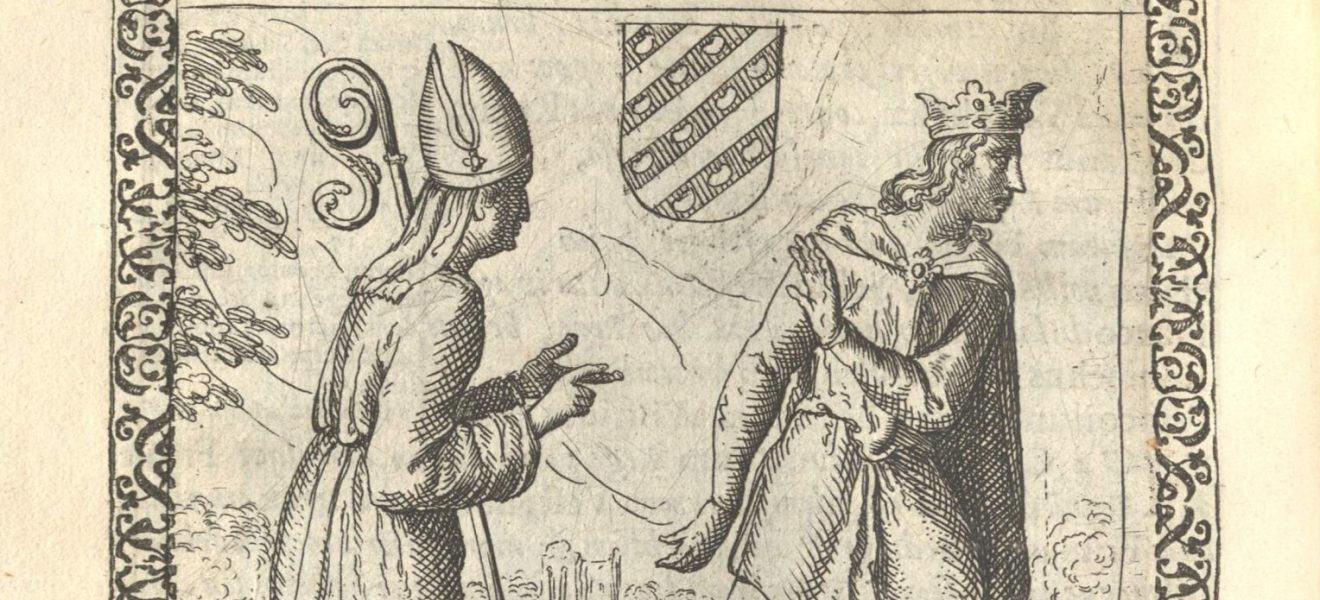
During the second journey of Saint Boniface to Rome, Wulfram, a monk and ex-archbishop of Sens, tried to convert Radbod, but after an unsuccessful attempt he returned to Fontenelle. It is said that Radbod was nearly baptised but refused when he was told that he would not be able to find any of his ancestors in Heaven after his death. He said he preferred spending eternity in Hell with his pagan ancestors than in Heaven with a pack of beggars.[7] This legend is also told with Wulfram being replaced with bishop Willibrord.
Legacy

Saint Radboud was a descendant of Radbod. Saint Radboud was a bishop of Utrecht who adopted his ancestor’s native name. The Nijmegen University and its corresponding medical facility were named after him in 2004.
In Richard Wagner‘s Lohengrin a certain “Radbod, ruler of the Frisians” is mentioned as Ortrud’s ancestor.
In Harry Harrison‘s The Hammer and the Cross series of novels, Radbod becomes the founder of “the Way”, an organized pagan cult, created to combat the efforts of Christian missionaries.
Black metal band Ophidian Forest recorded a concept album Redbad[8] in 2007.
Dutch folk metal band ‘Heidevolk‘ recorded a song ‘Koning Radboud’ (King Radbod) on their 2008 album ‘Walhalla Wacht’ singing about the legend of Wulfram and Radbod.
In 2015 the Frisian Folk-Metal band Baldrs Draumar[9] released a full album on the life and deeds of king Redbad called Aldgillissoan.[10] It is based on the book Rêdbâd, Kronyk fan in Kening[11] (Chronicles of a King) by Willem Schoorstra.
In 2018, Dutch production company Farmhouse released a film, Redbad, based on Radbod. It is directed by Roel Reiné and stars Jonathan Banks and Søren Malling alongside a variety of Dutch actors.[12]
 Rosamond Press


Leave a comment