Ken Kesey Meets Thomas Pynchon
by
John Presco
ALL RIGHTS RESERVED
What is the matter with people? Why can’t anyone make a movie about Ken Kesey – and Thomas Pynchon? Do all members of my generation have to die off. Or, just all members of the Grateful Dead – who should have their own movie!
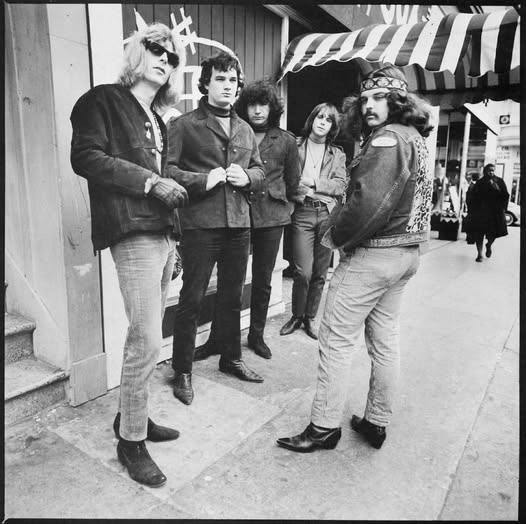
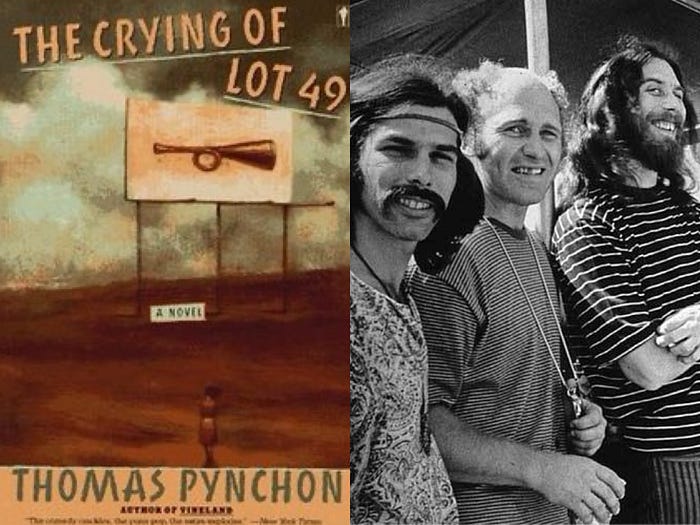
When Ken Kesey and the Pranksters drive to Woodstock, Thomas Pynchon gets a note to the Merry Hippie Ones.
“Come see me after the music festival. Bring the Dead with you!”
That’s it! No need for a script writer. Title the move…..
THE DHARMA DEMON BOX
Boom! Everyone wants to see what’s inside Pandora’s Box. But, first you got to open the damn thing. Don’t wait around for Ken Babbs to do it!
Carl Reiner needs a project to get his mind off his family tragedy. He needs to direct this movie.
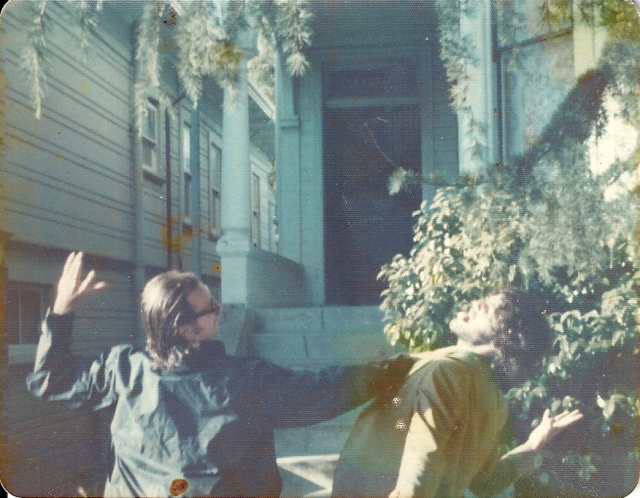
Above is photo of Peter Shapiro having a Psychedelic Boxing Matcjh in front of my home in Alameda where they lived with me at different times Tim moved in….The Beef. They have seen…..what’s inside the D-Box!
From the Demon to the Box: Comparing Pynchon and Kesey’s Perspectives on Maxwell’s Demon and Society

Ruei-Jie Chang 張睿倢Follow
6 min read
·
Dec 20, 2023
Pynchon和Kesey皆在各自作品中運用Maxwell’s Demon這個思想實驗作為隱喻來批判社會。本文旨在透過對 The Crying of the Lot 49和Demon Box的文本分析,比較他們使用這一隱喻時聚焦上的異同之處,同時闡釋他們所提出的觀點。
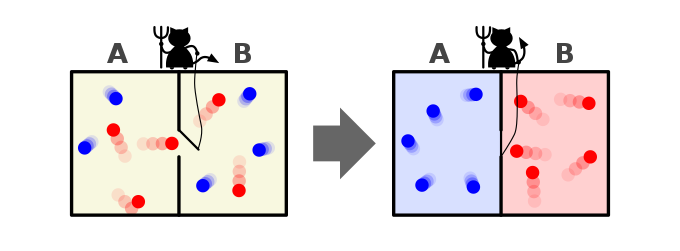
Maxwell’s Demon explained:
Maxwell’s demon, proposed by physicist James Clerk Maxwell in 1867, is a thought experiment suggesting a hypothetical violation of the second law of thermodynamics. In this scenario, a demon controls a door between two gas chambers of an enclosed container, selectively allowing fast-moving molecules in one direction and slow-moving molecules in the other. This manipulation seemingly reduces entropy without doing work, challenging the second law of thermodynamics and resulting in a perpetuum mobile of the second order.
Intro
Thomas Pynchon and Ken Kesey both employ the concept of Maxwell’s demon to underscore the inherent impossibility of establishing a fixed order in a chaotic world. They also embody the misguided faith in a singular order or solution to the complexities of society through the figure of the Demon. However, they differ in their narratives, directing their attention to different aspects and elements within the metaphor of Maxwell’s Demon. This essay will compare Pynchon’s The Crying of Lot 49 and Kesey’s Demon Box in conjunction, aiming to reveal how they use the same metaphor to elucidate the true chaotic nature of society, while simultaneously exploring distinct issues through their different focal points. I will begin by broadly describing how these two authors specifically deconstruct the symbolic elements of Maxwell’s demon thought experiment, breaking them down into separate components, and choosing their respective focuses to present different discourses. Then, through close reading of each author’s work, I will provide a more detailed exploration to further elaborate on their nuanced perspectives.
Pynchon v.s Kesey
In Pynchon’s work, the emphasis centers on the Demon itself. The Demon and Oedipa are juxtaposed, with the latter aspiring to become the former. Through Oedipa’s ultimate failure to find a definitive answer and her increased confusion and alienation, Pynchon illustrates the impossibility for individuals to attain a perfect order in society or to achieve clear sorting and dividing akin to the demon. On the other hand, Kesey places significance on the box and the inevitable entropy it results in. For Kesey, the false fantasy of Maxwell’s demon is directly pointed out and suggested to be merely a driving force reflected by capitalist society’s fixation on false order and categories. The act of sorting and dividing only contributes to entropy, resulting in negative effects on the world that can never be reversed. In a nutshell, while Pynchon envisions a dooming scenario where the Maxwell’s demon experiment is unrealizable, Kesey further elaborates on the negative impact of the construction of the box itself in the metaphor of Maxwell’s demon.
Close Reading on The Crying of The Lot 49
Pynchon introduces the concept of Maxwell’s Demon directly into the plot, as Oedipa visits John Nefastis and encounters his machine operating on the principles of Maxwell’s Demon. However, the concept takes on an ironic tone as the machine proves to be a highly esoteric and technically useless device that fails to function. As Nefastis suggests, “Communication is the key” (Pynchon 84), and “The Demon passes his data on to the sensitive, […] collects data on each and everyone. At some deep psychic level, […] the sensitive must receive that staggering set of energies, and feed back something like the same quantity of information” (Pynchon 84–85). However, the supposed communication with a “sensitive” individual nearby for data exchange without increasing entropy lacks a clear definition of who qualifies as a “sensitive.” In this regard, John Nefastis merely reassures, “Don’t worry. If you’re sensitive, you’ll know which one” (Pynchon 85). Additionally, the method of communicating with the Demon involves nothing more than watching a picture of Maxwell, employing a psychic and unreasonable approach. Despite this, Oedipa earnestly examines the picture, while John Nefastis goes to see “two Yogi Bears, one Magilla Gorilla, and a Peter Potamus” (Pynchon 85). These comical contrasts accentuate the ironic effect of Maxwell’s Demon concept in this context, also foreshadowing the ultimate revelation that the entire setup is a scam. This portrayal functions as a metaphor, encapsulating the microcosm of Oedipa’s experiences within the broader narrative. Oedipa’s yearning to discover order and meaning in a world fraught with chaos and randomness is evident in her quest to decipher the Trystero System — a yearning strong enough to lead her to initially trust John Nefastis’s machine, which is evidently unreasonable. This reflects the human inclination to seek patterns and control in a universe characterized by inherent chaos. The machine’s lack of concrete and practical communication means underscores the misplaced faith in rationality, assuming an inherent order amid chaos and irrationality, even through seemingly absurd methods. By exposing Maxwell’s Demon as a scam, the narrative further suggests that the possibility of finding a stable order in the midst of chaos is merely an illusion, with efforts destined to unfold ironically. This again emphasizes the world’s inherent inability to be enclosed and neatly sorted.
Close Reading on Demon Box
In contrast to Pynchon’s approach, Kesey straightforwardly elucidates the implausibility of Maxwell’s Demon’s operation, then redirects the focus of the metaphor to the existence of the box. It is stated that the demon sorting “would not be without expense” (Kesey 331). He emphasizes that the demon “not only consumes more energy than it produces and costs more than it can ever make, it will continue to do so and increase” (Kesey 331). Building upon this premise, Kesey draws attention to the box and the impacts of sorting within the imaginary framework, critiquing contemporary U.S. capitalist society where the repercussions of categorization and division become evident in the metaphorical “brave new boat” that is sinking (332). The negative impacts unfold as Kesey presents, “[e]very day finds more of us drowning in depression, drifting aimlessly in a sea of antidepressants, or grasping at straws such as psychodrama and regression catharsis” (332). The sinking boat presented serves as a powerful symbol encapsulating the consequences of constructing a false and artificially delineated fantasy of order — an illusion of an enclosed and perfect box. Similar to the demon that requires energy to perform tasks, the pursuit of fantasy comes at the expense of increased entropy, resulting in more negative feedback within society. Kesey further stresses, “The problem does not lie in poopoo fantasies from our past. It is this mistake we have programmed into the machinery of our present that has scuttled us” (332)! This statement reiterates that societal decline stems from collective programming, wherein people construct the box, driven by the urge to sort, and place faith in an illusory figure — the “Demon”, fostering a mistaken belief in its correctness.
From the Demon to the Box
In conclusion, the parallel exploration of Maxwell’s demon by both Pynchon and Kesey leads to a shared revelation about inherent chaos and humanity’s tendency to impose an often illusionary constant order on the world. Through their divergent narratives, from the demon to the box, they expose the fallacy of seeking a singular answer or order to the intricate complexities of society. Pynchon, focusing on the Demon and Oedipa’s pursuit of order, portrays the unattainability of such a goal, underlining the perpetual confusion and alienation that result. In comparison, Kesey directs our attention to the box and the entropy it inevitably generates, highlighting the destructive consequences of society’s fixation on false order and categorization. Together, their narratives serve as complementary cautionary tales, offering a more thorough picture of the failure of Maxwell’s demon amidst the chaotic nature of our world that cannot and should not be constrained within any rigid frame.
 Rosamond Press
Leave a comment