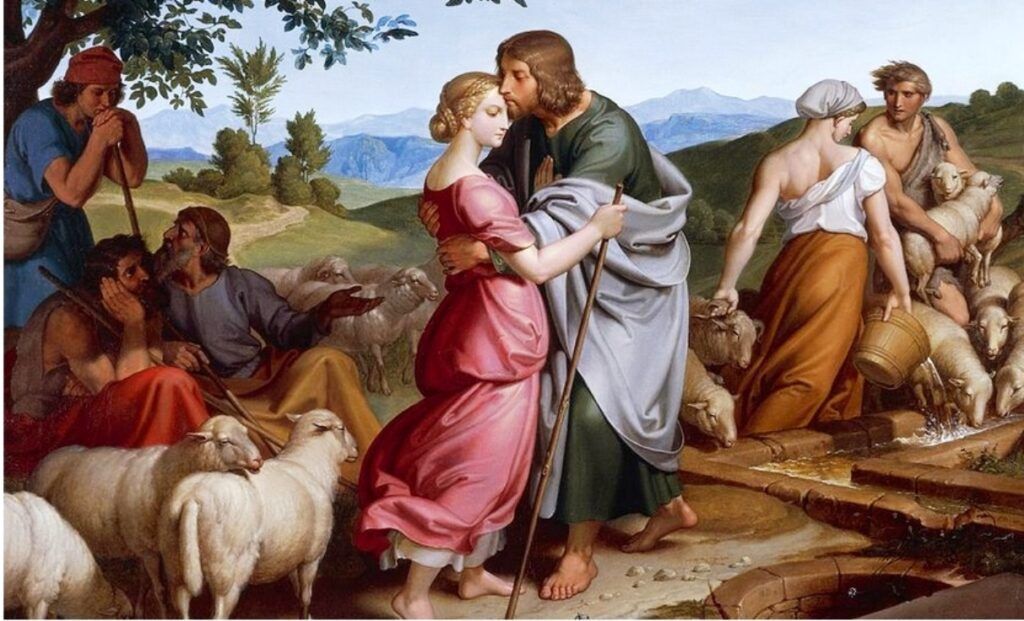
When I read the Bible for the first time in the spring of 1988, I was amazed how I was able to see words that were true, and words that are a lie.
As the most unbelievable War Propaganda the world has ever known, is launched by the Biggest Liar and Bullshitter in human history, let us look to Biblical text, and other ancient text, to discover…………
THE LIE OF LIES!
In the last thirty-eight years I have studied the two Bibles, and other text. in order to hide the CORE TRUTH. I do this by skipping on the Lying Stepping Stones, to cross…..The Swamp of Abysmal Lies. The story of Bilhah may be the first
SLEEPING BEAUTY STORY
She is the Daughter of Rotheus.
i AM JOHN
Historical criticism
There is a broad consensus among historians and biblical scholars that the ancestors of the Israelite tribes, as described in the Hebrew Bible, are best understood as eponymous figures (characters whose names are used to represent a group, place, or people) representing social, geographic, or political groups rather than historical individuals. This view is supported by the lack of extra-biblical evidence for the existence of specific tribal progenitors (no extra-biblical textual reference like the Merneptah Stele, Amarna letters or archeological finds like pottery or stone inscriptions mention any of the tribes) and by the patterns observed in ancient Near Eastern literature, where the origins of peoples are often traced to legendary or symbolic ancestors.[6][4] The names of tribes, such as Manasseh, Ephraim, and Benjamin, are thus interpreted as later constructs, reflecting collective identities or regions rather than actual persons.[3] Archaeological surveys and findings from the late Bronze and early Iron Age further reinforce this perspective, revealing that the emergence of Israelite society in the central hill country was a gradual process involving indigenous Canaanite populations, with tribal divisions likely developing as social and administrative structures after the initial settlement period.[2][5]
I don’t know what I find more appalling. The act of Reuben who mindlessly slept with/raped a woman because he wanted to challenge his father and lay claim to his wife, or the ultimate response (after a long silence) by Jacob, who does not even name the woman, but refers to her as “my couch” יצוע, . To these men she is not a person, not a human being at all, but a possession akin to a beautiful piece of furniture whose only function is to show the status of its owner. When Jacob tells Reuben that he no longer has the status and promise of the eldest son because of this action, it is because ‘hilalta’ – you have profaned/defiled – not the woman but his bed. And the fact that he repeats the image of his bed being misused, (almost in a staged aside of disbelief at the actions of his son), only makes it clearer to us just how they ignore and erase the act done to this woman – she is either ‘mishk’vei avicha’ the beds of your father (the place where he has sex) or y’tzui – my couch. Again contrast with the story of Dinah when Shimon and Levi justify their own horrific violence against Shechem with the question that hangs at the end “shall they treat our sister like a prostitute?” Yet here, there is no avenging the act done to Bilhah – she may be the mother to two of their brothers, yet she is less than nothing to them.
Bilhah (בִּלְהָה “unworried”, Standard Hebrew: Bilha, Tiberian Hebrew: Bīlhā) is a woman mentioned in the Book of Genesis.[a] Genesis 29:29 describes her as Laban‘s handmaiden (שִׁפְחָה), who was given to Rachel to be her handmaid on Rachel’s marriage to Jacob. When Rachel failed to have children, Rachel gave Bilhah to Jacob like a wife to bear him children.[1] Bilhah gave birth to two sons, whom Rachel claimed as her own and named Dan and Naphtali.[2] Genesis 35:22 expressly calls Bilhah Jacob’s concubine, a pilegesh. When Leah saw that she had stopped having children, she took her servant Zilpah and gave her to Jacob like a wife to bear him children as well.
The apocryphal Testament of Naftali says that Bilhah and Zilpah’s father was named Rotheus.[b] He was taken into captivity but redeemed by Laban, Rachel and Leah‘s father. Laban gave Rotheus a wife named Euna, who was the girls’ mother.[c] On the other hand, the early rabbinical commentary Pirkei De-Rabbi Eliezer and other rabbinic sources (Midrash Rabba and elsewhere) state that Bilhah and Zilpah were also Laban’s daughters, through his concubines, which would make them half-sisters to Rachel and Leah.[3][4][d] Scholars believe that these attempts to make Bilhah and Zilpah appear biologically related to Abraham’s family were a result of anti-foreign views in the postexilic period. It appears more likely that they were foreign like Tamar and Asenath, who were considered to be ‘secondary Matriarchs’.[5]
Bilhah is said to be buried in the Tomb of the Matriarchs in Tiberias.
In the Books of Chronicles, Shimei‘s brothers were said to have lived in a town called Bilhah and surrounding territories prior to the reign of David.[6]
Reuben’s adultery with Bilhah
Reuben was Jacob’s (Israel) eldest son with Leah. Genesis 35:22 says, “And it came to pass, while Israel dwelt in that land, that Reuben went and lay with Bilhah his father’s concubine; and Israel heard of it.”[7] As a result of this adultery, he lost the respect of his father, who said: “Unstable as water, you shall excel no longer; For when you mounted your father’s bed, You brought disgrace—my couch he mounted!”[8]
Some rabbinical commentators interpreted the story differently, saying that Reuben’s disruption of Bilhah’s and Jacob’s beds was not through sex with Bilhah. As long as Rachel was alive, say these commentators, Jacob kept her bed in his tent. When Rachel died, Jacob moved Bilhah’s bed into his tent, who had been mentored by Rachel, to retain a closeness to his favourite wife. However, Reuben, Leah’s eldest, felt that this move slighted his mother, who was also a primary wife, and so he moved his mother’s bed into Jacob’s tent and removed or overturned Bilhah’s. This invasion of Jacob’s privacy was viewed so gravely that the Bible equates it with adultery, and lost Reuben his first-born right to a double inheritance.[9][10]
In popular culture
- In the novels The Red Tent by Anita Diamant and Rachel and Leah by Orson Scott Card, Bilhah and Zilpah are half-sisters of Leah and Rachel by different mothers, following the Talmudic tradition.
- In Margaret Atwood‘s speculative fiction novel The Handmaid’s Tale, the theocratic society depicted cites the relationship between Bilhah, Rachel and Jacob as the scriptural basis for the role of handmaids as surrogates to high-ranking men and their infertile wives.[11]
According to the Hebrew Bible, the Tribe of Reuben (Hebrew: רְאוּבֵן, Modern: Rəʼūven, Tiberian: Rəʼūḇēn) was one of the twelve tribes of Israel. Unlike the majority of the tribes, the land of Reuben, along with that of Gad and half of Manasseh, was on the eastern side of the Jordan and shared a border with Moab. According to the biblical narrative, the Tribe of Reuben descended from Reuben, the eldest son of the patriarch Jacob. Reuben, along with nine other tribes, is reckoned by the Bible as part of the northern kingdom of Israel, and disappears from history with the demise of that kingdom in c. 723 BC.
Academic consensus, informed by historical context, textual analysis, and archaeological evidence, largely views the Israelite tribes as eponymous figures representing social or regional groups formed from indigenous Canaanite populations during the Late Bronze and Early Iron periods, rather than as actual historical individuals.[2][3][4][5][6]
Tribal territory
The Book of Joshua records that the tribes of Reuben, Gad and half of Manasseh were allocated land by Moses on the eastern side of the Jordan River and the Dead Sea.[7] The Tribe of Reuben was allocated the territory immediately east of the Dead Sea, reaching from the Arnon river in the south, and as far north as the Dead Sea stretched, with an eastern border vaguely defined by the land dissolving into desert; the territory included the plain of Madaba.
The exact border between Reuben and the Tribe of Gad, generally considered to have been situated to the north of Reuben, is somewhat inconsistently specified in the Bible, with Dibon and Aroer being part of Gad according to Numbers 32:34,[8] but part of Reuben according to Joshua 13:15–16.[9] On that basis, the Jewish Encyclopedia (1906) claimed that the territory of Reuben was an enclave in the territory of Gad.[10]
The territories described in Joshua 13 depict Gad as being to the north of Reuben, while the description in Numbers 32 and 34 has Reubenites living near Heshbon, surrounded by Gadites.[11] Yohanan Aharoni interpreted the description in Numbers as referring to the actual distribution of Reubenites and Gadites around the time of David, and the description in Joshua 13 as reflecting administrative districts set up in the time of Solomon, but not reflecting actual tribal settlement patterns.[11] By 900 BC, some of the territory of Reuben and Gad had been captured by the Moabite kingdom.[11]
Biblical narrative

Origins
According to the Torah, the tribe consisted of descendants of Reuben, the first son of Jacob, and a son of Leah, from whom it took its name. Modern scholarship views the events described in Genesis and Exodus, which contain the early stories about Jacob and his immediate descendants, as non-historical.[12][13][14]
The Bible divides the tribe of Reuben into four clans or families, the Hanochites, Palluites, Hezronites, and Carmites, which according to the Bible were descended from Reuben’s sons Hanoch, Pallu, Hazron, and Carmi.[15]
Genesis 49 contains the Blessing of Jacob, a series of predictions which the Bible presents as delivered by the patriarch Jacob about the future fate of the tribes descended from his twelve sons. Some textual scholars date it substantially later than these events.[16][page needed] Reuben is characterised as fickle, “unstable as water”, and condemned to no longer “have … the excellency” due to Reuben’s crime of having sexual relations with his father’s concubine Bilhah.[17]
The Bible relates that Jacob and his twelve sons, along with their sons, went down into Egypt as a group of about seventy persons, including Reuben and his four sons.[18] According to the account in Exodus, the Israelites stayed in Egypt for 430 years, and their numbers grew to include about 600,000 men, not counting women or children.[19] At this point they left Egypt (see The Exodus) and wandered for forty years in the wilderness between Egypt and the promised land of Canaan.[20]
As the tribes prepared to enter Canaan by crossing over to the west side of the Jordan, the Book of Numbers records that the Israelites defeated Sihon and Og, kings east of the Jordan.[21] The tribes of Reuben and Gad requested that they be given land in the territory east of Jordan, because it was suitable for their needs as livestock grazers. In exchange for their promise to help with the conquest of the land west of the Jordan, Moses accepted their request and granted to them and half of Manasseh land east of the Jordan.[22] Following the death of Moses, Joshua became the leader of the Israelites,[23] and with the help of these eastern tribes including Reuben,[24] conquered some of Canaan and assigned the land of Israel to the various twelve tribes.[25]
According to Kenneth Kitchen, this conquest occurred around 1200 BC,[26] but “almost all” scholars have abandoned the idea that Joshua carried out a conquest of Canaan similar to that described in the Book of Joshua.[27] Israel Finkelstein et al., have claimed that lack of evidence for a systematic conquest or the abrupt appearance of a new culture indicates that the Israelites simply arose as a subculture within Canaanite society.[28] The territory of Reuben encapsulated the territory of the earlier kingdom of Sihon.
Family tree
| Reuben | Eliuram | ||||||||||||||||||||||||||||
| Hanok | Pallu | Hezron | Karmi | ||||||||||||||||||||||||||
Tribal history
In this period, according to the ancient Song of Deborah, Reuben declined to take part in the war against Sisera, the people instead idly resting among their flocks as if it were a time of peace, though the decision to do so was taken with a heavy heart.[29]
Nahash appears abruptly as the attacker of Jabesh-Gilead, which lay outside the territory he laid claim to. Having subjected the occupants to a siege, the population sought terms for surrender, and were told by Nahash that they had a choice of death (by the sword) or having their right eyes gouged out. The population obtained seven days’ grace from Nahash, during which they would be allowed to seek help from the Israelites, after which they would have to submit to the terms of surrender. The occupants sought help from the people of Israel, sending messengers throughout the whole territory, and Saul, a herdsman at this time, responded by raising an army which decisively defeated Nahash and his cohorts at Bezek.
The strangely cruel terms given by Nahash for surrender were explained by Josephus as being the usual practice of Nahash. A more complete explanation came to light with the discovery of the Dead Sea Scrolls: although not present in either the Septuagint or Masoretic Text, an introductory passage, preceding this narrative, was found in a copy of the Books of Samuel among the scrolls found in cave 4:[30]
[N]ahash, king of Ammonites would put hard pressure on the descendants of Gad and the descendants of Ruben and would gouge everyone’s right eye out, but no res(cuer) would be provided for Israel and there was not left anyone among the children of Israel in the Tr(ans Jordan) whose right eye Nahash the king of Ammonites did not gouge out but be(hold) seven thousand men (escaped the power of) Ammonites and they arrived at (Ya)besh Gilead. About a month later Nahash the Ammonite went up and besieged Jabesh-Gilead.
According to the Book of Chronicles, Adina and thirty Reubenites aided David as members of his mighty warriors in conquering the City of David.[31] Also according to Chronicles, during the reign of King Saul Reuben instigated a war with the Hagarites, and was victorious;[32] in another portion of the same text, Reuben is said to have been assisted in this war by Gad and the eastern half of Manasseh.[33]
According to 1 Chronicles 5:26, Tiglath-Pileser III of Assyria (ruled 745–727 BC) deported the Reubenites, Gadites, and the half-tribe of Manasseh to “Halah, Habor, Hara, and the Gozan River.”
According to the Moabite Mesha Stele (ca. 840 BCE) the Moabites reclaimed many territories in the second part of the 9th century BCE (only recently conquered by Omri and Ahab according to the Stele). The stele does mention fighting against the tribe of Gad but not the tribe of Reuben, even though taking Nebo and Jahaz which were in the centre in their designated homeland. This would suggest that the tribe of Reuben at this time was no longer recognizable as a separate force in this area. Even if still present at the outbreak of this war, the outcome of this war would have left them without a territory of their own, just like the tribes of Simeon and Levi. This is, according to Richard Elliott Friedman in Who Wrote the Bible?, the reason why these three tribes are passed over in favour of Judah in the J-version of the Jacob’s deathbed blessing (composed in Judah before the fall of Israel).[34][35]
Banner
The Tribes of Israel had banners described by the Book of Numbers, such the Lion of Judah.[36][37] Jewish writers have diverged on whether the banner of Reuben bore the symbol of a man or male child (Aben Ezrah), a mandrake, or a child holding a mandrake in his hand.[38]
Historical criticism
There is a broad consensus among historians and biblical scholars that the ancestors of the Israelite tribes, as described in the Hebrew Bible, are best understood as eponymous figures (characters whose names are used to represent a group, place, or people) representing social, geographic, or political groups rather than historical individuals. This view is supported by the lack of extra-biblical evidence for the existence of specific tribal progenitors (no extra-biblical textual reference like the Merneptah Stele, Amarna letters or archeological finds like pottery or stone inscriptions mention any of the tribes) and by the patterns observed in ancient Near Eastern literature, where the origins of peoples are often traced to legendary or symbolic ancestors.[6][4] The names of tribes, such as Manasseh, Ephraim, and Benjamin, are thus interpreted as later constructs, reflecting collective identities or regions rather than actual persons.[3] Archaeological surveys and findings from the late Bronze and early Iron Age further reinforce this perspective, revealing that the emergence of Israelite society in the central hill country was a gradual process involving indigenous Canaanite populations, with tribal divisions likely developing as social and administrative structures after the initial settlement period.[2][5]
THE TESTAMENT OF NAPHTALI
The Eighth Son of Jacob and Bilhah.
CHAP. I.
Naphtali, the eighth son of Jacob and Bilhah. The Runner. A lesson in physiology.
THE copy of, the testament of Naphtali, which he ordained at the time of his death in the hundred and thirtieth year of his life.
2 When his sons were gathered together in the seventh month, on the first day of the month, while still in good health, he made them a feast of food and wine.
3 And after he was awake in the morning, he said to them, I am dying; and they believed him not.
4 And as he glorified the Lord, he grew strong and said that after yesterday’s feast he should die.
5 And he began then to say: Hear, my children, ye sons of Naphtali, hear the words of your father.
6 I was born from Bilhah, and because Rachel dealt craftly, and gave Bilhah in place of herself to Jacob, and she conceived and bare me upon Rachel’s knees, therefore she called my name Naphtali.
7 For Rachel loved me very much because I was born upon her lap; and when I was still young she was wont to kiss me, and say: May I have a brother of thine from mine own womb, like unto thee.
8 Whence also Joseph was like unto me in all things, according to the prayers of Rachel.
9 Now my mother was Bilhah, daughter of Rotheus the brother of Deborah, Rebecca’s nurse, who was born on one and the self-same day with Rachel.
10 And Rotheus was of the family of Abraham, a Chaldean, God-fearing, free-born, and noble.
11 And he was taken captive and was bought by Laban; and
he gave him Euna his handmaid to wife, and she bore a daughter, and called her name Zilpah, after the name of the village in which he had been taken captive.
12 And next she bore Bilhah, saying: My daughter hastens after what is new, for immediately that she was born she seized the breast and hastened to suck it.
13 And I was swift on my feet like the deer, and my father Jacob appointed me for all messages, and as a deer did he give me his blessing.
14 For as the potter knoweth the vessel, how much it is to contain, and bringeth clay accordingly, so also doth the Lord make the body after the likeness of the spirit, and according to the capacity of the body doth He implant the spirit.
15 And the one does not fall short of the other by a third part of a hair; for by weight, and measure, and rule was all the creation made.
16 And as the potter knoweth the use of each vessel, what it is meet for, so also doth the Lord know the body, how far it will persist in goodness, and when it beginneth in evil.
17 For there is no inclination or thought which the Lord knoweth not, for He created every man after His own image.
18 For as a man’s strength, so also in his work; as his eye, so also in his sleep; as his soul, so also in his word either in the law of the Lord or in the law of Beliar.
19 And as there is a division between light and darkness, between seeing and hearing, so also is there a division between man and man, and between woman and woman; and it is not to be said that the one is like the other either in face or in mind.
20 For God made all things good in their order, the five senses in the head, and He joined on the neck to the head, adding to it the hair also for comeliness and glory, then the heart for understanding, the belly for excrement, and the stomach for grinding, the windpipe for taking in the breath, the liver for wrath, the gall for bitterness, the spleen for laughter, the reins for prudence, the muscles of the loins for power, the lungs for drawing in, the loins for strength, and so forth.
21 So then, my children, let all your works be done in order with good intent in the fear of God, and do nothing disorderly in scorn or out of its due season.
22 For if thou bid the eye to hear, it cannot; so neither while ye are in darkness can ye do the works of light.
23 Be ye, therefore, not eager to corrupt your doings through covetousness or with vain words to beguile your souls; because if ye keep silence in purity of heart, ye shall understand how to hold fast the will of God, and to cast away the will of Beliar.
24 Sun and moon and stars, change not their order; so do ye also change not the law of God in the disorderliness of your doings.
25 The Gentiles went astray, and forsook the Lord, and charged their order, and obeyed stocks and stones, spirits of deceit.
26 But ye shall not be so, my children, recognizing in the firmament, in the earth, and in the sea, and in all created things, the Lord who made all things, that ye become not as Sodom, which changed the order of nature.
27 In like manner the Watchers also changed the order of their nature, whom the Lord cursed at the flood, on whose account He made the earth without inhabitants and fruitless.
28 These things I say unto
you, my children, for I have read in the writing of Enoch that ye yourselves also shall depart from the Lord, walking according to all the lawlessness of the Gentiles, and ye shall do according to all the wickedness of Sodom.
29 And the Lord shall bring captivity upon you, and there shall ye serve your enemies, and ye shall be bowed down with every affliction and tribulation, until the Lord have consumed you all.
30 And after ye have become diminished and made few, ye return and acknowledge the Lord your God; and He shall bring you back into your land, according to His abundant mercy.
31 And it shall be, that after that they come into the land of their fathers, they shall again forget the Lord and become ungodly.
32 And the Lord shall scatter them upon the face of all the earth, until the compassion of the Lord shall come, a man working righteousness and working mercy unto all them that are afar off, and to them that are near.
 Rosamond Press
Leave a comment