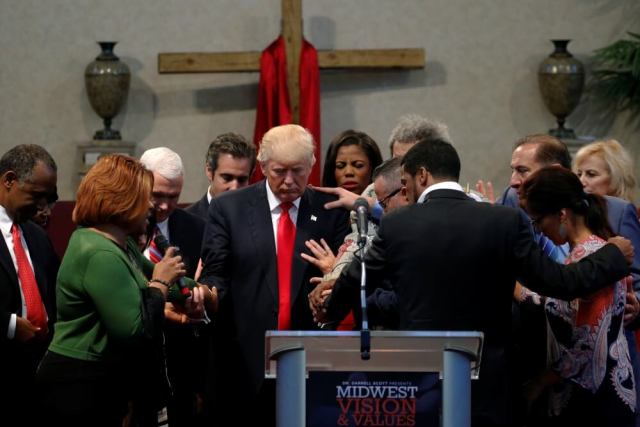
I will be taking Jesus away from every Christian on Earth.
As an extra added bonus, I will be taking God away from all the Jews on Earth.
Seer Jon
No war with Iran.
Yahoo/Inbox
- Senator Jeff Merkleyhttp://www.senate.govFrom:senator_merkley@merkley.senate.govTo:braskewitz@yahoo.comMon, Mar 2 at 3:50 PM

Dear John,Our Constitution is clear: Congress has the power to declare war, not the President.
Trump acknowledges he started a war, shredding our Constitution to do so. His strikes on Iran are plainly unconstitutional. The so-called “President of peace” is anything but.
We know where this road leads. Over two decades of war, more than 7,000 American servicemembers were killed in Iraq and Afghanistan. More than 50,000 were wounded. And more than $8 trillion was squandered. Families continue to carry that pain and grief. We cannot repeat this mistake.
American soldiers have already been gravely wounded or killed in action, and my heart grieves with their families and loved ones. This is a profound loss, and a painful reminder that our servicemembers are the ones on the frontlines, not the President and those around him.
The Iranian regime has suppressed and denied human rights to Iranians and supports violent proxies across the region. But those realities don’t give Trump the authority to start a war. Congress needs to use every lever we have to prevent Trump’s warmongering.Congress needs to vote on the War Powers Resolution NOW and rein in Trump’s reckless and unconstitutional strikes.
The American people don’t want endless war. I am working hard to make sure that Congress sends a clear message: No war with Iran.
All my best,
Jeff
Jakub KrupaWed 4 Mar 2026 11.22 ESTShare
The Guardian’s expert news coverage is funded by people like you, not a billionaire owner. Readers who choose an All-access digital subscription make the most impact and enjoy great benefits in return. Will you join them today?
Support usNewestPrevious2 of 2
‘Blunt rejection’ of US-Israeli attack on Iran and ‘call to learn from mistakes of the past’ – snap analysis

Sam Jones
in Madrid
Sánchez’s defiant speech may have been made in response to Trump’s threat to cut off all trade with Spain, but his words were also aimed every bit as much at other EU leaders (and at Spain’s political class).
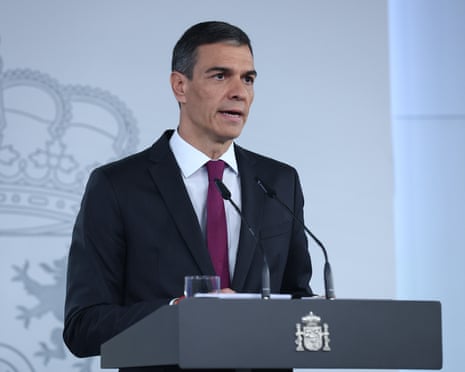
The PM was keen to stress that his government’s refusal to facilitate the attacks on Iran was firmly in line with its stance on Ukraine and Gaza.
He repeatedly insisted that a long and unpredictable war with Iran would only bring more death, more global uncertainty and more economic upheaval.
Not for nothing did he invoke the 2003 invasion of Iraq – the massively controversial and counterproductive military adventure that was so enthusiastically backed by Spain’s conservative prime minister at the time, José María Aznar:
“A war that, in theory, was said to be waged to eliminate Saddam Hussein’s weapons of mass destruction, bring democracy, and guarantee global security, but which, in reality, seen in retrospect, produced the opposite effect. It unleashed the greatest wave of insecurity our continent has suffered since the fall of the Berlin Wall.”
While no one could predict the exact course of the Iran conflict, he added, “what we do know is that a fairer international order will not emerge from it. Nor will it produce higher wages, better public services, or a healthier environment”.
In one of the most pointed passages of the speech, Sánchez also took aim at those who use war as a diversionary tactic, or as a means of enriching their cronies:
“It is absolutely unacceptable that those leaders who are incapable of fulfilling this duty use the smokescreen of war to hide their failure and, in the process, line the pockets of a select few – the same ones as always; the only ones who profit when the world stops building hospitals and starts building missiles.”
All in all, the speech is a blunt rejection of the US and Israel’s strikes and a call for Europe to learn from the mistakes of the past, to stand together, and to respect international law.
His words stand in sharp, and uncomfortable, contrast to the more weaselly utterances of others.
Let’s see how his fellow leader respond to the call in the final section:
“The government of Spain stands with those it must stand with. It stands with the values that our parents and grandparents enshrined in our constitution.
Spain stands with the founding principles of the European Union. It stands with the Charter of the United Nations. It stands with international law and, therefore, stands with peace and peaceful coexistence between countries and their harmonious coexistence.
We stand with many other governments that share our views, and with millions of citizens throughout Europe, North America, and the Middle East, who ask not for more war or uncertainty, but more peace and prosperity. Because the former only benefits a few. And the latter benefits us all.”
Share
Very punchy speech from Sánchez in response to Trump’s criticism – snap analysis

Jakub Krupa
Very punchy speech from Sánchez there as he set out Madrid’s position on the Iran war very clearly, mounting a defiant defence of international law and values.
But the lines that stick out most are the ones that effectively form a response to Donald Trump’s comments last night as he says Spain “will not be complicit in something that is bad for the world … simply out of fear of reprisals from someone.”
No prizes for guessing who is he thinking about there.
In another passage, he also spoke about the government’s obligation to “improve people’s lives, … not to worsen them,” with a bruising line on some leaders using “the smokescreen of war” when they can’t meet that basic obligation. Ouch.
His warnings about the unintended consequences and the risk of things escalating too far will also resonate with many.Share
Updated at 05.16 EST
Spain’s position ‘not naive, but consistent,’ Sánchez says, as he refuses to be ‘complicit’ just ‘out of fear of reprisals’
Sánchez says his position is not naive – and says “what is naive is thinking that violence is the solution” or that “democracies or respect between nations can come from ruins.”
He says Spain’s position is “not at all naive, but consistent.”
In the closest comments to directly criticising Trump, he says:
“We will not be complicit in something that is bad for the world and that is also contrary to our values and interests simply out of fear of reprisals from someone.”
He says Spain has “absolute confidence in the economic, institutional and I would even say more strength of our country.”
He says Spain is not alone in this view, which he says is enshrined in the EU, UN, and other international treaties.
He says that war would only “benefit a few,” while peace and more prosperity would “benefit us all.”
And he ends his speech here.
Why are the US and Israel framing the ongoing conflict as a religious war?
US troops reportedly told the war in Iran is intended to bring about biblical end times, Armageddon.
Listen to this article | 8 mins


By Sarah Shamim
Published On 4 Mar 20264 Mar 2026
Click here to share on social media
Share
SaveAdd Al Jazeera on Google
As conflict in the Middle East enters its fifth day on Wednesday, American and Israeli officials are pushing rhetoric suggesting that the campaign against Iran is a religious war.
On Tuesday, Muslim civil rights organisation, the Council on American-Islamic Relations (CAIR), condemned the Pentagon’s use of this rhetoric, deeming it “dangerous” and “anti-Muslim”.
Recommended Stories
list of 4 itemslist 1 of 4
Netanyahu to meet Trump in US to discuss Iran
list 2 of 4
Israeli woman watches TV report of her death in Iran protests
list 3 of 4
IAEA confirms buildings damaged at Iran’s Natanz nuclear facility
list 4 of 4
Iraq’s Kataib Hezbollah warns of ‘total war’ if Iran is attacked
end of list
The United States and Israel began their attack on Iran on Saturday and have continued to carry out strikes on Iran since then. In retaliation, Iran has hit back at targets in Israel, and US military assets in Bahrain, Saudi Arabia, Qatar, the United Arab Emirates, Iraq and Cyprus.
A US watchdog has reported that US troops have been told the war is intended to “induce the biblical end of times”. US Secretary of State Marco Rubio also recently stated that Iran is run by “religious fanatic lunatics”.
What are American and Israeli leaders saying?
US watchdog Military Religious Freedom Foundation (MRFF) said it has received emailed complaints that US service members were told the war with Iran is meant to “cause Armageddon”, or the biblical “end times”.
An unnamed noncommissioned officer wrote in an email to MRFF that a commander had urged officers “to tell our troops that this was ‘all part of God’s divine plan’ and he specifically referenced numerous citations out of the Book of Revelation referring to Armageddon and the imminent return of Jesus Christ”.
The MRFF is a nonprofit organisation dedicated to upholding religious freedom for US service members.
Advertisement
The officer claimed the commander had told the unit that Trump “has been anointed by Jesus to light the signal fire in Iran to cause Armageddon and mark his return to Earth”.
Israeli and US leaders have also resorted to religious rhetoric in public.
Last month, Mike Huckabee, the US ambassador to Israel, told conservative US commentator Tucker Carlson during an interview that it would be “fine” if Israel took “essentially the entire Middle East” because it was promised the land in the Bible. However, Huckabee added that Israel was not seeking to do so.
Sign up for Al Jazeera
Breaking News Alert
Get real-time breaking news alerts and stay up-to-date with the most important headlines from around the globe.Subscribe

By signing up, you agree to our Privacy Policy
protected by reCAPTCHA
Speaking to the media on Tuesday this week, Rubio said: “Iran is run by lunatics – religious fanatic lunatics. They have an ambition to have nuclear weapons.”
And, the previous day in a Pentagon news briefing, US Secretary of Defense Pete Hegseth said: “Crazy regimes like Iran, hell-bent on prophetic Islamic delusions, cannot have nuclear weapons.”
In its statement, CAIR claimed that Hegseth’s words are “an apparent reference to Shia beliefs about religious figures arising near the end times”.
On Sunday, Israeli Prime Minister Benjamin Netanyahu referenced the Torah, comparing Iran with an ancient biblical enemy, the Amalekites. The “Amalek” are known in Jewish tradition as representing “pure evil”.
“We read in this week’s Torah portion, ‘Remember what Amalek did to you.’ We remember – and we act.”
CAIR said: “We are not surprised to see Benjamin Netanyahu once again using the biblical story of Amalek – which claims that God commanded the Israelites to murder every man, woman, child and animal in a pagan nation that attacked them – to justify Israel’s mass murder of civilians in Iran, just as it did in Gaza.”
The statement added that every American should be “deeply disturbed by the ‘holy war’ rhetoric” being spread by the US military, Hegseth and Netanyahu to justify the war on Iran.
“Mr Hegseth’s derisive comment about ‘Islamist prophetic delusions’, an apparent reference to Shia beliefs about religious figures arising near the end times, was unacceptable. So is US military commanders telling troops that war with Iran is a biblical step towards Armageddon.”
Why are US and Israeli leaders framing the conflict with Iran as a religious war?
By attempting to frame the conflict as a holy war, leaders are using theological beliefs to “justify action, mobilise political opinion, and leverage support”, Jolyon Mitchell, a professor at Durham University in the UK, told Al Jazeera.
“Many on both sides of this conflict believe that they have God on their side. God is enlisted in this conflict, as with many others, to support acts of violence. The demonisation and dehumanisation of the enemy, the ‘other’, will inevitably make building peace after the conflict even harder,” Mitchell said.
Advertisement
“There are several overlapping reasons, and they operate at different levels: domestic mobilisation, civilisational framing, and strategic narrative construction,” Ibrahim Abusharif, an associate professor at Northwestern University in Qatar, told Al Jazeera.
Domestic mobilisation refers to rallying a country’s own people. Leaders can frame conflict as religious and hence morally clear and urgent, rallying public support, he said.
In a video circulating on social media this week, Christian Zionist pastor and televangelist John Hagee is seen delivering a sermon promoting the US assault on Iran. Hagee said that Russia, Turkiye, “what’s left of Iran” and “groups of Islamics” will march into Israel. He said that God will “crush” the “adversaries of Israel”.
“Religious language mobilises domestic constituencies,” Abusharif said, explaining that in the US, this connects deeply with many evangelicals and Christian Zionists, because they already see Middle East wars as part of a religious “end times” story.
“References to the ‘end times’, the Book of Revelation, or biblical enemies are not incidental; they activate a cultural script already present in American political theology.”
Civilisational framing refers to the creation of an “us vs them” dichotomy, casting the conflict as a clash between whole ways of life or faiths, not just a dispute over borders or policy, he added. Hence, statements such as Hegseth’s reference to “prophetic Islamic delusions” simplify the terms of the war in the minds of ordinary people.
“Wars are difficult to justify in technical strategic language,” Abusharif said.
“Casting the conflict as a struggle between ‘civilisation and fanaticism’, or between biblical ‘good and evil’, transforms a complicated regional confrontation into a moral drama that ordinary audiences can easily grasp.”
“Israeli leadership has long used biblical referents as political language. We all are familiar with it. The narratives have become globalised. In Israeli political discourse, this language situates contemporary conflict within a long historical narrative of Jewish survival, and it signals existential stakes,” Abusharif said.
Have US or Israeli leaders made religious references before?
Netanyahu and other Israeli officials have used the term “Amalek” before in reference to Palestinians in Gaza during Israel’s genocidal war in Gaza.
Historically, during wars or military confrontations, US presidents and senior officials have also invoked the Bible or used Christian language.
President George W Bush invoked similar language after the September 11, 2001 attacks.
On September 16, 2001, Bush said: “This crusade, this war on terrorism, is going to take a while.” The Crusades were a series of religiously framed wars, mainly between the 11th and 13th centuries, in which the papacy fought against Muslim rulers for territory.
The White House later tried to distance Bush from the word “crusade” to clarify that Bush was not waging a war against Muslims.
Abusharif said that the war on Iran is about power and politics, but using religious rhetoric energises supporters and “moralises” the conflict.
 Rosamond Press
Leave a comment