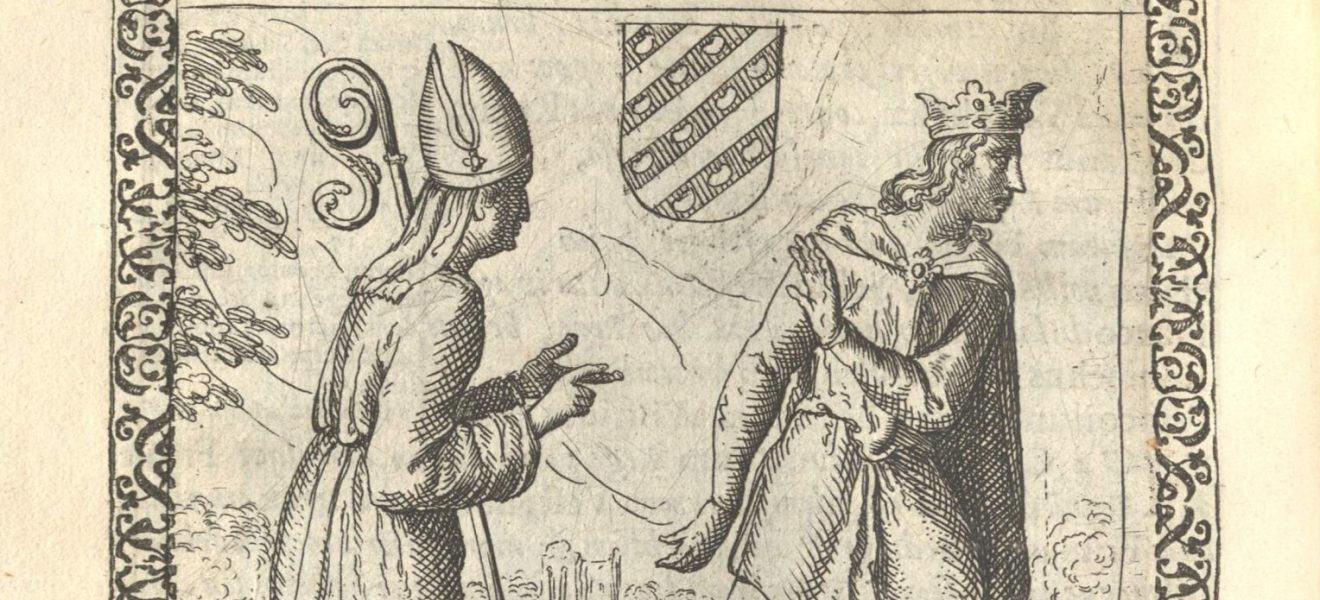
Where Art Thou?
by
John Presco
ALL RIGHTS RESERVED
I awoke wondering if Radbod was a Long-haired Nazarite who knew the Baptism of John the Baptist – who did not prepare THE WAY for Jesus. I suspect he was THE BAPTIZER of the Meomgovomg Lond-hir Kings, who let their hair grow long – after being baptized!
Radbod says he is concerned about his dead ancestors being in hell. But, his real concern, his children will not be practicing “The Way”. The Franks – want his…..BLOODLINE! Why? Why would they want Pagan DNA – in their…..Holy Blood? It must not be – that Holy. Perhaps they took Paul’s Fake Baptism of the Holy Spirit – that the Corinthians rejected – along with the lie Jesus only spoke through him.
Paul admits to hunting down the people of THE WAY, locking them up, torturing them them, then murdering the,. Jesus did not intervene, because – they were not Jews! Jewish authorities allowed this genetic, because they hated to tall, long face, blue-eyed Danes amongst them – who destined from Samson whose mother is not name, and the angel who bids them to build an alter – that is contrary to the one that housed the Ark
I suspect it is true, the Tribe of Dan are the Sea Peoples from Daneland, who fought with Egypt, and were defeated. Did they GO HOME, or settle in Canaanland, before it was conquered by Joshua – which is not true, either. I suspect Joshua targeted the peoples – that stood out – the strong as Samson Warriors – and longhaired Kings who took the Baptism of the Sea Peoples – who I believe are my ancestors.
Consider the People of Galatia! WAKE UP! Follow me! I know,,,,
THE WAY!
“Radbod was a man with a heart of stone, who became infuriated when he discovered that Willibrord had desecrated a holy well
devoted to the god Fosite on the island of Helgoland”
Where was John the Baptist taken after he was circumsized? Where was Jesus – in the missing yeats?
Am I……The End Time Elijah as seen by Herbert Armstong”
John ‘The Nazarite
Around this time there was an Archbishopric or bishopric of the Frisians founded for Willibrord[3] and a marriage was held between Grimoald the Younger, the oldest son of Pepin, and Thiadsvind, the daughter of Radbod in 711.[4]: 794
Paul in Ephesus
19 While Apollos was at Corinth, Paul took the road through the interior and arrived at Ephesus. There he found some disciples 2 and asked them, “Did you receive the Holy Spirit when[a] you believed?”
They answered, “No, we have not even heard that there is a Holy Spirit.”
3 So Paul asked, “Then what baptism did you receive?”
“John’s baptism,” they replied.
4 Paul said, “John’s baptism was a baptism of repentance. He told the people to believe in the one coming after him, that is, in Jesus.” 5 On hearing this, they were baptized in the name of the Lord Jesus. 6 When Paul placed his hands on them, the Holy Spirit came on them, and they spoke in tongues[b] and prophesied. 7 There were about twelve men in all.
8 Paul entered the synagogue and spoke boldly there for three months, arguing persuasively about the kingdom of God. 9 But some of them became obstinate; they refused to believe and publicly maligned the Way. So Paul left them. He took the disciples with him and had discussions daily in the lecture hall of Tyrannus. 10 This went on for two years, so that all the Jews and Greeks who lived in the province of Asia heard the word of the Lord.
The theory that the “Lost Tribe of Dan” settled in Denmark is a form of Nordic Israelism (British-Israelism) that suggests northern tribes migrated to Europe after 721 BC. Proponents often cite the phonetic similarity between “Dan” and “Danmark” (Denmark), along with early 17th-century historical claims linking the two. However, this connection is generally considered speculative, a form of historical fantasy, or not supported by mainstream academic history.
The Galatians (Ancient Greek: Γαλάται, romanized: Galátai; Latin: Galatae, Galati, Gallograeci; Greek: Γαλάτες, romanized: Galátes, lit. ‘Gauls’) were a Celtic people dwelling in Galatia, a region of central Anatolia in modern-day Turkey surrounding Ankara during the Hellenistic period.[1] They spoke the Galatian language, which was closely related to Gaulish, a contemporary Celtic language spoken in Gaul.[2][3]
The Galatians were descended from Celts who had invaded Greece in the 3rd century BC. The original settlers of Galatia came through Thrace under the leadership of Leogarios and Leonnorios c. 278 BC. They consisted mainly of three Gaulish tribes, the Tectosages, the Trocmii, and the Tolistobogii, but there were also other minor tribes. In 25 BC, Galatia became a province of the Roman Empire, with Ankara (Ancyra) as its capital.
In the 1st century AD, many Galatians were Christianized by Paul the Apostle‘s missionary activities. The Epistle to the Galatians by Paul the Apostle is addressed to Galatian Christian communities in Galatia and is preserved in the New Testament.
From Wikipedia, the free encyclopedia
| Radbod | |
|---|---|
| King (or Duke) of Frisia | |
| Embroidery depicting the legend in which the Frisian king Radbod is ready to be baptized by Wulfram (in this embroidery replaced by Willibrord), but at the last moment refuses. From the Museum Catharijneconvent, Utrecht | |
| Reign | c. 680 – 719 |
| Predecessor | Aldgisl |
| Successor | Bubo |
| Born | c. 648 |
| Died | 719 |
| Religion | Germanic paganism |
Radbod (died 719) was the king (or duke) of Frisia from c. 680 until his death. He is often considered the last independent ruler of Frisia before Frankish domination. He defeated Charles Martel at Cologne. Eventually, Charles prevailed and compelled the Frisians to submit. Radbod died in 719, but for some years his successors struggled against the Frankish power.
King or duke
What the exact title of the Frisian rulers was depends on the source. Frankish sources tend to call them dukes; other sources[which?] often call them kings.[citation needed]
Reign
While his predecessor, Aldgisl,[1] had welcomed Christianity into his realm, Radbod attempted to extirpate the religion and gain independence from the kingdom of the Franks. In 689, however, Radbod was defeated by Pepin of Herstal in the battle of Dorestad[2] and compelled to cede Frisia Citerior (Nearer Frisia, from the Scheldt to the Vlie) to the Franks.
Between 690 and 692, Utrecht fell into the hands of Pepin. This gave the Franks control of important trade routes on the Rhine to the North Sea. Some sources say that, following this defeat, Radbod retreated, in 697, to the island of Heligoland. Others say he retreated to the part of the Netherlands that is still known as Friesland.
Around this time there was an Archbishopric or bishopric of the Frisians founded for Willibrord[3] and a marriage was held between Grimoald the Younger, the oldest son of Pepin, and Thiadsvind, the daughter of Radbod in 711.[4]: 794
On Pepin’s death in 714, Radbod took the initiative again. He forced Saint Willibrord and his monks to flee and advanced as far as Cologne, where he defeated Charles Martel,[5] Pepin’s natural son, in 716. Eventually, however, Charles prevailed and compelled the Frisians to submit. Radbod died in 719,[6]: 90 but for some years his successors struggled against the Frankish power.
As an example of how powerful King Radbod still was at the end of his life, the news that he was engaged in assembling an army was reportedly enough to fill the Frankish kingdom with fear and trembling.[4]: 794
Relation with Christianity
During the second journey of Saint Boniface to Rome, Wulfram, a monk and ex-archbishop of Sens, tried to convert Radbod, but after an unsuccessful attempt he returned to Fontenelle. It is said that Radbod was nearly baptised but refused when he was told that he would not be able to find any of his ancestors in Heaven after his death. He said he preferred spending eternity in Hell with his pagan ancestors than in Heaven with a pack of beggars.[7] This legend is also told with Wulfram being replaced with bishop Willibrord.
Legacy

Saint Radboud was a descendant of Radbod. Saint Radboud was a bishop of Utrecht who adopted his ancestor’s native name. The Nijmegen University and its corresponding medical facility were named after him in 2004.
In Richard Wagner‘s Lohengrin a certain “Radbod, ruler of the Frisians” is mentioned as Ortrud’s ancestor.
In Harry Harrison‘s The Hammer and the Cross series of novels, Radbod becomes the founder of “the Way”, an organized pagan cult, created to combat the efforts of Christian missionaries.
Black metal band Ophidian Forest recorded a concept album Redbad[8] in 2007.
Dutch folk metal band ‘Heidevolk‘ recorded a song ‘Koning Radboud’ (King Radbod) on their 2008 album ‘Walhalla Wacht’ singing about the legend of Wulfram and Radbod.
In 2015 the Frisian Folk-Metal band Baldrs Draumar[9] released a full album on the life and deeds of king Redbad called Aldgillissoan.[10] It is based on the book Rêdbâd, Kronyk fan in Kening[11] (Chronicles of a King) by Willem Schoorstra.
In 2018, Dutch production company Farmhouse released a film, Redbad, based on Radbod. It is directed by Roel Reiné and stars Jonathan Banks and Søren Malling alongside a variety of Dutch actors.[12]
See also
Abstract
This contribution tries to outline a context for the well-known story of the Frisian King Radbod withdrawing from the baptismal font when hearing that
his ancestors would not receive the same privilege. This story is transmitted
in the Vita Wulframni, a text that has been regarded as a forgery. Following a
summary of Stéphane Lebecq’s analysis of the Vita, the story about Radbod’s
failed baptism can be shown to belong to a part of this text that was composed
by the Frisian monk Ovo in the AD 740s. As such, it is a central document
in the debate about the fate of pagan ancestors vibrant at precisely this time,
with Boniface and the Irish bishop Clemens being the best-known protagonists. The anecdote was not written to deny Willibrord his pride of place in the
Christianization of Frisia, but rather to corroborate Boniface’s point of view
with Willibrord’s authority. There is some indication suggesting that Willibrord himself had a different opinion in this question, a crucial element in the
process of Christianization.
Keywords
Radbod, Boniface, Clemens, Bede, Adomnán, St Wandrille, Theodore of
Canterbury, Patrick, Columba, Trajan, Willibrord, Wulfram of Sens; Frisians;
Palagianism, baptism, Christianization, paganism, ancestors, burial, churches.
Introduction
Alcuin described Radbod, ‘king of the Frisians’, as a major opponent of
Willibrord, the Anglo-Saxon missionary of noble, possibly even royal,
descent who set out from the Irish monastery of Rath Melsigi to convert
rob meens
WITH ONE FOOT IN THE FONT: THE
FAILED BAPTISM OF THE FRISIAN
KING RADBOD AND THE 8THCENTURY DISCUSSION ABOUT THE
FATE OF UNBAPTIZED FOREFATHERS
Early medieval Ireland and Europe: chronology, contacts, scholarship, ed. by Pádraic Moran
and Immo Warntjes, Studia Traditionis Theologiae, 14 (Turnhout, 2015), pp. 577–96.
© FHG 10.1484/M.STT-EB.5.103136
rob meens
the Frisians.1
Radbod was a man with a heart of stone, who became infuriated when he discovered that Willibrord had desecrated a holy well
devoted to the god Fosite on the island of Helgoland.2
We need not follow Alcuin in all details here. It can be questioned, for example, whether
Radbod was actually ‘king of the Frisians’ as Alcuin says, a statement
eagerly adopted by modern historians. Perhaps he was just ‘a king of Frisians’ and as such comparable to some Frankish aristocrats active in the
same region.3
Radbod was clearly involved in Frankish politics. He married his
daughter Theudesinda to Grimoald, son of the Frankish mayor of the
palace Pippin II. In the political turmoil following the murder of this
Grimoald in AD 714 and the death of Pippin later that year, Radbod
allied himself with the Neustrian mayor of the palace Ragamfred.4
He
was, therefore, an important player in high Frankish politics in the
early 8th century. We may also question whether he was such a fervent
opponent of Christianity, since he allowed Willibrord to travel and
preach in his kingdom. It is, moreover, not implausible that his daughter
Theudesinda had been baptized when marrying Grimoald.5
Yet, Alcuin
describes him as a fervent pagan and most other sources of the period do
likewise. The most famous portrayal of Radbod as an uncompromising
pagan comes from the Vita Wulframni, the Life of Archbishop Wulfram of Sens composed in the monastery of Saint Wandrille at the end of
the 8th or in the early 9th century. This source relates how Wulfram nearly succeeded in converting the Frisian king. The text runs as follows:6
Praefatus autem princeps Rathbodus, cum ad percipiendum baptisma inbueretur, percunctabatur a sancto episcopo Vulframno, iuramentis eum
per nomen Domini astringens, ubi maior esset numerus regum et principum seu nobilium gentis Fresionum, in illa videlicet caelesti regione,
quam, si crederet et baptizaretur, percepturum se promittebat, an in ea,
quam dicebat tartaream dampnationem. Tunc beatus Vulframnus: ‘Noli
errare, inclite princeps, apud Deum certus est suorum numerus electorum.
1 Ó Cróinín (1984); Ó Cróinín (2007).
2 Alcuin, Vita Willibrordi 9, 11 (ed. by Wilhelm Levison in MGH SS rer. Merov.
7, 123, 125); on Radbod as Willibrord’s main adversary, see Berschin (1991), 127–9.
3 van Egmond (2005).
4 Fouracre (2000), 53, 61; Fischer (2012), 51–3.
5 Angenendt (1998), 81.
6 Vita Wulframni 9 (ed. by Wilhelm Levison, MGH SS rer. Merov. 5, 661–73:
668); the translation is mine, here and throughout.
WITH ONE FOOT IN THE FONT
Nam praedecessores tui principes gentis Fresionum, qui sine baptismi sacramento recesserunt, certum est dampnationis suscepisse sententiam; qui
vero abhinc crediderit et baptizatus fuerit, cum Christo gaudebit in aeternum.’ Haec audiens dux incredulus – nam ad fontem processerat – et, ut
fertur, pedem a fonte retraxit, dicens, non se carere posse consortio praedecessorum suorum principum Fresionum et cum parvo pauperum numero
residere in illo caelesti regno.
‘When the named King Radbod was to be immersed in order to receive
baptism from the holy Bishop Wulfram, he hesitated and asked him
(Wulfram), meanwhile binding him through an oath in the name of
the Lord, where the greater part of the kings, princes, and nobles of the
Frisian people were: in the celestial realm that Wulfram had promised
him to be shown if he believed and would be baptized, or in that region
that he called the Tartarus of damnation. Whereupon the blessed Wulfram responded: ‘Don’t be mistaken, glorious prince, there is a certain
amount of the elect with God. For it is certain that your predecessors
as princes of the people of the Frisians, who have departed without the
sacrament of baptism, have received a sentence of damnation. But he
who from this moment believes and is baptized, will enjoy eternal bliss
with Christ.’ When the still pagan duke—pagan, because he was still
on his way to the baptismal font—heard this, he, as they tell, withdrew
his foot from the font declaring that he could not go without the company of his predecessors, the princes of the Frisians, to reside with a
small number of the poor in that celestial kingdom.’
Many modern scholars of this period have remarked on this famous
anecdote.7
Interestingly, others pass over it in silence.8
This remarkable discrepancy is probably the result of a different assessment of the
authenticity of the story. Already Wilhelm Levison, who edited Wulfram’s Life for the Monumenta Germaniae Historica in 1910, expressed
severe doubts about its reliability as a historical source. ‘Itaque pleraque
quae narrantur aut pro fabulis aut pro dubiis habenda sunt’, was his
judgement.9
Levison was critical because of the chronological problems
presented by the text. The most striking example of this is the date of
7 See e.g. Fletcher (1997), 239; Brown (2003), 417; Lynch (1998), 72; Dumézil (2005), 172; Blair (2005), 58; Charles-Edwards (2000), 199 (although presenting
a garbled version of the story); Smith (2005), 228; Weiler (1989), 78; Scheibelreiter
(1999), 481.
8 Palmer (2009); Innes (2007); Wickham (2009); Noble and Smith (2008); Blok,
Prevenier et al. (1981).
9 MGH SS rer. Merov. 5, 659.
rob meens
the failed baptismal rite. According to the Vita, this event took place not
long before the death of Radbod in AD 718. Yet, the Gesta of the abbots
of St Wandrille inform us that Wulfram had died before AD 704, as
his body was translated by Abbot Bainus of Fontenelle (St Wandrille)
in that year. The date given for Wulfram’s death in the Vita (AD 720) is
therefore clearly mistaken.
Historians have dealt with the question of the reliability of this
story in three different ways. Some present the anecdote as historical
fact without further qualification.10 Others have simply ignored it completely.11 A third group of historians consider the story itself unreliable, but maintain that its theme, the insecurity about the fate of pagan
forefathers, is a reflection of real issues involved in the early stages of
Christianization. Characteristic for this approach is the succinct phrase
by Lutz von Padberg:12 ‘Mag diese pittoreske Szene auch der Phantasie
des Hagiographen entstammen, so spiegelt sie doch tatsächliche Missionserfahrungen der Übergangsepoche.’ A fourth approach is to regard
the story as a way in which Wulfram and Radbod were remembered at
the time of composition of the Vita.
13 If the story does reflect authentic experiences in the missionary field, this raises the question why no
other historical or hagiographical source refers to this. The aim of this
paper is to provide the background for the emergence of the story about
Radbod’s failed baptism by demonstrating that the theme of the fate
of unbaptized forefathers was a real issue in the AD 740s in a couple of
texts related to mission and conversion. This 8th-century debate forms
the context for the story in the Life of Wulfram.
Authenticity and context
For this paper, the question of the authenticity of the story is, therefore,
of secondary importance. Yet, some remarks about this vexed question
are necessary in order to get a better understanding of the text and its
background. Recently, Ian Wood and Stéphane Lebecq have rekindled the debate on its authenticity and I will begin by outlining their
10 See Dumézil (2005), 172; Blair (2005), 58; Smith (2005), 228; Weiler (1989), 78;
Scheibelreiter (1999), 481.
11 See n 8.
12 von Padberg (2003), 123; van Eijnatten and van Lieburg (2005), 74.
13 Brown (2003), 417.
WITH ONE FOOT IN THE FONT
arguments. Ian Wood sees the Vita Wulframni mainly as a response by
the monks of St Wandrille to the composition of the Vita Willibrordi by
Alcuin. The text is designed not only to demonstrate the pre-eminence
of Wulfram over Willibrord, but also to promote a different conception
of mission. For the author of the Vita Wulframni, miracles are of primary importance, whereas Alcuin instead stresses the role of preaching.
According to Wood, the Vita Wulframni was written as a reaction to the
Vita Willibrordi because the monks of St Wandrille wanted to highlight
their contribution to the Frisian mission. For this purpose, they were
not hesitant in formulating ‘totally fraudulent assertions’, although the
Vita may also contain ‘a record of genuine events’. Wood does not explicitly address the question of the authenticity of the story of Radbod’s
failed baptism, but by pointing to similar concerns about the fate of
forefathers raised elsewhere, he suggests that the story had at least some
link with problems encountered in the missionary field. Wood considers
the reference to the faith of Clovis’s forefathers in the letter of Avitus of
Vienne sent on the occasion of his baptism as a close parallel.14
Stéphane Lebecq, although acknowledging the indisputable problems that the text presents, has fervently defended the Vita Wulframni
as a reliable source for the history of early medieval Frisia. The monastery
of St Wandrille was in contact with this region and some of the details
mentioned in the Vita have clear parallels with Frisian evidence. Lebecq
furthermore provides an explanation for the blatant inconsistencies in
the text, which have seriously prejudiced historians’ judgment of the
text’s reliability. The author, for example, calls himself Jonas (of Bobbio),
the 7th-century biographer of St Vedastus and St Columbanus, and pretends to dedicate the work to abbot Bainus, abbot of St Wandrille in the
early years of the 8th-century, while in other parts of the text references
to two later abbots of that monastery can be found: Wando (AD 716–
719 and 742–747/754) and Austrulf (AD 747–753).15 The text as transmitted must therefore postdate AD 747, which makes a dedication to
Bainus not only impossible but also suspiciously preposterous. According to Lebecq, these inconsistencies result from a somewhat clumsily
amalgamation of already existing smaller dossiers. A brief biographical
text was probably composed on the occasion of the elevation of Wulfram’s remains in AD 704. Anecdotes mainly concerned with Frisian
14 Wood (1991), 12–4; Wood (2001), 92–4 (‘may include a record of genuine
events’); Wood (2005), 720 (‘totally fraudulent assertions’) and 726–7; see Avitus of
Vienne, Epistula 46 (ed. by Rudolf Peiper in MGH Auct. ant. 6,2, 75–6).
15 Lebecq (2000), 432–3.
rob meens
issues were reported and possibly written down by the monk Ovo, one of
the Frisian boys saved by Wulfram and then brought to the monastery
of St Wandrille. Two miracle stories are closely related to Abbot Wando
and were probably recorded by him or under his direction.16 These then
were put together in the late 8th or early 9th century. Such a genesis of the
Vita may perhaps seem overly complicated, but it explains well the incoherence of the text as a whole; certainly, the chronological discrepancies
can better be squared by this interpretation than by the assumption the
Vita forms a coherent composition to compete with Alcuin’s carefully
balanced account of Willibrord’s activities, unless we regard the monks
of St Wandrille incapable of writing a structured narrative.
Moreover, the short anecdotes concerning Frisia show exceptional
features when compared to the rest of the Vita. Three chapters in the
Vita, for example, deal with the tradition of human sacrifices among the
Frisians.17 According to these, young boys were chosen by lot and then
offered to the gods, either by hanging or drowning. Sacrifice by drowning especially is peculiar and corresponds well with the Frisian landscape
dominated by wetlands and the sea. Such descriptions do not, or only
partly, rely on hagiographical topoi; rather, they show parallels with the
sacrificial procedures related in other sources from Frisia, such as the Vita
Willibrordi or the Lex Frisionum, but clearly do not derive from these.18
The Vita as such can therefore be dated to the end of the 8th or the early 9th century, but its components, in Lebecq’s reconstruction, were composed earlier. Lebecq suspects that Wando might have been involved in
the recording process of Ovo’s oral testimonies, which form the basis of
the Frisian couleur locale of the Vita. Both Wando and Ovo died around
the middle of the 8th century. If Lebecq is correct, and I see no reason for
questioning his reconstruction, then the story about the failed baptism
of Radbod was probably recorded in St Wandrille in the AD 740s when
Ovo would have been in his old age. Since the Vita refers to Ovo’s talents
as a scribe (in arte scriptoria eruditus), it is even possible that Ovo himself
composed the anecdotes in question, reflecting his own experiences.19
Lebecq thus dates the anecdote about Wulfram and Radbod to the
AD 740s. This date could be corroborated by further evidence for a
16 Lebecq (2000), 440–1.
17 Vita Wulframni 6–8 (MGH SS rer. Merov. 5, 665–7).
18 Lebecq (2007).
19 On Ovo’s talents as a scribe, see Vita Wulframni 7 (MGH SS rer. Merov. 5,
666). The parts probably written by him are translated in Lebecq (2011a).
WITH ONE FOOT IN THE FONT
contemporary discussion of the fate of unbaptized forefathers. Some
scholars have argued that the crucial question raised in the story of
Radbod’s failed baptism—i.e. why are we saved by the grace of baptism while our ancestors are not?—must have been of major concern
in many missionary contexts. Yet, the Vita Wulframni seems to be the
only Saint’s Life in which this issue is addressed. Comparison with the
other major Anglo-Saxon missionary, Boniface, however, demonstrates
that the issue was of some concern to him and to other contemporaries. First, there is Pope Gregory III’s reply to an earlier letter of Boniface which has not survived. In his papal letter of AD 732, the pope
discusses several issues related to baptism. He asks Boniface to baptize
again in the name of the Trinity those who have received baptism from
‘pagans’. Furthermore, Boniface was to (re)baptize those who are uncertain whether they have received baptism. Those baptized by a priest
who sacrificed to Jupiter or who participated in pagan sacrificial meals
should also undergo another baptism. These papal demands raise a
number of questions: Who are these pagans baptizing heathens? Does
the pope here refer to Christians who had not received proper baptism
themselves and should therefore technically be treated as pagans? Did
this cause such a confusion that people were uncertain about their state
as Christians? Were pagans possibly imitating baptismal ceremonies for
specific reasons? There are no definite answers to these questions. Still,
it is obvious that Boniface, at this time, encountered a number of problematical baptismal issues.20
In the same letter a question is raised which is closely related to the
central issue of the story of Wulfram and Radbod. Gregory here responds
to Boniface’s initial question whether one may bring liturgical offerings
for the deceased. Gregory allows this only for the deceased who are real
Christians (vere christianis). A priest may do so, but only for them, not
for those who are impious, even when the latter were Christian, the pope
specified.21 The term impios in this context is ambiguous. It seems to refer to ‘unbelievers’, whether (formally) Christian or pagan. Pope Gregory
III here seems to respond to a desire of recent converts to make liturgical
offerings for unbelievers. We may assume that some of these unbelievers
are to be identified with their deceased pagan ancestors.22
20 Boniface Letters 28 (ed. by Michael Tangl in MGH Epp. sel. 1, 50–1).
21 Boniface Letters 28 (MGH Epp. sel. 1, 50–1).
22 As supposed by Clay (2010), 386, who also relates this letter to the story about
Radbod’s failed baptism.
rob meens
That Boniface was confronted with precisely this issue and that
other contemporaries of a certain religious authority came to different
conclusions, is evident from his conflict with the Irish Bishop Clemens. This Clemens proved to be a fervent adversary of the Anglo-Saxon
archbishop. He is often mentioned in the same breath as the Frankish
Bishop Aldebert and they were both condemned by the same Roman
Synod of AD 745.23 Yet, we need to distinguish carefully between these
two charismatic men. Clemens is accused by Boniface of following several unorthodox views and embracing uncanonical practices. Although
the accusations of heresy levelled against Clemens may simply reflect heretical stereotypes, the Irishman may still have acted non-conformist.24
One of the accusations involves Clemens teaching the doctrine that
Christ had descended into Hell and liberated everyone there, believers
and unbelievers (credulos et incredulos) alike, the worshippers of God
and the idolaters (laudatores Dei simul et cultores idulorum).25 This suggests that Clemens held a more favourable view on the salvation of those
who had not had a chance to embrace Christianity in their lifetime. The
Roman synod, when summarizing Clemens’s case, chose exactly the
same ambiguous term for describing the unbelievers that Pope Gregory
III had used in his Letter to Boniface discussed above: impios. This indicates that Gregory’s letter and Clemens’s teaching possibly dealt with a
similar problem, i.e. the salvation of pagan forefathers.
Another text that has recently been associated with Boniface addresses the same question. The text in question is a short sermon,
known as Rogamus vos, which has traditionally been attributed to
Augustine of Canterbury.26 Michael Glatthaar has recently demonstrated that there is no firm basis for this attribution and has shown
that the sole manuscript witness of this text is closely associated with
Boniface and his mission. This manuscript, Vatican, Biblioteca Apostolica, Pal. lat. 577, contains a collection of texts that can, more or less
directly, be associated with the ‘apostle of the Germans’. According to
Glatthaar, the connection with Boniface was so close that we may dub
this collection the Sententiae Bonifatianae Palatinae.
27 It includes the
23 On Boniface’s two opponents, see de Jong (2005); Innes (2008); Meeder (2011).
24 For the influence of heretical stereotypes, see Zeddies (1995); the links with
Irish traditions are stressed by Meeder (2011).
25 Roman Synod of AD 745 (ed. by Albert Werminghoff in MGH Conc. 2,1, 40).
26 Machielsen (1961), 504–5.
27 Glatthaar (2004), 455–502; the argument is accepted by Mostert (2013), 115–9.
WITH ONE FOOT IN THE FONT
famous list of problematic religious observances that is known as the
Indiculus superstitionum, the so-called Old-Saxon baptismal formula,
and the texts of the Concilium Germanicum (AD 742) and the Council of Estinnes (AD 743). The short sermon Rogamus vos deals with
the question of why the remedies for salvation (salutis remedia) were
preached so late. Why did Christ arrive so late in this world and let so
many thousands of people perish? The fact that the sermon strongly
argues against the validity of such a question indicates that it was actually directed against Clemens and his followers, who, as we have seen,
also worried about the salvation of the souls of those who died before
Christian doctrine was known.28 That such questions must have been
particularly prominent in a missionary context may be obvious, but it
needs to be stressed that without someone like Clemens who actually
explicitly formulated such concerns, these were generally suppressed or
remained unarticulated.
An influential penitential handbook that probably was known to
Boniface contains a couple of sentences that also deal in a very rigorous way with pagan ancestors. This penitential is attributed to Theodore of Canterbury, whose teachings indeed form the basis of this text.
Actually, the Iudicia Theodori are known from five textual traditions of
which the Discipulus Umbrensium version together with the Canones
Gregorii were the best known.29 The Discipulus Umbrensium version was
probably composed in the late 7th or early 8th century, as it features in the
canon law collection known as the Collectio Vetus Gallica, redacted at
Corbie c.AD 725–750.30 Boniface was in close contact with the monks
of Corbie and particularly with Abbot Grimo, who is the most plausible
candidate as redactor of the Collectio Vetus Gallica.
31 Theodore’s penitential contains the following two sentences:32
28 A connection between the sermon and Clemens’s preaching is suggested by
Glatthaar (2004), 488–9.
29 For these traditions, see Kottje s.v. ‘Paenitentiale Theodori’ in HRG 3, 1413–6.
30 Mordek (1975), 86.
31 For Boniface’s contact with Grimo, see Glatthaar (2004), 215, 386–9; see also
Meens (2007), 220–1.
32 Paenitentiale Theodori, Discipulus Umbrensium-version (U) II 1, 4–5 (ed.
Finsterwalder (1929), 312; I added some punctuation); cf. P. Theodori Canones Gregorii 149–150 (ed. Finsterwalder (1929), 267); P. Theodori Capitula Dacheriana 98 (ed.
Finsterwalder (1929), 247); P. Theodori Canones Cottoniani 56–58 (ed. Finsterwalder
(1929), 274); P. Theodori Canones Basilienses, 71a–b, 89 (ed. Asbach (1975), Anhang, 85
and 87); see also Meens (2012), 128; Meens (2014), 90–6; and the comments in Blair
(2005), 236.
rob meens
In ecclesia in qua mortuorum cadavera infidelium sepeliuntur, sanctificare altare non licet sed si apta videtur ad consecrandum inde evulsa et
rasis vel lotis lignis eius reaedificatur.
Si autem consecratum prius fuit, missas in eo caelebrare licet si relegiosi
ibi sepulti sunt. Si vero paganus sit, mundare et iactare foras melius est.
‘One should not consecrate the altar in a church in which the bodies of
unbelievers (infidelium) are buried, but if the altar seems well suited for
consecration, the bodies should be removed and it can be re-established
after the planks are scoured and washed.
But if it has already been consecrated, Mass may be celebrated in it
when the people buried there are relegiosi. But if it concerns a pagan it
is better to clean it and to throw [the remains] out.’
These enigmatic sentences can be interpreted as reflecting a desire
among recent converts to have their ancestors buried in consecrated
churches (or to build churches on their graves). It is obvious that Theodore took an uncompromising stand against such practices, a position
that is in line with Boniface’s views, who, before going to the Continent,
had close links with Theodore’s successor Berhtwald.33 The same opinion is expressed in the story of Radbod’s failed baptism.
Clemens’s background
The story about the failed baptism of Radbod, therefore, though unique
in hagiographical literature, can be set in the context of a group of texts
all known and used in the northern Frankish region which concentrate
on the salvation of pagan ancestors. This theme seems to have been a major issue of dispute between Boniface and the Irish Bishop Clemens. Clemens took a more lenient stance in this debate, while Boniface denied
any possibility for pagan ancestors to be saved. We may wonder whether
Clemens’s approach was singular, or whether he represented a wider
movement. Sven Meeder recently suggested that Clemens might have
been influenced by Pelagianism, which would explain the accusation of
asserting ‘horrible’ ideas on predestination levelled against Clemens at
the Roman Synod of AD 745.34 His Irish background could, of course,
have provoked such claims, as Pelagianism was strongly associated with
33 Yorke (2007), 32.
34 Roman Synod of AD 745 (MGH Conc. 2,1, 40); Meeder (2011), 277–9.
WITH ONE FOOT IN THE FONT
the British Isles, partly thanks to Bede’s treatment of this issue in his
recent Historia ecclesiastica.
35
If we look at the religious culture of Clemens’s native Ireland, it becomes apparent that his positive attitude towards the pagan past had its
roots there. Quite a few Irish texts speak of pagan ancestors with an exemplary life though uninfluenced by Christianity. Moreover, some texts
claim that Irish men believed in the Christian God even before Patrick
spread the word on the island.36 Adomnán, in his Vita Columbae written in the late 7th century, relates how the saint miraculously foresaw the
arrival of a man who had preserved natural goodness (naturale bonum)
throughout his entire life without having been baptized, and therefore
uninfluenced by Christianity, or so the story implies. When this man,
Artbranán, heard the word of God from the holy man, he agreed to be
baptized by Columba and died almost immediately thereafter.37 Later
in the same text, a similar story is narrated.38 These episodes have been
interpreted as evidence of persistent Pelagianism in the Irish church.39
Yet, both episodes stress the importance of baptism, even for someone
who had preserved natural goodness throughout his life. Rather than
reading these stories as statements of Pelagianism, they should be taken
as expressions of the pervading force of divine grace which makes a naturally good person receive baptism before encountering death.40 They
do show, however, ‘a conciliatory attitude towards paganism’.41
The same can be observed in the late 7th-century Life of Patrick by
Muirchú. When Patrick returned to Ireland, he met a certain Dichu,
who became the first Irishman to convert to Christianity. According
to Muirchú, before meeting Patrick he had already been ‘from nature a
good man, although a pagan’.42 Tírechán, the other late 7th-century biographer of Patrick, went even further. In his Collectanea, in which he as35 Bede raised the issue particularly by his quote from the letter of Pope-elect
John to the northern Irish clergy in Historia ecclesiastica II 19 (ed. and trans. Colgrave
and Mynors (1992), 200–3); see Ó Cróinín (1985).
36 McCone (1991), 72–5.
37 Adomnán, Vita Columbae I 33 (ed. and trans. Anderson and Anderson (1991),
62–3).
38 Adomnán, Vita Columbae III 14 (Anderson and Anderson (1991), 200–3).
39 Herren and Brown (2002), 95.
40 O’Sullivan (2010).
41 Charles-Edwards (2000), 200.
42 Muirchú, Vita S. Patricii I 11(10) (ed. and trans. Bieler (1979), 78–9): cuiusdam
uiri natura boni licet gentilis.
rob meens
sembled a lot of information about the saint in order to support the material claims of the church of Armagh, he relates how the saint revived
a deceased pagan man and baptized him before he was returned into
his grave.43 We can imagine that such posthumous baptisms appealed
to newly converted Christians worrying about their ancestors’ salvation.
Thus, a conciliatory attitude towards paganism seems to have existed
in Ireland, resulting in three stories in which a naturally good pagan
is finally baptized before passing away. In one case even a pagan man
is resurrected and received baptism before being returned to his grave.
These stories all date from the end of the 7th century, a period when, we
may surmise, Clemens, who was active on the Continent in the early
AD 740s, spent his youth in Ireland. Even if Clemens was younger than
this, he certainly must have been active in Ireland in the early 8th century at the latest. We must therefore conclude that Clemens appears to
have grown up in an environment supportive of the idea of retrospective
baptism of the deceased.
But not only in Ireland do we find traces of such discussions in hagiographical sources. In early 8th-century Northumbria, an anonymous
monk or nun composed a Life of Pope Gregory the Great.44 This text
contains an intriguing chapter concerning the posthumous baptism of
the Roman Emperor Trajan by Pope Gregory. When walking through
the Forum of Trajan in Rome, Gregory learned the anecdote of the Roman emperor stopping on his way to do battle to oversee justice for a
widow whose son had been killed. Because the killers were unwilling
to pay compensation, the emperor made them do so. This Christian act
done by a pagan emperor moved Gregory so greatly that he went to St
Peter’s church and wept ‘floods of tears’ for the emperor. By these tears,
Trajan’s soul was ‘refreshed’ and baptized (refrigeratam vel baptizatam).
The author seems to expect some criticism for his choice of the term
baptizare here, but he stressed that without baptism no one is able to
see God.45 The author of this Life, probably a monk of the monastery
of Whitby, has been criticized for his lack of theological sophistication,
but he seems to have been aware of the critique which the story could
potentially generate.46 He insisted on the importance of baptism and it
43 Tírechán, Collectanea 40 (ed. and trans. Bieler (1979), 154–5).
44 The Vita Gregorii and its account of the baptism of the Roman Emperor Trajan
are also discussed in Colin Ireland’s contribution elsewhere in this volume.
45 The anonymous Life of Gregory 29 (ed. and trans. Colgrave (1968), 126–9).
46 For the criticism levelled against the author, see, e.g., Marenbon (2012), 46:
‘From a theological point of view, there is almost everything wrong with this story.’
WITH ONE FOOT IN THE FONT
appears that he wanted to make the story of the pagan Emperor Trajan
being saved acceptable by introducing the act of baptism. There are no
indications that the author knew the Irish Lives we just discussed, but
it is hardly a coincidence that the theme of the salvation of a just pagan
by baptism appears in Northumbria, a region closely linked to the Irish
church. This evidence demonstrates that there was a lively debate on
such issues in these regions, which made the Whitby author choose his
words carefully. Such a discussion might be linked to persistent forms
of Pelagianism in the British Isles, but the relevance of such a topic in a
recently converted region is easy understood without any Pelagian influence.47
Clemens Willibrordus
The debate about the fate of pagan ancestors, of which we find traces in
the Irish and Northumbrian hagiographical literature of the late 7th and
early 8th century, provides the general background for Clemens’s opinion on this matter. In the AD 740s, this debate was one of the central
themes in the dispute between Boniface and Clemens, who cherished a
much more positive view of the salvation of pagans than Boniface did.
The story about the failed baptism should be considered as contemporary evidence of this dispute. It agrees fully with Boniface’s position:
there is no salvation without baptism. A possible connection to an overarching debate on predestination is suggested by the text’s insistence on
the well-defined number of those eligible for salvation, thus expressed
in Wulfram’s words: certus est suorum numerus electorum (‘there is a certain amount of the elect with God’).48 The author here cites Bede’s commentary on the Gospel of Luke; Bede himself, it will be remembered,
considered Pelagianism an imminent threat to the church of his time.49
The story about Radbod’s failed baptism therefore represents Boniface’s position in the struggle with Clemens. Michael Glatthaar has
recently argued in favour of a connection between the Irish opponent
of Boniface and Willibrord, Northumbrian missionary and former
47 For Pelagianism, see Herren and Brown (2002), passim.
48 Vita Wulframni 9 (MGH SS rer. Merov. 5, 668).
49 Bede, In Lucae Evangelium Expositio II 5 (ed. by David Hurst in CCSL 120,
115); on Bede’s views on Pelagianism, see Herren and Brown (2002), 97–8; Holder
(2005).
rob meens
companion of Boniface.50 There exists no firm evidence for a relation
between the two except for Clemens’s name. Willibrord had received
that very name from Pope Sergius and though not uncommon, the fact
that Clemens bore the same name might suggest a connection between
the two. Moreover, although the geography of Clemens’s activity is difficult to establish with certainty, the fact that Carloman was deemed
responsible for the capture of Clemens, we can infer that Austrasia was
the territory of his mission, which was also the region where Willibrord
was active.51 A connection between the two men therefore can neither
be proven nor rejected.
If Glatthaar is right in his assessment of the relationship between
Clemens and Willibrord, this would shed new light on the relation of
the Vita Wulframni to Willibrord. Ian Wood argued that the Vita Wulframni was composed as a reply to Alcuin’s Vita Willibrordi. This may be
true for its final composition, but it cannot explain the reference to Willibrord in the episode of Radbod’s failed baptism, if this indeed originated in the AD 740s, decades before Alcuin started to work on the Vita
Willibrordi. In the anecdote under discussion here, Willibrord plays a
prominent role. He is summoned by Radbod as the teacher on the Frisian people (doctor praefatae gentis) in order to discuss the conversion of
the Frisian king with Wulfram. Radbod, however, kept arguing with
the bishop, apparently not interested in becoming Christian. According
to the anecdote, Willibrord said the following when receiving Radbod’s
summon:52 “Why should your duke who spurns the preaching of our
brother the saintly Bishop Wulfram, be inclined to follow my advice?
For tonight in a dream I have seen him bound in fiery chains. Therefore,
it is certain that he is already undergoing eternal damnation.” When on
his way to Radbod, Willibrord received the news that the Frisian leader
had died without baptism, and thus his vision was substantiated.
Wood argues that Willibrord’s role in the Christianization of the
Frisians was so well known that the author of the Vita Wulframni, although presenting Wulfram and Willibrord as competitors, could not
simply pass over the Anglo-Saxon missionary in silence.53 Yet, the text
50 Glatthaar (2004), 152, 523.
51 For Clemens’s connection to Austrasia, see Meeder (2011), 266.
52 Vita Wulframni 9 (MGH SS rer. Merov. 5, 668): ‘Quia praedicationem sancti
fratris nostri Vulframni pontificis dux vester audire contempsit, meis quoque qualiter obsecundabit edictis? Nam hac nocte vidi illum in visu catena religatum ignea. Unde certum
fore constat, dampnationem illum iam subisse aeternam.’
53 Wood (2001), 93.
WITH ONE FOOT IN THE FONT
does not seem to indicate any rivalry between the two men, it rather
stresses their cooperation: ‘together with the blessed Wulfram, who
agreed [with him] in his religious teaching’.54 Willibrord fully endorses
Wulfram’s theological position. Perhaps this is the crucial message that
the story wants to bring across: Wulfram’s position, which so neatly
concurs with that of Boniface in the dispute with Clemens, was fully
vindicated by Willibrord. Willibrord had died in AD 739. This chronology suggests that after his death, reference to his authority was used to
substantiate a claim that featured in a dispute of the AD 740s between
another Clemens, perhaps a (self-acclaimed) follower of Willibrord, and
Boniface.
We know that Willibrord and Boniface had been at loggerheads,
which Willibald, in his Vita Bonifatii, describes as a beautiful and harmonious form of discord.55 There are indications that Willibrord considered a conciliatory approach to the Christian mission, based on compromise and assimilation, most fruitful, whereas Boniface was a more
uncompromising character.56 Archaeological evidence suggest that de
facto posthumous Christianization of ancestors happened, as for example in the Rhineland near Alzey, where a church was built on top of a preChristian burial site.57 Moreover, archaeological records from the early
medieval period indicate that in missionary regions in the Low Countries and Germany, graves were frequently opened shortly after burial,
presumably by relatives of the deceased.58 In some cases gold-foil crosses
seem to have been deposited in such reopened graves, which suggests
a form of posthumous Christianization.59 Formerly, such violations of
graves were considered grave robberies, but more recently archaeologists
interpret them as forms of ancestor worship or as an on-going relationship between the dead and the living.60 Boniface would probably have
objected to such forms of behaviour, but they seem nevertheless to have
frequently occurred in many regions, also in Willibrord’s area of activ54 Vita Wulframni 9 (MGH SS rer. Merov. 5, 668): simul cum beato Vulframno, in
doctrina suae religionis concordante.
55 Willibald, Vita Bonifatii 5 (ed. by Wilhelm Levison in MGH SS rer. Germ. 57,
25): spiritalis inter eos orta est contentio et consona pulchrae discretionis facta dissensio.
56 For Willibrord’s possibly more accommodating attitude, see Meens (2000);
Meens (2014), 102–6.
57 Geary (1994), 36–8.
58 van Haperen (2010), 3.
59 van Haperen (2010), 15.
60 van Haperen (2010).
rob meens
ity. In this context, the story about the failed baptism of Radbod may
very well be regarded as an appropriation of Willibrord’s authority in a
conflict over his ‘religious inheritance’. The St Wandrille author of the
text sided with Boniface and added Willibrord’s authority to counter
the views of Clemens and his followers. Willibrord may have disagreed
with Boniface on this subject given his inclination for a more compromising approach in religious matters. As a native of Northumbria, he
may have known the story of Trajan’s posthumous baptism. Also, he
spent twelve years in Ireland, where, as we have seen, texts were written towards the end of the 7th century with a decidedly positive view of
pagan ancestors. Whether Willibrord had access to these texts cannot
be determined, but the Vitae probably reflect attitudes and discussions
current in Irish and Northumbrian ecclesiastical circles at that time. It
is hardly conceivable that Willibrord was not aware of such tendencies,
especially since the issues in question were of primary importance for
his missionary work.
Conclusion
The well-known story of the Frisian King Radbod withdrawing his foot
from the font when supposed to be baptized by Bishop Wulfram of Sens
is only rarely regarded as historically trustworthy. More often it is considered an imaginary episode; its relevance, in this reading, lies in its
depiction of sincere hopes and fears by those involved in the process of
Christianization. If we follow Lebecq’s persuasive reconstruction of the
genesis of the Vita Wulframni, we can date this specific story to the AD
740s. In those years, Boniface had serious disputes with an Irish bishop
named Clemens who was active in Austrasia. One of the main issues of
controversy was the question of the fate of pagans who had remained
ignorant of Christian doctrine. Clemens, whose views are only known
through the defamation by Boniface and the papacy, seems to have been
more positive concerning the fate of pagan ancestors than the uncompromising Boniface. The theme of the naturally good pagan to be found
in Irish hagiographical texts of the end of the 7th century can explain
Clemens’s positive approach. The story about Radbod’s failed baptism
should be seen as a text supporting the views of Boniface cum suis. It
argues against a possible salvation for pagan ancestors and stresses the
need for baptism. The discussion between Clemens and Boniface may
also reflect an earlier dispute between Boniface and Willibrord. This
WITH ONE FOOT IN THE FONT
at least would explain why Willibrord, besides Wulfram, plays such a
central role in the Radbod story. Willibrord’s authority is claimed here
in order to corroborate the Bonifatian view on the condemnation of pagan ancestors. This need not have been Willibrord’s own opinion and
there are some indications to the contrary. Boniface’s strict attitude in
such matters may have been an exception in the more general process of
Christianization. If so, this would explain why we have only this single
testimony to what must have been a central question. Other missionaries seem to have been less outspoken on the subject than Boniface was
and thus seem to have given their new converts more comfort in d
Radbod, A Tale of the Love of Blood Against the Lust for Power.
Posted on by MimirsBrunnr
When I first read of the legendary Radbod and his most defiant tale, it struck me as just as much a love story as it was one of defiance.
Radbod was a king of Frisia, although his exact heritage is unknown, some believe he was the son of Aldgil whom Radbod succeeded. Although King Aldgil is said to of converted to Christianity via his friendship and protection of the exiled Saint Wilfrid of Northumbria, if Radbod was his son then defiance to Frankish authority certainly ran in the family. Aldgil’s himself tore up a “dead or alive” demand for Wilfrid in front of Frankish ambassadors in a bold display disobedience to their power. There is some controversy here though, there is no actual evidence of Aldgil’s conversion, and Wilfrid left none to minister the new “converts”. It is much more likely that Aldgil simply helped Wilfrid, because of the good relations between the Frisians and Northumbria, and of course as a tool of defiance against the overbearing Franks, as is seen by their demand, he was no ally of the theirs.
Even if Wilfrid did convert Aldgil, he had little if any success other than that. Later missionaries never mention a Christian contingent among the Frisian’s. There is no doubt about Radbod’s spiritual allegiance though, Radbod was a firm follower of the old ways of the North. With no power in Frisia the church had no say in their allegiances, this made them a major threat to Frankish power. Unable to use the church as a means to domination, they would be forced to use strength of arms.
Radbod’s Reign began around 679, and it appears, he like Aldgil was disinterested in Frankish attempts to convince them of their “divine” right to rule. With little options of a “peace”, that is of Frisian subjugation, if the Franks wanted to control Frisia, they would have to take it by force. At around the same time Radbod became king of Frisia, Peppin of Herstal had united the Frankish kingdoms and became its head under the title “Mayor of the Palace”. Peppin was clearly an ambitions man and had through military victory reduced the Frankish kings to mere baubles of pomp and ceremony, with him being the real power behind the curtain. This move showed Peppin not only to be an accomplished general in war, but also a shrewd political mover, as he had avoided any outright challenge to the throne, yet had effectively removed all of its power. Given the characters of these two men, it was now only a matter of time before they clashed.
With Peppin at its “head”, the united Frankish states became even more aggressive in their quest for domination and Frisia was a high priority. This resulted in all out war in about 689/690 where we are told Radbod was defeated in the battle of Dorestad, eventually losing Utrecht too. Not much is known of what happened in this battle, with some even believing it may never of took place. Whatever happened though some form of peace had been achieved, albeit with the Franks now seemingly in control of most of Frisia. To seal this peace Radbod’s Daughter Theodelinda married Peppins second Son Grimoald the younger.
With this new peace came missionaries sent by Peppin himself. Interestingly here Peppin chose to send Anglo-Saxon Priests considering them to have a better chance of converting the Frisian Heathens. The reasoning for this is quite simple, The Frisian peoples were closely related to the Anglo-Saxons, with some even believing they were essentially one and the same peoples. This is something that can be seen in their language and even the jewelry (below) of the period.
 Anglo-Saxon
 Frisian
 Anglo-Saxon
 Frisian
Given their close racial bonds, it seems Radbod was happy to allow these missionaries into his lands. We are told via Bede, that despite Willibrord’s (the Anglo-Saxon missionary) best efforts Radbod was unwilling to convert.
“He [Willibrord] had the boldness to present himself at the court of Radbod, at that time King of the Frisians and like his subjects, a pagan. Wherever he travelled he proclaimed the Word of God without fear; but though the Frisian king received the man of God in a kind and humble spirit, his heart was hardened against the Word of Life”
Bede states that Radbod’s “heart was hardened against the word of life”, I would argue Radbod’s heart far from being “hardened” to the word of life, was truly in tune with it.
It was via another missionary Saint Wulfram, that we get the most legendary event of Radbod’s life, that of his baptism, well failed baptism that is.
The story starts as you would expect from a medieval Christian point of view. Wulfram upon visiting the Frisian’s and having no luck in their conversion, witnesses a “sacrifice”, well two. One of two children apparently tied to stakes to be taken by the sea, Wulfram obviously leaps to their rescue untying them and saving them from a miserable fate. It is the second though, that is of importance, as this is where Wulfram is said to of performed a miracle, which thus persuaded the Frisians to convert. Wulfram apparently pleading with Radbod to stop the slaughter of innocents, is told that it cannot be stopped, as it is the will of the Gods. At this point a young man called Ovon is picked to be sacrificed, and Wulfram is given chance to prove his Gods power. Radbod tells Wulfram that if his God can, then he could free Ovon from his fate. Wulfram then proceeds to kneel and pray. After two hours of hanging, Ovon was thought to be dead, and the crowd that had gathered begin to leave. This is when the rope holding Ovon suddenly breaks and the young man is saved by “God”. Ovon becomes a follower of Wulfram and later a monk.
After this “miracle”, Radbod is said to of considered being baptised. All the ceremony was organised for Radbod to embrace the word of “God”, then Radbod asks a most pertinent question. With one foot in the baptismal font, Radbod asks, “when I die will I be with my ancestors in heaven?”, Wulfram Replies “of course not, they are sinners and will burn in hell”. This angered the Noble Radbod, and he immediately withdrew his foot and stated “He would rather be in hell with his ancestors, than spend an eternity in heaven with his enemies”.
Radbod’s powerful statement is somewhat marred by the first part of the story, that of child sacrifice, seemingly for no good reason. This was of course common of the time period, to paint the “Heathens” as some kind of superstitious killers, who regularly practice human sacrifice to their Gods and Goddesses. This is itself a big subject, and one that I cannot expand upon to much here. As for the story above though, apart from the obvious fear mongering there is clear symbolic meaning. Many of the miracles claimed by the church have an “unbinding” element to them, as with the children and Ovon above. this is something that should not be quickly overlooked and clearly points to deeper hidden meaning. In the case above we even have a hanging of a certain “Ovon”, now given the name and the manner of sacrifice, we can only assume that this in some way speaks of the God “Woden”. Whatever the symbolic meaning of this “miracle” though, what we can say is that despite Claims Wulfram converted many a Frisian, similarly to Wilfrid, this is not backed up by the events that follow. Radbod and the Frisians appear to be even more determined “Heathens” than before Wulfram’s visit.
Whilst it is possible that the Frisians were practising some sort of Human sacrifice, I would severely doubt it was in the random manner attributed to them in the story above. Radbod’s actions themselves speak far greater to actions of love and obedience to nature, than cruelty. This obedience to the natural order is often overlooked by people claiming Heathens randomly sacrificed their children to their Gods. As what is more unnatural than killing ones own posterity? Anyway, as I said we will leave this subject for another time.
No one is sure what occurs in Frisia whilst Peppin is still in charge of the Franks. There are stories of Radbod leaving for the island of Heligoland. Which itself is interesting given its speculated association with the Goddess “Nerthus”. If he left because of his failed conversion or some other reason, there is little record. Whatever the occurences during Peppin’s “reign” though, when he died, things take a dramatic turn.
Shortly before Peppin’s death, Radbod’s son in law Grimoald the Younger had been placed in the position of “mayor of the palace” which at this time was the central authority of the Franks. By this time, Grimoald had a son by Radbod’s Daughter Theodelinda. This meant that Radbod’s own blood was in direct line to the Frankish power. Grimoalds “Regin” was sadly not to last long, as whilst travelling he was unceremoniously murdered.
Many a later historian puts the blame for this act upon Radbod himself, stating that the murderer was in his employment. This is of course feasible, I mean it would make his grandson Theudoald heir to the title “Mayor of the Palace” and with it control over the Frankish power. But, his Grandson was a child (8), was also heir anyway, and how do you explain to your Grandchild you had to kill their father? In my opinion there is another option for the culprit behind the murder of Grimaold, and that is the famous Charles Martel, Peppin’s other son, often referred to as his “illegitimate son” and Grimaold’s half brother. The evidence begins to mount up when you consider that on Peppin’s Death bed he persuaded by his wife Plectrude, had Charles disinherited, and picked Theudoald to be “mayor of the palace” despite his young age. As with the Christian stories, this would also make more sense given the events that follow.
Plectrude acting for the young Theudoald, had Charles locked up, but this didn’t hold him long. He was soon free and on the war path. He wasted little time after his escape and attacked cologne, only to come up against Radbod and the Frisians. So here we have Radbod coming to the aid of his 8 year old Grandson, despite his grievances with the Franks. On the one side we have Radbod, honoring his blood ties to his Grandson and on the other Charles Martel, riding to war against his nephew and disobeying his father’s wishes. Charles Martel was defeated at the battle of Cologne, giving Radbod the renown of being the only man to ever defeat the famous King of the Franks.
Sadly, despite Radbod’s best efforts the Frisians were eventually beaten back. Charles Martel seized power and then removed the hidden nature of his families true influence and declared himself “king of the Franks”. After Radbods death he also brought Frisian lands under his control, although they resisted his authority and that of the church for several years afterwards. His Famous Grandson Charlemagne would further his efforts in bringing the Heathen Germanic peoples to heel. Most famously with the massacre of Verden, where he killed unarmed Heathens by the thousand, for their refusal to “accept Christ”
As we all know history is written by the victor, in this case Charles and Christianity, so is it any wonder Radbod is painted as murderer of his son in law and a man who sacrifices children? I mean the church gets to paint a grim picture of Heathenism, whilst Charles is absolved of the title Kin slayer. If we read through the propaganda and look to Radbod’s actions a different picture appears. Despite being called Radbod the “unpeace” he nearly converts to Christianity for peace, and he also offers his daughter in marriage for peace. Despite the claims of unnatural sacrifice, in every instance he honors the laws of nature, that of blood. Radbod, honored his ancestors at the baptismal font, and in his war with Charles Martel he obeyed natural law and rode out to assist his posterity. Radbod clearly in both cases shows his love for his blood, where as Charles goes against this natural order and shows his lust for power.
c
 Rosamond Press

Leave a comment