
President Donald Trump speaks during a press briefing after the U.S. Supreme Court struck down his sweeping tariffs, in the James Brady Press Briefing Room at the White House in Washington, on Feb 20, 2026. | Francis Chung/POLITICO
On this day, February 21 2026, I declare American Democracy – DEAD! Trump has declared he is the King of the World, when he punished all European Nations because of his megalomania. The last King who sent arms to help form our Democracy, was Charles 111, of the House of Bourbon-Parma, that gave us Empress Zita and her son Otto of the Pam European Union, that became the European Union. It is to his exmple tjat I look as the model hoinh gorward. I suggest you do the same, until at time – all Amerivn return to sanity.
The Belmont and the whole peninsula was ruled by the House of Bourbon-Parma, via the Patriot King Charles 111 who came to the aid of our Founding Fathers daring the revolutionary war.
John Presco
Count of Carlmont
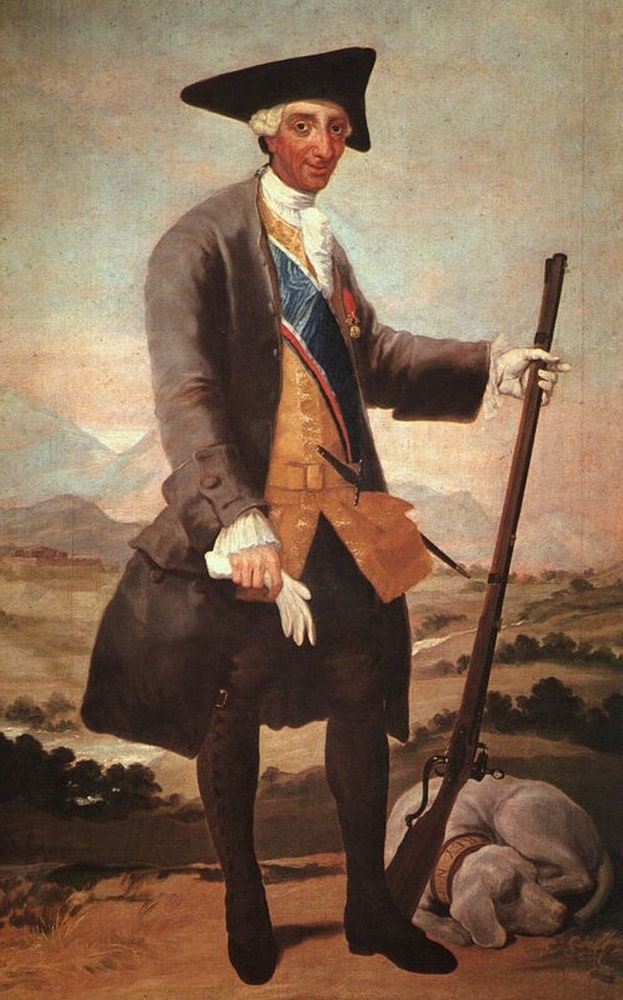
King Charles III of Spain Biography & Facts
by Edward St. Germain
Contents
About the author
Edward A. St. Germain created AmericanRevolution.org in 1996. He was an avid historian with a keen interest in the Revolutionary War and American culture and society in the 18th century. On this website, he created and collated a huge collection of articles, images, and other media pertaining to the American Revolution. Edward was also a Vietnam veteran, and his investigative skills led to a career as a private detective in later life.
Quick facts
- Charles III of Spain was born on January 20, 1716, in Madrid, Spain.
- He initiated the Bourbon Reforms in Spanish America and the Philippines to revitalize the empire.
- Charles III supported the American colonies during the American Revolution by providing financial aid and military support against the British.
- His reign saw the expulsion of the Jesuits from Spanish territories in 1767.
- He died on December 14, 1788, and was succeeded by his son, Charles IV.
- He was buried at the Pantheon of the Kings located at the Royal Monastery of El Escorial.
The President of the European Parliament, Jerzy Buzek, stated: “This morning, a European giant passed away […] In the darkest hours of our continent, Otto von Habsburg has been a rock of truth and humanity. He resisted Nazism with the same determination he opposed the Communist regimes of the Eastern bloc. He kept the flame of hope for the reunification of Europe alive when many others had given up. I will never forget the moment when the Paneuropean Picnic, which Otto von Habsburg organised on 19 August 1989 at the Austro-Hungarian border, cut the first holes in that Iron Curtain of shame.”[8]
The European Parliament held a minute of silence in honour of Otto von Habsburg.[9]
European People’s Party – President Wilfried Martens said: “Otto von Habsburg was a great European. He relentlessly defended the European project and European integration”.[10]
From Wikipedia, the free encyclopedia
| Zita of Bourbon-Parma | |
|---|---|
| Servant of God | |
| Photograph by Carl Pietzner, 1911 | |
| Empress consort of Austria Queen consort of Hungary | |
| Tenure | 21 November 1916 – 12 November 1918 |
| Coronation | 30 December 1916 |
| Born | 9 May 1892 Villa Borbone delle Pianore, Tuscany, Kingdom of Italy |
| Died | 14 March 1989 (aged 96) Zizers, Grisons, Switzerland |
| Burial | 1 April 1989 Imperial Crypt (body)Muri Abbey (heart) |
| Spouse | Charles I of Austria(m. 1911; died 1922) |
| Issue | Otto, Crown Prince of AustriaArchduchess AdelheidRobert, Archduke of Austria-EsteArchduke FelixArchduke Carl LudwigArchduke RudolfCharlotte, Duchess of Mecklenburg-StrelitzArchduchess Elisabeth, Princess of Liechtenstein |
| NamesZita Maria delle Grazie Adelgonda Micaela Raffaela Gabriella Giuseppina Antonia Luisa Agnese | |
| House | Bourbon-Parma |
| Father | Robert I, Duke of Parma |
| Mother | Infanta Maria Antonia of Portugal |
| Religion | Catholic Church |
| Signature | |
Zita of Bourbon-Parma (Zita Maria delle Grazie Adelgonda Micaela Raffaela Gabriella Giuseppina Antonia Luisa Agnese; 9 May 1892 – 14 March 1989) was the last Empress of Austria and Queen of Hungary, in addition to other titles. She ascended to these titles when her husband, Charles I, became the last monarch of Austria-Hungary. She was declared Servant of God by Pope Benedict XVI.
Born as the seventeenth child of the dispossessed Robert I, Duke of Parma, and Infanta Maria Antonia of Portugal, Zita married Archduke Charles of Austria in 1911. Charles became heir presumptive to the Emperor Franz Joseph I of Austria in 1914 after the assassination of his uncle Archduke Franz Ferdinand of Austria, and acceded to the throne in 1916 after the elderly emperor’s death.
After the end of World War I in 1918, the Habsburgs were deposed and the former empire became home to the states of Austria, Hungary, and Czechoslovakia, while other parts were annexed to or joined the Kingdom of the Serbs, Croats and Slovenes, Italy, Romania, and a reconstituted independent Poland. Charles and Zita left for exile in Switzerland and, after the failure of attempts to restore royal rule in Hungary, were subsequently removed from that country by the Allies to Madeira, where Charles died in 1922. After her husband’s death, Zita and her son Otto served as symbols of unity for the exiled dynasty. A devout Catholic, she raised a large family after being widowed at the age of 29; she never remarried.
House of Bourbon-Parma
Tools
Appearancehide
Text
- SmallStandardLarge
Width
- StandardWide
Color (beta)
- AutomaticLightDark
From Wikipedia, the free encyclopedia
 | This article includes a list of general references, but it lacks sufficient corresponding inline citations. Please help to improve this article by introducing more precise citations. (October 2014) (Learn how and when to remove this message) |
| House of Bourbon-Parma | |
|---|---|
| Parent house | Bourbon-Anjou (agnatic) Farnese (enatic) |
| Country |  Italy Italy Luxembourg Luxembourg NetherlandsFormer countries NetherlandsFormer countries |
| Founded | 18 October 1748; 277 years ago |
| Founder | Philip, Duke of Parma |
| Current head | Prince Carlos |
| Final ruler | Guastalla: Ferdinand I (1765–1802) Etruria: Louis II (1803–1807) Lucca: Charles I (1824–1847) Parma: Robert I (1854–1859) |
| Titles | Current:Grand Duke of LuxembourgPrince of Bourbon de ParmeFormer:King of EtruriaKing of Northern Lusitania[1]Duke of ParmaDuke of PiacenzaDuke of GuastallaDuke of Lucca |
| Deposition | Etruria: 10 December 1807 (annexed by French Empire) Parma: 9 June 1859 (annexed by Sardinia) |
| Cadet branches | Luxembourg-Nassau |
The House of Bourbon-Parma (Italian: Casa di Borbone di Parma) is an Italian cadet branch of the Spanish royal family, whose members once ruled as King of Etruria and as Duke of Parma and Piacenza, Guastalla, and Lucca. The House descended from the French Capetian dynasty in male line. Its name of Bourbon-Parma comes from the main name (Bourbon) and the other (Parma) from the title of Duke of Parma. The title was held by the Spanish Bourbons, as the founder Philip, Duke of Parma who was the great-grandson of Ranuccio II Farnese, Duke of Parma, married Louise Élisabeth of France, getting the house of Bourbon, and the state of Parma, together.[2][3] The House of Bourbon-Parma is today the Sovereign House of the Grand Duchy of Luxembourg (agnatically) and all members of the Grand Ducal Family of Luxembourg are members of the House of Bourbon-Parma with the title of “Princes/Princesses” and the predicate of Royal Highness.[4][5][6][7]

Duchy of Parma
The Duchy of Parma was created in 1545 from that part of the Duchy of Milan south of the Po River, as a fief for Pope Paul III‘s illegitimate son, Pier Luigi Farnese, centered on the city of Parma. In 1556, the second Duke, Ottavio Farnese, was given the city of Piacenza, becoming thus also Duke of Piacenza, and so the state was thereafter properly known as the Duchies of Parma and Piacenza.
The House of Farnese continued to rule the duchies until 1731 and the death of the last male-line duke, Antonio. Upon his death the duchy passed to Infante Charles of Spain, the heir to the duchy through his mother, Elisabeth Farnese. However by the terms of the Treaty of Vienna (1738) Charles had to give up the duchy to Austria.
_-_family_tree_by_shakko_(EN).jpg)
Temporary Habsburg rule
The Habsburgs only ruled until the conclusion of the Treaty of Aix-la-Chapelle in 1748, when it was ceded back to the Bourbons in the person of Philip of Spain, Charles’s younger brother. As Duke Philip, he became the founder of the House of Bourbon-Parma.
In 1796, the duchy was occupied by French troops under Napoleon Bonaparte and absorbed into the Cisalpine Republic and Kingdom of Italy.
In 1814, the duchies were restored under Napoleon’s Habsburg wife, Marie Louise, who was to rule them for her lifetime. The duchy was renamed the Duchy of Parma, Piacenza and Guastalla.
Return to the Bourbons
After Marie Louise’s death in 1847, the duchy was restored to the Bourbon-Parma line, which had been ruling the tiny Duchy of Lucca. As part of the return, the Duchy of Guastalla was transferred to the Duchy of Modena. The Bourbons ruled until 1859, when they were driven out by a revolution following the Franco-Sardinian victory in their war against Austria.
The duchies of Parma, Piacenza and Guastalla and the Duchy of Lucca joined with the Grand Duchy of Tuscany and the Duchy of Modena to form the United Provinces of Central Italy in December 1859, and were annexed to the Kingdom of Sardinia in March 1860. The House of Bourbon continues to claim the title of Duke of Parma to this day. Carlos-Hugo (Carlist pretender to the Spanish throne in the 1970s) held the title from 1977 to his death. His son now claims the title.
List of dukes
House of Bourbon-Parma (1731–1735)
See also: Bourbon family tree
| Duke | Portrait | Birth | Marriages | Death |
|---|---|---|---|---|
| Charles, Duke of Parma 1731–1735 | 20 January 1716 Madrid son of Philip V of Spain and Elizabeth of Parma | Maria Amalia of Saxony 1738 13 children | 14 December 1788 Madrid aged 72 |
House of Bourbon-Parma (1748–1802)
| Duke | Portrait | Birth | Marriages | Death |
|---|---|---|---|---|
| Philip, Duke of Parma 1748–1765 | 15 March 1720 Madrid son of Philip V of Spain and Elizabeth of Parma | Louise-Elisabeth de Bourbon 25 October 1739 3 children | 18 July 1765 Alessandria aged 45 | |
| Ferdinand I, Duke of Parma 1765–1802 | 20 January 1751 Parma son of Philip, Duke of Parma and Louise-Elisabeth de Bourbon | Archduchess Maria Amalia of Austria 19 July 1769 9 children | 9 October 1802 Fontevivo aged 51 |
During the French ownership of the Duchy of Parma, the title of Duke of Parma was used as an honorary form and style. From 1808, the title was used by Jean Jacques Régis de Cambacérès. He kept the style of Duke of Parma until 1814. Only in 1847 was the actual title restored to the Bourbons, after a period of being held by Marie Louise of Austria, who was a Habsburg and the second wife of Napoleon I.
House of Bourbon-Parma (1847–1859)
| Duke | Portrait | Birth | Marriages | Death |
|---|---|---|---|---|
| Charles II, Duke of Parma 1847–1848 | 22 December 1799 Madrid son of Louis of Etruria and Maria Louisa, Duchess of Lucca | Maria Teresa of Savoy 5 September 1820 2 children | 16 April 1883 Nice aged 84 | |
| Charles III, Duke of Parma 1848–1854 | 14 January 1823 Lucca son of Charles II, Duke of Parma and Princess Maria Teresa of Savoy | Princess Louise Marie Thérèse of France 10 November 1845 4 children | 27 March 1854 Parma aged 31 | |
| Robert I, Duke of Parma 1854–1859 | 9 July 1848 Florence son of Charles III, Duke of Parma and Louise Marie Thérèse of Artois | Maria Pia of the Two Sicilies 5 April 1869 12 children Maria Antonia of Portugal 15 October 1884 12 children | 16 November 1907 Viareggio aged 59 |
 Rosamond Press


.jpg)

.jpg)
Leave a comment