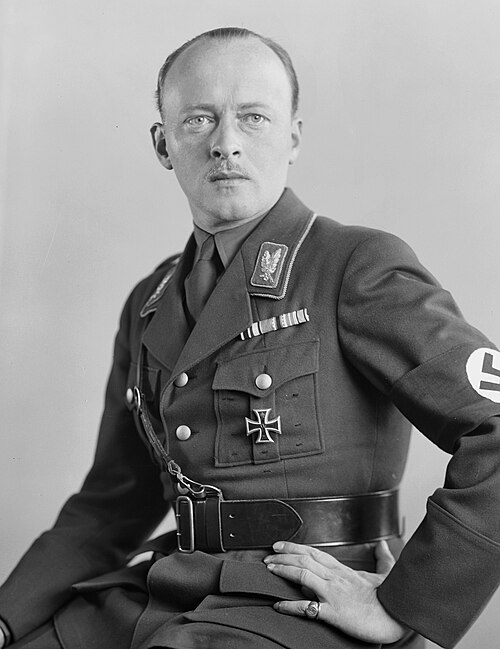
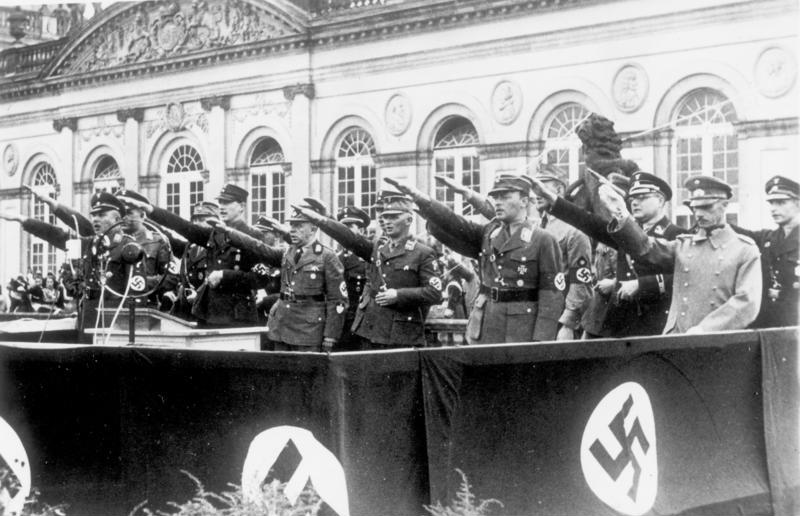
Deutschland 1933: Reichstreffen des Reichsbundes Volkstum und Heimat in Kassel. Unter den offiziellen Gästen sind Prinz Philipp von Hessen 1.R.2.v.r. und Generalleutnant Wilhelm Ritter von Leeb 1.R1.v.r.
On February 4, 2026, I found the reason our linage was hidden, and why Vicror William Presco could not trust his children. Rosemary said he was a “made man” when he turned 21 the Stuttmister aunts offer him a San Frncisco moving company. He turned them down. One of his secretaries called my father “Vic the Nazi” because he put on video of Nazi Germany during lunch.
Phillip was a great uncle of William and Harry. Is this why Harry wore a Swastika to a royal party?
John Presco
Princess Mafalda of Savoy (19 November 1902 – 28 August 1944)[1] was the second daughter of King Victor Emmanuel III of Italy and his wife Elena of Montenegro. In 1925, at the age of 22, she married the Landgrave of Hesse, Philipp. In 1943, during World War II, she was imprisoned in the Buchenwald concentration camp, where she died.[2] The future King Umberto II of Italy was her younger brother.
Mafalda was born a princess of Savoy. She was the second child and daughter of King Victor Emmanuel III of Italy and Elena of Montenegro. She was very close to her mother, and went with her mother to visit Italian military hospitals during World War I.[3] In 1925, Mafalda married Philipp, Landgrave of Hesse. They had four children together.
In 1943, during World War II, Mafalda was tricked into going to the German Embassy, under the impression that her husband needed to speak to her.[2] However, her husband was already imprisoned in a concentration camp, while her children had been given sanctuary in the Vatican.[4] On her arrival at the German embassy, Mafalda was arrested and transported to Munich for questioning, then to Berlin,[5] and finally to Buchenwald concentration camp.[5]
On 24 August 1944, the Allies bombed Buchenwald’s ammunition factory. Mafalda suffered from burns on her left arm and face, and was found covered up to her neck in debris. Her arm soon became infected, and she had an operation done. The operation resulted in her death from blood loss during the night of 28 August.[2][6]
Victor Emmanuel remained silent during the winter of 1925–26 when Mussolini dropped all pretence of democracy. During this time, the king signed without protest laws that eliminated freedom of speech and assembly, abolished freedom of the press, and declared the Fascist Party to be the only legal party in Italy.[19] In December 1925, Mussolini passed a law declaring that he was responsible to the King, not Parliament. Under the Statuto Albertino Italian governments were legally answerable to Parliament, but politically answerable to the monarch. However, it had been a strong constitutional convention since at least the 1860s that they were legally and politically answerable to Parliament. In January 1926, the squadristi used violence to prevent opposition MPs from entering Parliament and in November 1926, Mussolini arbitrarily declared that all of the opposition MPs had forfeited their seats, which he handed out to Fascists.[20] Despite this blatant violation of the Statuto Albertino, the king remained passive and silent as usual.[21] In 1926, Mussolini had violated the Statuto Albertino by creating a special judicial tribunal to try political crimes with no possibility of a royal pardon. Even though the right of pardon was part of the royal prerogative, the king gave his assent to the law.[21] However, the king did veto an attempt by Mussolini to change the Italian flag by adding the fasces symbol to stand beside the coat of arms of the House of Savoy on the Italian tricolour. The king considered this proposal to be disrespectful to his family, and refused to sign the law when Mussolini submitted it to him.[21] By 1928, practically the only check on Mussolini’s power was the King’s prerogative of dismissing him from office. Even then, this prerogative could only be exercised on the advice of the Fascist Grand Council, a body that only Mussolini could convene.[21]
In any event, once the referendum’s result was certified, Victor Emmanuel and all other male members of the House of Savoy were required to leave the country. Taking refuge in Egypt, where he was welcomed with great honour by King Farouk, Victor Emmanuel died in Alexandria a year later, of pulmonary congestion.[71] He was interred behind the altar of St Catherine’s Cathedral. He was the last surviving grandchild of Victor Emmanuel II of Italy. In January 1948, Time magazine published an article about “The Little King”.[59]
Imprisonment and death: 1943–1944
The relationship between Prince Philipp and Hitler was beginning to sour by the spring of 1943.[13] Although he initially worked for Hitler, Prince Philipp tried to resign, but he was prevented.[5] He, reportedly, provided passports for Jews to allow them to flee to the Netherlands.[5]
Early in September 1943, Princess Mafalda travelled to Bulgaria to attend the funeral of her brother-in-law, King Boris III.[8] While there, she was informed of Italy’s surrender to the Allied Powers, that her husband was being held under house arrest in Bavaria, and that her children had been given sanctuary in the Vatican.[4] The Gestapo ordered her arrest, and on 23 September she received a telephone call from Hauptsturmführer Karl Hass at the German High Command, who told her that he had an important message from her husband.[2][3] On her arrival at the German embassy, Mafalda was arrested, ostensibly for subversive activities. Princess Mafalda was transported to Munich for questioning, then to Berlin,[5] and finally to Buchenwald concentration camp.[5] The Italian prisoners at the Buchenwald concentration camp recognized her, and stated that she shared her food with other prisoners.[5]
On 24 August 1944, the Allies bombed an ammunition factory inside Buchenwald.[14] Some four hundred prisoners were killed and Princess Mafalda was seriously wounded: she had been housed in a unit adjacent to the bombed factory, and when the attack occurred she was buried up to her neck in debris and suffered severe burns to her left arm.[2][3][5] She said, “I’m dying. Remember me not as a princess but as your Italian sister.”[2]
The conditions of the labour camp caused her arm to become infected as a result,[2] and the medical staff at the facility amputated it;[3] she bled profusely during the operation and never regained consciousness. She died during the night of 26–27 August 1944;[15] her body was reburied after the war at Kronberg Castle in Hesse.[citation needed]
Eugen Kogon, author of The Theory and Practice of Hell – The German Concentration Camps and the System Behind Them (1950), adds more details of Mafalda’s death – some of it in conflict with the previous account. After the air raid of 24 August 1944, the princess was wounded in the arm and Dr. Schiedlausky, camp medical office, performed the arm amputation, but his patient did not survive due to loss of blood. Her naked body was dumped into the crematorium, where Father Joseph Thyl dug it out of the body heap, covered her up, and arranged for speedy cremation. Thyl cut off a lock of the princess’s hair, which was smuggled out of camp to be kept in Jena, until it could be sent on to her German relatives. Her death was not confirmed until after Germany’s surrender to the Allies in 1945.[16]
On 24 August 1944, the Allies bombed an ammunition factory inside Buchenwald.[14] Some four hundred prisoners were killed and Princess Mafalda was seriously wounded: she had been housed in a unit adjacent to the bombed factory, and when the attack occurred she was buried up to her neck in debris and suffered severe burns to her left arm.[2][3][5] She said, “I’m dying. Remember me not as a princess but as your Italian sister.”[2]
Philipp, Prince and Landgrave of Hesse (6 November 1896 – 25 October 1980) was head of the Electoral House of Hesse from 1940 to 1980.
Philipp joined the Nazi Party in 1930, and, when they gained power with the appointment of Adolf Hitler as Chancellor in 1933, he became Oberpräsident of the Prussian Province of Hesse-Nassau. However, he later began to fall out of favour with Hitler in the spring of 1943 after delivering an honest assessment of the military situation in Italy.[1] He was arrested in September 1943 on the day Italy surrendered to the western Allies, dismissed in the following year, and was sent to the Flossenbürg concentration camp, then Dachau, where he remained until being transported to Tyrol by the SS, where he was liberated by Wehrmacht forces on 30 April 1945[2] and then arrested by U.S. forces on 4 May 1945, being interned until 1947.[3]
Philipp was a grandson of Frederick III, German Emperor, and a great-grandson of Queen Victoria, as well as the son-in-law of Victor Emmanuel III of Italy.[4]
Philipp was born at Schloss Rumpenheim in Offenbach, the third son of Prince Frederick Charles of Hesse and of his wife Princess Margaret of Prussia (sister of the German Emperor Wilhelm II). Philipp had a younger twin brother Wolfgang, as well as two older brothers and two other younger twin brothers.
SavoyA Berlin Hotel with Tradition
Monday, October 17 2011
© Savoy
Map
Address
Savoy
Fasanenstrasse 9-10
10623 Berlin-Charlottenburg
…How to get there
Contact
+49 30 311 030
…www.hotel-savoy.com
price level
The Savoy is probably the one hotel with the richest tradition in town. Classy, prudent and with a brilliant location, even world celebrities like Romy Schneider, Greta Garbo and Thomas Mann made it their temporary home of choice on a regular basis.
It’s a soulful place with creaking floor boards and the inimitable charm of the past days. Taken to the present with its beautifully renovated restaurant Weinrot and the Salon Belvedere.
The Savoy’s very own Times Bar, Germany’s exclusive distributor of world renowned Cuban Casa del Habano cigars, is an absolute must-see for every cigar lover.

https://www.cremeguides.com/en/berlin/savoy-a-berlin-hotel-with-tradition/
 Rosamond Press
Leave a comment