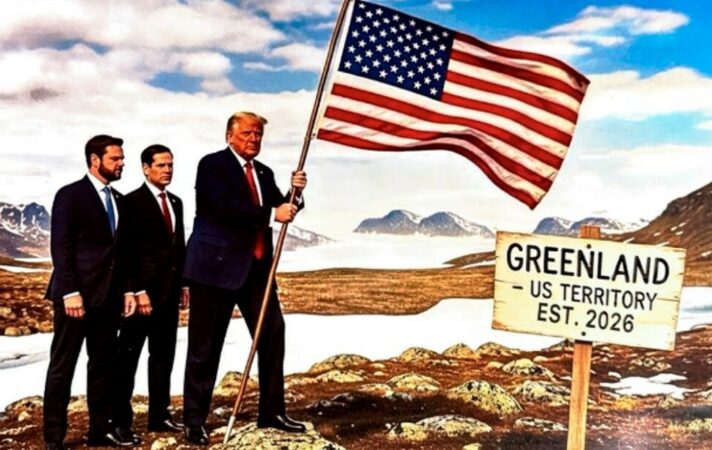
High-ranking officials working for Director of National Intelligence Tulsi Gabbard ordered U.S. intelligence agencies to step up their spying of the island,
I have launched an investigation as to what Democrat Leaders were doing, and thinking, after Trump said he wanted Greenland. Why didn’t the Democrats hold a mock trial her at home, and invite NATO members to join in. Instead, Jack Smith is put on THE CASE – and nothing is done.
THINK SWING VOTERS!
Launching a massive litigation – that went nowhere – told swing voters
TRUMP IS INNOCENT OF ALL CHARGES
This article was published May 6, 2025!!!!! Why didn’t the Democrats hap on our Intelligence…..
WAS ON THE CASE?
You don’t have to prove Trump is nuts. You can do all humanly possible…
TO MAKE HIM LOOK CRAZY!
Instead you get these White Women maintaining the status quo for a party fuled by Black Women – who don’t want any white Democrat focusing on White Europeans – who are all guilty! Even their women?
John Presco
“The Trump administration seems to be already taking steps to realize the president’s goal. High-ranking officials working for Director of National Intelligence Tulsi Gabbard ordered U.S. intelligence agencies to step up their spying of the island, the Wall Street Journal reported Tuesday.
Nancy Pelosi Hits Trump With Brutal Reality Check On His Greenland Takeover Plan
The California Democrat warned against abandoning NATO allies, noting the support its members previously offered the country at a critical moment.

May 8, 2025, 08:08 AM EDT111 COMMENTS
 00:20Will Trump Grab Greenland?
https://cds.connatix.com/p/plugins/cnx.bridge-1.0.10.htmlThe video player is currently playing an ad.
Speaker Emerita Nancy Pelosi (D-Calif.) on Wednesday poked fun at President Donald Trump’s plans to acquire Greenland, referencing the unpopularity of his suggestion among the people who live on the island.
“I think that more people think that Elvis Presley is alive in the United States than Greenlanders who think they want to be part of the United States,” Pelosi told Politico’s Securing Europe: NATO’s Next Steps Event.
Advertisement
Indeed, his push for annexing the island seems wildly unpopular with Greenlanders. Just 6% said they supported the idea of becoming part of the U.S., according to a poll published in late January.
Despite the discouraging numbers, Trump, who has repeatedly made his desire to annex the semi-autonomous Danish territory known, said he would not rule out taking the island by force.
“I don’t say I’m going to do it, but I don’t rule out anything,” Trump told NBC’s Kristen Welker this weekend. “We need Greenland very badly. Greenland is a very small amount of people, which we’ll take care of, and we’ll cherish them, and all of that. But we need that for international security.”
The Trump administration seems to be already taking steps to realize the president’s goal. High-ranking officials working for Director of National Intelligence Tulsi Gabbard ordered U.S. intelligence agencies to step up their spying of the island, the Wall Street Journal reported Tuesday.
In response to the article, Danish Foreign Minister Lars Lokke Rasmussen said he would call the acting U.S. ambassador to Denmark to review the report’s contents, which he described as “disturbing.”
“We do not spy on friends,” Rasmussen said, according to Reuters.
Denmark, along with the U.S., are of the 12 founding members of the NATO military alliance.
Asked if the European Union and NATO can still count on the U.S. as a “reliable partner,” Pelosi said: I “absolutely hope so.”
“I think it’s essential to global security that the United States be an essential part of it,” Pelosi added.
Despite past comments by the president questioning his commitment to NATO, the California Democrat expressed optimism that the U.S. would honor the alliance’s mutual assistance clause, just as its fellow members did after the Sept. 11, 2001, terrorist attacks. Notably, this was the only time that NATO’s mutual assistance clause has ever been triggered.
Advertisement
Pelosi also warned of the dire consequences that would follow if the U.S. abandoned its NATO allies.
“I do think that if we as the United States of America do not honor our commitments,” she said, “I don’t know how we expect people to honor their commitments to us.”
Why spying on Greenland isn’t the problem
It’s all the other coercive ways Trump is pursuing our strategic interests there

May 13, 2025
According to a report in the Wall Street Journal last week, Director of National Intelligence Tulsi Gabbard has instructed U.S. intelligence agencies to increase collection of information on Greenland.
The topics of interest include independence sentiment among Greenlanders, attitudes regarding U.S. mining interests, and individuals in Greenland and Denmark who might be supportive of U.S. objectives in Greenland.
It is not unusual, and can be appropriate, for the intelligence community to respond positively to peculiar interests of whoever is the incumbent administration. Such intelligence directives do not necessarily foreshadow actual administration policy and may be part of an exploratory effort to see what the possibilities are.
In this instance, the leak of the reported directive evoked sharp negative reactions in both Denmark and Greenland. The Danish government summoned the U.S. ambassador in Copenhagen for an explanation. The newly elected prime minister of Greenland, Jens-Frederik Nielsen, stated that the reported intelligence collection was “completely unacceptable,” “entirely abnormal” and “disrespectful toward an ally.”
A further downside of devoting intelligence resources to an administration hobby horse is that such resources are limited. Thus, there inevitably are opportunity costs in having fewer resources available to monitor matters more important for U.S. interests, including threats to U.S. national security, elsewhere in the world.
Gabbard’s directive may or may not point to future U.S. policy, but President Donald Trump has repeatedly indicated that he is serious about wanting U.S. ownership of Greenland. His sending of Vice President JD Vance on a trip to Greenland in March demonstrated the depth of the administration’s interest in the island.
The key policy question at hand is not whether Greenland is relevant to U.S. interests, but rather whether those interests are better advanced through current ownership and sovereignty arrangements or through the United States somehow acquiring the island.
The security interests stem from Greenland’s geographic location. It is underneath many air and missile routes between Russia and the United States. The location also is relevant to naval operations, with Greenland being on one side of the Greenland-Iceland-United Kingdom gap between the North Atlantic and Arctic Ocean, as well as next to Northwest Passage navigation routes that will see increasing usage with the melting of arctic sea ice.
Under a 1951 treaty with Denmark, the United States already has what amounts to military sovereignty in Greenland. It is free to erect installations and conduct operations there without compensation to the Danes. During the Cold War, the United States constructed more than a dozen military installations in Greenland. Most have since been abandoned, only because they became obsolete or unneeded and not because of resistance from Denmark.
The United States still operates the Pituffik Space Base, the northernmost U.S. military installation in the world. The base’s main declared mission is to keep watch on the atmosphere and space to the north for any Russian and Chinese missiles and satellites.
The Danish and Greenlandic authorities have fully cooperated with the United States on security matters in other respects. This has included responding positively to U.S. prompting, from both the Biden and Trump administrations, to rebuff Chinese attempts to establish investments and infrastructure in Greenland. Greenland’s own foreign, security, and defense strategy published last year states that the territory “plays a key role in the defense of the United States against external threats, especially from the Arctic region.”
NATO ally Denmark recently has expressed its willingness to expand further its security cooperation with the United States in Greenland. Denmark also is augmenting its own defense activities in Greenland.
The economic interests, in a land that has only about 57,000 people and is mostly covered with ice, are minimal. Most talk on economic matters in Greenland focuses on minerals, echoing what Trump has talked about concerning Ukraine. And also like Ukraine, mineral exploitation in Greenland is mostly a matter of potential that is as yet unproven and undeveloped.
Newsletter
Subscribe now to our weekly round-up and don’t miss a beat with your favorite RS contributors and reporters, as well as staff analysis, opinion, and news promoting a positive, non-partisan vision of U.S. foreign policy.
Invalid emailEnter your emailSubscribe
To the extent there is valuable potential to be developed, Greenlandic officials are not only willing but eager for the United States to participate in that development. This is part of a larger Greenlandic eagerness for U.S. economic involvement, to include tourism and other forms of investment.
Greenland’s minister of business and trade wrote earlier this year — while pointing out that 39 of the 50 minerals that the United States has classified as critical to national security and economic stability can be found in Greenland — that “the big obstacle to development of Greenland’s mineral resources is a lack of capital.” He noted that Greenland “has been collaborating with the U.S. State Department for several years to provide new knowledge about our critical minerals.” The latest agreement on this subject was signed in 2019 during the first Trump administration, and the minister expressed his “high hopes of signing a new agreement with the United States as soon as possible.”
In short, it is hard to imagine anything in Greenland that would serve U.S. security or economic interests that the United States cannot get already, simply by working harmoniously with the Danes and Greenlanders. Acquiring U.S. sovereignty over the island would not serve those interests any better.
The downsides of the act of acquisition also need to be factored in. So far, Trump has been vague about how this would be accomplished and has not ruled out any method, including even armed force. If it did come to a military operation, this would be an even more cataclysmic turnabout of the U.S. security posture than Trump already has caused with his shattering of alliances and cozying to authoritarians. It would be not only a naked act of aggression, but one against the territory of a NATO ally.
Even if military force were not used, acquisition would be an act of coercion because it would be contrary to the clear and strong preference of the people of Greenland. A recent poll showed that 85 percent of Greenlanders are opposed to becoming part of the United States. The Greenlandic prime minister before last month’s election in the territory reflected this sentiment in declaring “we do not want to be American.” The government of Denmark has supported this position and emphasized that the future of Greenland is for Greenlanders to decide, including eventually through a referendum.
It is not hard to understand this preference. While Greenland has had self-government since 2009, its people still have full Danish citizenship and mobility within the European Union. They also enjoy Nordic-type welfare rights including health care, social security, and free education.
Although most Greenlanders eventually want complete independence, the substantial support they get from Denmark — including a direct subsidy that amounts to $12,500 per capita — is the main reason they have hesitated to make that move by holding the promised referendum. The Trump administration has tried to exploit the pro-independence sentiment as a wedge issue between Greenland and Denmark, but the administration’s approach has backfired. Greenlanders’ anger over the U.S. attempt at a takeover has pushed them closer to Denmark.
This result is similar to what occurred in recent elections in Canada and Australia, in which right-of-center parties were punished by voters who associated them with Trump’s policies. In each case, citizens of an allied nation responded to what they perceived as unfriendly actions — either a trade war or threat of annexation — in a direction opposite to what the Trump administration presumably preferred.
The problems of coercively taking over a nation whose people do not want to be taken over would occur partly within the nation itself. A taste of that came during Vance’s visit, when concerns about popular demonstrations in opposition resulted in scrapping most of the planned itinerary and limiting the visit to a stop at a U.S. military base.
The problems also extend to other parts of the world, with the green light that coercive annexation would give to Russia, China, or other powers that might want to seize territory whose residents do not want to be annexed.
The overall conclusion is that U.S. acquisition of Greenland would be a clear net negative for the United States.
Trump’s determination nonetheless to pursue this project probably has multiple motivations. Partly it is nostalgia for his view of the late nineteenth century, in which imperialism as well as tariffs were the external counterparts of a domestic Gilded Age dominated by robber barons. Partly it is a desire to show a highly visible “accomplishment” as something some of his predecessors considered but never achieved. Partly it is a crude acquisitiveness that was reflected in Trump’s resistance to surrendering classified government documents that he claimed to be “my” documents.
What it is not is a well-reasoned pursuit of U.S. interests.
c
 Rosamond Press
Leave a comment