6 “All the days that he separates himself to the Lord he shall not go near a dead body. 7 Not even for his father or for his mother, for brother or sister, if they die, shall he make himself unclean, because his separation to God is on his head. 8 All the days of his separation he is holy to the Lord.
Bond’s With Angels
by
John Presco
ALL RIGHTS RESERVED
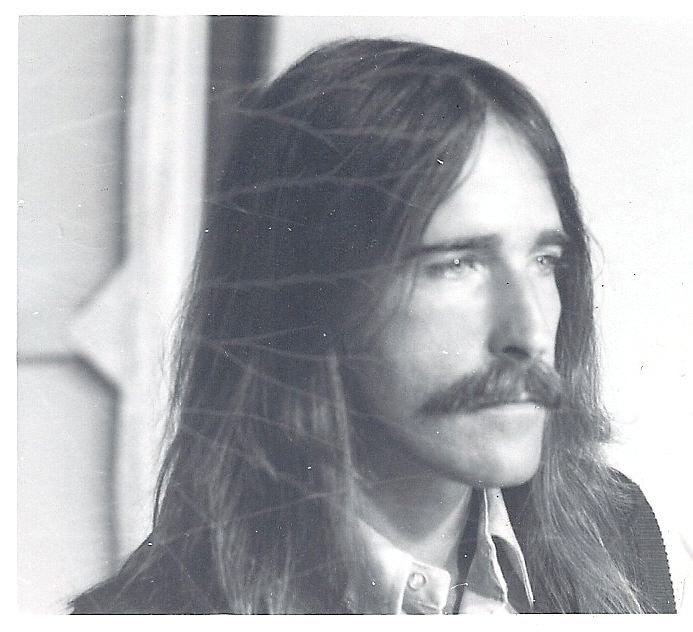
On December 23, 20 I believe I found proof Jesus was a Nazarite – after his cousin, John the Baptist. It is alleged his bother James was a Nazarite. It is FORBIDDEN for a Nazarite to get near a dead body
OR TOUCH A DEAD BODY
Jesus’ brother, James knew this, for he was a famous Nazarite, like John the Baptist. his cousin? Did Jairus the rabbi know this? Og course! He read Numbers 6. Did this rabbi eer meet John the Baptost
THE NAZARITE FOR LIFE?
Surely he heard of him – and the that he Baptized Jeus – and the Holy Spirit descended, and crowned his head with a Holy Halo.
35 While Jesus was still speaking, some people came from the house of Jairus, the synagogue leader. “Your daughter is dead,” they said. “Why bother the teacher anymore?”
36 Overhearing[a] what they said, Jesus told him, “Don’t be afraid; just believe.”
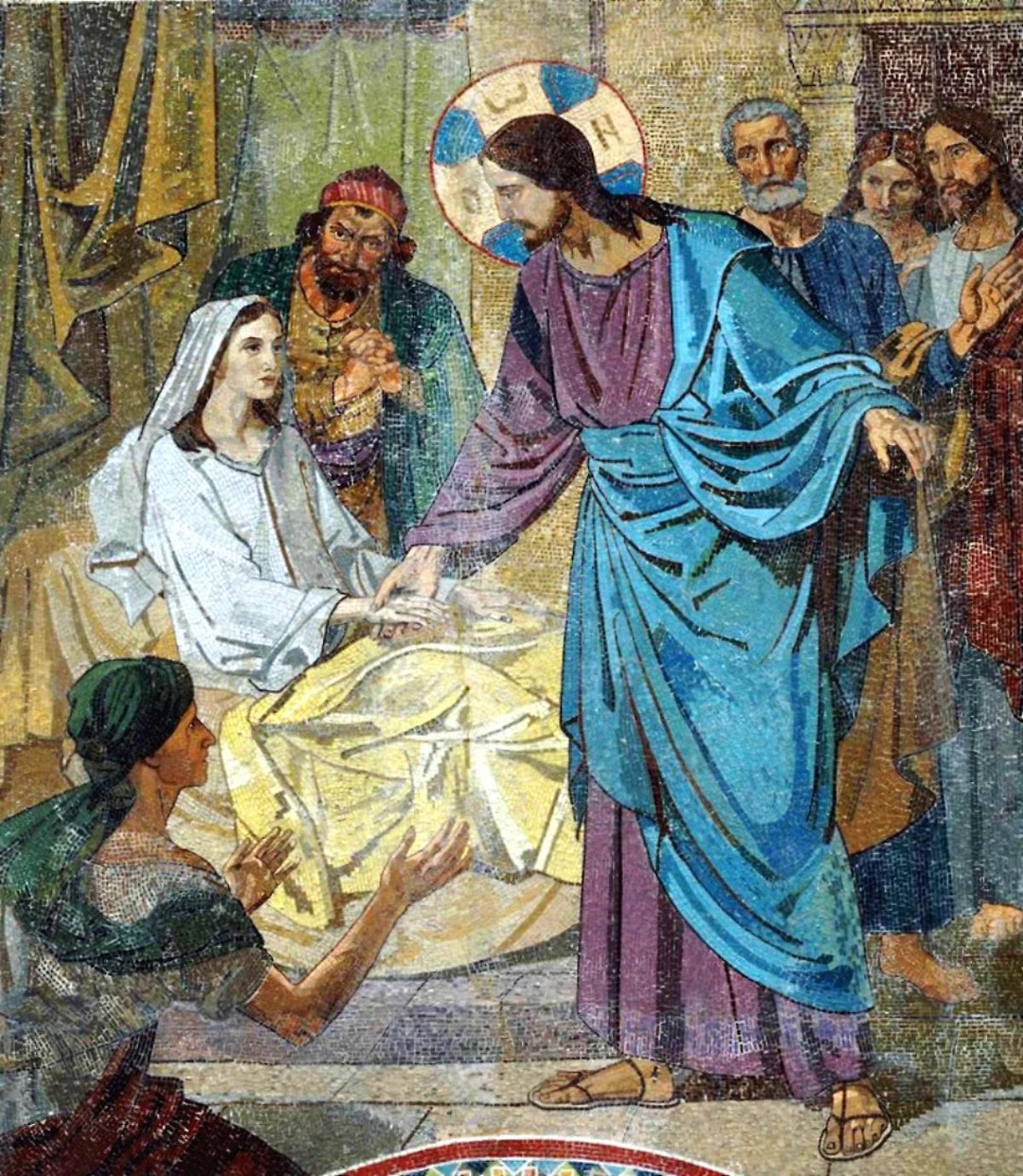
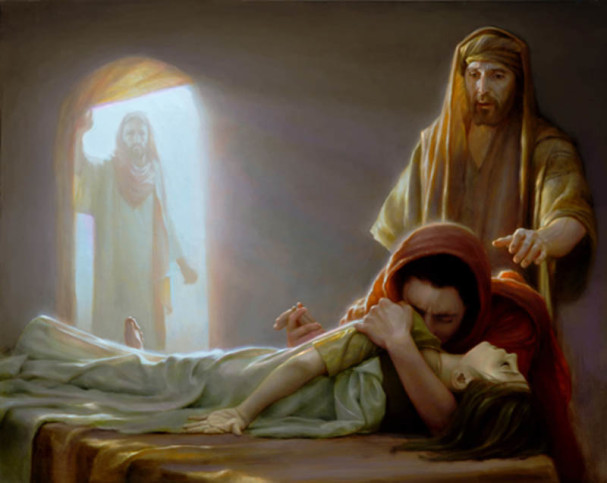
I am convinced The Daughter of The Rabbi – was raised from a distance. When Jesus came to visit her, he was struck by how
BEAUTIFUL SHE IS
There is a halo around her head. Jesus neals, take her hand, and
“WILL YOU MARRY ME?”
This maiden is thirtteen, the age Jewish females become a woman. She grew up in a ritually clean home. She knows her Torah – like the back of her hand. She is……
A VIRGIN!
Amen!
I bid my readers and followers to copy and save this post, for it is the key in restoring the Original Nazarite Church
John ‘The Nazarite Judge’
Accounts in the New Testament describe Jesus healing people from a distance, where he did not physically touch the person but rather issued a command or declaration.
The most prominent instances are:
- The Healing of the Centurion’s Servant/Slave: This miracle is recorded in the Gospels of Matthew (8:5–13) and Luke (7:1–10). A Roman centurion in Capernaum sent Jewish elders to Jesus because his servant was gravely ill. The centurion later sent friends to tell Jesus not to bother entering his home, as he felt “unworthy” and believed Jesus could simply say the word from a distance to heal the servant. Jesus praised the centurion’s great faith and the servant was healed at that exact moment.
- The Healing of the Royal Official’s Son: Described in the Gospel of John (4:46–54), a royal official came to Jesus in Cana to ask him to come to Capernaum and heal his dying son. Instead of traveling with the official, Jesus simply told him, “Your son will live.” The official took Jesus at his word and found out later that his son had recovered at the precise time Jesus had spoken the words.
- The Exorcism of the Syrophoenician Woman’s Daughter: Recorded in Matthew 15:21–28 and Mark 7:24–30, a Gentile woman (Syrophoenician) begged Jesus to drive a demon out of her daughter. Jesus initially resisted, explaining his mission was primarily to the “lost sheep of the house of Israel.” After the woman’s persistent and faith-filled reply, Jesus stated, “Woman, great is your faith! Let it be done for you as you wish,” and her daughter was healed instantly, without Jesus ever meeting the daughter.
James the Just, or a variation of James, brother of the Lord (Latin: Iacobus from Hebrew: יעקב, Ya’aqov and Ancient Greek: Ἰάκωβος, Iákōbos, can also be Anglicized as “Jacob“), was, according to the New Testament, a brother of Jesus. James was personally known to Paul the Apostle (Gal 1:19).[6] He was the first leader of the Church of Jerusalem.[b] Traditionally, it is believed he was martyred either in 62 AD by being stoned to death on the order of High Priest Ananus ben Ananus, or in 69 AD by being thrown off the pinnacle of the Temple by scribes and Pharisees and then clubbed to death. James, Joses, Simon, and Judas are mentioned as the brothers of Jesus as well as two or more unnamed sisters.(See Matthew 13:55; Mark 6:3.)[8][9]
Catholics, Orthodox, and some Protestants teach that James, along with others named in the New Testament as brothers[c] of Jesus, were not the biological children of Mary, mother of Jesus, but were cousins of Jesus,[11] or step-brothers from a previous marriage of Joseph (as related in the non-canonical Gospel of James).[12][d] Others consider James to be the son of Mary and Joseph.[16][17]
The Catholic tradition holds that this James is to be identified with James, son of Alphaeus, and James the Less.[18] It is agreed by most that he should not be confused with James, son of Zebedee also known as James the Great.[1]
James, the brother of Jesus, became a key leader in the early Jerusalem church and was known as “James the Just,” with traditions, particularly from early historians like Hegesippus, suggesting he followed a strict Nazirite vow, abstaining from wine, meat, and cutting his hair, practices associated with being consecrated to God, though this asceticism is sometimes debated. He transformed from a skeptic to a pillar of the faith, leading the Council of Jerusalem and becoming the first Bishop of Jerusalem, eventually martyred around 63 A.D. for his Jewish Christian beliefs.
Mary Was Sleeping Beauty and Jesus’ Wife
Capturing Beauty
by
John Presco
ALL RIGHTS RESERVED
On December 23, 2025, I John Gregory Presco, asked this question:
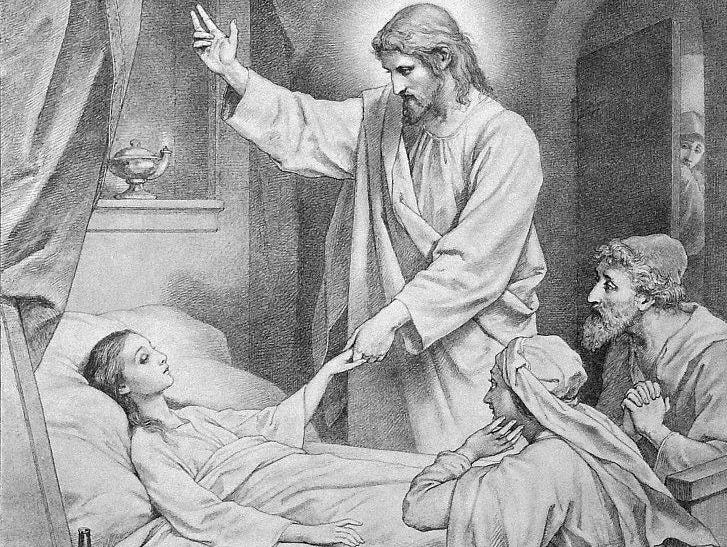
“Did Jesus marry the young woman – he raised from the dead?”
Jesus sad;
“She is only sleeping!”
He then – TAKES HER HAND! He knew….she would be his bride according to God’s Law.
Some claim Martha was the wife of Jesus. Martha was….
THE SISTER OF LAZARUS
So was the woman named MARY
To be continued
Jesus Raises a Dead Girl and Heals a Sick Woman
21 When Jesus had again crossed over by boat to the other side of the lake, a large crowd gathered around him while he was by the lake. 22 Then one of the synagogue leaders, named Jairus, came, and when he saw Jesus, he fell at his feet. 23 He pleaded earnestly with him, “My little daughter is dying. Please come and put your hands on her so that she will be healed and live.” 24 So Jesus went with him.
A large crowd followed and pressed around him. 25 And a woman was there who had been subject to bleeding for twelve years. 26 She had suffered a great deal under the care of many doctors and had spent all she had, yet instead of getting better she grew worse. 27 When she heard about Jesus, she came up behind him in the crowd and touched his cloak, 28 because she thought, “If I just touch his clothes, I will be healed.” 29 Immediately her bleeding stopped and she felt in her body that she was freed from her suffering.
30 At once Jesus realized that power had gone out from him. He turned around in the crowd and asked, “Who touched my clothes?”
31 “You see the people crowding against you,” his disciples answered, “and yet you can ask, ‘Who touched me?’ ”
32 But Jesus kept looking around to see who had done it. 33 Then the woman, knowing what had happened to her, came and fell at his feet and, trembling with fear, told him the whole truth. 34 He said to her, “Daughter, your faith has healed you. Go in peace and be freed from your suffering.”
35 While Jesus was still speaking, some people came from the house of Jairus, the synagogue leader. “Your daughter is dead,” they said. “Why bother the teacher anymore?”
36 Overhearing[a] what they said, Jesus told him, “Don’t be afraid; just believe.”
37 He did not let anyone follow him except Peter, James and John the brother of James. 38 When they came to the home of the synagogue leader, Jesus saw a commotion, with people crying and wailing loudly. 39 He went in and said to them, “Why all this commotion and wailing? The child is not dead but asleep.” 40 But they laughed at him.
After he put them all out, he took the child’s father and mother and the disciples who were with him, and went in where the child was. 41 He took her by the hand and said to her, “Talitha koum!” (which means “Little girl, I say to you, get up!”). 42 Immediately the girl stood up and began to walk around (she was twelve years old). At this they were completely astonished. 43 He gave strict orders not to let anyone know about this, and told them to give her something to eat.
At the Home of Martha and Mary
38 As Jesus and his disciples were on their way, he came to a village where a woman named Martha opened her home to him. 39 She had a sister called Mary, who sat at the Lord’s feet listening to what he said. 40 But Martha was distracted by all the preparations that had to be made. She came to him and asked, “Lord, don’t you care that my sister has left me to do the work by myself? Tell her to help me!”
41 “Martha, Martha,” the Lord answered, “you are worried and upset about many things, 42 but few things are needed—or indeed only one.[f] Mary has chosen what is better, and it will not be taken away from her.”
41 “Martha, Martha,” the Lord answered, “you are worried and upset about many things, 42 but few things are needed—or indeed only one.[f] Mary has chosen what is better, and it will not be taken away from her.”
c
Share this:
Royal Rosamond Press
The Nazirite Vow
6 And the Lord spoke to Moses, saying, 2 “Speak to the people of Israel and say to them, When either a man or a woman makes a special vow, the vow of a Nazirite,[a] to separate himself to the Lord, 3 he shall separate himself from wine and strong drink. He shall drink no vinegar made from wine or strong drink and shall not drink any juice of grapes or eat grapes, fresh or dried. 4 All the days of his separation[b] he shall eat nothing that is produced by the grapevine, not even the seeds or the skins.
5 “All the days of his vow of separation, no razor shall touch his head. Until the time is completed for which he separates himself to the Lord, he shall be holy. He shall let the locks of hair of his head grow long.
6 “All the days that he separates himself to the Lord he shall not go near a dead body. 7 Not even for his father or for his mother, for brother or sister, if they die, shall he make himself unclean, because his separation to God is on his head. 8 All the days of his separation he is holy to the Lord.
9 “And if any man dies very suddenly beside him and he defiles his consecrated head, then he shall shave his head on the day of his cleansing; on the seventh day he shall shave it. 10 On the eighth day he shall bring two turtledoves or two pigeons to the priest to the entrance of the tent of meeting, 11 and the priest shall offer one for a sin offering and the other for a burnt offering, and make atonement for him, because he sinned by reason of the dead body. And he shall consecrate his head that same day 12 and separate himself to the Lord for the days of his separation and bring a male lamb a year old for a guilt offering. But the previous period shall be void, because his separation was defiled.
13 “And this is the law for the Nazirite, when the time of his separation has been completed: he shall be brought to the entrance of the tent of meeting, 14 and he shall bring his gift to the Lord, one male lamb a year old without blemish for a burnt offering, and one ewe lamb a year old without blemish as a sin offering, and one ram without blemish as a peace offering, 15 and a basket of unleavened bread, loaves of fine flour mixed with oil, and unleavened wafers smeared with oil, and their grain offering and their drink offerings. 16 And the priest shall bring them before the Lord and offer his sin offering and his burnt offering, 17 and he shall offer the ram as a sacrifice of peace offering to the Lord, with the basket of unleavened bread. The priest shall offer also its grain offering and its drink offering. 18 And the Nazirite shall shave his consecrated head at the entrance of the tent of meeting and shall take the hair from his consecrated head and put it on the fire that is under the sacrifice of the peace offering. 19 And the priest shall take the shoulder of the ram, when it is boiled, and one unleavened loaf out of the basket and one unleavened wafer, and shall put them on the hands of the Nazirite, after he has shaved the hair of his consecration, 20 and the priest shall wave them for a wave offering before the Lord. They are a holy portion for the priest, together with the breast that is waved and the thigh that is contributed. And after that the Nazirite may drink wine.
21 “This is the law of the Nazirite. But if he vows an offering to the Lord above his Nazirite vow, as he can afford, in exact accordance with the vow that he takes, then he shall do in addition to the law of the Nazirite.”
 Rosamond Press
Leave a comment