Statues were found behind a wall at Sacred Heart in Takoma.
John ‘The Nazarite
Military archbishop: Army’s cancellation of religious support contracts unfairly harms Catholics
written by OSV News 2 days ago
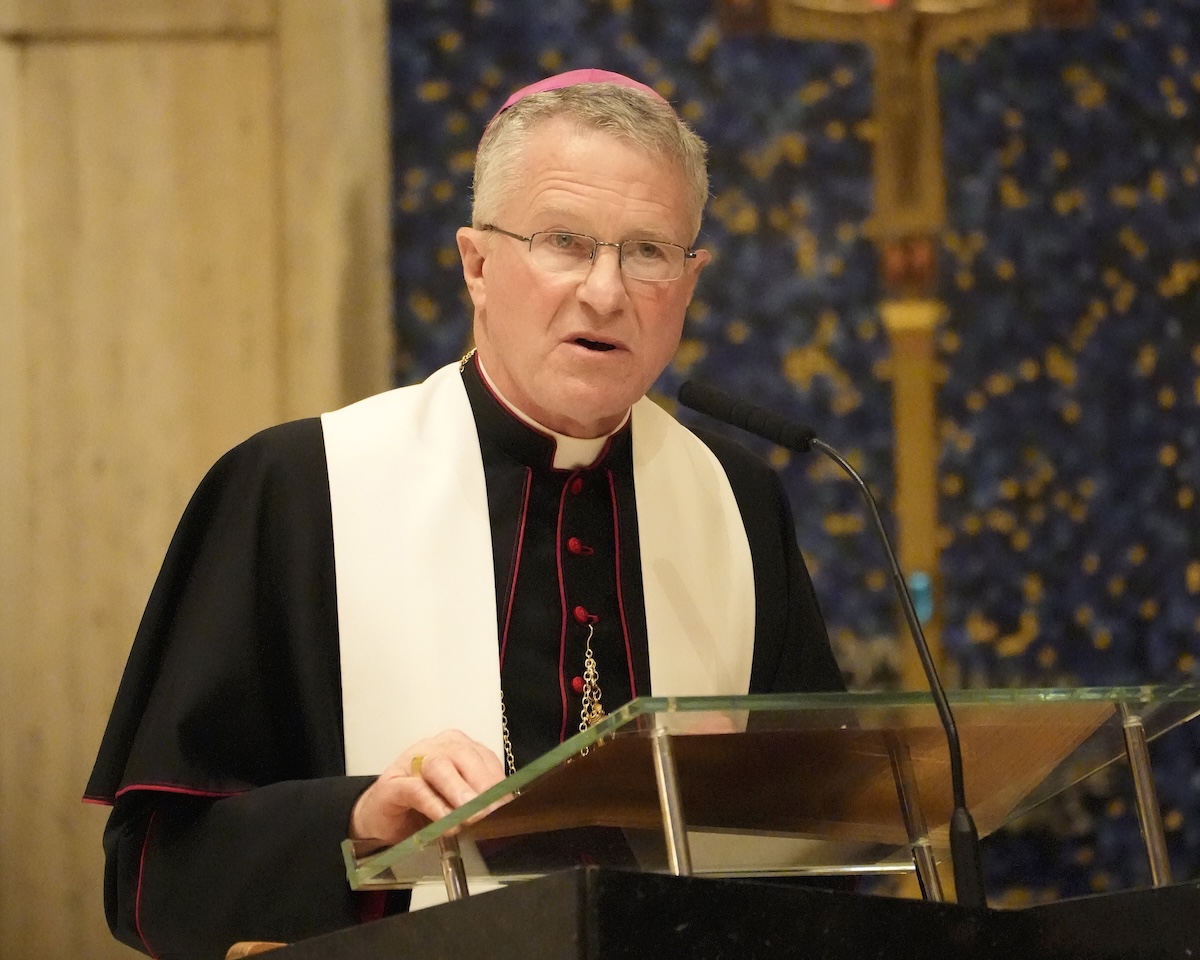
Archbishop Timothy P. Broglio of the U.S. Archdiocese for the Military Services and president of the U.S. Conference of Catholic Bishops, speaks during a prayer service at Holy Family Church in New York City Sept. 8, 2025. Archbishop Broglio issued a pastoral letter Oct. 17, 2025, over the U.S. Army’s decision to cancel all religious support contracts for Army chapels, which he said placed an insurmountable restriction on Catholics’ free exercise of religion. (OSV News photo/Gregory A. Shemitz)
WASHINGTON (OSV News) — Archbishop Timothy P. Broglio of the U.S. Archdiocese for the Military Services said Oct. 17 the U.S. Army has cancelled all religious support contracts for Army chapels, “including those for religious educators, administrators, and musicians.” He said this has placed on Catholics “an insurmountable restriction on the free exercise of religion.”
“For those who attend Mass, visit chapel offices, or participate in faith formation on a U.S. Army installation, you likely noticed, that beginning on Sunday, 5 October 2025, contract services and contractor offices were dark and music was absent during Mass,” the archbishop said in a letter addressed to members of the military archdiocese, which he said will also be sent to all members of Congress.
“These changes were not due to the government shutdown,” he said, “but rather, due to a memorandum issued in March of this year by U.S. Army Installation Management Command which directed the cancellation of all chapel contracts for Coordinators of Religious Education (CRE), Catholic Pastoral Life Coordinators (CPLC), and musician contracts, across the U.S. Army.”
He assured the faithful of the military archdiocese that he “will pursue all legal options to address this grave misstep.”
A spokesperson for the Department of Defense — which is using the moniker “Department of War” as a secondary, ceremonial title under an executive order signed by President Donald Trump — directed OSV News to the U.S. Army for comment. The U.S Army did not immediately respond to an inquiry.
“For decades, contracted CREs, CPLCs, and musicians have served the faith communities at military chapels. Their essential services have assisted Catholic priest chaplains in their duties and animated the life of the community,” Archbishop Broglio said.
“Over the past several months,” he added, “I have met with the Secretary of the Army and the Army Chief of Chaplains about the severe, negative impact that the cancellation of these chapel contracts will have on Catholic soldiers serving in the U.S. Army and their families entrusted to my care.”
Archbishop Broglio expressed “tremendous gratitude for CREs, CPLCs, and musicians” and “deep lament that the Army’s actions have proven so injurious to the practice of the Catholic faith on Army installations.”
Catholic chaplains fraction of total chaplain corps
“There are merely 137 Catholic chaplains serving in the active and reserve components of the U.S. Army, yet there are more than 2,500 chaplains in the U.S. Army Chaplain Corps,” he continued. “This means that less than 5.5% of the Chaplain Corps is Catholic. However, about twenty-percent of soldiers are Catholic.”
Archbishop Brolio cited a RAND report that found “there are approximately six Protestant chaplains for every 1,000 Protestant soldiers, and approximately one Catholic chaplain for every 1,000 Catholic soldiers.”
So the cancellation of religious support contracts “disproportionately harms Catholics,” he explained. “First, because Catholic chaplains are already so low density and in such high demand, and second because the Catholic faith requires continuing religious education and sacramental preparation that can only be accomplished through competent support.”
“Catholic priests who serve as U.S. Army chaplains offer spiritual and pastoral care to soldiers of any, or even no faith,” he added. “At the same time, they also serve, within their Catholic faith, six times the number of soldiers served by Protestant chaplains. The sheer number of Catholic soldiers and families creates a significant pastoral and administrative responsibility for Catholic chaplains.
“Moreover, because Catholic chaplains are most often assigned full-time to operational units, such as brigades and battalions, the demands of the unit, and the operational tempo of deployments, field time, and training rotations, make it impossible for a Catholic chaplain to oversee the daily operations of chapel programs without professional support.”
Canceling chapel contracts “may appear to be a neutral elimination of chapel support which itself affects the free exercise of religion for all soldiers,” Archbishop Brolio said. But he said the Army’s action “over-burdens Catholic chaplains,” “harms chapel communities” and “intolerably infringes upon the free exercise of religion for Catholics in the U.S. Army.”
He implored the faithful of the archdiocese “to continue to worship at military chapels and offer your gifts and talents for the building up of the Church, especially in sacramental preparation and religious education.”
The king of the shutdown
As the head of the White House’s budget office, Russ Vought has assembled an army of program-cutters and veteran Washington hands.

Office of Management and Budget Director Russ Vought looks on during a media availability at the White House on Sept. 29. | Francis Chung/POLITICO
By Sophia Cai10/18/2025 07:00 AM EDT
In an administration full of disruptors, Russ Vought is a different beast.
Vought, as head of the White House’s budget arm, has assembled one of the most powerful and exacting teams in Washington, all aimed at slashing the federal bureaucracy and ensuring what’s left bends to the administration’s will.
00:00
02:00
Read More
He has increased the number of policy lieutenants typically operating at the Office of Management and Budget and supercharged their mandate to ensure White House priorities are pushed into each agency.
That handiwork is now in motion as the Trump administration targets funding cuts to what it calls “Democrat agencies” and threatens more mass layoffs called “reductions in force,” or RIFs. On Friday, Vought said that $11 billion in Army Corps of Engineers projects in mostly blue states would be paused.
Vought’s expanded policy army, the nearly dozen “Program Associate Directors” or PADs, are charged with combing line-by-line through the nearly $7 trillion federal budget for programs to slash and helping him play what he’s called “budgetary twister” (finding money to blunt the most politically painful parts of the shutdown).
Beyond numbers, Vought’s lieutenants also are steeped-in-policy wonks who each lead an office composed of dozens of political and career servants. All of this positions Vought’s OMB as a potent political strike force.
“Pound for pound, they’ve got the strongest team of subject matter experts and experienced political people as well as policy experts across the government. It’s probably the strongest OMB that’s ever been assembled,” said Joe Grogan, former director of the White House domestic policy council during the first Trump administration.
OMB declined comment.
Under the direction of Mick Mulvaney, director of OMB in President Donald Trump’s first term, PADs “were not as empowered,” said one former Trump White House official, granted anonymity to discuss internal dynamics. “Now, they’re wielding the bully pulpit to say, ‘This is how it’s going to be.’”
The person said these positions are “much more enabled to unilaterally act and carry out the direction than they were in the past, where everyone was trying to be much more cooperative.”
They also reveal a microcosm of the Trump White House’s interests, such as slashing climate and diversity programs as well as restructuring federal procurements.
Vought’s policy lieutenants include Mark Calabria, who previously ran the Federal Housing Finance Agency and pushed to end Fannie Mae and Freddie Mac’s government conservatorship. He oversees the departments of Treasury, Housing and Commerce.
For natural resources and energy, Vought has selected Stuart Levenbach, who once served as chief of staff at NOAA and in Trump’s National Economic Council. Homeland security is helmed by Brian Cavanaugh, a former National Security Council senior director during Trump’s first term.
Then there’s Amaryllis Fox Kennedy, daughter-in-law of Robert F. Kennedy Jr., who directs intelligence and international affairs, Michael Stumo, who leads economic policy and the Made in America Office, Anne DeCesaro, who handles education, labor and income maintenance, Tom Williams for defense, Don Dempsey for health, Hal Duncan for legislative affairs and Kevin Rhodes for federal procurement. Unlike staffers in Elon Musk’s Department of Government Efficiency who were similarly looking for programs to cut, each of the PADs has significant government experience.
The core of OMB’s operation is a tight inner circle of Trump veterans who are laying the legal groundwork for OMB’s moves during the shutdown, which has dragged on since starting Oct. 1.
OMB’s general counsel Mark Paoletta, who served in the same role during Trump’s first term and once shepherded Clarence Thomas through his Supreme Court confirmation, has been intimately involved in drafting the administration’s justification not to backpay furloughed workers and to defend OMB’s actions in court.
Stephen Billy, a senior adviser, has been filing RIF updates on behalf of OMB in court. A former vice president of Susan B. Anthony Pro-Life America, Billy in particular has deep knowledge about the government programs related to abortion that OMB has targeted.
As one of his deputy directors, Vought has selected Eric Ueland, a reliable operator with a resume that includes multiple stints in the federal government as well as on Capitol Hill, including as staff director for former Senate Majority Leader Bill Frist. Former Rep. Dan Bishop (R-N.C.), chief of staff Katie Sullivan and communications director Rachel Cauley round out the senior echelon.
Leading the charge on OMB’s deregulatory efforts is Jeff Clark, the former acting head of the civil division at the Justice Department who pushed the agency to investigate voter fraud claims. Clark is now acting administrator of the Office of Information and Regulatory Affairs, an office within OMB which reviews pending federal regulations.
Some of these picks were affiliated with Vought’s Center for Renewing America and other conservative organizations like the Cato Institute or the Heritage Foundation during Joe Biden’s presidency, where they contributed to the Project 2025 policy blueprint and drafted proposals for Trump’s second-term agenda.
“We did a lot of things in the first term,” Vought said this week on “The Charlie Kirk Show.” “But one of the things we did not do was reductions in force. We honestly learned about it in our years of exile.”
Most Read

- IRS files tax lien against Jim Justice
- The king of the shutdown
- Lawmaker resigns after involvement in racist chat
- Johnson refuses to swear in Grijalva, brushes aside Democrats’ legal threat — for now
- Trump’s reshoring push is tripping over itself
Over the past nine months, his team has scrutinized federal accounts to identify what he calls the “woke and weaponized” corners of government. That work produced a 1,224-page addendum to the fiscal 2026 White House budget request this spring, a granular manifesto of what Trump’s White House wants to spend — or cut.
Vought’s team has been notably deliberate compared with the chaotic first days of the administration when Elon Musk took a chainsaw to the federal government. It waited to send the first rescissions package to Capitol Hill until it had better odds of passage. They asked the Department of Energy to pace its cuts to preserve leverage for negotiations. And they’ve used the apportionment process to control agency spending, cognizant that any moves to withhold funding could form the basis of a Supreme Court challenge to the Impoundment Control Act.
But the shutdown gave Vought his clearest opening yet. Since the start of the shutdown, Vought cut $7.5 billion in energy grants identified by the Department of Energy, ordered all 200 federal agencies to submit RIF plans and cut programs like the Minority Business Development Agency, CISA and the Office of Population Affairs.
 Rosamond Press
Leave a comment