
The Royal Janitor
A Caddillac Woman
Victoria Bond bought a Cadillac Motor home when Baby Her came to live with her. They made several strips to the coast. When she saw the living condition their daughter was in at the Blue River Bat Cave – she freaked out! Starfish blushed with shame – for the first time in her life. Owning a Guilt Trip was against everything she believed in. This is why she could never buy St. Paul’s Jesus. He was so – SIN FREE! After Pay had his way with him, Jesus was dripping with
SHAME
He shamed everything that movied! How could he be the….
THE FATHER OF THE BLUE LAWS
Calling up her Cadillac dealer, she ordered the Moto Home El Supereo, and drove her Velocity Cad to the dealership to pick it up.
“If you’re going up river, the one you got will do just fine. You might bottom-out on 126, and the logging trail.”
Victoria winced. She told her dealer about the logging road. Could he keep his mought shut? Cadillac Dealers are famous for keeping their moth shuts. You could trust them on all levels.
“There’s nothing tooo good for my baby and wife!”
To be continued
Coming into the Walterville slowdown, Victoria slowed to a crawl to let the Zippu One – zio by! They were furious at the thought they almoat got caught behind a Slubmobile, all the way to Vida, before they were able- zip on by again! Looking down, a pump blonded wearing a red hat threw her the bird.
“Do you have Pete’s book on the screen?” asked Starfish.
“Yes!”
WTF? Who have you been talking to. Looks like he modeled his whole existence around us. What do you make of his tattoos?”
“Im reading it now! Wow! I can read this guy – like a book!”
“So can I. Did you read the Bible last night like I asked?
“Yes! It took me four hours while wearing the the Wizard’s Halo. My memory capacity has increased. We invented a trial video game. We got a hundred million dollar advance.”
“What’s it called? Starfish asked
“Cadillac Girl!”
“How many do you own?”
“Three! I know your next question.”
Go!”
“What’s wrong with Mathew 27? For starters. Jesus raised Lazarus from the dead. Surely Pontius Pilate had heard of this miracle. Did he call for Lazarus to be questioned? Did he hear his account and declare
I FIND NO FAULT IN THIS MAN!”
“Oh you are good. I did not see Pilate’s questioning of Lazarus.”
“Got to hang up. I let the slow-pokes get a five mile minute head start. My rig goes from Zero to Sixty in six seconds.”
Victoria tapped a button on her column that began her soundtrack. She would see her beloved wife in a hour.
The chief priests requested that Pontius Pilate order Roman guards to secure Jesus’ tomb, fearing Jesus’ followers would steal the body and falsely claim he had risen. Pilate granted their request, and a Roman guard, likely a unit of at least four soldiers, sealed the tomb with a stone and a Roman seal. This account is recorded in the Gospel of Matthew, chapter 27.
The mileage from Eugene to Blue River, Oregon is approximately 43 to 45 miles, depending on the specific destination within the Blue River area or the Blue River Reservoir. This route is typically about an hour-long drive on State Highway 126 East.
The War on Warriors: Behind the Betrayal of the Men Who Keep Us Free is a 2024 non-fiction book by later United States Secretary of Defense Pete Hegseth. In the book, Hegseth criticizes the US military for its focus on “woke” policies and counter extremism.[1][2] The book gained sustained attention after Hegseth was nominated to be the Secretary of Defense by US President-elect Donald Trump.
Contents
In the book, Hegseth writes that the “don’t ask, don’t tell” policy and its end served as a “gateway” and a “camouflage” that opened the door for broader political and ideological changes in the military, which he says undermined the effectiveness of the United States Armed Forces. He wrote that he accepted LGBTQ service members early in his National Guard service, believing that because “America was at war…we needed everybody,” but later came to see this mindset as naive, stating that “our good faith was used against us.”[3] He compares the American left-wing to a “Jody”, military slang for a person who sleeps with the spouse of a serviceperson abroad, saying they “stayed home and wrecked our house. America-wreckers, all of them”. He accuses the Pentagon of being consumed by “woke” ideology after the 2020 George Floyd protests, writing they “will not stop until trans-lesbian black females run everything”.[4] He criticizes the renaming of U.S. Army installations named for Confederate soldiers and advocates for renaming Fort Liberty back to Fort Bragg; “We should change it back. We should change it back. We should change it back, because legacy matters. My uncle served at Bragg. I served at Bragg. It breaks a generational link”.[5]
In the book, Hegseth criticizes “woke” generals and leaders of elite service academies for promoting diversity, equity, and inclusion (DEI), which he says left the US military weak and “effeminate”; “Turns out, all the ‘diversity’ recruiting messages made certain kids—white kids—feel like they’re not wanted”.[6] He criticizes efforts to counter extremism within the US military, writing that “Rooting out ‘extremism,’ today’s generals push rank-and-file patriots out of their formations”.[7] He criticizes the Geneva Conventions, writing “The key question of our generation—of the wars in Iraq and Afghanistan—is way more complicated: what do you do if your enemy does not honor the Geneva conventions? We never got an answer. Only more war. More casualties. And no victory.” He calls on the US to ignore the convention, writing “Would that not be an incentive for the other side to reconsider their barbarism? Hey, Al Qaeda: if you surrender, we might spare your life. If you do not, we will rip your arms off and feed them to hogs.” He continues by saying “We are just fighting with one hand behind our back—and the enemy knows it … If our warriors are forced to follow rules arbitrarily and asked to sacrifice more lives so that international tribunals feel better about themselves, aren’t we just better off winning our wars according to our own rules?!” and also says “Who cares what other countries think?”[8]
Publication
The 256-page book was published by Broadside Books on June 4, 2024.[9]
Pete Hegseth’s Tattoos and the Crusading Obsession of the Far Right
The symbols sported by Trump’s defense pick reveal how the medieval past is being reimagined by Christian nationalists, behind a shield of plausible deniability

Lydia WilsonLydia Wilson is Culture Editor at New Lines magazine
November 29, 2024
Listen to this article
20 min
In 1862, the future King Edward VII of England, then Prince Albert, visited Jerusalem. He recorded in his diary that he had been tattooed there by “a native.” Just 20 years later, his son, who would become King George V, repeated this experience, writing to his mother that he had been tattooed “by the same old man that tattooed Papa, and the same thing too, the five crosses.” This is the Jerusalem cross, also known as the Crusader cross: square (unlike the more usual elongated versions of the Christian symbol), and with a smaller square cross in each of the four quadrants.
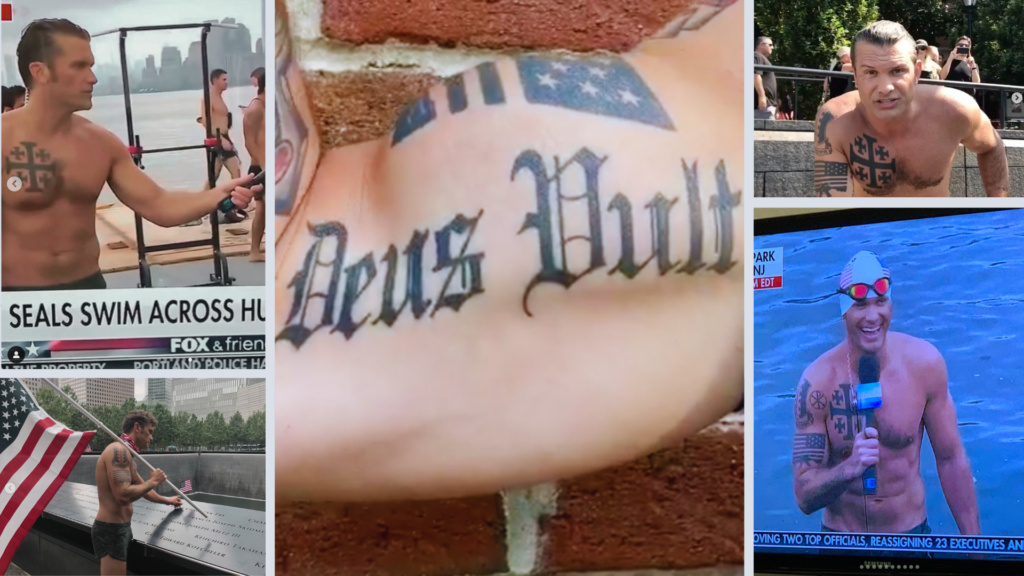
This very same cross has been in the limelight recently, emblazoned — far, far larger than King Edward VII’s version — on Pete Hegseth’s chest. Hegseth, a Fox News anchor and former member of the National Guard, is Trump’s pick for secretary of defense. It’s by no means his only tattoo. He also has a “Chi-Rho,” the first two letters of the Greek word for Christ and one of the earliest forms of a so-called Christogram (letters formed into a monogram expressing the essence of the religion). Perhaps the most contentious is the Christian expression on his bicep: “Deus Vult,” meaning “God Wills It,” believed to be a Crusader battle cry. Τhere is another cross with a sword, referencing a verse in the Gospel of Matthew reporting the following words of Jesus: “Do not suppose that I have come to bring peace to the earth. I did not come to bring peace, but a sword.” “Yeshua,” Jesus’ name in Hebrew, can be read across his elbow. All these Christian-related symbols, words and letters are accompanied by others that draw on American history and identity: the U.S. Constitution’s famous opening phrase “We the People,” the year “1775” in Roman numerals (the year the American War of Independence started), a “Join, or Die” snake from the American Revolution (from a cartoon attributed to Benjamin Franklin, urging the then-colonies to unite), an American flag with an AR-15 rifle, a pair of crossed muskets, a circle of stars and a patch of his regiment, the 187th Infantry.
The internet was quick to respond to this compilation of images with charges of violent far-right ideology, if not outright white supremacism. Hegseth was equally quick to deny, with countercharges of anti-Christian sentiment. While we can’t ever know for sure a true intention or individual interpretation of symbols behind a tattoo, a closer look at the history of these particular images produces an undeniable picture of militant Christianity, drawing on a long history of iconography connected to the Crusades, one of the bloodiest periods of Christian history. It is also a fact that many of these symbols are ubiquitous among far-right communities, seen in events from the Charlottesville rally to the manifesto of the Norwegian far-right shooter Anders Breivik and the engravings on the gun of the Christchurch shooter. But though these symbols have a long lineage, they have only been put together in the way they are seen on Hegseth’s body over the past decade, from around the time of Trump’s first campaign and ever more openly since. Unpeeling the layers of history and meaning shows the tightrope of plausible deniability the far right is walking, with history as their weapon — simultaneously signaling to their supporters and enabling them to deny the implications of Christian nationalism to the rest of the world.
Tattooing Christian pilgrims to the Holy Land is a pedigree that goes back many centuries before the young Edward VII’s own such experience, with the Jerusalem cross among the most popular designs. As with so many old symbols in many belief systems, there are various ways of reading its meaning. Some say the four smaller crosses represent the four Gospels of the New Testament, with the bigger cross the cross of the crucifixion itself. Or it can instead be described as “five crosses,” as George V wrote to his mother, which evokes the five wounds of Christ on the cross (the four smaller ones represent two hands and two feet, while the bigger one is the spear wound in his side). Other readings make it a symbol of evangelism, representing the spread of the gospel to all four corners of the world.
It has similarly been reappropriated by different groups through the centuries since its earliest known usage, which was during the Crusades. It became one of the symbols for the Franciscans, a Christian monastic order that was founded over a century after the capture of Jerusalem, in 1209, and now has custodianship over holy places in Jerusalem and the Holy Land on behalf of the Catholic Church, making it also the symbol of the city itself. This in turn meant that Christian pilgrims to the Holy Land, from future kings to bishops to more humble pilgrims, have traveled home with this permanent souvenir of the trip on their arm, shorn of the meaning of going on a Crusade. In other words, the Jerusalem cross can be read with a militant or a nonmilitant meaning. Where Hegseth deviates quite significantly from the pilgrims is in the size of his tattoo. “It’s interesting it’s so large,” says Matt Lodder, a senior lecturer in art history and theory and director of American studies at the University of Essex, and an expert on the Jerusalem pilgrim tattoos. “In Jerusalem, you’re looking at a 20-minute job. His is hours and hours and hours of tattooing.” This is a statement in itself. “Sometimes the more seditious symbols are sort of hidden away, more plausibly deniable. But this isn’t supposed to be hidden.”
The Chi-Rho has a similarly layered set of meanings. For many, the Christogram is uncontroversial, akin to the “Alpha and Omega” that adorns so many churches, which refers to the description of Jesus in the Book of Revelation as these two letters, the first and last of the Greek alphabet, meaning Christ is “the beginning and the end.” But the Chi-Rho is attached to a very specific meaning in early Christianity. The Roman Emperor Constantine, so the story goes, had a dream the night before a battle, telling him he would conquer if he had this symbol on his shield. On waking, he gave the order that all must carry this sign, and indeed his army was victorious, in the Battle of Milvian Bridge in 312 CE. “It was a turning point of early Christian history,” says the historian Mike Horswell, author of “The Rise and Fall of British Crusader Medievalism, c.1825-1945” and co-editor of the Routledge series “Engaging the Crusades.” Constantine went on to make Christianity the official religion of the Roman Empire. “For someone who looks out for these associations, there is a clear story being built of Christian militancy through history,” Horswell says. I ask Thomas Lecaque, associate professor of history at Grand View University, who specializes in the nexus of apocalyptic religion and political violence, if he reads it the same way. “Look, I don’t know if Hegseth has done a deep dive into Constantinian history,” he begins, “and I certainly haven’t seen a source suggesting he’s aware of this history. But could it be a far-right meme passing around the internet? Absolutely it could.”
And this is the strength of using both the Chi-Rho and the Jerusalem cross: There is a militant Christian meaning (one from Constantine’s battle victory and the other from the Crusades) and a nonviolent meaning, and no easy way to determine the intent behind any single example. “What he’s gone for is plausible deniability,” says Ben Elley, a researcher who wrote his doctoral thesis on far-right online radicalization. “There are a whole lot of things with a whole load of meanings they can point to as innocent. But that collection of symbols all together, it builds to a picture that’s very common in far-right communities.”
The tattoo that is far harder to dismiss as simply an innocent sign of commitment to the Christian tradition is the Deus Vult across his bicep. Literally meaning “God Wills It,” it is in the Latin imperative form, a command to go and do something — God wills that you do. Going by language alone this could sound neutral — a belief in the Abrahamic God after all comes with all sorts of commands to obey. But the history of the phrase is more specific than this: It is traceable back to the Crusades, and it has never, unlike the Jerusalem cross, absorbed a second meaning.
Its origins are contentious, with medieval historians demurring over modern claims that it was how Pope Urban II called for the First Crusade back in 1095. Although there are sporadic mentions of the phrase, for example in chronicles from 1100 and 1130, the close connection between the phrase and crusading knights is a much later invention. “Deus Vult being closely associated with the Crusades is a 19th-century idea,” Charlotte Gauthier, a historian of religious conflict and nationhood, told me. “Virtually all of our contemporary understanding of crusading culture is traceable to the Victorians or the early 20th century.”
The reinterpretation of the past was a key part of the 19th century and had a lasting impact on the European history we still learn today. It was a period when many countries were inventing national stories. “What historians in the 19th century tended to do is look at the medieval past to find stories: what it means to be whatever — English, German, Czech, French. These interpretations that come to us such as the “code of chivalry,” they’re all Victorian formulations to establish historically rooted ideals of the nation,” says Eleanor Janega, a medieval historian and co-host of the podcasts We’re Not So Different and Gone Medieval. One of the outcomes was what we might recognize as reconstructions or cosplaying. “By the end of the 19th century you have all these people who are literally cosplaying as Crusaders, making themselves some funny costumes and crap armour and riding around,” Gauthier says. “When the alt-right say they’re going back to the traditions of their ancestors, they mean — without knowing it — the 1880s, not the 11th century.”
Although it is frustrating to professional medieval historians that misunderstandings and false constructions of history are being propagated, accurate reporting of the past is hardly the aim of Hegseth’s tattoos. “The point of using the symbols is to bring the cultural and psychological associations that these symbols have,” is how Gauthier puts it. That is, it’s the perception of the history they have in our society today that is important. Lecaque, who has been following these communities for over a decade, is very clear. “There is no version of Deus Vult that means anything other than Crusader fanboy.” There aren’t multiple readings, as for the Jerusalem cross or Chi-Rho? “Absolutely not.” Lecaque stands firm, and Janega agrees. “It’s a call to religious violence, expressly linked to a pretty horrific episode in history. There isn’t another way of reading it other than that.”
The same unambiguous reading holds true for the sword piercing the cross, referencing the Matthew verse reporting that Christ came not to bring peace but a sword. There is very little leeway here in denying the militancy of the intention. “It’s not Jesus with the loaves and the fishes, is it?” Janega quips, referring to Jesus feeding a crowd of 5,000. “He hasn’t chosen ‘blessed are the peacemakers,’” says Horswell, illustrating the same point: There are a lot of peaceful quotes from the New Testament to choose from, yet Hegseth went for the far less common sword imagery.
It’s not just the militancy that’s inherent in Hegseth’s choices. “The key thing with those tattoos,” Elley says, “is that even if they are just Christian symbols, they are still by definition symbols of a type of Christianity that defines itself against Islam — that’s a part of this that is quite clear.” Lecaque is equally direct: “It’s explicitly Islamophobic and implicitly antisemitic. It’s just another expression of Christian nationalism, as Hegseth is saying in his books, his tattoos and in the church he belongs to.”
This was also clear when George W. Bush called his response to 9/11 a “crusade,” a framing gleefully jumped on by Osama bin Laden, and for good reason. “I was only a baby medievalist at that point,” says Janega, “But I remember thinking, ‘But we lost.’” Not only did Christians lose the medieval Crusades, but the West has steadily continued to lose wars in the Middle East. “Yes, white people are obsessed with taking over the Holy Land and we just can’t do it,” Janega says. “It all hinges on expressed dehumanization of people — seeing the people there as simply not human, as if they can be made to leave.”
The harking back to the Crusades, or even Constantine, serves many purposes. For a start, it roots the communities in an enduring tradition, building a sense of continuity and authenticity around a European, Christian ideal — one also (and incidentally also ahistorically) rooted in white identity. “I think there are two vitally important aspects to this history,” says Andrew Elliott, author of “Medievalism, Politics and Mass Media: Appropriating the Middle Ages in the Twenty-First Century.” “First of all, there’s a longing for an invented past, and second, there’s a sense of belonging to an in-group.” He cites examples from Anders Breivik’s verbose manifesto, emailed to journalists and politicians before he committed the worst mass shooting in Norway’s history in 2011. They suggest a desire to belong to an international order that he has himself invented. Breivik also used the term “Deus Vult,” as did protesters at the “Unite the Right” rally that happened in Charlottesville in 2017 (along with other standard far-right fare such as “Jews will not replace us”), supporters of Bolsonaro in Brazil and insurrectionists on Jan. 6, 2021, at Capitol Hill. “It’s everywhere,” Gauthier tells me, “Germany, Hungary, Russia, Brazil, the U.K., the U.S. — it would be quicker to say where this isn’t used, frankly.” Crucially, the phrase is rarely seen outside far-right circles. “I have never seen Deus Vult used outside far-right culture.” Elliott says. “Except in video games, when Crusaders shout it. Which is how I think they know about it.” The tradition Hegseth is firmly placing himself in is neither peaceful nor tolerant.
Although references to the Crusades stretch back a long time, there is a very recent twist to the tale. “The crusading obsession combined with the tattoos is a modern phenomenon,” Lodder tells me, “Literally I’ve been seeing it only in the past decade, this more weaponized Christian tattooing culture.” Lacaque agrees with this timeline, adding in the American element. “This particular combination of overt pseudo-revolutionary iconography together with militant Crusader history — it’s very common online in far-right spaces, and escaped into the mainstream right-wing media landscape from the [2015] Trump campaign onward.” Gauthier pushes this back a few years, to the 2008 financial crash, and the resulting anxiety and anger over individual financial difficulties. She, too, references 2015 but for a different reason, saying that use of the imagery exploded around then, “with the so-called migrant crisis — those images of refugees pouring into Germany,” adding that “as the economic situation has worsened, especially for younger people, and young white males in particular, they’ve been looking for someone to blame — and xenophobia is the oldest trick in the book.”
Many of the experts I spoke to also referenced Ridley Scott’s 2003 film “Kingdom of Heaven,” which showcased the Jerusalem cross prominently, and is another example of how the far right repurposes symbols and messages. The Jerusalem cross “is plastered everywhere in that movie,” explains Gauthier, “as a symbol standing up for the right, for the good. The far right has changed Scott’s message of Western liberal values, of ‘can’t we just all get along,’ to ‘We need to defend the West against the invasion of Muslims.’”
The timing of Hegseth’s own collection of tattoos is similarly recent — and important to understand, Lecaque emphasizes. “It’s a very deliberate package of tattoos put together during the Trump administration. It was not a long process, it’s a very small amount of time, starting toward the end of the Trump administration and spread over the next four years.” There is, therefore, no sense of a gradual evolution of ideas, and no chance that some of these could be regretted follies of youth. The whole is carefully designed and implemented to signal a very clear message.
You don’t have to look far to find actual sources for Hegseth’s beliefs: He has written books, including one called “American Crusade,” in which he writes: “Our present moment is much like the 11th century … We don’t want to fight, but, like our fellow Christians a thousand years ago, we must. We need an American crusade.” He argues that Europe has already been “invaded,” and is particularly angered by Turkey’s NATO membership, a country he describes as “Islamist,” and wanting to return to the Ottoman Empire — which, of course, reached well into Europe for hundreds of years.
So how can Hegseth deny the charges of this ideology as expressed in his tattoos, when he himself has committed himself to this ideology in print, and instead make accusations of the oppression of Christian culture? “It was a lesson that the alt-right learned early on, from I’d say the 2010s,” Elley says. “That if you can get anyone to accuse you of anything that has plausible deniability, they can then spin it any way they like.” They can claim, for example, that the woke left or the politically correct are stamping on their identity, or baselessly accusing them of crimes.
Janega can find some humor in the whole charade. “In terms of Crusader notions of virility, he’s really not measuring up. It’s totally against the ideal of Crusader courage — the Teutonic knights would not be impressed by Pete Hegseth,” she laughs. “From a medieval standpoint, it’s cowardly — do it or don’t do it, don’t do it and hide it.”
But she’s not amused when it comes to questions of the real-world implications. “For a medieval historian, they’re really obvious red flags,” she says, and all the experts interviewed expressed similar unease and anxiety. “If you told me that it was some random proud boy, I wouldn’t be surprised for a second. But given his position it is pretty shocking,” Elley says. Lodder echoes this exact feeling: “It’s both absurd and terrifying; terrifying that … someone with such prominent and worrying tattoos on their body is getting a Cabinet position in the U.S., but also absurd, because it’s all very cosplay.”
When it comes down to it, there are some undeniable features of Hegseth’s collection of tattoos. “It’s all very specifically violent,” summarizes Jannega. “There is no way of reading this that isn’t about violence, when you have guns and swords all over you. He’s telling you this. He cannot play the misunderstood Christian — he’s violent.” What a medievalist finds particularly troubling in the real history of the Crusades is what happened before Crusaders got to the Holy Land. “One thing that happened was horrific violence here in Europe,” Janega continues. “There were so many knights so keyed up — why would they bother waiting for the Holy Land when there were non-Christians in their backyard?” Lecaque, too, is anticipating increasing oppression at home — already seen in Hegseth’s book “American Crusade,” which, in its own words, “lays out the strategy we must employ in order to defeat America’s internal enemies,” as well as more violence abroad, especially in the Middle East.
With such clear messages writ so large and indelibly on his body, Hegseth’s politics are clear, denials notwithstanding. In fact, his denials, consisting of accusations of “anti-Christian bigotry,” are also well chosen. He hasn’t taken the opportunity to explain the more innocent meanings of some of his tattoos, nor disavow them as something he is no longer committed to, nor balanced the militancy with speaking of other aspects of Christianity. It may be unwise to ignore such repeated and unambiguous signals of violent Christian nationalism, especially when the individual has been given one of the most powerful positions in the world. Pete Hegseth is on a crusade, against his perceived domestic and international enemies, and come January, he will have nigh-unlimited power to unleash violence, on Americans and the rest of the world.
Pete Hegseth has a large Jerusalem cross tattooed on his chest, which he says is a historic Christian symbol. The tattoo has been a source of controversy due to its modern association with extremist and white supremacist groups.
Hegseth’s interpretation
- During his January 2025 confirmation hearing for Secretary of Defense, Hegseth described the tattoo as a historic Christian symbol.
- He cited its use on a program for former President Jimmy Carter’s memorial service at the Washington National Cathedral as evidence of its conventional religious significance.
- He claims that his Christian tattoos led to him being barred from National Guard duty at President Joe Biden’s 2021 inauguration, framing criticisms of his tattoos as “anti-Christian bigotry”.
Other interpretations and controversy
The Jerusalem cross symbol, which features a large cross surrounded by four smaller ones, has complex historical roots dating back to the Crusades. For some, it represents traditional Christian values. However, the symbol has also been appropriated by modern extremist groups, particularly those associated with white nationalism.
Critics highlight that the association with these extremist groups makes the tattoo controversial, especially for a high-ranking public official. They note that other “Crusader” symbols and phrases, such as “Deus Vult” (“God wills it”), have been used at events like the 2017 Charlottesville rally and the January 6, 2021, attack on the U.S. Capitol.
Other related tattoos
In addition to the Jerusalem cross, other Crusader-inspired and religious tattoos on Hegseth’s body have drawn criticism:
- “Deus Vult”: A tattoo on his bicep of the Latin phrase “God wills it,” a battle cry of the First Crusade. This phrase has also been adopted by white supremacist groups. A National Guardsman flagged this tattoo as an “insider threat” before the 2021 inauguration.
- “Kafir”: In March 2025, Hegseth revealed a tattoo of the Arabic word “kafir,” meaning “infidel” or “unbeliever.” This drew additional outrage due to Hegseth’s history of anti-Muslim rhetoric and the term’s use by the anti-Muslim far-right.

#1 Trending / Bible Studies
2564
The Roman Guard | Evidence For The Resurrection
6 min read
5 years ago
Johnny Ova
The Roman Guard
One of the most intriguing facts of the resurrection that is often overlooked are the facts concerning the guards that were to watch the tomb where Jesus was buried.
I want to start with a little background from professor Albert Roper in the book, “Did Jesus rise from the dead?” Here is an overview of what I had read:
Led by Annas and Caiaphas, the chief priests sought out Pontius Pilate to request the tomb where Jesus was to be buried be sealed and that Roman guards would be stationed to watch it. Their fear was that the friends of Jesus would steal the body to give the appearance of a resurrection.
Pilate responded to this request, ‘You shall have a guard, go your way and make it secure according to your wish”.
So with that request about 30 Roman soldiers sealed the tomb of Jesus after His body was placed inside the tomb of Joseph of Arimathaea. They rolled a stone that weighed about 2 tons (4000 pounds) and then sealed it with the Roman imperial seals of the procurator himself, which was the official Roman wax seal. Understand that defacing these seals was a very high crime.
According to tradition, Pilate had placed one of his best guards to lead the pack named Petronius. Their job to watch the tomb was to be as precise and faithful as the crucifixion itself. Honestly, they had no interest in doing this at all, but their sole purpose and obligation were to rigidly perform their duty as a soldier in which they made an allegiance. The Roman seal that was put over the tomb was far more sacred to them than any philosophy or creed of Israel. These are not men who would be fooled by timid Galileans or jeopardize their necks by sleeping on post.
George Currie states- “The punishment for quitting post was death, according to the laws. The most famous discourse on the strictness of camp discipline is that of Polybius which indicates that the fear of punishment produced faultless attention to duty, especially night watches”.
Think about that. You not being where you were supposed to be brought upon your physical death and torment. OHHH how does this ring true for YOU! When you are out of position, or not in the right spot. The torment you bring upon yourself, the death of your destiny…ouch.
Let us continue…There are 2 types of guards during this time. A Roman guard and a Temple guard.
The Roman Guards
According to the Greek and Roman Antiquities, one “Roman Guard” consisted of 4 men that rotated throughout the night. So two “guards” would be 8 men. One would stand watch and the others rested beside him to be easily woken. #STAYWOKEROME
The Temple Guards
Temple guards, specifically at night, were placed in 24 stations about the gates and courts. Of these, 21 were occupied by Levites alone. To put this in numbers for ya, that would be 240 Levites and 30 priests on duty every night. During the night, the captain of the Temple made his rounds. On his approach the guard had to rise and salute him in a particular manner. Any guard found asleep when on duty was beaten, or his garments were set on fire— a punishment, as we know, actually awarded. These men were not allowed to sit down, much less sleep.
The Night Jesus Was In The Tomb
This is how tight the security measures were for both the Romans and Temple guards in general…now how tight do you think the security measures were the night Jesus was put in the tomb?
French priest and historian, E. LeCamus stated “Never had a criminal given so much worry after His execution. Above all never had a crucified man had the honor of being guarded by a squad of soldiers”
Everything was done in human policy to PREVENT a Resurrection.
So just think of this. All of a sudden a great earthquake takes place. An angel descends from heaven and rolls the stone not just out of the way, but rolls it halfway up the mountainside. How would 12 men, do this type of feat, in front of all of these watchmen? Without alarming anyone? Anyways, the Roman guards saw this with their own eyes, and Matthew 28:4 states that were so scared they “became like dead men”.
The question is what do the soldiers do? Do they say someone broke the seal (who, if they did and had no one to point to, the soldiers would be punished to death)? Do they say they broke the seal(a crime punishable by death). Do they lie and say they fell asleep (also punishable by death), or do they say Jesus rose from the dead and bounced (blasphemy, which we know is punishable by death).
The Bible says that the guards came rushing into the city to the chief priests and told them everything that had happened. They assembled together and gave a large sum of money to the soldiers to falsely accuse the disciples of stealing the body (false witness was also punishable by death under Roman law). They took the Money…
The Predicament…
Not only is He not in the tomb, He then teaches people publicly for 30 days and there are over 500 eyewitnesses.
The disciples now start preaching and teaching a Resurrection right in the region where it happened, while all of the opposers stood helplessly watching it all transpire.The enemies of Christ stood silent with no opposition to these claims…Why?
Question Time…
So let me ask this..if it were false or they were making it up…why so silent?
If the Apostles were lying and made it up and started proclaiming this in the region where literally everyone knows what had happened, why not easily disprove this fictitious tale by just producing the body?
If the Apostles were lying, why would they start there where they could be easily disproved? Why wouldn’t they tell their lies to people in a different region who had no clue to what happened so nobody could dispute it?
I believe with this information above there is only one logical answer. That Jesus Christ…Resurrected.
 Rosamond Press
Leave a comment