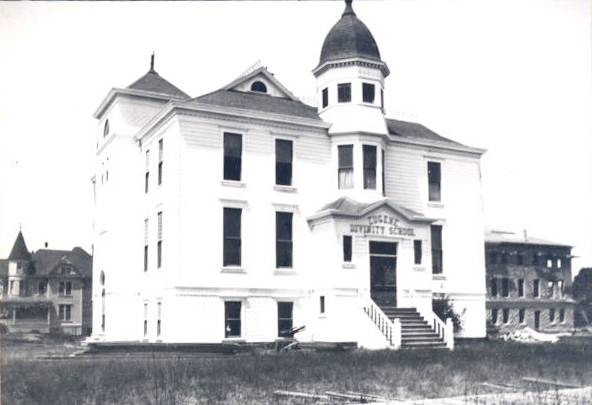
 Zoom imageOld building of Eugene Divinity School. Institution would move and eventually become the Northwest Christian University Courtesy Oreg. Hist. Soc. Research Library, 009634
One of my tormentors worked as a nurse in the Johnson Unit at Sacred Heart that has its beginning with the workdof Sister Francis Clare.
John Presco
“Cusack was raised in the Anglican church, but converted to Catholicism in 1858. She entered the Poor Clare Sisters, and was then known as Sister Francis Clare’
Cusack was raised in the Anglican church, but converted to Catholicism in 1858. She entered the Poor Clare Sisters, and was then known as Sister Francis Clare
Bushnell University to buy former Eugene hospital buildings
Eugene Register-Guard
- Bushnell University is purchasing two PeaceHealth properties in downtown Eugene.
- Bushnell, formerly Eugene Divinity School and Northwest Christian University, has made big moves to expand its reach in recent years.
This story was updated to add new information and a video.
Bushnell University is purchasing two PeaceHealth properties that were part of the former University District hospital, marking the university’s next big step in expanding its healthcare training capacity.
Bushnell University President Joseph Womack announced the acquisition during the private Christian college’s 130th Convocation Chapel, an annual ceremony welcoming students to the school year. Classes at Bushnell began Aug. 25. The two buildings are located on the University District campus, which is across the street from Bushnell. The college intends to further expand its College of Health Professions at the site.
“This blessing adds to our campus a staggering 125,000 square feet of space for the university,” Womack told the crowd gathered on Aug. 26. “Since 2012, your university has increased 151% in campus capacity.”

Womack said this is the single largest acquisition in Bushnell’s history.
However, for Bushnell, which is located just north of University of Oregon in Eugene, this is just the most recent step in the school’s expansion.
The university has approximately 820 students enrolled across 27 degree programs, which it has been adding to over the years.
Since Womack stepped into his leadership role at the university in 2010, enrollment has grown by 45%. Despite a dip in enrollment during the COVID-19 pandemic, enrollment is back up to pre-pandemic levels.
From Eugene Divinity to Northwest Christian to Bushnell
Bushnell was founded in 1895 under the name Eugene Divinity School by pastor-educator Eugene Sanderson and pioneer businessman and church leader James A. Bushnell. It was originally established as a supplemental college, intended to provide Christianity-based courses for students studying at the University of Oregon. Over the years, the college began offering more courses until it stood on its own, independent of UO.
Over the years, Bushnell has had several names. Many may remember it as either Northwest Christian College or Northwest Christian University. In 2020, the university rebranded, naming itself Bushnell University after its founder and first Board of Regents president. One of the driving factors was searchability, as the university hoped to expand its reach to be recognized nationally and internationally.
“Changing our name did not diminish our Christ-centered mission … It was purely a marketing challenge,” Womack said. “We’re starting to see that people know who we are.”
Get the Daily Briefing newsletter in your inbox.
Start your day with the morning?s top news
Delivery: DailyYour Email
Today, Bushnell offers bachelor’s, master’s and online degree pathways in majors such as nursing, computer science, pre-law and Christian ministry.
Physically, the college has expanded significantly in recent years. Three major capital projects and three program expansions were funded by the Venture Forward campaign, which raised $22 million over three years.
In 2021, Bushnell took over the former Phoenix Inn, renovating the hotel for student housing and renaming it Jim and Sharron Kay Womack Residence Hall after the current president’s parents.
In 2024, Bushnell purchased the 1000 Alder St. property, formerly the Sigma Phi Epsilon house. The property is being demolished and will be rebuilt as the John & Marilyn Duke Student Commons. The 37,000-square-foot center will house offices, a new dining facility, and gathering spaces for students and community members.

On Aug. 26, Bushnell held a ribbon cutting for Goodrich Hall and Donna Racine Pomajevich Bell Tower, signifying the grand reopening of the school’s oldest halls and the unveiling of the new tower, which includes an elevator for accessibility as well as a single-locking restroom on each floor.
Bushnell has also expanded its sporting facilities, launching the Player Development Center at Pine Ridge Golf Club in August, opening collaborative beach volley courts with Grace Community Fellowship in 2024 and entering an agreement for Bushnell baseball to use the Hamlin Sports Complex in 2022.
Bushnell University’s connection to PeaceHealth, health professionals
The two buildings purchased include the four-story Support Services Building at 770 E. 11th Ave. that currently houses PeaceHealth’s behavioral health unit and the three-story Center for Medical Education & Research building, which currently contains PeaceHealth’s medical education and research department and Bushell’s nursing program.
As part of the deal with Bushnell, PeaceHealth will lease the first floor behavioral health unit space and second floor Behavioral Health Intensive Outpatient and Partial Hospitalization program space until construction is completed on the Timber Springs Behavioral Health Hospital, expected to open in 2027 near the Riverbend campus in Springfield.
Bushnell has a long history with healthcare in Eugene. In 1924, the college founded Pacific Christian Hospital, which is now the former University District hospital. Sisters of St. Joseph of Newark purchased the hospital from Bushnell in 1936 for $50,000 and renamed it Sacred Heart General Hospital. Since then, the hospital has undergone numerous modifications, with a six-story wing added in 1941, and other buildings following.
Womack said since the 1936 sale, the university has been looking to buy some of the property back. Womack recalled his father, Jim Womack, who was president of Bushnell from 1985 to 2004, talking about reacquiring the space.

“We’ve been interested if PeaceHealth was going to end up not needing those facilities,” Womack said. “We’ve been saying every chance we get… ‘We’ll buy it.’”
In 2016, Bushnell launched its registered nurse to bachelor of nursing science program at Womack’s insistence. Bushnell already rented nursing simulation space out of the PeaceHealth property.
In December 2023, the PeaceHealth Sacred Heart Medical Center University District closed, leaving the second largest city in Oregon without a hospital.
In March, PeaceHealth listed the University District hospital property for sale.
“It just finally came to the point that they were really ready to pull that trigger and we went through the process of winning that bid,” Womack said.
After nearly 90 years, part of the property is going back to its foundations. The purchase will close at the end of September. Womack said the price of the buildings won’t be disclosed until the purchase is finalized.
“I’m excited to know that they were interested in these buildings and really keeping them in the community,” Dr. Jim McGovern, chief hospital executive of PeaceHealth Oregon Network, told The Register-Guard. “This just allows them to continue growing healthcare in education and the community.”
Bushnell’s goal in purchasing the hospital buildings is to grow its health professions pathways for clinical mental health counseling and nursing. In 2022, Bushnell began offering an accelerated bachelor’s degree in nursing. The nursing school just graduated its seventh cohort of approximately 24 students. This fall, Bushnell began its standalone, traditional nursing bachelor’s program.
The university also plans to launch new programs to support both behavioral and physical health needs in the future.
Womack said space is one of the biggest barriers for some programs’ expansion. The clinical mental health master’s program, he said, has a waitlist every term.
“Space is always a problem for us,” Womack said. “Our health professions, they’ve been chomping at the bit to grow already. This gives us the space to do that.”
In 2026, Bushnell plans to launch its next fundraising campaign following the Venture Forward campaign that closed in October 2024. This campaign will have an even larger goal and will be aimed at getting the former PeaceHealth buildings opened, completing the new student commons, potentially opening more athletic facilities and expanding more programs.
Miranda Cyr reports on education for The Register-Guard. You can contact her at mcyr@registerguard.com or find her on Twitter @mirandabcyr.
Bushnell University was founded in Eugene in 1895 by Eugene C. Sanderson, a preacher and educator in the Christian Church. He served as its first president from 1895 to 1929. The school has been known by a number of names, including Eugene Divinity School (1895-1908), Eugene Bible University (1908-1930), Eugene Bible College (1930-1934), Northwest Christian College (1934-2008), and Northwest Christian University (2008-2020). Sanderson was a prominent preacher and educator in the Christian Church, having pastored many churches in the Pacific Northwest.
James A. Bushnell was a prominent Junction City businessman and the first chair of the board of trustees from 1895 to his death in 1912. The first library was named the Bushnell Library. He and his wife provided the funds for Sanderson to purchase rare bibles when Sanderson took a leave of absence from 1910 to 1911 and traveled to Europe. The Sarah E. Bushnell Bible and Rare Book Collection, established in 1913, is still a prominent collection in what is now the Kellenberger Library.
Eugene Divinity School was established to prepare Christian Church ministers in the Pacific Northwest as part of the Stone-Campbell Restoration Movement. Barton Stone and Alexander Campbell started the movement in the early 1800s as a way to restore Christian unity by abolishing creeds and focusing on the principles of the early church as shown in the New Testament. Sanderson strongly believed that ministers should have a solid liberal arts background as well as a strong ministerial foundation. He located Eugene Divinity School next to the University of Oregon so students could take advantage of the liberal arts program there, while the divinity school focused on such courses as theology, bible study, oratory, and music.
During the 1920s, Eugene Bible University, as it was then called, expanded to include a number of other enterprises. Pacific Christian Hospital (now the PeaceHealth Sacred Heart Medical Center University District) was opened in March 1924. Eugene Bible University offered a nursing program in conjunction with the hospital. It also organized several schools, including Kansas Bible College (now Manhattan Christian College), Minneapolis Bible College, Colorado Bible College, and Missouri Christian College, which were considered extensions of Eugene Bible University. During the Depression, Eugene Bible College scaled back its operations to the Eugene campus. In 1934, the college merged with Spokane University, a school associated with the Christian Church in Spokane, Washington, to become Northwest Christian College.
Many Christian Church ministers and missionaries have been educated at Bushnell University, including Everard Roy Moon, who with his wife Bessie served in the Democratic Republic of the Congo from 1909 to 1923. The Louis H. Turner Museum at Bushnell U holds a large collection of items from the Congo and East African countries, where many Bushnell U graduates served. Another prominent alumnus is Frank Morse, former president of Morse Brothers construction company and an Oregon state senator from Albany.
The university occupies two and half blocks between the University of Oregon and PeaceHealth Sacred Heart Medical Center University District, centered on East 11th Avenue and Alder Street in Eugene. The campus includes the Martha Goodrich Administration Building, constructed in 1908 of volcanic stone from southern Oregon. It is the oldest building on campus. Other facilities include the Edward P. Kellenberger Library, the Lottie Price Music Building, the Burke-Griffeth Residence Hall, the Morse Event Center (with athletic facilities), the Pomajevich Faculty Building, the Education and Counseling Building, the Professional Studies Building, the Mom Richart Apartments, and the Hilyard Apartments.
In the twenty-first century, Bushnell University continues to prepare students in ministry, liberal arts, business, education, and counseling programs. Bachelor’s and master’s degrees are offered in undergraduate and graduate programs, with courses offered on campus, online, and in hybrid formats. The university began with five students in 1895 and one faculty member. In 2020, there are over 800 students taught by over 30 fulltime faculty.
Bushnell University has been regionally accredited since 1962. The school is a member of the Oregon Alliance of Independent Colleges and Universities, the Council for Christian Colleges and Universities, the Council on Undergraduate Research, and the Cascade Collegiate Conference of the National Association of Intercollegiate Athletics.
Ringing in the future: Bushnell installs bells in historic Goodrich Hall’s new tower
Eugene Register-Guard
A chorus of mechanical beeps from heavy machinery and the tolling of bells rang out across E. 11th Ave. and Alder Street Friday morning as Bushnell University marked a major milestone with the installation of four bells in the newly constructed bell tower at Goodrich Hall.
The building has lived many lives since it was built in 1908. Over the years, it served as a library, classrooms and administrative offices. As time marched on, the space saw less use due to the historic building’s lack of accessibility.
Bushnell’s Venture Forward campaign raised $18 million to renovate a number of campus spaces, including Goodrich Hall. Since construction began, the building’s interior has been completely renovated and a new, four-story bell tower has been built near the southwest corner. The bell tower houses restrooms, elevator access and four bells that will ring for special events like commencement and will signal worship times.
The bells were donated by legacy families of Bushnell University and are named in honor of the donors: Edwin “Ted” Baker, Linda McKay Korth, Ada O.L. Lee and the Stewart Family.
Bridget Baker Kincaid is Ted Baker’s daughter. She said she and her husband donated some funds for the project, crediting University President Joseph Womack for coming up with the idea. She partnered with other legacy families of the university to see if they wanted to join the effort.
“The Goodrich building is a historic building and we couldn’t find it in our hearts to tear it down but it didn’t have handicapped access, it didn’t have really nice restrooms and so the second and third floors were very difficult for access for students or faculty who needed to get up there,” Baker Kincaid said.
Linda McKay Korth was also at the installation and said having her family’s name etched into one of the bells is an honor. A former board member of the university, Korth said the school is a major asset for the city of Eugene.
“I cry every time I think about it. I just think it’s wonderful and it’s a huge, huge honor for the family to be recognized in this way in the oldest building at Bushnell,” Korth said. “Every building they purchase or re-do is done in such a caring way.”
Get the Daily Briefing newsletter in your inbox.
Start your day with the morning?s top news
Delivery: DailyYour Email
The bells were crafted by Benjamin Sunderlin of the B.A. Sunderlin Bellfoundry, which uses equipment and techniques dating back to 1856. Sunderlin, who developed his passion independently and studied the art of bell-making in Europe, said his foundry is the only one in the United States still using traditional techniques.
“A lot of our competitors are 500 years old,” Sunderlin said. “No one has opened up a bell foundry in the United States for probably 160 years. I’m the oddball.”
Sunderlin said that even though the bells aren’t ringing regularly yet, the installation process is the payoff for the work that goes into making them.
“They’re creating a little community and a sense of atmosphere for the university,” he said. “The technology of our cell phones has largely replaced the utility of bells but people still make them and like them because of that human element.”
These $5 million renovations and upgrades to Goodrich Hall help preserve the more than 117-year-old historic building while improving accessibility. The first two stories will house classroom spaces while the third floor will include the president’s office and a welcome center.
Joseph Womack, president of Bushnell University, called the process of modernizing a historic building both unique and challenging. Despite the obstacles, he said the work to provide updated classrooms and facilities is something folks at Bushnell are “geeking out about.”
“For an institution that is as old as ours, that building means an awful lot to us,” Womack said. “We very much wanted to see the Goodrich building survive and try to honor its past with a future but give it those things it needed. It just was not usable.”
Inpatient Behavioral Health at PeaceHealth University District
30
Behavioral Health Center
Inpatient Behavioral Health at PeaceHealth University District, located in Eugene, Oregon, offers compassionate and comprehensive care for individuals experiencing mental health challenges. This program provides both inpatient and outpatient treatment options, ensuring that patients receive the right level of support for their unique needs. Inpatient care focuses on stabilizing individuals in crisis through a safe and structured environment, while outpatient services provide ongoing psychiatry, counseling, and case management to support long-term recovery. With early screening and intervention at the forefront, PeaceHealth helps patients identify challenges early and achieve better outcomes.
The facility serves adults, children, adolescents, and families with a full continuum of behavioral health services. Conditions commonly treated include anxiety, depression, bipolar disorder, schizophrenia, trauma-related disorders, and developmental concerns such as autism spectrum disorders and ADHD. Patients benefit from an interdisciplinary team of psychiatrists, psychologists, social workers, counselors, nurses, and mental health professionals who collaborate to deliver individualized, patient-centered care. Specialized approaches such as trauma-informed therapy, suicide prevention, and family involvement create a healing environment where patients feel supported and understood.
PeaceHealth’s Inpatient Behavioral Health Unit is committed to providing treatment in the least restrictive environment while ensuring safety and effectiveness. Whether through crisis stabilization, counseling, or coordinated outpatient services, this program reflects PeaceHealth’s mission of fostering healing, resilience, and recovery for the whole person.
 Rosamond Press
Leave a comment