
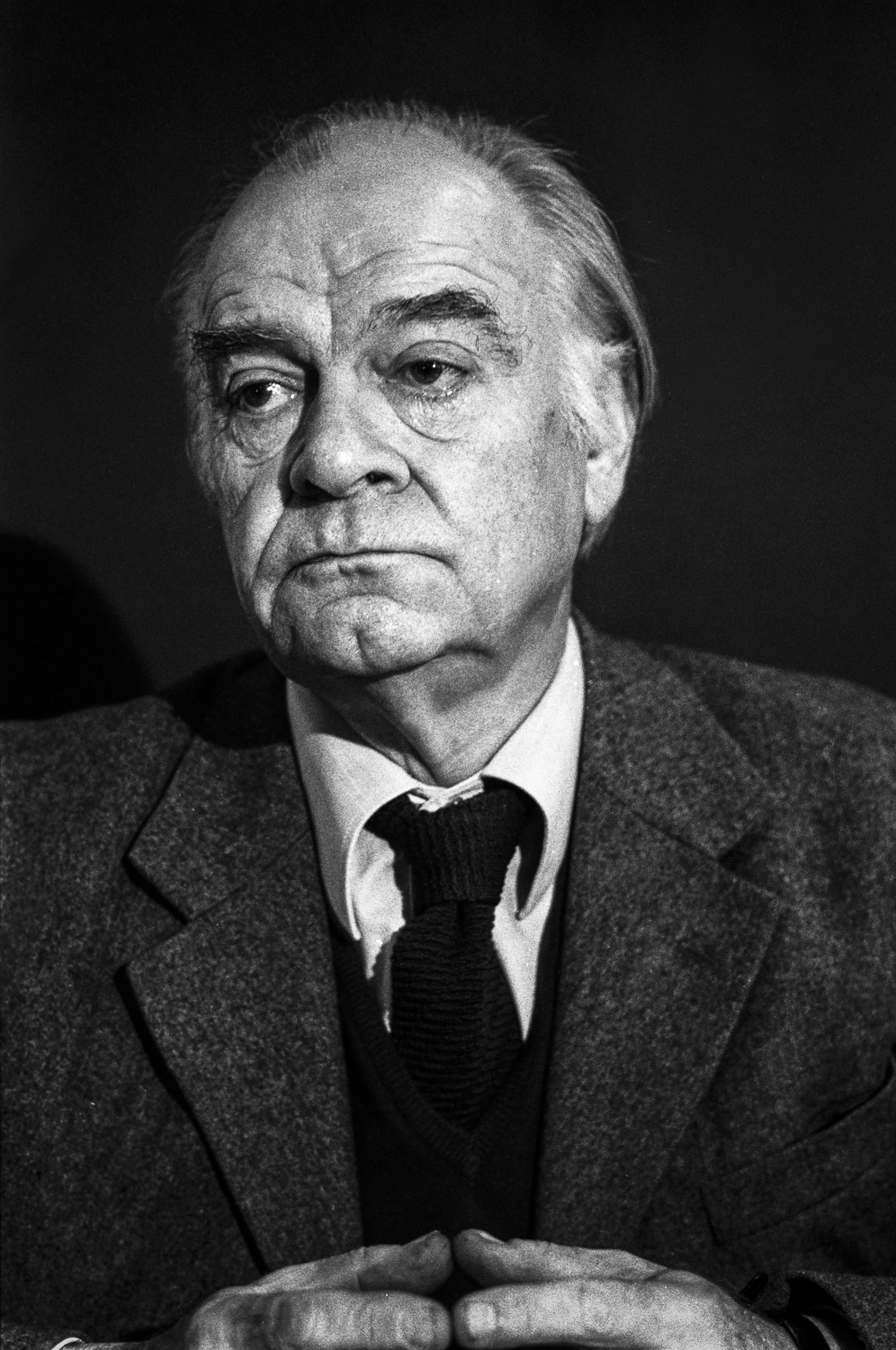
Denis de Rougemont, Schriftsteller, aufgenommen in den 1970er Jahren in Genf. (KEYSTONE/Max Vaterlaus)

Denis de Rougemont was titled ‘The Prince of European Culture’. He was at the first Bilderberg meeting, and is considered a co-founder of the European Union. Frederich the Great granted the Rougemonts of Neufchatel a title of old nobility when he came to this area in Switzerland. Rougemont was the Director of Congress of Cultural Freedom that employed Writers and Artists against the Soviet Block.
My Kindred – Elizabeth Rosemond Taylor
Elizabeth Rosemond Taylor may be kin to Denis.
Jon Presco
http://monthlyreview.org/1999/11/01/the-cia-and-the-cultural-cold-war-revisited
http://modernhistoryproject.org/mhp?Article=Kulturkampf
Rougemont, Denis (de)
8.09.1906, Couvet (Neuchâtel) – 6.12.1985, Geneva
Source Fondation Denis de Rougemont
next article
Denis de Rougemont
Biography
Denis de Rougemont was born on on September 8th, 1906 in Couvet in the Canton from Neuchâtel in Switzerland. His/her father is Pasteur. He continues studies of letters at the University of Neuchâtel between 1925 and 1930. In parallel, it starts its first voyages and remains in particular in Vienna, in Hungary and Souabe.
In 1930, it settles in Paris and becomes, within the Esprit movements and the Order New one of the founders of Personalism, at the sides of Emmanuel Mounier, Arnaud Dandieu, Robert Aron, Henri Daniel-Rops and Alexandre Marc. They were called “the nonconformists of the Thirties”. Rejecting as well Hitler as Stalin, just as nationalism and individualism, they preach the idea of an political organization, economic and social which is with the service of the Person designed like a unit at the same time distinct (the individual) and connected to the Community (the citizen), at the same time free (as an individual) and person in charge (as a citizen).
The Federalism appears the model to them which makes it possible best to link the People without giving up their diversity, and this is why they preach it. On the other hand, they reject the State-Nation centralized like mode of organization of the company.
During the years 1930, Denis de Rougemont develops the topics of Personalism through two works: Policy of the Person (1934), To think with the Hands (1936). In 1935-1936, it remains in Germany like French reader at the University of Francfort-sur-le-Main and brings back from there a very negative testimony on the Nazism, which it delivers in his Newspaper of Germany (1938). In 1939 appears the Love and the Occident which shows the influence D `a certain number of accounts mythical (of which Tristan and Iseult) on the typically Western design of an impassioned love and finally destructor, that the author opposes to the true charity.
In 1940, it is mobilized in the Swiss army and, with other personalities, it founds the League of Gothard which aims at stimulating the spirit of resistance to Hitler. Its positions being considered to be not very compatible with Swiss neutrality, it is sent on mission of conferences to the United States. Installed in New York, it publishes the share of the devil into 1942 who is a reflection on the disorders of the modern world, limed in totalitarianism and the materialism. It binds with many writers or European artists in exile (Saint-Exupéry, André Breton, Max Ernst, Marcel Duchamp, Saint-John Perse, Wystan Auden). After Hiroshima and Nagasaki, it shows, in its Letters on the atomic bomb (1946), that the nuclear weapon places the men in front of a world danger which must encourage them to exceed the idea of national sovereignty.
Returned definitively to Europe in 1947, it takes part, at the sides of the federalists, the efforts to link Europe. On August 26th, 1947, he makes the inaugural speech of the first Congress of the European Union of the Federalists (the federalistic attitude). At the time of the Congress of $the Hague (7 May 10th, 1948), he is at the same time rapporteur of the cultural Commission and writer of the Final declaration (Message to Europeans). During this Congress, the cultural Commission proposes the creation of a Center European of the Culture, tries whose seizes itself Denis de Rougemont who to this end organizes the first European Conference of the Culture (Lausanne, 8 December 12th, 1949). The Center European of the Culture is finally made up in Geneva in 1950 and placed under the direction of Denis de Rougemont.
At the same time, it is mobilized with other intellectuals against Stalinist propaganda conveying the idea of a culture to the service of the class struggle, within the Congress for the Freedom of the Culture of which he becomes President in 1952 (he will occupy this function until 1966).
In charge of the Center European of the Culture, Denis de Rougemont provided the foundations, in December 1950, of an organization gathering the European scientists working on nuclear energy: it will be the CERN. He was at the origin of the first association joining together the very first Institutes of European Studies, which was drawn up in Geneva in 1951 (it existed until 1991), as well as European Association of the Festivals of Music. In the sides of Robert Schuman, it took part in the creation of the European Foundation of the Culture (Geneva, December 16th, 1954) which was transported to Amsterdam in 1957 when it always continues its activities.
He undertakes a deliberation on the cultural features which characterize the Occident compared to other civilizations. It is the topic of its work the Western Adventure of the Man (1957) and the think tank on the “dialog of the cultures” (formulates begun again later by UNESCO) which it organizes as from 1961. This same year, it publishes a work on the history of the European idea entitled Twenty-eight centuries of Europe. In 1963, it founds in Geneva the Institute of European Studies which will be incorporated in the University in 1992.
From the years 1960, its activity will concentrate on two topics: the rise of the areas and the transborder areas which carries out it towards the idea of a federalism being combined to the ideal of “Europe of the Areas”; destruction of the environment which leads it to call in question the finalities of our companies. He sees in the emergence of areas to human size at the same time an alternative to the State-Nation and the chance to reintroduce in our companies the concept of responsibility so essential to safeguarding for the environment. Ecology and areas are in the center of its last two major works: Open letter with Europeans (1970), the Future is our business (1977).
One will also raise permanence of his reflection on the technical development and his consequences, since his work on the atomic bomb going back to 1946 until data processing (article “Information is not to know” in 1981), via civil nuclear energy (the CERN).
Denis de Rougemont dies in Geneva on on December 6th, 1985.
The Foundation Denis de Rougemont
One finds on the site of the Foundation Denis de Rougemont of the many information on the writer, in particular of the reference books, the images and bibliography.
The Idea of Europe in the work of Denis de Rougemont and the French non-conformists
09/03/2009 Leave a comment
Denis de Rougemont was a main thinker of the so-called non-conformistes des années trente, a movement of young intellectuals that appeared in France at the beginning of the turbulentcover 1930s, in opposition to both the individualism of liberalism and the collectivism of the Soviet Russia. [1] The main bulk of their work was published between 1930-34 and was concentrated around three separate currents:
◾ The founders and members of L’Ordre nouveau. An intellectual movement established by the Russian migrant Alexandre Marc (born in 1904 in Odessa as Aleksander Markovitch Lipiansky), its goal was to prepare the conditions for a ‘spiritual rebirth’ of the European culture. Its effort was concentrated on going beyond such dualistic divisions as nationalism-internationalism and capitalism-communism. Its inspirations came, among other sources, from the Christian existentialism of Kierkegaard, the federalism of Proudhon, the great critique of Modernity Nietzsche, or from the historicism of Péguy. The thinkers who were a part of L’Ordre nouveau also included Robert Aron, Arnaud Dandieu, Daniel-Rops, Jean Jardin and finally Denis de Rougemont.
◾The Catholic revue L’Esprit of Emmanuel Mounier, founded in 1932. From the beginning it evolved in tight collaboration with L’Ordre nouveau. In reaction to the events of the Second World War it radically shifted to the political left , in order to slowly move back to more moderate positions of the ‘New Left’, under which it still publishes to this date.
◾Young thinkers of Jeune Droite, who were mostly dissidents of the French reactionary and monarchistic right Açtion française. These thinkers included Jean de Fabrègues, Jean-Pierre Maxence and Thierry Maulnier.
Furthermore, Ferdinand Kinsky also includes among them those thinkers, from whom the non-conformists drew their inspiration: Stern, Blondel, Buber, Nédoncelle, Karl Barth, Gabriel Marcel, Jacques Maritain or Nicholas Berdiaeff.[2]
Although the non-conformists came from different backgrounds and their thinking took on some issues rather opposing positions, they all subscribed to the doctrine of ‘personalism’, and, consequently, to federalism. The non-conformists converged on the point that
‘man was above all not an “individual.” He is a “person,” that is both responsible and free, committed and autonomous, a being in himself, but related to his fellowmen by his responsibility’.[3]
As a person, human being is not a lonely monad, not even a rational being, which could exist outside of society, but a social entity whose nature is fulfilled only by sharing his life in common with others. To live within a society does not mean to be enclosed in a ‘homogeneous’ nation-state, but to be a part of multiple and overlapping ‘intermediary’ communities, which are most naturally formed around family, territory, or profession. For the non-conformists/personalists, these intermediary communities both historically and philosophically ultimately share the common European ‘well’ from which they draw their actual particular ideas and traditions. Europe and its culture for them necessarily precede nations and nation-states. The thinkers such as the Schlegels or Herder constructed the idea of a self-sufficient nation from already present, primordial European philosophical and historical traditions. The English historian Christopher Dawson best summarises this position in his 1932 work The Making of Europe, when he notes that
‘The evil of nationalism does not consist in its loyalty to the traditions of the past or in its vindication of national unity and right of self determination. What is wrong is the identification of this unity with the ultimate and inclusive unity of culture which is a supernatural thing.
The ultimate foundation of our culture is not the national state, but the European unity’.[4]
The nation-state was thus only one realised possibility of the European culture. A peculiar thing about nationalist movements was that they consciously denied the notion of their own continuity and grounding in the common European history and philosophical thought. Martin Heidegger would say this was a perfect manifestation of the ‘metaphysics of subjectivity’ – they picked up one particular set of characteristics out of their European heritage and by intellectual sleight of hand, suppressing the memory of their nations continuity with other European sources,[5] argued for their ‘homogeneity and cultural self-sufficiency’.
The French thinker Alain de Benoist recently argued from the same perspective, when he distinguished our ‘objective’ history as ‘a pile of representations of identity of past times and past protagonists’,[6] from our actual-assumed identity, whose dimension is always political since it is based on the projection of our past towards the future. In other words, our actual identity (in the 19th and 20th c., it was that of nations and nation-states), always grounds the collective ‘I’ in the past, based on values and necessities of the present and possibilities of the future. As Alain de Benoist adds, ‘memory screens [our timely, historical identity] and retains what conforms to its idea of the past and to the image it wants to give in order to give it a meaning’.[7]
Diversity of European identities
The purpose of Denis de Rougemont’s book The Idea of Europe is precisely to rip off our identity from the grip of the present and selective memory of nation-states and ground it in the timely and space-bound objective narrative of Europe. Rougemont’s preface to the book also forms the general leitmotif that weaves through the whole work:
‘ Europe is much older than the European nations. Their lack of unity and their ever more illusory claims to absolute sovereignty endanger its very existence. If only they could unite, Europe would be saved, and with it all that remains valuable in its richly creative diversity’.[8]
titian_rape_of_europa
The Rape of Europa by Titian
‘from that time onward the name of Europe and the concept of Europe will recur in even more solemn contexts down to the Carolingian Empire, in apostrophes to the Pope, in ecclesiastical panegyrics, in prose and verse chronicles, and in the lives of the saints’.[12]
The final step was taken with Charlemagne, whose dominium was called ‘Europe vel Regnum Caroli’ and on whom his court poet Angilbert bestowed the titles of ‘head of the world . . . summit [or tiara] of Europe . . . supreme father’.[13] Europe thus becomes a political entity, which is not merely constructed as one of the contemporary three divisions of the map of the world (Europe, Libya or Africa, Asia), it is finally an ‘autonomous entity, endowed with spiritual virtues’.[14]
As we know however, this was a premature spring and the fragmentation of Charlemagne’s empire under his three sons soon followed, as if in the anticipation of the things to come in the period from the 17th to 20th century. On 434 pages, Denis de Rougemont continues to recount various conceptualisations of Europe that followed. Nevertheless, what is probably the most intriguing section of the book is part seven,[15] where he tries to mend together various 20th century historians and thinkers to give us an idea what ‘European identity’ means, if it went through such diverse historical manifestations.
Rougemont’s conceptualisation of European identity
First of all, through his overview of different conceptualisations of Europe, Rougemont lead us to reject the idea that there could be one ‘ true’ atemporal European essence, which could be taken as the lowest ‘common denominator’ of everything European.[16] Europe is above all the totality of its representations – and a European is in the first instance the one who finds in its diversity something that resonates with his ‘present I’. The first step in the formation of any identity is thus conscious self-identification, finding one’s possibilities not by ‘returning to the sources’, but by resorting to the sources in order to discover how do they fit into one’s present and future. It might be therefore said that there are ‘two Europes’, the one which is philosophical and historical, i.e., the one which provides us through its totality with different representations of what it has meant to be a European, and the other which is inherently bound to politics. The latter is dependent on the way one answers the question of what one wants Europe to be – 0n the way how does one ‘chooses’ one’s identity from the possible sources. In other words, in one way Europe (‘unconsciously’) already ‘is’, but in the other way it is still dormant, waiting to be appropriated as a political project – consciously adopted as a part of our own present identity. Only when Europe materialises through the political process as a cultural entity, it will be possible to ‘grasp’ it and built upon it in our social life in new ways.
This idea of ‘two Europes’ is in fact very close to the constitutive or expressivist theory of language of Herder. Its importance was recently recognised by the Canadian communitarian thinker Charles Taylor.[17] Herder, and through him Taylor, argued that the language not only describes the reality (‘what is already there’, on the background), as such theorists as Condillac claimed, but also constitutes and recreates it anew, under a different perspective. For Condillac or Locke, linguistic expression was always linked to some pre-existing content, to the idea that ‘at each stage of [linguistic] process, the idea precede[d] its naming, albeit its discriminability results from a previous act of naming’.[18] Herder, however, adds to the language a new, ‘expressive’ dimension, claiming that the interlocution not only describes, but that ‘it also open[s] possibilities for us which would not be there in its absence’.[19] In other words, by saying something, we do not only describe what is already there, but also shape it to a new dimension. By creating a political Europe, we do not only re-represent what is already there, but we are giving Europe a new dimension by the creative process itself.
Perhaps this was also a reason why Heidegger in his later thought credited the poetry for allowing us to temporally ascend to the ‘authentic’ Being. As one of Heidegger’s interpreters Richard Polt notices, ‘if Heidegger is right, then our most authentic relation to language is poetic. Instead of using language as a tool for representation, we should respect it as a rich source of poetic revelation’.[20] The poet thus represents an authentic existence – instead of using old words and worn out meanings, he ‘appropriates’ the reality in relation to his own person. Does it mean that all great minds who try to build Europe politically are also poets?
The Abduction of Europa by Rembrandt (1632)
The Abduction of Europa by Rembrandt (1632own person.
This excurse to the theory of language might help us appreciate what Denis de Rougemont is ultimately suggesting in his search for ‘the’ European identity. Although there are undeniable sources of European culture such the ancient Greece, Rome and Christianity, the Celts, or the ancient German tribes, what Europe is for us will in the last instance depend on what do we want it to be. It is true that the most of the European thought arose as the positive or negative reaction to the ancient Greeks, be it the Romans with their sombre gravitas who unsuccessfully tried to emulate the joyous Greek spirit, or the Christians who upheld the rational Apollo at the expense of Dionysos. Nevertheless, in the last instance it always depends on ourselves whether we identify with these sources or not. Paul Valéry for instance felt closest to the Greeks, claiming that
‘what we owe to Greece is perhaps what has most profoundly distinguished us from the rest of humanity. To her we owe the discipline of the Mind, the extraordinary example of perfection in everything. To her we owe the method of thought that tends to relate all things to man, the complete man. Man became for himself the system of reference to which all things must in the end relate. He must therefore develop all the parts of his being and maintain them in a harmony as clear and even as evident as possible. He must develop both body and mind’.[21]
Denis de Rougemont would have certainly agreed with Valéry. One might even argue that personalism itself – with its conception of a person as against the liberal idea of a self-sufficient individual, is the conscious adoption of the Greek heritage on the part of the non-conformists. Rougemont keenly notices that our Greek heritage has become in the recent years more important, arguing that
‘the revival of our interest in things Greek is reflected in the twentieth century by the most varied symptoms: discovery of the pre-Socratic philosophers . . . the vogue for mythology (Freud’s Oedipus complex, the Ulysses of Joyce or Kazantzakis, Spitteler’s Prometheus, Gide’s Theseus, Cocteau’s Orpheus, etc); revival of the themes and titles of Greek tragedy by many playwrights, poets, and composers (“Choephores and Eumenides,” by Claudel and Darius Milhaud, to mention only one example, re-created the sacred thrill of the ancient drama, of which a poet like Racine retained only the plot); rediscovery of the secret of the Doric style; passionate researches into the mystery religions . . .[22]‘.
Philosophically and historically, as Denis de Rougemont shows us in The Idea of Europe, we therefore already are Europeans. Politically and in our memory, some still consider themselves to be enclosed within ‘homogeneous’ national entities and deny their shared European roots. Only the future will shows us, however, whether we will also manage to appropriate our identity politically.
Denis de Rougemont Founded European Union



This alleged Jewish Political Philosopher, Yorman Harzony, has stepped into my wheelhouse – BIG TIME! For starters, Yorman is trying to steal the fire of Denis De Rougemont, one of the Father’s of the European Union – who is a known philosopher. Hazony and his Gang of Jewish Nationalists may be responsible for Brexit – and the election of Donald Trump – who conducted REPEXIT, the exit of the Republican Party from the Union – and reality – in the name of Jesus, a Semitic sky-god, who I believe only wanted to be a Davidic king. The Nationalistic Tribe of Judah worshipped Chemosh, and not YHWH.
https://en.wikipedia.org/wiki/Bar_Kokhba_revolt
Let’s begin with SOME NUMBERS! There are 4,431,756 females in the NATION OF Israel. There are 12,492,550 females in the STATE Of Texas, that has had asperations to be a NATION. Let us assume that 4,431,756 female Texans feel they have been rendered second class citizens by followers of the Semitic Religion of Christianity? How many Texas females feel religion no longer works for them? What does religion have to do with formation of A NATION? Secular Jewish Socialists – who sprang for the Jewish Turnverein – founded the Nation of Israel. De Rougemont founded a Union of Nations because European Nations had been fighting with each other for 1,500 years. The EU was not formed to intimidate ANY JEW, nor founded to activate the crazy inferiority complex of most Semitic Peoples, who for the most part are Armed Muslims – who will never forget or forgive – THE HOLY CHRISTIAN CRUSADERS!
Semitc people have been waging war with one another -for 10,000 years! The Roman empire tried to stop this warfare and assimilate Semitic People into their Empire, that Harzony sissy-slaps as being The Bad Guy, on par with the EU, who is not like Britain -of late. Harzony ignores the fact there was a British Empire that ruled India. The Romans threw all the Jews out of Israel because they were forever waging armed warfare in the name of THEIR MESSIAH. They came to live in Europe. Before Hitler came to power, THE TRIBAL GERMAN PEOPLE treated Jews as equals. The Jews of Germany were a nation within a nation, a religion within a religion. Many Religious Jewish Leaders preached about the return to Zion. How many European Jewish Philosophers came up with a Zionist Philosophy? Ten thousand? Here is the founder of Reformed Judaism which gave up on the dream of Zion.
How many women in Texas want their lives to return to normal, and the threat of looming Anti-Abortion Bounty Hunters – removed! Screw the TEN COMMANDMENTS of the Semites! In the Nation of THE UNITED STATES We The People live by a system of laws that branch out from our Constitution that was WRITTEN BY Anglo-Saxon Celtic Peoples. Seventy percent of the White Population in 1770 – were indentured slaves! A million and more, where black slaves. Millions of women in America – were Tribal Native Americans. How did Southern States come to rule the Republican Abolitionist Party – is the big question! What was the PHILOSOPHY behind that? I blame the Judeo-Christian religion for twisting the hell out of our National Politics. Who invented The Southern Strategy?. The Crisis-Christians launched a CAMPAIGN OF CHAOS! They trained millions of loyal Americans to be….TREACHEROUS TRAITORS – who won’t get vaccinated – in the name of Jesus! Where is the Collective National Care for fellow citizens? Most want OUT of here! Millions want to be Raptured, and like rats – desert the sinking national ship of state! Thanks – Jesus! Thanks Harzony – but no thanks! How many females are there in the United States?
There are 166,700,000 million women in the United States and 4,400,000 million Jewish Women living in the Nation of Israel. Harzony owns dual-citizenship. As he stands on the boundary of these two nations, which females does Yormany feel – more love for? Does he know armed ,mitlias are backing him?
My kin, Elizabeth Rosemond Taylor allegedly became a Jew after she married a Jew. She may have been – part hippy – like her brother. She encouraged Michael Jackson to take up art. We are kin to Ian Fleming. For awhile, in theory, James Bond was a member of the European Union, and, was advancing the Cause of Denis De Rougemont – who might be our kin! I have two Lesbian Lovers be the stars of my Bond book ‘The Royal Janitor’ I am kin to John Fremont who was the first Presidential Candidate for the Republican Party that HARZONY CHAMPIONS! I contend Harzony does not want A UNITED UNITED STATES. He is a BIG LIAR – who with stealth – carves out half of my Nation to be the Bodyguards of his beloved Nation of Israel. Consider John Haggee – and Herbert Armstrong who warned us about Russia that Harzony ignores. Was this Jew all for Trump-David getting chummy with Putin – before he got elected?
Many scholars have concluded the Civil War was the result of a Christian Schism. I contend Yorman Harzony is a Neo-Confederate – until proven otherwise! Let’s have a debate! But, before I appear in the same building with Harzony, he must denounce the Confederacy as being Anti-Nationalistic – due to RACISM! I demand Harzony take….The Iron Clad Oath! If four million Texas Women can be subject to being watched by BIG CHRISTIAN BROTHER AND SISTER, followed while driving in their car to see if they are Loyal to a Semitic God, that did not want Gentiles to be members of His Nation – and thus follow His Ten Commandments……..then why not have a pro-Abortion group try to pass a law requiring every Texan take the Iron Clad? To hell with feelings of being DISENFRANCHISED! Everyone gets to feel the same way…
“Dagnamit!”
Harzony has the word “VIRTUE” highlighted in his title, yet no Founding Father of our Nation found enough virtue in the Bible to free the slaves, and give women the right to vote. WHAT THE FUCK?! Then there is Judah Benjamin, the Sephardic Jews that did not find merit in the sermon of the Northern ministers who used the Bible to make a case for Abolition. He did find merit in both books of the Bible as interpreted by Southern ministers, to not only keep his 400 slaves…..BUT BUILD ANOTHER NATION where there would exist no Biblical doubt that God and Jesus were pro-slavery, even though Jesus appears to restore the Jubilee at the beginning of his ministry.
https://en.wikipedia.org/wiki/Judah_P._Benjamin
Paul, the Father of Christianity, did away with Levitical Law – that includes the Ten Commandments – and bid Christians to abide by the laws and ruling of foreign leaders. Paul ‘The Jew’ was not into Nation Building – was he? Did he or his followers come across peoples who worshipped Abortion Getting?
“Saint Paul. We saw young women lined up before a temple waiting their turn to go inside to get a abortion.”
“What is that to you? Mind your own business. You must follow me – I mean – Jesus!”
Paul encourages his followers to not get married, and have children, because – the world is coming to an end! The Reproductive Program of God – IS AT AN END! Wrong! Perhaps Christians should stop clinging to Worldly Laws, and – let go? And – let live! Stop putting people under arrest! Stop trying to take over our Democracy.
John Presco
President: Royal Rosamond Press
Taliban is ‘hunting Americans,’ says California mom-to-be left behind in…How America’s Afghanistan withdrawal puts the world at risk

KABUL, Afghanistan (AP) — Taliban special forces in camouflage fired their weapons into the air Saturday, bringing an abrupt and frightening end to the latest protest march in the capital by Afghan women demanding equal rights from the new rulers.
Taliban special forces bring abrupt end to women’s protest (msn.com)
The Ironclad Oath was an oath promoted by Radical Republicans and opposed by President Abraham Lincoln during the American Civil War. The Republicans intended to prevent political activity of ex-Confederate soldiers and supporters by requiring all voters and officials to swear they had never supported the Confederacy. Given the temporary disenfranchisement of the numerous Confederate veterans and local civic leaders, a new Republican biracial coalition came to power in the eleven Southern states during Reconstruction. Southern conservative Democrats were angered to have been disenfranchised.
The Judaizers were a faction of the Jewish Christians, both of Jewish and non-Jewish origins, who regarded the Levitical laws of the Old Testament as still binding on all Christians.[1] They tried to enforce Jewish circumcision upon the Gentile converts to early Christianity and were strenuously opposed and criticized for their behavior by the Apostle Paul, who employed many of his epistles to refute their doctrinal errors.[1][2][3]
According to Hazony, national identity is based not on race or biological homogeneity, but on “bonds of mutual loyalty” to a shared culture and a shared history that bind diverse groups into a national unit.[3] Hazony argues that the social cohesion enabled by a nation-state where a common language and history are shared by the majority of the population can produce a level of trust that enables the production of social and moral goods, such as civil and political liberties.[4][5][3]
Denis de Rougemont Founded European Union | Rosamond Press
I Am Embodiment of Herbert Armstrong | Rosamond Press
The Virtue of Nationalism
From Wikipedia, the free encyclopediaJump to navigationJump to searchFirst edition (publ. Basic Books)
The Virtue of Nationalism is a 2018 book by Israeli-American political activist Yoram Hazony.
Contents
Contents[edit]
Hazony argues that the nation state is the best form of government that humans have yet invented, contrasting both with historical empires and modern forms of global governance including United Nations affiliated institutions such as the International Court of Justice.[1][2] In particular, Hazony argues that nationalism uniquely provides, “the collective right of a free people to rule themselves.”[2]
According to Hazony, national identity is based not on race or biological homogeneity, but on “bonds of mutual loyalty” to a shared culture and a shared history that bind diverse groups into a national unit.[3] Hazony argues that the social cohesion enabled by a nation-state where a common language and history are shared by the majority of the population can produce a level of trust that enables the production of social and moral goods, such as civil and political liberties.[4][5][3]
He argues that because, in contrast with systems like the European Union where member states are bound by measures taken by the Union, each nation state sets up unique systems, standards and administrative procedures, effectively producing a series of experiments that other nation states can freely copy as they strive for improvement.[2][1]
And he asserts that it is a matter of historical fact that the rights and freedoms of individuals have been protected best by nation-states, especially in England and in the United States. This, in Hazony’s view, contrasts sharply with attempts at “universal political order . . . in which a single standard of right is held to be in force everywhere, tolerance for diverse political and religious standpoints must necessarily decline.”[2] Hazony argues that globalizing politically progressive elites have promoted a “global rule of law” that is intolerant of cultural differences, of patriotism, and of religious faith.[2] Hazony writes that globalists promulgate “anti-nationalist hate,” and are aggressively intolerant of cultural particularism.[2] In Hazony’s words, “liberal internationalism is not merely a positive agenda. . . . It is an imperialist ideology that incites against . . . nationalists, seeking their delegitimization wherever they appear.”[2]
Israel and the European Union[edit]
In a juxtaposition that book reviewer Ira Stoll describes as the book’s “strongest case,” for nationalism Hazony discusses the conflicting understanding held by Europeans and by Israelis.[1]
In November 1942, as word seeped out of Europe about mass killings of Jewish families, Israel’s founding Prime Minister Ben Gurion said that Jews were being “buried alive in graves dug by them,… because the Jews have no political standing, no Jewish army, no Jewish independence, and no homeland.”[1]
The consensus view in Europe is that the Holocaust was caused by German nationalism. Therefore, in Hazony’s words, “It is not Israel that is the answer to the Holocaust, but the European Union.”[1]
Hazony describes the Nazism of the Third Reich as both a distinctive form both of imperialism and of racial supremacism. He states that what the Jews lacked was a Jewish state in which they could have sought refuge. The consensus view among Israelis is that Israel is the most effective response to the Holocaust.[1][2]
Critical reception[edit]
John Fonte, writing in the National Review, described Virtue as a book “that will become a classic.”[2] In February 2019, the book won the Paolucci Book Award from the Intercollegiate Studies Institute.[6]
Reviewing the book for The New York Times, Justin Vogt called Hazony’s narrative a, “reductive approach (that) poses a false choice between an idealized order of noble sovereign nations and a totalitarian global government.” In Vogt’s opinion, “The world could use a less moralistic, more nuanced defense of nationalism. This book is a missed opportunity.”[7] In that vein, critics of the book largely faulted Hazony’s use of terms and categorizations. For instance, one review by Park MacDougald for New York magazine’s the Intelligencer commented: “The book’s major flaw is that Hazony tends to define his terms as ideal types and then argue from those definitions.”[8] Likewise, another review by George Washington University professor Samuel Goldman in Modern Age stated that Hazony’s argument “rests on a confusing and counterproductive use of terms.”[9]
Some reviewers commented that Hazony’s theory and defense of nationalism does not appear to take into account the historical body of nationalist thought, possibly to make his position more palatable to his readership. [10][11] For instance, an essay by Michael Shindler in Jacobite, notes that Hazony’s theory is heavily derived from recent scholarship from Israel and the anglosphere (particularly Fania Oz-Salzberger’s ‘The Jewish Roots of Western Freedom,’ and Philip Gorski’s The Mosaic Moment), which depicts “nationalism as a descendant of the biblical Israeli model,” as opposed to the “robust body of nationalist theory that’s been developing since the 19th century.” This lack of engagement, Shindler claims, is “conspicuous” since that body of literature, though it is “quite cogent…admits that nationalism is culpable of precisely what it is accused of by its liberal critics.”[12]
 Rosamond Press

Leave a comment