How many messages did I send Governor Newsom, and got no response?
JP
‘Had a gutful’: staff at major art gallery walk out

Michael BaileyArts & Culture editor
Aug 27, 2025 – 10.26amSave
Listen to this article
5 min
Art Gallery of NSW staff walked off the job on Wednesday in protest at 51 jobs being cut at their institution, while the Powerhouse Museum rebuild in Sydney’s west, they allege, has received a “blank cheque”.
More than 100 gallery staff, carrying signs including “More Op-ex, Less Cap-ex” and “Art Can’t Hang Itself”, left its main building at 12.30pm and assembled in The Domain, chanting against the job cuts that are aimed at saving $7.5 million a year.
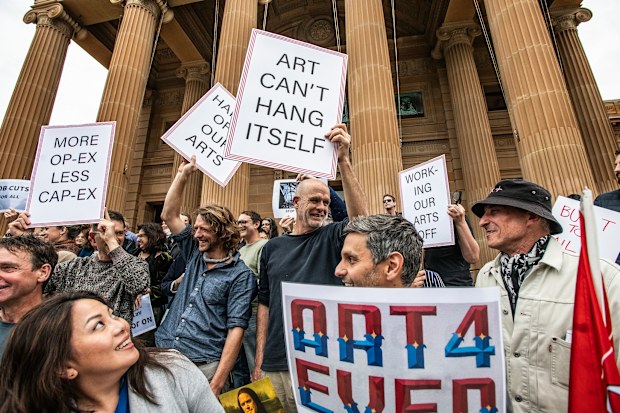
Anne Kenneally, officer of the Public Service Association (PSA), which represents many of the gallery’s staff, addressed the protest and asked why the NSW government could “find $50 million for [an upgrade of] Leichhardt Oval” but could not find $7 million to support the world’s 25th most-visited cultural institution.
Tony Wright, assistant general secretary of the PSA, said the cuts would “literally decimate the Art Gallery of NSW”.
“Our members have had a gutful … these are public-facing roles [and] there’s only one manager included in these cuts,” he said. “The public will notice these cuts. If you enjoy the gallery, then you need to know that the amount of exhibitions and their quality is in the firing line.”
Advertisement
Kenneally said the jobs to go included managers of training and development, diversity and inclusion, and risk and safety. The latter’s removal was “negligent”, she said, in the context of a gallery that welcomed a record 2.5 million visitors in 2024, and required the “dangerous manual work” of installing often heavy artworks.
Revenue growth lags rise in costs
The NSW government has defended the cuts, pointing to a state Treasury review conducted last year. That review found that AGNSW’s revenue growth had not kept up with a sharp increase in the costs associated with the 2022 opening of its Naala Badu building, and that it was using more staff than comparable institutions interstate.
The gallery’s total funding, allocated in line with the Treasury review, was $72.4 million in the 2024-25 financial year, but is set to fall to $66.6 million in 2025-26.
Treasury ordered the AGNSW to cut 29 jobs last year. Yet, just five were scrapped, so this month the gallery announced that its newly appointed director, Maud Page, who took over from Michael Brand in March, would oversee a “change management plan”.
Wright also questioned the government’s spending on other art institutions.
“NSW Arts Minister John Graham needs to know we won’t cop this,” he said. “The Powerhouse Museum in Parramatta has a blank cheque; meanwhile, established arts institutions are being looted and vandalised,” he said.
“We’ve seen new galleries and gardens added, like the [Naala Badu] extension. And now we see how they’re paying for it – by painting our members out of the picture.”
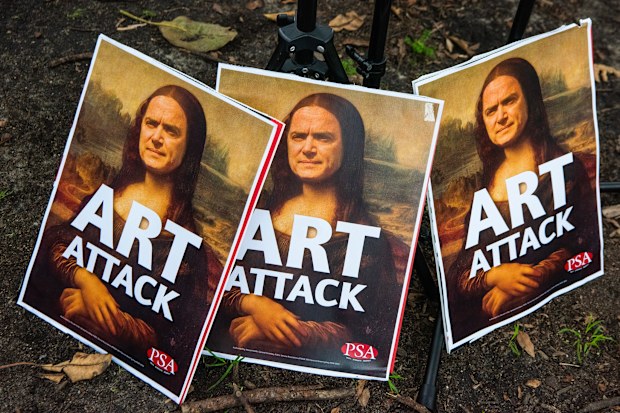
Graham will be grilled about the cuts on Thursday by NSW Liberal MLC Jacqui Munro. She attended Wednesday’s protest, and told The Australian Financial Review she agreed with the union’s claim that “it would appear” arts and culture spending in the state was being channelled disproportionately to cap-ex for the Powerhouse Museum, which was costing $1.4 billion between its new venue in Parramatta and the revamp of its original Ultimo site.
An AGNSW insider who asked not to be identified said all 51 jobs could have been saved had its art garden, which is still incomplete, been delivered on time and budget.
But an AGNSW spokesperson said this was incorrect, adding that commissions – such as the one made to First Nations artist Jonathan Jones for the garden – were done from “non-operational revenue sources”.
The spokesperson added that the consultation process regarding the cuts had been extended by two weeks and would now conclude in mid-September.
The cuts come at a difficult time for cultural institutions in NSW and beyond.
Earlier this month, Sydney’s Museum of Contemporary Art chair Lorraine Tarabay pointed to continuing austerity at the museum after it recorded a $2.1 million operating loss in 2024. That loss would have been $5.1 million, had it not been for a $3 million NSW government grant intended for 2025 but paid out last year.
In June, the NSW government announced that a quarter of its Create NSW arts funding agency’s 91 staff would be cut, with savings to be reinvested in programs intended to build audiences. The Australian Design Centre and several regional galleries have also been defunded.
Meanwhile, Museums Victoria, which operates Melbourne Museum and several other venues, is to cut 55 jobs, The Age revealed on Tuesday.
Related

- Exclusive
- Visual art
Senior staff depart Art Gallery of NSW amid tension at the top

Meet Tony Ellwood, art’s blockbuster man
Museums Are Under Fire. Silence Isn’t an Option
As political attacks on institutions grow, the work of ethical curation and civic engagement becomes more urgent.
James StewardAugust 27, 2025 Share This Article
What was long optimistically termed the “encyclopedic museum” emerged during the European Enlightenment as an instrument for organizing knowledge, educating and even reforming its target audiences, even as it affirmed nationalistic impulses. The very first museum in a sense in which we might understand the term—a place both collecting and presenting objects and welcoming the public—was attached to a university, the University of Oxford, the fruit of an early and extraordinary act of philanthropy. When it opened in 1683, the invited public may initially have largely been limited to those who might be termed gentlemen and -women, although laborers and others were soon enough invited, too, in an effort to “improve” both their morals and their skills. But from the outset, that museum and the many that grew up in its image was a place of discourse between object, curator, and visitor.
The best of Artnet News in your inbox.
Sign up for our daily newsletter.
More recently, since at least the 1990s, museums—including the one I have led at Princeton since 2009—have moved to place object and visitor on a more equal footing and to position themselves not only as engines of preservation and of learning but also as centers of community life. At Princeton we seek to be what I term a town square, a campus in microcosm, in which disparate publics might gather to interrogate not only works of art specifically but themselves and each other. I can think of few venues more apt to be locales for considering what it is to be human.
It is tragic, then, to see the museum broadly under assault, its commitment to being a center of independent, creative thought challenged in a polarized moment in which the center no longer holds. Long-established national institutions that have welcomed millions, such as the Smithsonian Institution, are under scrutiny for the narratives they present. Directors, like university presidents, are under fire for being too committed to the principles of diversity and inclusion. Museums serving audiences of color are becoming targets of immigration agents. Amid these changes, the voices of some directors and curators seem to have dimmed both here in the U.S. and internationally, perhaps reasonably seeking to avoid unwanted attention. As much as I understand this impulse, I cannot embrace it; instead, I choose to speak.
Donald W. Reynolds Center for American Art and Portraiture, home to the Smithsonian American Art Museum, the National Portrait Gallery, and the Lawrence A. Fleischman Gallery of the Archives of American Art in Washington, D.C. Courtesy of the Smithsonian.
The only viable response to these attacks is to double down on our ability to hold contradictory ideas in tension, support difference, and foster dialogue and debate. If we are to retain or regain the public trust, we must avoid the perils of partisanship and ensure that all members of our communities can find in us places of welcome, support, and, yes, provocation. In a moment when the National Endowment for the Arts—should it continue to exist at all—is offering grants only in support of projects that celebrate the U.S. semi-sesquicentennial in 2026, we must embrace the work of research and analysis, reasserting the role of expertise in shaping what can then be opened out into participatory meaning-making.
This means shaping galleries and exhibitions that do not rest solely in providing safety, comfort, or pleasure, but that also recognize the importance of provoking discomfort and unease as tools in discovery. If we are only peaceable venues pacifying the preexisting views of our publics or ourselves, then surely we are not educating. So long as the present age of disinformation endures, museums must provide a counter measure of fact-based, deeply considered contextualization, drawing out the lessons of the past to shape a healthier future. Through the objects we collect, exhibit, and interpret and the dialogues we encourage around them, we must be venues that dwell in larger truths, encouraging the kind of deeper—even at times unpleasant—self-interrogation that is desperately needed.
This means shaping galleries and exhibitions that do not rest solely in providing safety, comfort, or pleasure, but that also recognize the importance of provoking discomfort and unease as tools in discovery.
In asking that museums make productive noise, that we reject the safe and the bland, key pillars must remain in our work, even in a time in which the terms “diversity” and “equity” have been weaponized against us. In both the near and the long term, we must sustain our commitments to representation, updating and expanding our collections to give voice to those who were denied their voices in the past. This must not be an act of substitution in which others lose their voices, but one of addition. Only by doing so can we foster and contextualize the kinds of social narratives that our age requires.
James Steward, director of the Princeton University Art Museum. Photo: Joseph Hu. Courtesy of the museum.
Here at Princeton, where we are preparing to open an entirely new facility in October, we have shaped an architecture that allows us to place the world’s cultural heritage on a more level playing field by literally placing 95 percent of our galleries on a single level, overcoming traditional hierarchies of display to bring out ideas of cultural exchange and encounter across geographies and chronologies. Galleries both spatially and conceptually bridging cultural borders focus attention on issues such as elegy and death, or art’s universal ability to still the act of looking, subtly reminding us of how the act of being alive and being human itself transcends borders and identities. While inevitably space constraints will continue to require that choices be made about what is displayed, these are proof points of how museums globally might reconsider their own deeply held practices and open out notions of storytelling, inviting visitors to become active participants in these narratives.
In our physical and digital spaces, we must redouble efforts to foster civic dialogue and civil discourse and in doing so, show ourselves worthy of the public trust and of public investment. In doing so, we must help our visitors better understand their own lived experiences and then go beyond these to see the world more fulsomely and find a new understanding and empathy for others. By boldly amplifying our mission to educate, challenge, and inspire our visitors, thus awakening wider world views, we can continue to foster both enlightened citizenship and democratic values.
Visitors view a Revolutionary War film at the National Museum of African American History and Culture on March 31, 2025 in Washington, DC. In an executive order, U.S. President Donald Trump has threatened funding for the museum due to its “race-centered ideology.” Photo: Kayla Bartkowski/ Getty Images.
Together these pillars ladder up to museums capable of sharing the value of ethical stewardship not just in regard to the collections we care for but to the artists and makers to whom we give voice and the audiences we cultivate and serve. If museums are to remain vital and valuable, we must take productive risks, being responsive to our times and understanding the responsibilities we bear as custodians of the world’s cultural heritage. Far from being a time to linger in silence, we must seize the moment as an invitation to continue remaking our places in our communities, reclaiming our role in the unfettered pursuit of knowledge even as we strengthen the mental health of our citizens. In some future moment, perhaps we can look back to this time as one of renaissance in which we reclaim the human and humane possibilities on which our museums were founded.
James Steward is the Nancy A. Nasher—David J. Haemisegger, Class of 1976, director of the Princeton University Art Museum, which will open its new facility on October 31, 2025. There, he oversees collections of more than 117,000 works of art that span the globe and encompass over 5,000 years of human history. Under his leadership, the museum expanded its exhibition program, educational activities, and outreach, including doubling attendance. A lecturer with the rank of professor in Princeton’s Department of Art and Archaeology and a faculty fellow at Princeton’s Rockefeller College, Steward holds a doctorate in art history from Oxford and has received numerous national and international awards.
 Rosamond Press
Leave a comment