
A painting of ‘gallant highwayman’ Claude Duval by William Powell Frith | Photo credit: Manchester Art Gallery / Bridgeman Images
Capturing Beauty
When I helped fill out the death cirtificate of Drew Tyler Benton, who added the name Rosamond on her driver’s liscence, that was mispelled Rosmond, I was fully aware of the different spelling of
ROSAMOND ROSEMOND
Consider
ELIZABETH ROSEMOND TAYKOR
We share the same grandfather.
JRP
In 1724, . . . John ROSAMOND and his friend William Ray were arrested in Abingdon, Berkshire, England for stealing a hat, periwig, 30 pounds British sterling, five pairs of shoes, and a brown gelding. They were held in the gaol in Reading, Berkshire, after their trial where they were sentenced to be exiled to the colonies for 14 years hard labor.
One of the sons’ names was either John or Thomas Rosamond. Current researchers have not been able to confirm this connection. It appears probable that the American branch of the family are descended from John “The Highwayman” Rosamond who arrived in Annapolis, Maryland in 1725. He was sentenced to be transported into 14 years servitude for robbery from the Oxford Assizes. This John could be the son of Sergeant William Rosamond, and the mix up in names likely stems from the fact that his father-in-law’s name was Thomas Wilson.
“Smartass” tourguides[17][18] and the Harvard College undergraduate newspaper[19] commonly assert that John Harvard does not merit the honorific founder, because the Colony’s vote had come two years prior to Harvard’s bequest. But as detailed in a 1934 letter by the secretary of the Harvard Corporation, the founding of Harvard College was not the act of one but the work of many; John Harvard is therefore considered not the founder, but rather a founder,[20][21] of the school—though the timeliness and generosity of his contribution have made him the most honored of these:
John Roseman and Sarah Wilson
Posted on April 3, 2019 by Royal Rosamond Press

A Rose Among The Woodwose
by
John Presco
Chapter Three
John ‘The Highwayman’
When Sarah Wilson was told about John Rosamond, she heard he was a very bad man. But, he is a very good man, too, some say. Could he be both? For sure he was the best cobbler in the Colonies, and she had need for a special shoe for her special foot. This foot got Sarah in a lot of trouble. Indeed, she was cast out of Church because of it.
“Don’t go see him, Sarah. He’s trouble. He’s a robber. He’s killed men. They say he killed his lover, a black slave who was half Cherokee.”
“I hear he is very handsome, and a man of means due to his profession!”
“He was a slave! He was thrown in Reading Gaol for stealing the shoes of a Baroness. She went barefoot for a week! He put on her husbands wig and rode away laughing!”
Sarah launched herself off the walk, and her sister noticed her awkward gate as she headed for the shop with a markee of a rose and shoe, a woman’s shoe. John looked up as Sarah threw open the door to his shop. He could see her chest swell as she took in a deep breath.
“Not another one!” John whispered to himself. They just had to judge for themselves. They had to look into his eyes for The Stain………….’Woman Killer’!
Sarah gasped as she took in John’s pale blue eyes, that were the color of her father’s eyes, and thus they were – her eyes! She heard the word “Brother” She had beautiful brothers, but these brothers ripped the buttons off her dress after they dragged her into the courtyard.
John lowered his eyes, and tried to see Sarah’s shoes. He was embarrassed, even ashamed, because his heart had skipped a beat. And there – it missed again! In that second, there were feelings he thought he would never own again.
“Come, sit here in this chair. You are hiding something.”
“How do you know?”
“Because your dress is tailored too low. The hem is getting worn on the ground!”
“I have a club foot.”
“Lift your dress, and let me see.”
As Sarah lifted her dress, her stomach deeply flinched. When he gently took her foot in his hand, she ached with an ancient longing. Watching his eyes take in her, flaw, all she wanted in this Green Earth was to lay atop him, and hold his face in the candlelight, and take him in til morning.
“Were you born with this foot?”
“No. I was a breached birth. The midwife called for a Doctor who had special tools and skills. He got hold of my foot with one, and pulled. He wept, and cursed his invention. He did not sleep for three days until he fashioned a better one.”
“You must be in great pain. I can help you. When I was in Reading Gaol I made shoes for fellow prisoners. Most of them were deformed in some manner. Especially in their feet.”
“I am not a prisoner!” Sarah said defiantly. And John knew, she was guilty of something. Had she stood trial, like he had? Many convicted men were sent to the colonies as indentured slaves. Was she one of the rare women that were sailed to the New World – in chains?
“This foot is my bane. It ruined my life”
“How so?” John inquired. He knew he was about to hear another Confession. There was something about kneeling down before a woman, something, holy. All women want a chance, for a better life. Very few men can accept this, because redemption – is their’s!
“Physician, heal thyself!” Spoke Sarah in a tone never heard in this quiet shop. John’s heart was fluttering – and wouldn stop!
“I was fourteen. My Reverned was a Puritan. At his Bible study, I put forth a theory. I wondered aloud if Jesus was a cripple. There is a history of children with club feet in the line of King David. Is this, hereditary? I also suggested that Mark-John had a club foot that Peter noticed after the Resurection, as he walking behind Jesus.”
John looked up into Sarah’s eyes, and got her silent permission to finish unlacing her shoe. Pulling it off, he began to gently rub her foot after tugging off her socking. Sarah felt John’s hand rubbing blood back into her veins.
“The Reverand’s face turned a deep red. He was filled with fury! “How dare you suggest our Lord was – flawed! Take her out into the courtyard, and bring a bench!”. “I have welts on my back that will not go away.”
When John lowered his head and rest it upon her Shame, she wanted to reach for him and run her fingers through his hair.
“Did you kill her?”
Sarah could not believe she asked this question. When will she learn to keep her mouth shut? It was now evident they were going to be lovers. Did she spoil – her chance? She watched John’s caged soul pace back and forth, looking for an exit. She could not believe she took hold of his long hair.
“Yes.”
“Why?”
“She was a runaway slave. The bloodhounds had caught up with us. She did not want to go back to her master. There were welts on her back. She asked me take her home – to freedom.”
From back of the shop came the sound of John’s apprentice hammering tacks in the new shoe of the Governor of Virginia. Sarah could not oppress her, weeping. She reached across the chasm, and ran her fingers throught John’s hair, and he let go his pent up tears.
John clasped Sarah’s hand in his hands, and spoke.
“I am a very lonely man. Marry me Sarah.”
Sarah, let go of her grip, as she struggled to catch her breath again. The wild animal in her thought about making a break for the woods! “My God, we have not even courted.” Where did that come from? She thought of her two cousins who were captured by Indians. When they were seen again, they had tattoos on their face, and babes in their arms – they loved dearly! They were welcomed back. In this young nation, things happened – just like that! You had to be prepared to act – and fast!
“I will be your wife, so I can tell you why I took such a beating. I don’t want you to marry a heretic that you will abandon once you know the truth.”
“Tell me! Tell me the truth about yourself, that I should know.” John spoke with joy and tears in his eyes.
“I told the congregation that it is my belief that after Mark-John left Paul, he sailed to America with the Phoenicians! He, prepared – our way!”
John looked at his young fiancé, who was about eighteen. And, already she was a religious fanatic. English jails were full of men with wild visions. As a captive audience, John had listened to some very crazy ideas, then, he was sent to America against his will. The Colonies were full of half-crazed prophets. Some of them were completely naked, and, only had their long beards to keep them warm. When they died of exposure, a forest of wild animals – had a feast day!
John raised Sarah’s foot, and kissed her. He kissed, all of her, all that was cast out, all that was lost, and, forsaken.
“He is coming. He will find us, waiting, here!”
“Peter turned and saw the disciple whom Jesus loved following them; he was the one who had reclined next to Jesus at the supper and had said ‘Lord, who is it that is going to betray you?’ When Peter saw him, he said to Jesus ‘Lord, what about him?’ Jesus said to him, ‘If it is my will that he remain until I come, what is that to you? Follow me!” (John 21:20-22).
*****
Last night I had the most intense dream I have had in years. I was in bed with a beautiful black woman. Her whole family and friends wanted to meet me, a white man. I h ad a black girlfriend when I lived in Sacramento. One of her friends had made a chart. White men were bid to sign it and admit they were racist. I had admitted this before, and happily signed. But, then my ancestors appeared – in me.
“We not only owned slaves, we killed men, women an children. We killed as many Indians as we could find. We drove the Cherokee out of the 98th. District of South Casrolina. We were cold blooded murderers.”
I was crying in my dream. I told my lover and her people I can see Native American Blood in all of them. I started naming the tribes.
“Am I right? Did I get you right! Can I see your ancestors?’”
I believe this dream was brought to me after I told a woman about my DNA test. She was thinking about having a test. But, she looked, blue. She told me her grandfather had dark skin, and would not give her any names, or, tell anyone about his roots.
I want to thank Jimmy Rosamond for his wonderful research, and the researchers that have gone before us. Well done!
My Dear Americans, We have to grow up! We are a mixed-race nation and will be so – forever! Do not lament the loss of your blue-eyed sons and daughters: for we are all a Rose among the Wild Woodwose. We are a Christian Nation born of Wilderness Prophets. We were among the Lions in the arenas of Rome. What is all this to you? You are bid to follow him? Then – follow! We have a long way to go! Do not kill the thing you love.
Yet each man kills the thing he loves
By each let this be heard,
Some do it with a bitter look,
Some with a flattering word,
The coward does it with a kiss,
The brave man with a sword!
Some kill their love when they are young,
And some when they are old;
Some strangle with the hands of Lust,
Some with the hands of Gold:
The kindest use a knife, because
The dead so soon grow cold.
Some love too little, some too long,
Some sell, and others buy;
Some do the deed with many tears,
And some without a sigh:
For each man kills the thing he loves,
Yet each man does not die.

Sarah Wilson Rosamond (Willson) MP
| Gender: | Female |
|---|---|
| Birth: | 1726 County Antrim, Ireland |
| Death: | 1790 (64) Abbeville County, South Carolina, United States |
| Immediate Family: | Daughter of Thomas Wilson and Elizabeth Willson Wife of Pvt. John Roseman Mother of Margaret Weems; James Rosamond; Jean Rosamond; Capt Samuel Rosamond and Sarah F Hodges Sister of Capt Matthew Willson; Samuel Willson; Rebekah Willson; Elizabeth Musgrove; Nathaniel Willson and 2 others |
| Added by: | Jimmy Dale Rosamond on March 21, 2009 |
Now Paul and his company set sail from Paphos, and came to Perga in Pamphylia. And John left them and returned to Jerusalem; but they passed on from Perga and came to Antioch of Pisidia.[Acts 13:13–14]
And Barnabas wanted to take with them John called Mark. But Paul thought best not to take with them one who had withdrawn from them in Pamphylia, and had not gone with them to the work. And there arose a sharp contention, so that they separated from each other; Barnabas took Mark with him and sailed away to Cyprus, but Paul chose Silas and departed, being commended by the brethren to the grace of the Lord.[Acts 15:37–40]
(1) Source: Jimmy Rosamond <jdrosamond@comcast.net>.
(2) Jon Presco <http://rougeknights.blogspot.com/2008/10/highwayman-is-free-images-hi gwayman.html>:
In 1724, . . . John ROSAMOND and his friend William Ray were arrested in Abingdon, Berkshire, England for stealing a hat, periwig, 30 pounds British sterling, five pairs of shoes, and a brown gelding. They were held in the gaol in Reading, Berkshire, after their trial where they were sentenced to be exiled to the colonies for 14 years hard labor. By March 1725, they were transported to Newgate Prison and held there until they boarded the convict ship “Forward” owned by Jonathan Forward, and captained by Daniel Russell. The ship set sail on 28 September 1725 from London via the Thames River. The ship arrived [and] disembarked at Annapolis, Maryland on 8 December 1725. We don’t know who bought his indenture, but he is recorded as being in CPT Beall’s militia of Prince George Co, Maryland between 1734-1737. By 1747-1765 we find John ROSAMOND living in Augusta Co, Virginia and listed as a master shoemaker, owned land, paid tithes, served in the militia, etc.
(3) Coldham, Peter Wilson, Bonded Passengers to America, 9 Volumes in 3, Baltimore, MD: Genealogical Publishing Co., 1983, Vol. 6, Oxford Circuit, 1663-1775: Berkshire, Gloucestershire, Herefordshire, Monmouthshire, Oxfordshire, Shropshire, Staffordshire, and Worcestershire, p. 9:
Berkshire
Ray, William. S Lent R 14 yrs Summer 1725 for highway robbery LC from Forward at Annapolis, Md, December 1725. . . .
Rosamond, John. S Lent R 14 yrs Summer 1725 for highway robbery LC from Forward at Annapolis, Md, December 1725.
ABBREVIATIONS USED
LC – Landing Certificate issued at the colonial port of entry, followed by the date of issue.
R – Reprieved on condition of transportation to the American colonies. In the case of those reprieved for 14 years or of life transportation, this is noted where it appears in the records; otherwise the term imposed was normally seven years.
S – Sentenced to be transported to the American colonies for a period of seven years unless otherwise stated, followed by the date of the Sessions at which the trial took place.
(4) Christianson, Scott, With Liberty for Some: 500 Years of Imprisonment in America, Boston, MA: Northeastern University Press, 1998, pp. 23-24:
In 1717 Parliament passed an act empowering courts to sentence offenders directly to transportation. Persons convicted of clergyable felonies or petty larceny could now be sent to American plantations for seven years instead of being whipped or burnt on the hand. This meant that a large portion of England’s offenders were eligible to be shipped abroad and sold as servants for seven-year terms. Felons convicted of capital crimes could, with royal consent, be commuted to a term of fourteen years’ transportation or, in some cases, life. Anyone who returned before her or his term expired or who helped a convict to escape was liable to be hanged.
Jonathan Forward, a young London merchant with extensive contacts in Maryland, obtained a lucrative subsidy of three pounds for every Newgate felon and five pounds for every convict taken from the provinces. In exchange, he agreed to ship any and all criminals sentenced to transportation, and to pay all costs, including gaol fees, for their conveyance. Forward was experienced in the African slave trade and had recently shipped two vessels with 171 convicts to Maryland. Operating out of his Cheapside house on Fenchurch Street, London, he collaborated with Jonathan Wild, who helped to provide “felons” for shipment abroad.
On April 26, 1718, 29 malefactors at the Old Bailey were ordered to be transported. Four months later the Historical Register reported that 106 convicts “that were ordered for transportation, were taken out of Newgate and put on board a lighter at Blackwall Stairs, from whence they were carried through the Bridge to Long Reach, and there shipped on board the Eagle galley, Captain Staples commander, bound for Virginia and Maryland. (The Eagle was a well-known slave ship that had sailed for the Royal African Company for more than a decade, so the transport of prisoners to America was nothing new for her.)
Forward retained his monopoly for over twenty years until April 1739, when Andrew Reid was added to the payroll. Although Forward continued to transport felons from provincial gaols until the late 1740s, Reid assumed main control of the convict trade.
(5) Bailyn, Bernard, Voyagers to the West: A Passage in the Peopling of America on the Eve of the Revolution, New York, NY: Vintage Books, 1988, pp. 262-263:
For thoughtful Americans concerned with the character of American society, the banishment of convicts to America was an abomination, and for those with an eye for macabre humor it was ludicrous. The most famous comment on the problem was [Benjamin] Franklin’s proposal-published after a crime wave, perpetrated in Virginia, Maryland and Pennsylvania chiefly by convict servants, was luridly reported in the press-that the colonies should be authorized to “transport” their rattlesnakes to Britain in exchange for “the human serpents sent us by the mother country.”
(6) Jimmy Rosamond <jdrosamond@comcast.net>:
Researchers [have] assumed that John relocated to Virginia where he married Sarah Wilson. . . . John and Sarah relocated their family to the Abbeville District of South Carolina no later than 1765.
The first instance of John being in Virginia is from Chalkley’s Chronicles showing him in Augusta County in 1747. Then in 1765, there is a record in Chalkley’s that says the property he and Sarah owned was sold to them by a man who didn’t own the property himself. This apparently caused a problem, because the final record in Chalkley’s shows them selling the land to someone else with the court’s permission. The next record of him is a land grant dated 1767 in Abbeville District, SC. That dates their move to SC between 1765 and 1767.
John was a master shoemaker in Augusta County, VA in the 1750s. This is documented in Chalkleys.
(7) Caution: Based on a will which Jimmy Rosamond <jdrosamond@comcast.net> has found for a John ROSEMAN in Prince George’s County, MD, proved in 1789, John “The Highwayman” ROSAMOND may have lived out his life and died in Prince George’s County, MD. If this proves to be true, the John ROSAMOND who lived in Augusta County, VA is probably not the same person as John “The Highwayman” ROSAMOND.
(8) John ROSAMON, John ROSAMOND, John ROSEMAN, John ROSEMAND, John ROSEMOND, John ROSMAN and John ROSMOND are mentioned in Chalkley, Lyman, The Chronicles of the Scotch-Irish Settlement in Virginia: 1745 to 1800 [Reprint, Originally Published, 1912], Baltimore, MD: Genealogical Publishing Co., 1980 <http://www.rootsweb.ancestry.com/~chalkley/>. The compiler assumes that all of these Johns were the same person, namely, John ROSAMOND. Set forth below are all of these references from Chalkley, with the capitalization of John’s surname added by the compiler:
Volume I, p. 39:
AUGUST 24, 1749.
John ROSEMOND added to tithables.
Volume I, p. 120:
APRIL 15, 1765.
James Bell, provisions. Wm. Bell, provisions. Wm. McCutcheon, provisions and horse impressed. John ROSEMOND, provisions. Andrew Cowan, enlisting men to garrison Fort Lewis. Walter Trimble, provisions. Thos. Alexander, provisions. John Francis, provisions. James Kirk, provisions. Rob. Armstrong, provisions. Wm. Christian, self et als., ranging. Loftus Pullen, provisions. Rob. Christian, provisions. Danl. O’Freild, provisions. Thos. Poage, provisions. Charles Kilpatrick, provisions. George Moffett, for Wm. Mann et als. Benj. Estill, horse impressed. Andrew Hamilton, provisions. Wm. McClenachan, provisions. Wm. McKarney, self et als., ranging.
Volume II, pp. 414-415:
1750-Sam’l Akerlin, gone to Pennsylvania; Gabriel Akerlin, gone to Pennsylvania; Jeremiah Bates, can’t find; John Boaman, can’t find; Edward Boil, gone to Carolina; Jno. Bolin, not found; Wm. Crisp, to Carolina; Edw’d Cochran, runaway; Pierce Castlan, lives in Lunenburg; Philip Linch, runaway; Robt. Crumbe, twice charged; Nath’l Cherry, not found; John Droen, not found; John Doson. to Carolina; James Dailey, runaway; Rob’t Fryer, not found; James Gordon, no effects; Rob’t Gamble, not found; Chas. Gilham. not found; David Galloway, twice charged; Naftalin Gregory, not found; Wm. Hardgrove, to Carolina; Elias Hamilton, not found; Joseph Hendon, not found; Wm. Hall, twice charged; Wm. Hambleton, not found; Benj. Hardin, twice charged; Wm. Henry, to Carolina; Wm. Inglish, Constable; Melchisedick Johnston, not found; Martin Kelley, no effects; Wm. Terrey, Constable; Ro. Teat, gone to Carolina; Benj. Thompson, not found; Bryan White, runaway; Alex. Walker, Constable; Thos. Wilson, twice charged; Ben. Young, not in this County; Rob’t Lockndge, Constable; Jno. McFarland, Constable; Jno. McClenachan, Constable; Henry Leonard, not found; John Lawler, to Carolina; Geo. Maison, not found; Henry Miller, not found; Jno. McCurry, Jr., not found; Joseph McCurry, runaway; James Murphy, runaway; Neal McNeal, twice charged; Hugh McBride, runaway; James McAffee, twice charged; Arch’d McCleerie, not found; Hugh Maires, not found; Wm. McLehanny, not found; Jno. McHunis, not found; Jas. McCrenneld, not found; Abraham Mires, not found; Rob’t Mains, not found; Jno. Mills, dead, and no effects; Jacob Martin, twice charged; poor John Hance, not found; Jno. Potts, twice charged; James Ryan, not found; Jno. Ramsey, twice charged; James Robeson, twice charged; Sam’l Stalnaker, lives at Holston River; Jno. Scott, thrice charged; Jno. Shields, lives at Rockfish; Jno. Stevenson, twice charged; James Scot, twice charged; Jno. Stanley, not found; Jno. Vance, lives in Lunenburg; Elias Wallraven, not found; Nath’l Wilsher, not found; Wm. Walker, twice charged; John Walker, gone to Carolina; John Warnock, twice charged; James Gay, Constable; James Mais, Constable; David Miller, Constable; Jno. ROSMOND, Constable.
Volume II, p. 463:
1760: Processioned in Capt. Moore’s Company by John Stephson, Nathaniel Evins: For Nathaniel Evins, for Wm. McCreerey, for Thos. Willson, for John Stevenson, for John McClung, for Wm. McClung, for Alex. Moore, for Adam Reed, for Wm. Hays, for Wm. Paris, for Thomas Bard, for John Cunningham, for Mathew Huston, for John Mountgumery, for Wm. Moore, for Wm. Lockridge, for Thomas Boyd, for John Boyd, for Thomas Hill, for Robert Ware (Wire), for Wm. Hays, for Wm. Beard, for Wm. Wardlaw, for Andrew Steel, for James Steel, for Joseph Kennedy, for John Lowry, for Samuel Huston, for James Eakins, for John Hanly, for John Logan, for Alex. Logan, for Alex. McNutt, for James McNutt, for John ROSMAN, for Andrew Dunkin, for John Wardlaw, for Wm. McCanless, for James Cowdan, for John Moore.
Volume III, p. 15:
28th October, 1749. James McNutt’s appraisement by James Trimble, Joseph Coulton, John ROSEMAN. Notes of Philip Chittam, Jas. Davis and Arthur Miliken.
Volume III, p. 26:
21st September, 1750. John Greer’s vendue. Sold to John Lockhart. John ROSEMAN, Sarah Lynn, John Teat, John Mitchell, Christopher Kelly, George Breckinridge, Thos. Scott, James Lynn, Thos. Teat, Francis Beaty, John Mitchell.
Volume III, pp. 29-30:
23d May, 1751. James McNutt’s orphans. Settlement by Thos. Beard, administrator. Paid Mr. Burden for 185 acres bought by my wife (Thos. Beard’s?) now, but before marriage. 17__ to Mr. Burden quit rents on 85 acres for 10 years. 1747 to Mr. Downs for quit rents. 1744 to Mr. Burden for quit rents, 300 acres. December 20th, 1748, paid David Hays rents debt due before marriage. Paid Wm. Nutt debt. 8th May, 1749, paid Wm. Hunter for work. 4th February, 1747, paid John Huston, debt. 9th December, 1748, paid John ROSEMAN. debt. 10th May, 1748, paid Saml. Wilson, for bringing some linen from Penna. Paid to Widow Sheals, a debt. Paid to Robt. Alexander, for schooling James and Robert McNutt. Paid to James Dobbins, for schooling Alex. McNutt. Paid one new Bible, for Alex. McNutt. Paid one new Testament, for James McNutt. Paid one new spelling book, for the children.
Volume III, p. 54:
20th September, 1758. Vendue of John Snodgrass’ estate, by Agnes Patton-To David Edmund, Wm. Parris, Robt. McRandolph, John Wardlaw, Wm. Adair, Peter Angel. Paid to John Mountgomery, Edmond Tarr, James Henry, Jno. ROSAMOND, Patrick Hays, James McCown, Andrew Steel.
Volume III, p. 306:
Page 456.-19th August, 1752. Joseph Kennedy to John ROSEMAN, 380 acres, 20 poles. Moffett’s Creek. Teste: Wm. Wilson, James Walker, Fr. Beatey.
Volume III, p. 311:
10th February, 1753. Same [Borden, etc.] to Thomas Beard, 605 acres of 92100; Moffett’s Creek of James; corner John ROSEMAN. Delivered: Saml. Buchanan, 21st June, 1758.
Volume III, p. 335:
24th _____, 1755. Daniel McBride puts himself apprentice and servant to John ROSEMAN. cordwainer or shoemaker, for 2 years. Teste: Ro. Armstrong (mark) and James Goodly.
Volume III, p. 344:
15th June, 1754. George Henderson to John ROSEMAN, £60. Bill sale conveys all horses and cows, sheep and hogs, all movable goods and chattels. Teste: Wm. Wardlaw, Robert Henry. Acknowledged, 17th November, 1756.
Volume III, p. 359:
18th March, 1760. Thomas Beard and Margaret to William Beard, £100, 605 A., 1 R., 28 P., in Borden’s tract, on side Moffet’s Creek; corner Jno. ROSEMAN’s land. Delivered: Wm. Beard, August 12, 1791.
Volume III, p. 383:
5th February, 1762. George Henderson to Hugh Wardlaw, £60, 284 acres in Bordin’s tract, on Moffett’s Creek; cor. John ROSEMAN; cor. Wm. Wardlaw, James Wardlaw’s line. Teste: Henry Long.
Volume III, p. 433:
14th October, 1765. Same [Borden’s executors] to Robert Gay, 100 acres, part of 92,100, oak on Moffet’s opposite John ROSEMAND’s old survey, opposite George Henderson’s land, post in the Barrens. Delivered to Robert and Archibald Rhea, devisees, 17th January, 1803.
2d October. 1765. George Patterson, eldest son and heir of John Patterson, to John ROSEMAN, £30, 380 acres on Moffet’s Creek. David Mitchell.
Volume III, p. 436:
October, 1765. John ROSEMAN and Gabriel Jones to George Patterson, £150. Bond conditioned, whereas John Patterson, late of Augusta, deceased, father of George Patterson, was seised of 380 acres which he sold to Joseph Kenedy, but never made title, and Joseph sold to John Koseman for £45.10, and either mistake or design the said Kennedy conveyed to John ROSEMAN, 19th August, 1752. though the title was in Patterson and devolved upon the above named Geo. Patterson as eldest son of John, and George has conveyed to John ROSEMAN; if John and Gabriel keep said George safe of law suits, troubles, &c., then to be void.
10th October, 1765. John ROSEMAN and Sarah to Robert Gay, £120, 380 acres, 20 p., on Moffet’s Creek. Teste: Francis Railey. Delivered: Robt. Rhea, one of the devisees, 17th January, 1803.
[Note by compiler: Chalkley is not without its problems, as Daphne Gentry of the Publications and Educational Division of the Library of Virginia has pointed out. (See http://www.lva.lib.va.us/whatwehave/local/va5_chalkleys.htm.) Not all documents are included. There are not only errors of omission, but errors of transcription have also been documented. This simply means that the careful researcher should send for a copy of the original document, as with any secondary source, and should not assume that because it doesn’t appear in Chalkley it does not exist.]
(9) Brown, Katherine L., New Providence Church, 1746-1996, A History, Raphine, VA: New Providence Presbyterian Church, 1996, p. 42 (transcript provided to the compiler by Jimmy Rosamond <jdrosamond@comcast.net>):
In the absence of session records for the first sixty years of the life of New Providence Church, this signed call and the first subscription list are highly significant documents. The 1753 call is not divided by congregation, but the separate lists for New Providence and Timber Ridge for 1754 and 1755 can be compared with the names on the call. There were a total of forty-six names on the New Providence salary list, thirty-four in 1754, all of whom renewed their support the next year, and twelve additional names in 1755. The pledging founders of New Providence Church are William and Thomas Berry, Samuel Buchanan, James Coulter, Robert Culton, James Eaken, Walter Eaken, John Edmiston, William Edmiston, Robert Gamble, John Handly, George Henderson, Thomas Hill, John Houston, Matthew Houston, Samuel Houston, Joseph Kennedy, John Logan, James Lusk, Edward McColgan, McCroskey, Samuel McCutchan, Alexander Miller, John Montgomery, Alexander Moore, James Moore, Patrick Porter, Robert Reagh, William Reagh, James Robinson, Matthew Robinson, John ROSEMAN, Widow Smith, William Smith, Andrew Steele, John Stewart, James Trimble, Alexander Walker, James Walker, John Walker, William Wardlaw, Robert Weir, and Ann Wilson. In addition, there were nine names on the call that did not pledge, but who were closely associated with New Providence. They were Charles Berry, Samuel Dunlap, James Edmiston, Samuel Hay(s), McCrosky, William Reagh, William Robinson, Samuel Steel and John Wardlaw. [Capitalization of John ROSEMAN’s surname supplied by the compiler.]
Most of those pledging contributed fifteen shillings up to one pound, but there were a few pledges larger than that. Andrew Steele, who traveled to New Castle Presbytery to present the call, pledged two pounds, three shillings and four pence.
(10) Morton, Oren Frederic, A history of Rockbridge County, Virginia, Staunton, VA: The McClure Co., Inc., 1920, pp. 34-35:
THIS INDENTURE made the twenty fourth Day of _____ in the year of Our Lord Christ one thousand seven hundred and fifty five WITNESSETH that Daniel McBride of the County of Augusta in the Colony of Virginia hath Put himself apprenting Servant and by these presents Doth Voluntarily Put himself and of his own free will & accord put himself apprenting servant to John Roseman Cordwainer or shoemaker of this sd County of Augusta in the Colony aforesd to Learn his art and Trade or Mystery after the manner of an apprenting servant to sarve him or his assigns from the Day of the Date hereof for & During the full Term and Time of two full years next ensuing, During all what time the sd apprentice his Said Master faithfully shall Serve his secret Keys his Lawfull Commands very _____ gladly obey he shall Do no Damage to his said Master nor see it Done by others with out Letting or giving notice thereof to his said Master he shall not wast his said Master’s goods nor lend them unlawfully to others he shall not Commit fornication nor Contract Matrimony within the sd Term at Cards or Dice or any other unlawfull games he Shall not play whereby his said Master may be Damaged with his own goods or the goods of others During the sd Term without the License of his sd Master he Shall Nither Buy nor Sell he Shall not absent himself Day nor Night from his sd Master’s Service without his Leave nor haunt ale houses still houses Taverns or play Houses but in all things Behave himself as a faithful apprentice Savant ought to Do During the sd Term & Time and the sd Daniel McBride doth hereby Covenant and Declare himself Now to be of the age of Nineteen years a single Person & no Covenanted Indented or Contracted Servant or apprentice to any persons or persons whatsoever and the sd Master Shall use the utmost of his Indeavors to Teach or Cause to be Taught & Instructed the sd prentice in the Trade and Mystery he now professes Occupieth or followeth and procure and provide for him the sd apprentice sufficient meat Drink apparel washing and Lodging fitting for an apprentice During the sd Term and at the End & Expiration thereof the sd master shall pay unto the sd prentice the sum of Ten pounds Current Money of Virginia or the value thereof in goods or Chattels and for the true performance of all & every this sd Covenant & agreement Either of the said Parties binded them selves to the other firmly by these presents IN WITNESS whereof they have hereunto Interchangeably set their hands and affixed their seales the Day and Year first above written.
[Note by compiler: Rockbridge County, VA was formed from Augusta and Botetourt Counties, VA in 1778.]
============
1. In 1925 William Sam Rosamond did a relatively complete genealogy. His research indicated that we were descended from a Huguenot born in France sometime in the mid to late 1600s. He discovered that his earliest traceable ancestor was a “Sergeant” Rosamond who left France following the Revocation of the Edict of Nantes on 22nd October 1685. He found that Sergeant Rosamond supposedly travelled to Holland where he joined the army of William III, went to England, and from there went with William’s army to Ireland. He fought in the Battle of the Boyne on 1st July 1690 (by the old calendar – 12th July by the new calendar) and then remained in County Leitrim, Ireland. (There is still a family of Rosamonds in County Leitrim.) He had three sons, two of whom went to the American colonies and settled in the mid-Atlantic region. One of the sons’ names was either John or Thomas Rosamond. Current researchers have not been able to confirm this connection. It appears probable that the American branch of the family are descended from John “The Highwayman” Rosamond who arrived in Annapolis, Maryland in 1725. He was sentenced to be transported into 14 years servitude for robbery from the Oxford Assizes. This John could be the son of Sergeant William Rosamond, and the mix up in names likely stems from the fact that his father-in-law’s name was Thomas Wilson.
John Harvard and Shakespeare
Posted on April 2, 2019 by Royal Rosamond Press


For the last thirty years I have been giving myself a College Education. If I show anger towards people I know, and those who have gotten to know me, it is they think I am mad to study all by myself. Thanks to the DNA TEST I took at Ancestry.com, I have not been – that alone! I have been – compelled, driven by unseen forces I could not elude! I did not knowwwwwwww, better!
Richard Burton and Liz Burton suffered from the disease of alcoholism, thus, it is wondered how much more stellar their careers would have been if they did not drink. A bad biography about my famous sister, the artist ‘Rosamond’, wonders the same. There is no wonderment about me, because in many people’s mind, I never had a career! Yet, I own thirty-one years of sobriety on April 7th.
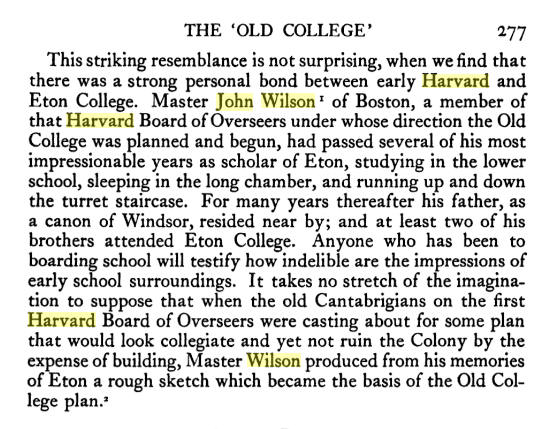
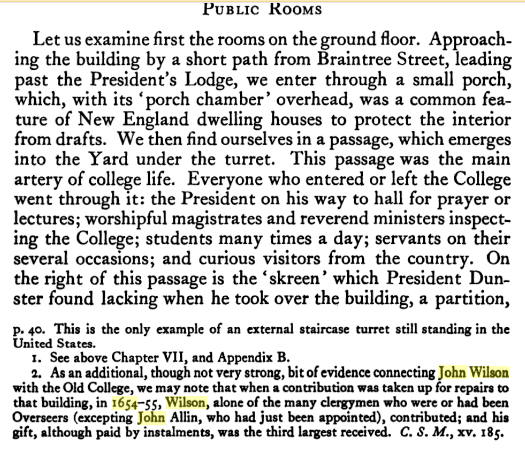
There is a very good chance John Harvard knew my great, great, great, great, grandfather, Reverend John Wilson. Both men wondered if the wonderful things they had done, would be remembered by their offspring – years from now. I have been given such concerns, but, I think the buck stops here. I carry on!
Some of you have heard me rant about ‘My Dumb Daughter’ which might become a play, or, an epic poem. I know many people can relate. ‘The Taming of the Un-Shrewd’?
I will explore the claim, that it wassssss – Reverend John Wilson who founded Harvard. He certainly had the pedigree! His son graduated from Harvard in 1642. John Harvard was born in Stratford-On-Avon, and may have known the Webb family, which is the only family line one can trace in order to be kin to William ‘The Bard’ for his three daughters, died. And, thus is comes down to me to carry on any and all family feuds? Of course! That makes sense, as to why I am tooooo clever to be in the good company of – anyone!
So, I study…………alone! There will be no crappy folding chairs put out on the lawn for my happy relatives who can’t wait to see what is coming to me. I have already got what I deserve!
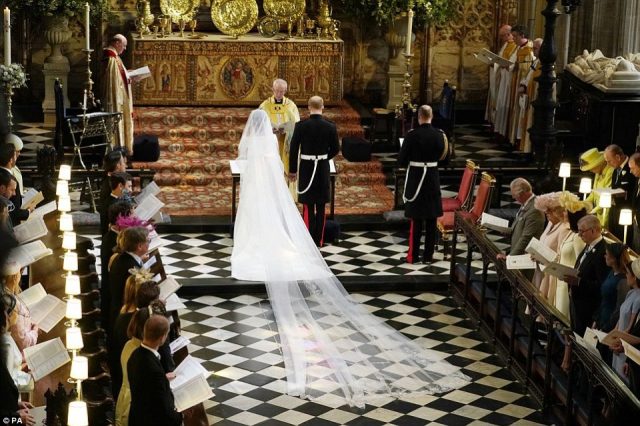
I just heard that Harry and Markle are going to have a child in a few days. I feel this is my Graduation Day: for when they married in Saint George’s Cathedral, they took their vows not but ten feet away from where the bones of Reverend William Wilson, lie, under the cold granite, under a brass plaque, just he, and his wife, a great, great, grandmother to me.
So, it was God who kept calling to me, when it was my ambition to be a Drunken Scallywag, blinded on the squiggly road taken by the infamous, to ne’er land. I was a better and more loved Smartass when I had a bartender tending to all my ambitions.
“Come on, Mr. Presco! Let me pour you another drink! Stop putting on airs! All you did was pass a bloody DNA test – with flying colors!”
John Presco
“Smartass” tourguides[17][18] and the Harvard College undergraduate newspaper[19] commonly assert that John Harvard does not merit the honorific founder, because the Colony’s vote had come two years prior to Harvard’s bequest. But as detailed in a 1934 letter by the secretary of the Harvard Corporation, the founding of Harvard College was not the act of one but the work of many; John Harvard is therefore considered not the founder, but rather a founder,[20][21] of the school—though the timeliness and generosity of his contribution have made him the most honored of these:


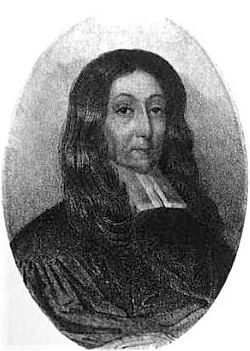
Rev. John Wilson was born in London, England, Sept. 1621, and came with his father to New England in 1630. He graduated from Harvard College in 1642, and was ordained and settled with Mr. Mather at Dorchester. In 1651 he removed to Medfield, Mass., where he became a famous preacher, and remained there until his death in 1691. He died at Medfield, Mass., Aug. 23, 1691. She died at Braintree, Mass., Aug. 20,1725.
John Harvard (clergyman)
From Wikipedia, the free encyclopedia
Jump to navigationJump to search
This article is about the founder of Harvard College. For John Harvard, the statue in Harvard Yard, see John Harvard (statue). For other uses, see John Harvard (disambiguation).
| John Harvard | |
|---|---|
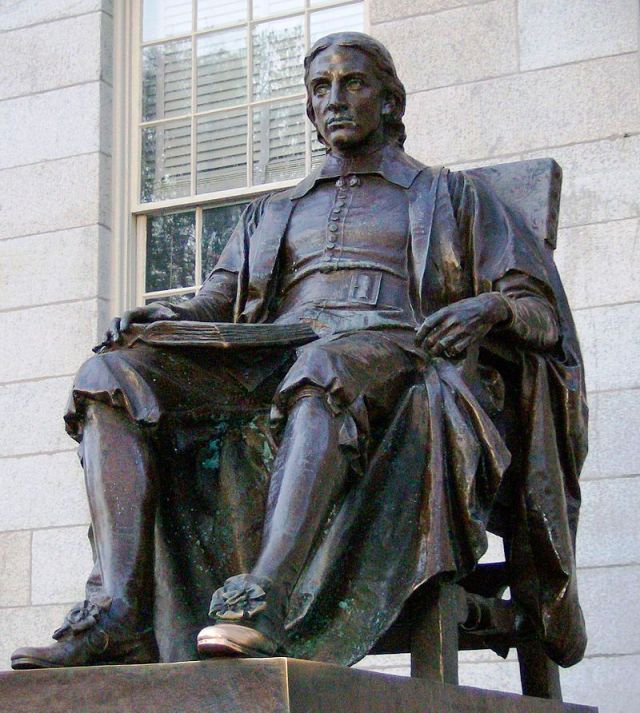
| John Harvard statue, Harvard Yard | |
| Born | (1607-11-26)26 November 1607Southwark, Surrey, England |
| Died | 14 September 1638(1638-09-14) (aged 30)Charlestown, Massachusetts Bay Colony |
| Cause of death | Tuberculosis |
| Alma mater | Emmanuel College, Cambridge |
| Occupation | Pastor |
| Known for | A founder of Harvard College |
| Spouse(s) | Ann Sadler |
| Children | None |
| Signature | |
John Harvard (1607–1638) was an English minister in America, “a godly gentleman and a lover of learning”[1] whose deathbed[2] bequest to the “schoale or Colledge” founded two years earlier by the Massachusetts Bay Colony was so gratefully received that it was consequently ordered “that the Colledge agreed upon formerly to bee built at Cambridg shalbee called Harvard Colledge.”[3] The institution considers him the most honored of its founders – those whose efforts and contributions in its early days “ensure[d] its permanence,” and a statue in his honor is a prominent feature of Harvard Yard.
Contents
- 1Life
- 2Founder of Harvard College
- 3Memorials and tributes
- 4References
- 5Further reading
- 6External links
Life[edit]
Early life[edit]
Harvard was born and raised in Southwark, Surrey, England, (now part of London), the fourth of nine children of Robert Harvard (1562–1625), a butcher and tavern owner, and his wife Katherine Rogers (1584–1635), a native of Stratford-upon-Avon whose father, Thomas Rogers (1540–1611), was an associate of Shakespeare’s father (both served on the borough corporation’s council). Harvard was baptised in the parish church of St Saviour’s (now Southwark Cathedral)[4] and attended St Saviour’s Grammar School, where his father was a member of the governing body and a warden of the Parish Church.
In 1625, bubonic plague reduced the immediate family to only John, his brother Thomas, and their mother. Katherine was soon remarried—firstly in 1626 to John Elletson (1580–1626), who died within a few months, then (1627) to Richard Yearwood (1580–1632). She died in 1635, Thomas in 1637.
Left with some property, Harvard’s mother was able to send him to Emmanuel College, Cambridge,[5] where he earned his B.A. in 1632[6] and M.A. in 1635, and was subsequently ordained a dissenting minister.[7]
Marriage and career[edit]
In 1636, Harvard married Ann Sadler (1614–55) of Ringmer, sister of his college classmate John Sadler, at St Michael the Archangel Church, in the parish of South Malling, Lewes, East Sussex.[citation needed]
In the spring or summer of 1637, the couple emigrated to New England, where Harvard became a freeman of Massachusetts and,[5] settling in Charlestown, a teaching elder of the First Church there[8] and an assistant preacher.[7] In 1638, a tract of land was deeded[clarification needed] to him there, and he was appointed that same year to a committee “to consider of some things tending toward a body of laws.”[5][clarification needed]
He built his house on Country Road (later Market Street and now Main Street), next to Gravel Lane, a site that is now Harvard Mall. Harvard’s orchard extended up the hill behind his house.[9]
Death[edit]
On 14 September 1638, Harvard died of tuberculosis and was buried at Charlestown’s Phipps Street Burying Ground.
In 1828, Harvard University alumni erected a granite monument to his memory there,[5][10] his original stone having disappeared during the American Revolution.[8]
Founder of Harvard College


Tablets outside Harvard Yard’s Johnston Gate. The tablet on the left quotes from a longer history which continues, “And as we were thinking and consulting how to effect this great work, it pleased God to stir up the heart of one Mr. Harvard (a godly gentleman and a lover of learning, there living among us) to give the one-half of his estate (it being in all about 1700 £) toward the erecting of a college, and all his library. After him, another gave 300 £; others after them cast in more; and the public hand of the state added the rest.” [11]

Emmanuel College window (1884) depicting John Harvard on left

Tablets, Emmanuel College chapel
Two years before Harvard’s death the Great and General Court of the Massachusetts Bay Colony—desiring to “advance learning and perpetuate it to posterity: dreading to leave an illiterate ministry to the churches, when our present ministers shall lie in the dust”—appropriated £400 toward a “schoale or colledge”[3] at what was then called Newtowne.[11] In an oral will spoken to his wife[12] the childless Harvard, who had inherited considerable sums from his father, mother, and brother,[13] bequeathed to the school £780—half of his monetary estate—with the remainder to his wife;[4] perhaps more importantly[14] he also gave his scholar’s library comprising some 329 titles (totaling 400 volumes, some titles being multivolume works).[15]:192 In gratitude, it was subsequently ordered “that the Colledge agreed upon formerly to bee built at Cambridg shalbee called Harvard Colledge.” [3] (Even before Harvard’s death, Newtowne had been renamed[3] Cambridge, after the English university attended by many early colonists, including Harvard himself.)[16]
Founding “myth”[edit]
“Smartass” tourguides[17][18] and the Harvard College undergraduate newspaper[19] commonly assert that John Harvard does not merit the honorific founder, because the Colony’s vote had come two years prior to Harvard’s bequest. But as detailed in a 1934 letter by the secretary of the Harvard Corporation, the founding of Harvard College was not the act of one but the work of many; John Harvard is therefore considered not the founder, but rather a founder,[20][21] of the school—though the timeliness and generosity of his contribution have made him the most honored of these:
.mw-parser-output .templatequote{overflow:hidden;margin:1em 0;padding:0 40px}.mw-parser-output .templatequote .templatequotecite{line-height:1.5em;text-align:left;padding-left:1.6em;margin-top:0}
The quibble over the question whether John Harvard was entitled to be called the Founder of Harvard College seems to me one of the least profitable. The destruction of myths is a legitimate sport, but its only justification is the establishment of truth in place of error.
If the founding of a university must be dated to a split second of time, then the founding of Harvard should perhaps be fixed by the fall of the president’s gavel in announcing the passage of the vote of October 28, 1636. But if the founding is to be regarded as a process rather than as a single event [then John Harvard, by virtue of his bequest “at the very threshold of the College’s existence and going further than any other contribution made up to that time to ensure its permanence”] is clearly entitled to be considered a founder. The General Court … acknowledged the fact by bestowing his name on the College. This was almost two years before the first President took office and four years before the first students were graduated.
These are all familiar facts and it is well that they should be understood by the sons of Harvard. There is no myth to be destroyed.[22]
Memorials and tributes[edit]
A statue in Harvard’s honor—not, however, a likeness of him, there being nothing to indicate what he had looked like[7]—is a prominent feature of Harvard Yard (see John Harvard statue) and was featured on a 1986 stamp, part of the United States Postal Service’s Great Americans series.[23] A figure representing him also appears in a stained-glass window in the chapel of Emmanuel College, University of Cambridge.[7][5]
The John Harvard Library in Southwark, London, is named in Harvard’s honor, as is the Harvard Bridge that connects Boston to Cambridge.[24] There is a memorial window in his honor in Southwark Cathedral.[25]
Rev William Wilson
| Birth | 1542Windsor, Windsor and Maidenhead Royal Borough, Berkshire, England |
|---|---|
| Death | 15 May 1615 (aged 72–73)England |
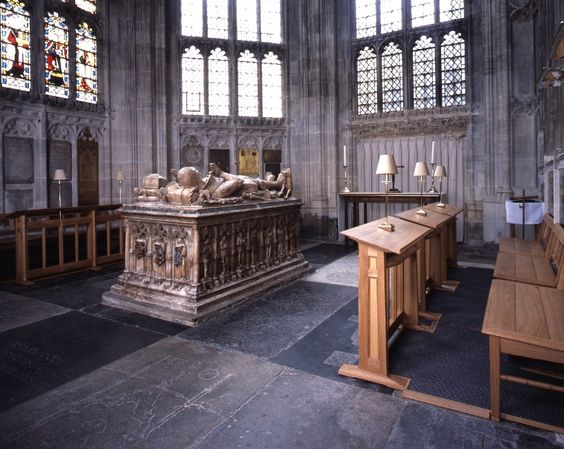
| Burial | St. George’s ChapelWindsor, Windsor and Maidenhead Royal Borough, Berkshire, England |
| Plot | St. George, Windsor Castle |
| Memorial ID | 70589734 · View Source |
Share
Save to Suggest Edits
Reverend William Wilson born 1542 Doctorate of Divinity and graduate of Merton College, Oxford BA in 1564, MA in 1570, BD in 1576, DD 1607. Rector of Islip, Oxfordshire, 1578; rector of Cliffe, co. Kent 1579, rector of Caxton, co. Kent, 1593, prebendary of St. Paul’s London 1595-1615, and of Rochester Cathedral 1591-1614. About 1580 he became chaplair to Edmund Grindll, Archbishop of Canterbury, and in 1583 became the canon of Windsor, holding his position for thirty two years until his death Mary 15, 1615 at age 73, he was buried in the chapel of St.George, Windsor Castle, where a monumental brass to his memory states that he was “beloved of all in his Life, and much lamented in his Death.” (Alumni Oxoniensis, vol. iv, p. 1657; Ashmole’s ‘History and Antiquities of Berkshire’ p. 305; register, ante, vol. xxxviii, pp 306-308, and vol. lii, p. 144). He married first about 1575, Isabel, daughter of John Woodhall, Esq., of Walden, co Essex, by Elizabeth his wife, sister of Rev. Edmund Grindall, the celebrated Puritan Archbishop of Canterbury, described by Lord Bacon as ‘the gravest and greatest prelate of the land.” (Register, ante, vol. xxxviii,pp.301-308). He married second, Anne, sister of Rev. Erasmus Webb, canon of Windsor, who died in 1612, without issue.(Register, ante, vol. lii,pp 143-4). He was a prebend of St. Paul’s of Rochester and of Windsor, and rector of Cliffe. Notes from the Antiquities of Berkshire, by Elias Ashmole, Esq (Reading, 1736) give the inscriptions found by that famous antiquary in the Chapel of St. George, Windsor Castle, relating to this family. On the North side lied a grave stone, on which, in Brass Plates, is the figure of a Man, and this Inscription “To me to live is Christ, and to dye is Gain.” Phillip I.21. Here underneath lied interr’d the Body of William Wilson, Doctour of Divinitie, and Prebendarie of this Church by the space of 32 years. He had issue by Isabell Woodhall Wilson six sons and six daughters. He dy’d the 15th of May, in the year of our Lord 1615, of his age of 73. ‘Who thinke of Death in lyfe, can never dye, but mount through Faith, from Earth to heavenly pleasure, weep then no more, though her his body lye, his Doul’s possest of never ending Treasure.” On another small brass plate on the same grave stone, is the following inscription. ‘Neere unto this place lyes buried William Willson, the third son, who after along trial of grievous sickness, did comfortably yield up his spirit in the yeare of our Lord 1610, of his age of 23. On a brass plate, on a grave stone northward of the last is this inscription, ‘William Wilson, late of Wellsbourne, in the County of Lincolne, Gent, departed this Lyfe, within the castle of Windosre, in the yeare of our Lord 1587, the 27 day of August, and lyeth buried in this place.’ p. 309. Arms of Will’m Wilson of Welborne, per Norroy flower, 1586. ‘Per pale argen and azure three lion’s gambs barways, erased and counterchanged. Crest:-a lion’s head erased argent guttee de sang. Harleian Coll., No. 1550, Fol. 192, British Museum: Richard Mundy’s copy of the Visitation of Lincolnshire, 1564 and 1592.
A COPY OF VERSES Made by that Reverend Man of God Mr. John Wilson, Pastor to the first Church in Boston; On the sudden Death of MR. Joseph Brisco, Who was translated from Earth to Heaven Jan. 1. 1657.
Not by a Fiery Chariot as Elisha was,
But by the Water which was the outward cause:
And now at last unto Christ his Saviour dear,
Though he hath left his dear Relations here.
Anagram.
- Joseph Briscoe
- Job cries hopes.
THere is no Job but cries to God and hopes,
And God answer in Christ; to cries he opes,
Out of the deeps to him I cry’d and hop’d,
And unto me his gracious ear is op’d:
Doubt not of this ye that my death bewail;
What if it did to strangers me assail:
What if I was so soon in Waters drown’d,
And when I cry’d to men, no help I found:
There was a God in Heaven that heard my cry,
And lookt upon me with a gracious eye:
He that did pity Joseph in his grief,
Sent from above unto my soul relief:
He sent his Angels who did it conveigh
Into his Bosom, where poor Lazarus lay:
Let none presume to censure my estate,
As Job his Friends did stumble at his Fate.
All things on Earth do fall alike to all,
To good Disciples, which on God that call;
To those that do Blaspheme his Holy Name,
And unto those that reverence the same:
He that from nature drew me unto Grace,
And look’d upon me with a Fathers face:
When in my blood upheld me to the last,
And now I do of joyes eternal tast.
Remember how Job’s precious children Dy’d,
As also what the Prophet did betide:*
What was the end of good Josiah’s life,
And how it fared with Ezekiels Wife:
Remember what a Death it was that Christ
(Suffered for me) the Darling of the highest;
His Death of Deaths hath quite remov’d the sting,
No matter how or where the Lord doth bring
Us to our end, in Christ who live and die
And sure to live with Christ eternally.
 Rosamond Press


Leave a comment