My neighbor called me a “coward” then menaced me with her dog. Then she shouted I was a dangerous lunatic, again. If this was true – why provoke me? Did she fear for the safety of her dog? No! She then said I was irate because she is going to heaven – and I’m not! She raged against my blog!
Putin is sending tens of thousands of N.Korea troops into Ukraine. Here are my posts before the election.
John Presco
Armstrong – Sukkot – Templar
Posted on October 26, 2024 by Royal Rosamond Press

If KORE Radio was still there, I would ask to build a Sukkot on the grounds Herbert Armstrong blessed with his ministry. North Korea has joined forces with Russian Imperial forces. Musk is having secret talks with Putin. I am looking for backer of my New Radio Church of God. I have been secretly recorded without my permission. All my words, written and spoken are protected by a special copyright given to ministers.
While in Riverbend hospital, I met a Jewish woman and her husband who was a Palestinian Catholic. Debbie saw the book I was reading written by Zena Halpern. Because I acted as Drew Benton Rosamond’s God-el, and because I had no family to visit me, I declared God my Go-el. God bid me to employ the Rougemont Knights Templar to marry Palestinians and Jews.
Armstrong On North Korea
Posted on October 27, 2024 by Royal Rosamond Press
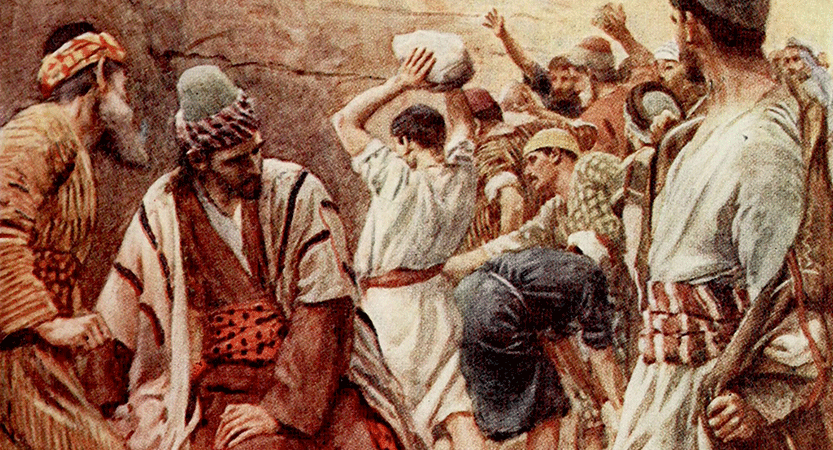
The young man Saul at the stoning of Stephen
My old Stalker, Satan Saul-Paul, is back and is trying to steal my power’s of prophecy. His family gave him a tablet and he didn’t tell me . He has been secretly recording me and inviting his white supremist cronies to listen in and text him advice on how to make me look bad, Satan-Saul was born with a good memory, but I held my own to his chagrin. He admitted he queued up WIKIPEA articles and secretly read them on his tablet, as I sat in my easy chair away from my computer. Satan had no empathy for Drew – and my family crisis. I asked him why? He had his devil monks listening in, and they knew my family was the enemy of this Gutter Snipe! He is my Judas!
I suspect another name for the Savior, was Stephan, meaning crown. Satan-Saul invented Death by Cross that did not become popular until four hundred years after The Crowned!
All this adds up to – The War of Armageddon as Herbert Armstrong saw it….HAS BEGUN! Sneaky Saul-Satan has no gifts to see the future. He is a, PARASITE! Why aren’t right-wing Christians talking about the Battle of Armageddon?
Seer John ‘The Nazarite’ Leader of The Anchor of The Way’
So far, U.S. officials have declined to comment about what North Korea’s deployment of troops to Russia could mean for American troops in South Korea.
Before we get too worked up about what the North Koreans might learn in Ukraine, it’s worth pointing out that Russia’s biggest advantage over its adversaries is its willingness to accept losses that most governments would not. Since invading Ukraine in February 2022, the Russian military has suffered at least 600,000 killed and wounded, a recent Congressional Research Service report says.
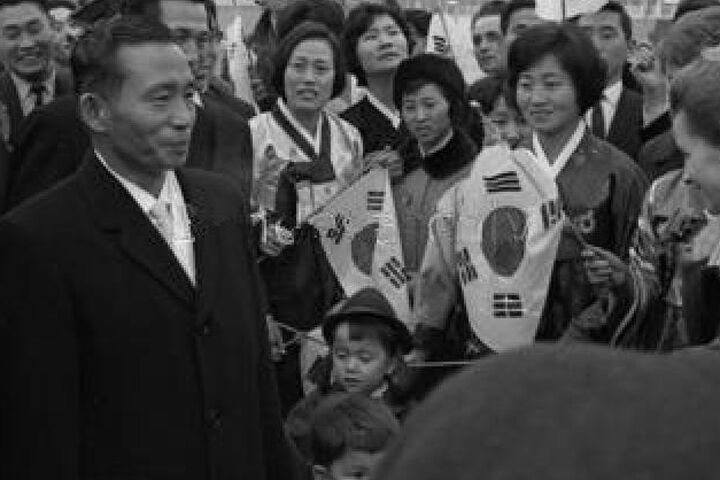
Herbert W. Armstrong’s Efforts to Deliver the Matthew 24:14 Message to North and South Korea
Bundesarchiv, B 145 Bild-F019540-0028/Wegmann, Ludwig00/CC-BY-SA
How South Korean President Park Chung-hee and North Korean President Kim Il-sung came to request audiences with the unofficial ambassador for world peace.
By Gareth Fraser • August 22, 2012
During his lifetime, few geopolitical theaters challenged Herbert W. Armstrong’s travel schedule and safety more than North and South Korea.
The Japanese ruled Korea until the end of the Second World War, at which time the United States separated the peninsula along the now-famed 38th parallel. Soviet forces oversaw the North, which established a Communist government, while the U.S. was the protector of the South and its capitalist government.
The subsequent invasion by forces from the North in the summer of 1950 escalated tensions to all-out war, resulting in significant loss of life and an ultimate return of divided borders near the 38th parallel.
Fifteen years later, Mr. Armstrong wrote co-workers Jan. 31, 1968, “Now the United States faces a new crisis in North Korea.” He observed that the newspapers of the day reported the crisis but not what it meant. He went on to outline, “Just over a week ago, Monday night, January 22, a little fourth-rate nation, North Korea, seized the United States Navy lightly-armed intelligence ship Pueblo, and its 83-man crew, on international waters. This was an illegal act of war against the United States.”
He drew attention to God’s prophetic declaration, “I will break the pride of your power” (Leviticus 26:19), underscoring its modern-day fulfillment in advance of Christ’s Second Coming, preceded by the declaration of the good news of the imminent Kingdom of God (Matthew 24:14).
“God gave us the most colossal national power and wealth ever possessed by any nation or empire,” he continued. “Already He has taken away that power from Britain. Before World War i they were the world’s greatest power. Today they are a second- or third-rate power—no longer one of the world powers. But the United States still possesses that power! We are the world’s greatest power! Yet we are afraid to use it. God has taken from us the pride of our power!”
Our older readers may remember North Korea’s seizure of the Pueblo. The act itself, in international waters, “was an illegal act of war against the United States,” only compounded, as Mr. Armstrong added, by the U.S. failing to intervene and counter the aggressive action.
He concluded his letter to supporters with a historic reminder. “Had a little nation like North Korea captured a United States Navy ship when Theodore Roosevelt was president, he probably would have issued orders at lightning speed to effect the recapture of that vessel, and had it back even before the world heard the news.”
Seven years following this incident, he urgently wrote, “We are now planning a campaign for South Korea, but it’s a race against time—because we know that North Korea is planning now to invade South Korea. We must try to get there first” (co-worker letter, Oct. 8, 1975).
Mr. Armstrong had scheduled meetings with South Korea’s President Park Chung-hee, who, having been in power since a 1961 coup, was later duly elected in 1963, and set in place rapid industrial and financial growth incentive programs chiefly focused on exports.
On Aug. 18, 1976, just weeks before the meetings, two U.S. Army officers were slain by North Korean military personnel in what was known as the Ax Murder Incident. The deaths took place in what was known as the Joint Security Area (jsa), which is ensconced in the famed Demilitarized Zone (dmz), acting as the line of demarcation between North and South.
Within days, Operation Paul Bunyan was launched by the U.S., which was supported by an armed platoon, B-52 bombers and helicopters paroling the dmz. Tensions were at fever pitch as the troops to the north held steady without firing.
Days later, the jsa was separated along the line of demarcation, with troops from the North staring in the face those from the South, thus maintaining an uneasy tension that extended far beyond their border to respective Soviet, Chinese and American spheres.
Considering this drama, on September 29, Mr. Armstrong informed co-workers, “My schedule for this last trip called for flying from Hong Kong direct to Seoul, South Korea, where I had a definite and important private meeting set up with President Park. I wrote to you about a year ago that I was trying to get to Seoul before the Communist North Koreans reopen the war and attack South Korea. Well, try as we did, it seems we were too late, but only by a very few days. The North Koreans are now openly threatening [the South], as I knew privately they were a year ago. It had become unsafe for us to fly in there. However, all other meetings were a real success.”
Mr. Armstrong never gave up on reaching North and South Korea, as evidenced in January 1980 when he excitedly informed co-workers, “The most important event in the work in our time took place this very month of December. I was the first world religious leader from the world of Christianity to be officially invited as guest of the government of the People’s Republic of China to meet privately with top officials, and speak before groups of leaders of this new Communist republic!”
That historic moment for the unofficial ambassador for world peace also led to invitations for him to visit Moscow, Poland and North Korea. Regional tensions and his death in 1986 would put an abrupt stop to his desire to reach the Koreans in person with the good news of Christ’s gospel of the coming Kingdom of God (Matthew 24:14).
The North’s request in 1980 under the leadership of Kim Il-sung and the 1976 overture by South Korea’s President Park Chung-hee to personally meet Mr. Armstrong and receive this nation-saving message have not fallen on deaf ears.
Trumpet founder Gerald Flurry has followed in the footsteps of the unofficial ambassador’s legacy of humanitarianism and the pursuit of peace according to God’s Word and prophecy. Realizing that God has a plan for the peoples of the Far East that will play out in high profile in the very near future, he has directed the publishing and distribution of the booklet holding the prophetic keys to the future of these divided peoples.
Request your copy of Russia and China in Prophecy to understand what lies ahead for North and South Korea and the greater Asia region.
President Vladimir Putin said Russia would use “a range of responses” if the US and its Nato allies allowed Ukraine to strike inside his country with Western long-range weapons.
The comments, published on Sunday, came as Russian forces advanced further into several eastern Ukrainian towns, bringing them closer to capturing the strategic city of Pokrovsk.
“The enemy advanced in Selydove,” DeepState, a group with close links to the Ukrainian army that analyses combat footage, wrote on the Telegram messaging app late on Saturday.
Russian forces have been storming the coal mining town of Selydove in Ukraine’s Donetsk region for the past week.
The Russian news outlet SHOT said on Telegram that Moscow’s troop control 80% of Selydove.
The Russian-installed head of Donetsk region, Denis Pushilin, said Russian forces had hoisted their unit’s flag on the roof of one of the buildings in the town of Hirnyk.
acks on Ukraine’s power grid have affected civilian morale in the hopes of replicating such tactics against South Korea, Bennett told Task & Purpose.
Subscribe to Task & Purpose today. Get the latest military news and culture in your inbox daily.
One lesson that the North Koreans likely hope to learn from their combat experience in Ukraine is how to punch holes through front lines and achieve strategic breakthroughs, Bennett said.
“If they succeed, that’s a really interesting thing to take back,” Bennett said. “In this modern battlefield, how do you create a hole and how do you keep it open over time? With drones and so forth, the potential for sealing a hole is pretty good. The question that they’ve got to ask is: How do you create a breakthrough that really is strategic as opposed to tactical?”
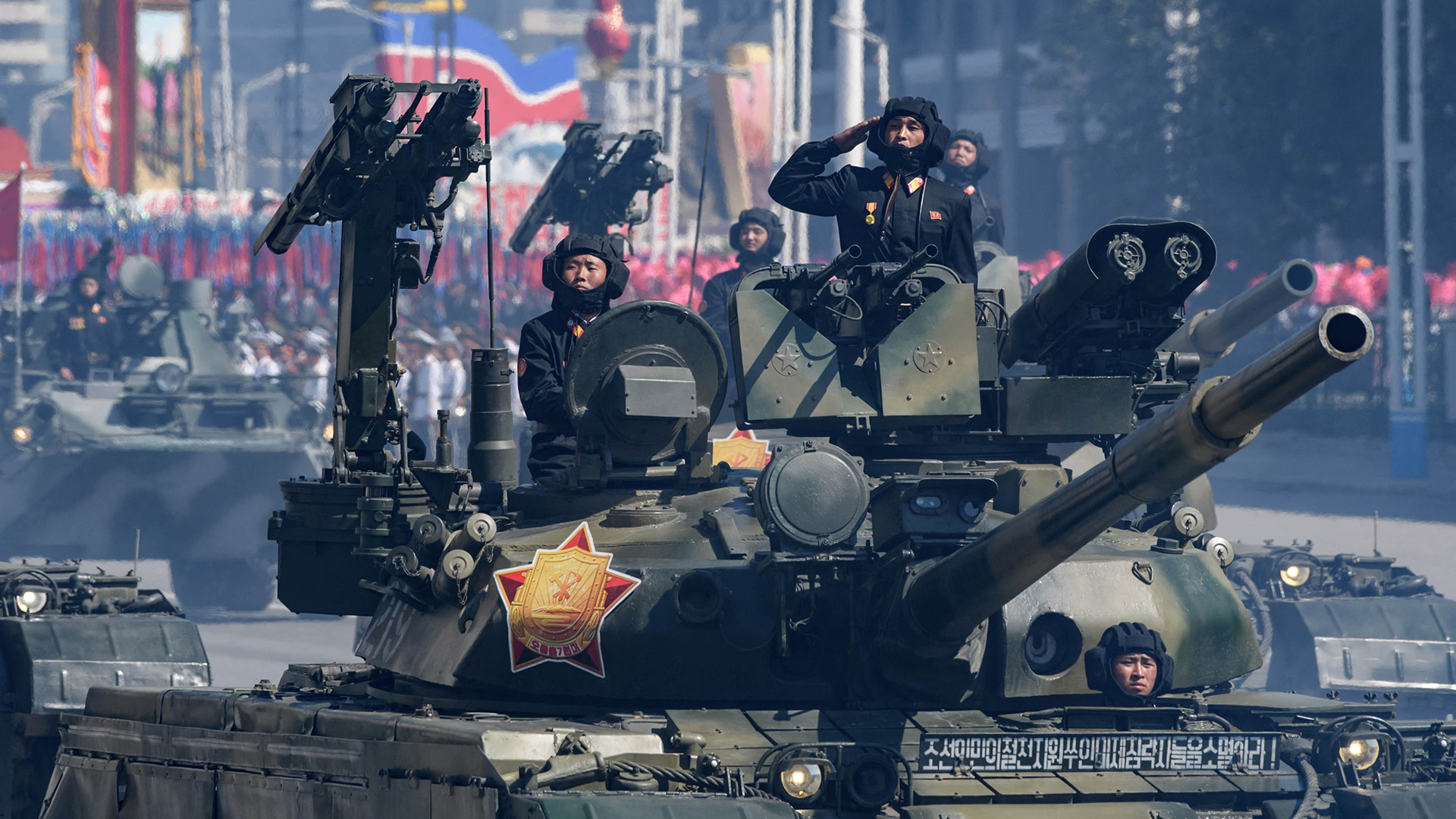
However, whether the North Korean troops who fight in Ukraine learn how to smash through modern defenses depends a lot on how the Russians send them into battle, Bennett said.
“The Russians have been using their own troops as cannon fodder, kind of like the Chinese in the Korean War, just trying to achieve breakthroughs,” Bennett said. “I don’t think the Russians are going to respect the North Koreans. I think they’re going to treat them pretty badly. I think they’re going to tend to use them as cannon fodder rather than as what they’re trained to do.”
Given just how lethal the war in Ukraine has been, the North Korean forces could learn about casualty management from the Russians, or they could learn that the Russian military is so bad at treating its own troops that “once you’re seriously wounded, you’re dead,” Bennett said.
Heavy casualties expected
So far, U.S. officials have declined to comment about what North Korea’s deployment of troops to Russia could mean for American troops in South Korea.
Before we get too worked up about what the North Koreans might learn in Ukraine, it’s worth pointing out that Russia’s biggest advantage over its adversaries is its willingness to accept losses that most governments would not. Since invading Ukraine in February 2022, the Russian military has suffered at least 600,000 killed and wounded, a recent Congressional Research Service report says.
Advertisement
Thus, the main lesson that the Russians may impart on their North Korean comrades is how to get mowed down by machine guns, artillery, rockets, and drones.
Retired Army Col. David Maxwell, a former Green Beret, said he doubts the North Koreans will learn “magic tricks” to counter Western technology and the breaching tactics they will likely employ date back to World War I trench warfare.
It is also unclear whether the Russians plan to deploy the North Korean troops in distinct units or as individual replacements for Russian casualties, said Maxwell, vice president at the Center for Asia Pacific Strategy and a senior fellow at the Global Peace Foundation.
“Of course, those two methods there will also impact on what kind of lessons that they learn,” Maxwell said. “Because if they’re used as individual replacements, it’s likely they’re going to be cannon fodder and many will not survive. If they’re employed as operational units, in total, they will come through — if they survive — with lessons learned in command and control, in fire and maneuver, in employing, perhaps, combined arms.”
The better-trained army wins
To effectively make use of their battlefield lessons, North Korea’s military would have to invest time, money, and resources into training rank-and-file troops, Maxwell said. Because training is perishable, North Korea’s military would need to continue to expend resources to sustain such large-scale efforts over time.
“And so, even if they conduct training on the next winter training cycle, if they do not follow that up with sustained training throughout the year, they will never be at a level that will benefit from the relatively small number of troops that have combat experience,” Maxwell said.
 Rosamond Press
Leave a comment