

Where Art Thou
by
John Presco
ALL RIGHTS RESERVED
On this day, July 3, 2025, at 12:00 P.M…I John Presco found the
COOPER CHURCH OF THE REDEEMER
It is my belief, that the real Jesus came to redeem the Moabites that lived amongst the Jews of Judea whose nation was invaded by the Persians, and dispersed. Slowly they came back to live as ALIENS and GLEANERS amongst the Jews. This descendant of Boaz and King David was greeted as a King, and may have worn a crown as he went about Judea acting also a a rabbi and teacher. I believe he read from the Book of Ruth on the Mount of Olives, and was arrested when he appear at the temple with a sum of money to pay the debt on The Threshing Floor. At this time, he could have been arrested.
I believe Jesus was a Carpenter who made kegs to hold wine and water. I believe he built kegs to put grapes in for fermentation before the Wedding at Canna. On this day, I found the California Barrel Company in order to make containers of all sizes, so that surplus food can be shipped all over the world to feed the hungry. Surplus Medical Supplies will also be shipped in California Barrels in order to fulfil the role of Jesus as a Healer-Physician. I also found the Belmont Soda Works that will make sodas of a kinds that will be sold all over the world, the monies going for the support of NATO.
There is no requirement to believe in a Supreme Creator to be a member of the CCR. WE will be known by our good works, and will refute and condemn the action of the Republican Party, who at 11:30 AM. destroyed much of the mission of Jesus, as he was worshipped. Their Jesus is not God The Creator., as was suggested by the Speaker of the House, when he passed the Ugly Bill.
John ‘The Nazarite’
“Jesus Christ Will Return On “the Day of Atonement”, For “the Feast of Tabernacles”, And Will Proclaim A “Jubilee”
In accordance with the Levitical Law given to Moses; “during the Feast of Tabernacles”, on “the Day of Atonement”, a “Jubilee” was proclaimed, where all of the debts of the Israelites were canceled, all of the Israelites who had become enslaved were set free, and all of the land belonging to the Israelites was returned to its rightful Israelite owner.”
where all of the debts of the Israelites were canceled,


The book of Ruth begins with Naomi and her Moabite daughter-in-law, Ruth, returning to Naomi’s home of Bethlehem in Judah after having lived in Moab, a Gentile land, for some years. Naomi returns home destitute – she has lost everything: her husband, her sons and her wealth. While her daughter-in-law could have stayed in her homeland she decides instead to follow Naomi to Bethlehem. As widows, with no one to provide for them, they are suddenly plunged into a life of poverty.
According to the Law of Moses (Leviticus 19:9-10, Deuteronomy 24:19), those who farmed the land had to leave some crops on their fields for the poor to reap harvest for themselves. This is precisely what Ruth begins to do.
One day as she is reaping in the fields, she catches the eye of an honourable man named Boaz, a close relative of her mother-in-law. He shows her favor, adopting her like a daughter, letting her reap from his field and inviting her to eat and drink with him.
Once Naomi hears of this, she tells Ruth to make an advance on Boaz by creeping under his blanket while he is asleep. Boaz wakes up startled in the middle of the night to find Ruth at his feet. She asks him to be her redeemer. In other words, she asks him to marry her, as the role of a redeemer in those times was to buy a relative out of poverty, provide for them and if need be, provide an heir.
Boaz accepts Ruth’s offer and becomes her redeemer. He buys a piece of land that belonged to Naomi’s deceased husband, Elimelech, marries Ruth and agrees to provide an heir to Elimelech’s estate. They have a son, Obed, who is the grandfather of King David.
Boaz’s redemption of Ruth looks forward to our redemption in Christ.
Boaz redeems Ruth in chapter 4:7-10. According to the Law of Moses (Leviticus 25) a relative was to act as a redeemer for any family member who was destitute, widowed or living in poverty. The redeemer would buy back property that person had lost in time of need, so it would be kept in the family. If they were sold into slavery, the redeemer would buy back his freedom.
Boaz becomes Ruth’s redeemer. He gets her out of poverty, provides for her, buys back Elimelech’s land and marries Ruth, providing an heir for Elimelech’s line. She is redeemed from poverty to abundance and from hopelessness to a bright future.
It Was The Season For Figs
Posted on January 19, 2012 by Royal Rosamond Press

In 2009 I posted the following solution as to why Jesus cursed the fig tree. I am the only person who has solved this riddle, and the riddle of what Jesus wrote in the dust. Because the parasites who lay their eggs of evil in the True Teaching of Jesus – have failed to come up with an answer – I demand that all church properties snd monies be turned over to me, immediately, so I can distribute these ill gotten gains to the rightful heirs of God’s Kingdom – come!
“The meek shall inherit the earth!”
The symbol for New Kingdom will be the fig tree!
Jon the Nazarite
The Savior of the Jubilee has Risen
On the aniversary on Martin Luther Kings ‘I have a Dream’ speech, the Spirit of
the Jubilee Jesus has risen! Barack Obama will be the first Black Candidate for
the office of President of the United States! Oh Glorious Day!
The long curse of the fig tree will be lifted and God’s Bounty will flow over
this Democratic Land.
Why was there no attempt by the Son of God to throw off the yoke of Roman
slavery? Eighteen years later, I found the answer to so many riddles -hanging in
a baren fig tree.
“And on the morrow, when they had come out of Bethany, he [Jesus]hungered. And
seeing a fig tree afar off having leaves, he came, if perhaps he might find
anything thereon: and when he came to it, hefound nothing but leaves; for it was
not the season of figs. And he answered and said unto it, `No man [will] eat
fruit from you from now on – for ever.’ And his disciples heard it . And as they
passed by in the morning, they saw the fig tree withered away from the roots.
And Peter calling to remembrance said unto him, `Rabbi, behold, the fig tree
that you cursed is withered away’” (Mk. 11:12-14; 20-21).
Jon
The Nazarite
Deuteronomy 24:20 “When you beat the olives from your trees, do not go over the
branches a second time. Leave what remains for the alien, the fatherless and the
widow.Deuteronomy 24:19 “When you are harvesting in your field and you over look
a sheaf, do not go back to get it. Leave it for the alien, the fatherless and
the widow, so that the LORD your God may bless you in all the work of your
hands.”Strangers shall stand and feed your flocks, and foreigners shall be your
plowmen and your vinedressers.”
Who Were the Moabites? Origins, Israel’s Enemies, and Ruth
11 minute read
This post is part of the series “King Jehoshaphat’s Prayer”
- King Jehoshaphat’s Prayer: 8 Bible-Backed Steps to Trade Panic for Peace
- Who Was Jehoshaphat Anyway?
- Who Were the Moabites? Origins, Israel’s Enemies, and Ruth 👈 you are here
- Sitting In the Shadows of History: The Story of the Ammonites
- Everywhere and Nowhere: The Story of the Amalekites
On this page
- The Scandalous Birth of Moab
- Moab vs. Israel: A Long History of Conflict
- The Assassination of Eglon
- Moab in the Days of the First Kings of Israel
- The Moabite Stone: Moab’s Side of the Story
- More Wars, More Kings, Same Old Moab
- Moab and the Prophets: Isaiah and Jeremiah
- The Fall of Moab: Back to Sodom
- From Curse to Blessing: Moab’s Redemption
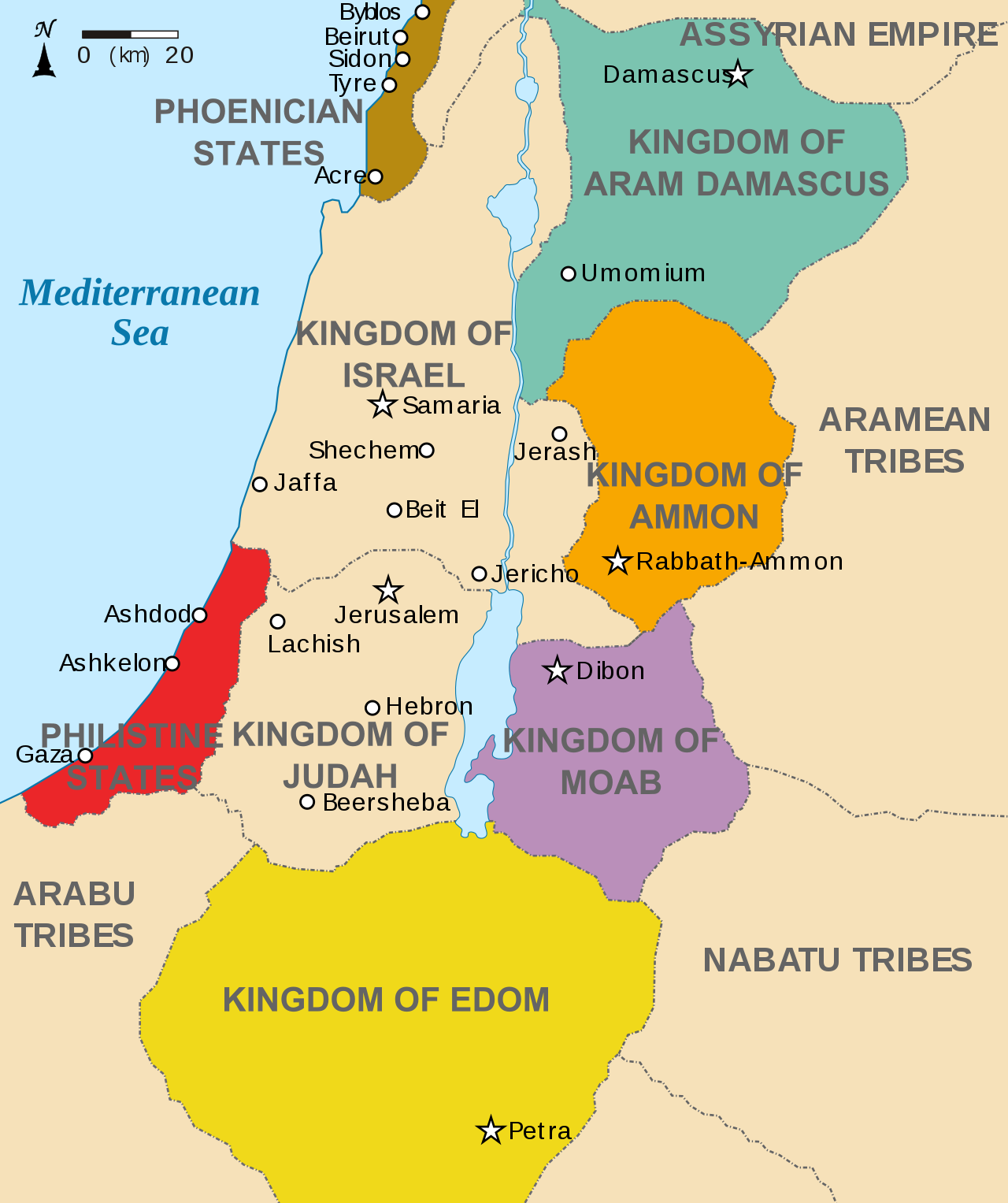
The Moabites—descendants of Lot’s son Moab—settled east of the Dead Sea. Worshipers of Chemosh, they were ruled by kings such as Balak and Mesha, clashed with Israel for centuries, yet through Ruth became ancestors of King David and, ultimately, Jesus.
This is the story of the Moabites.
Free 2-Page Cheat Sheet: Bible People and Nations
Timeline, maps, and quick facts on Moab, Ammon, Amalek, and more.Get the PDF
We won’t send you spam. Unsubscribe at any time.
The Scandalous Birth of MoabPermalink
To find the beginning of the Moabites, we have to go back pretty far, to a more-or-less unknown guy named Terah. Terah lived in a city called Ur, and he had three sons, one of whom you’ve probably heard of: Haran, Nahor, and Abram. Haran had a son named Lot. Then Haran died. Then Terah died.
Abram adopted Lot, and the two of them moved around together. Eventually, Lot settled in a town called Sodom. You may know that Sodom wasn’t populated with model citizens, and God decided to destroy it. But before He did, He sent angels in to get Lot and his family out before the fire fell (Genesis 19:12–13).
There’s a horrible scene with the men of the city, the angels, and Lot’s daughters (Genesis 19:4–11), but ultimately Lot and his family escape. Lot’s wife disobeys the instruction not to turn back and is turned to salt (Genesis 19:26). Lot and his daughters reach safety exhausted, far away from home, and alone.
They had originally planned to live in a little village called Zoar, but Lot fears the locals, so they go up to a cave in the hills. While they’re up in the hills, Lot’s daughters suddenly realize that every man in their lives is dead, killed by the wrath of God. Panicking and not thinking clearly, they get Lot drunk and sleep with him on subsequent nights (Genesis 19:31–35).
Lot’s younger daughter, who never gets a name, gives birth to a boy and names him Ben-Ammi, “son of my kin”—that is, “product of incest”. Not the nicest of names.
Lot’s older daughter, who also never gets a name, also gives birth to a boy, and she names him Moab, which sounds an awful lot like the Hebrew for “from father”. Again, inauspicious. And we read in Genesis 19:37,
The firstborn [daughter] bore a son and called his name Moab. He is the father of the Moabites to this day.
Moab vs. Israel: A Long History of ConflictPermalink
Moab and Israel never get along. And they keep running into each other.
Because Abram had adopted Lot, God blessed Lot’s descendants along with Abram’s, and He gave Moab the land of Ar, just east across the Jordan River from Jericho. According to Deuteronomy 2:11, they had to drive out a race of giants called the Emim.
The next time we see them, though, is during the Exodus from Egypt, when God tells Moses to go around that land instead of through it, because the land is His gift to Moab (Deuteronomy 2:9).
Fast forward, and it’s Numbers 21:26–30. The Moabites are getting run out of their land by King Sihon and the Amorites. When the Israelites get there, they beat the Amorites back—not for the Moabites’ sake, but because Sihon had refused Israel passage under Moses.
After their victory, they camp on the border of Moab. Unfortunately, living together doesn’t work out so well for Israel.
King Balak of Moab sees all these Israelites camping on his border, and he gets nervous. But Israel has just defeated the Amorites, who had previously defeated the Moabites, so he cleverly decides against going to war. He comes up with a better idea: he’ll get a prophet, Balaam, to curse the Israelites, and maybe they’ll go away.
Here, in Numbers 22–24, we get an amazing story of Balak and Balaam and a talking donkey and an angel with a sword. And rather than curse the Israelites, Balaam blesses them… four times! Not what Balak intended.
Later as a consequence of Balak’s attempted curse, God forbids the Moabites from joining the assembly of Israel (Deuteronomy 23:3–6).
Anyway, the Israelites spend enough time there to start intermarrying with Moab, and even start worshipping the local god, Baal-peor. In Numbers 25, we read that God responds with a swift plague and a command to Moses to kill the chiefs of the idolatrous clans. The plague was only stopped when Phinehas the priest, the grandson of Aaron, ran a spear through an Israelite man and the foreign woman he had brought into the camp explicitly against God’s orders.
By that point, 24,000 Israelites had already died.
The Assassination of EglonPermalink
You’d think after incest, a talking donkey, and a plague, the story of Moab couldn’t get crazier.
You’d be wrong.
At some point during the period of the judges, King Eglon of Moab, allied with the Ammonites and Amalekites, conquers Israel. (The time of the judges is chaotic for Israel, a seemingly endless cycle of sin and war and salvation and peace.) Eglon rules Israel for eighteen years.
But eventually Israel turns back to God, and He hears their cries. Enter Ehud, “a left-handed man” (Judges 3:15). Ehud is appointed to bring Eglon the tribute Israel owed Moab, and he has a plan.
After delivering the tribute, Ehud tells Eglon he has a secret message for him from God, but he can only tell him when they are alone. So Eglon sends his guards away, Ehud pulls out the short sword he has concealed on his right thigh, and stabs Eglon in the stomach.
It’s at this point we learn two things. First, apparently there were no left-handed warriors in those days, because the the guards surely checked his left thigh for weapons, and somehow didn’t think about the other way around.
Second, Eglon was a very fat man (Judges 3:17). So fat that his stomach closes back around the eighteen-inch sword, and Ehud simply walks out with Eglon seemingly intact.
Hours later, Eglon’s servants were standing around, intensely embarrassed because Ehud had left him in the “well-ventilated room”—probably the bathroom—and they didn’t want to interrupt him, but also it had been a while, and you don’t yell to a king, “What happened, you fall in?!”
Eventually, the servants open the door and Eglon grossly rolls out, dead. But by this time Ehud has made it home, gathered an army, and re-crossed the Jordan river.
Ehud’s army kills 10,000 Moabites in the sneak attack. Moab gives up control of Israel, and Ehud becames judge of Israel. And for eighty years, the land has peace.
Moab in the Days of the First Kings of IsraelPermalink
But the Moabites don’t go away. They just disappear for a while.
Fast-forward to Saul’s reign as king, and we see him at war with Moab (1 Samuel 14:46–48). Of course, Saul was at war with a lot of Israel’s neighbors. But Moab is unique, because while David was running from Saul, he leaves his parents with the king of Moab for protection. At the advice of the prophet Gad, David himself keeps moving (1 Samuel 22:3–4).
Later (2 Samuel 8:2), despite their previous care for his parents, David finally defeats the Moabites. He gruesomely measures the defeated army with a rope, and slaughters two thirds of them by area.
Another generation later, and Solomon is getting friendly with Moab again. He has apparently forgotten all of Israelite history up to this point, and he marries Moabite wives (1 Kings 11:1), the thing that had earlier caused a plague that killed 24,000 Israelites. He even builds an altar to Moab’s primary god Chemosh (1 Kings 11:7). Not a good move for a king chosen by Yahweh. (These events are part of Solomon’s descent into idolatry, which eventually results in his weak son Rehoboam fracturing the kingdom into north and south and never reuniting.)
The Moabite Stone: Moab’s Side of the StoryPermalink
The next story of Moab and Israel comes not from the Bible but from an archaeological artifact called the Mesha Stele, or the Moabite Stone (Mesha was a king of Moab, as we’ll see).
The Moabite Stone was written in about 840 BC and re-discovered in 1868. It’s written in an ancient Hebrew script, and it tells the story of how Chemosh, the god of Moab, had become angry and allowed Israel to defeat them (sound familiar?), but later relented and led them to victory. We don’t have a definitive parallel in the Bible, but this is probably the story of how King Jeroboam of Israel defeated Moab and how they rebelled under King Omri. Omri, who is mentioned by name on the stone, was the evil King Ahab’s father.
The story of the stone then skips forward several generations and tells of King Mesha of Moab, who survived assaults from both King Jehoshaphat of Judah and King Joram of Israel (read the rest of that story here) and freed Moab. This story is almost certainly the story of 2 Kings 3, but from the Moabite perspective.
More Wars, More Kings, Same Old MoabPermalink
During the period of the kings of Israel and Judah, the nations continue to clash repeatedly.
After King Omri of Israel puts down one Moabite rebellion, Moab rebels again under the weak and short-lived king Ahaziah, Omri’s grandson (2 Kings 1:1).
Moab rebels again against Ahaziah’s younger brother Joram, who succeeded him on the throne of Israel. Joram, not as weak as his brother, asks King Jehoshaphat of Judah for help, and the two of them go to war. On the way to battle, however, they run out of water (in the desert, water is a necessary ingredient for victory). The kings visit the prophet Elisha—yes, that Elisha—for help, and he totally blows off Joram, because Joram is just like his father Ahab: anti-God and proud of it.
But for Jehoshaphat’s sake, Elisha tells them how to trick the Moabites by digging holes in the desert. God fills the holes with water, and the Moabites mistake it for blood. They assume Jehoshaphat and Joram have killed each other, and they charge, only to be met by two full-strength armies. King Mesha of Moab, hanging back, sacrifices his first-born son to Chemosh, but it does him no good and his army is defeated. Israel and Judah destroy the land, pulling up trees and stopping up springs, even scattering rocks anywhere that could grow food.
The wars continue. While Jehoshaphat was still king of Judah, Moab allies yet again with the Ammonites to attack Judah. Jehoshaphat turns to Yahweh for help, and [it doesn’t go well for Moab][kjp-post] (2 Chronicles 20).
Moab continues to be a thorn in Israel’s side, raiding the nation (2 Kings 13:20) until Jeroboam II of Israel subdues them again (2 Kings 14:25), but then God sends Moab against Israel yet again to punish them for their own rebellion against Nebuchadnezzar of Babylon (2 Kings 24:1–2).
Moab and the Prophets: Isaiah and JeremiahPermalink
Moab is a constant presence in the life of Israel, living just across the Jordan river, so it’s not a surprise the prophets take notice as well.
The first time we see Moab in prophecy is in the lament of Isaiah 15. Isaiah describes an invasion of Moab from Ar on the border to the central city of Kir (Isaiah 15:1). It’s hard to date the prophecy, so it could refer to Assyria’s final conquest of the area under Sennacherib (705–701 BC) or it could refer to an as-yet-unknown event.
Anyway, Zion offers Moab hope, as it does to anyone desiring to live in the presence of God and follow His laws, but Moab’s pride prevents it from accepting help, and as a result, the lament continues into Isaiah 16.
Speaking of invasions from massive eastern empires, Jeremiah mentions Moab as one of the many nations conquered by Nebuchadnezzar of Babylon (Jeremiah 27:1–8).
The Fall of Moab: Back to SodomPermalink
Finally, Moab ends exactly as it began: in a firestorm of sin.
Zephaniah 2:8–9 tells us that God will make Moab as Sodom, and Ammon as Gomorrah. Thinking back a thousand years or so, the destruction of Sodom that drove Lot into the hills and his daughters into his bed is where Moab (and Ammon!) began. Centuries of strife kicked off by that desperate first sin end the same way.
And indeed, some time around 400 BC, the Nabatheans come through Moab and wipe it off the map, never to be heard from again.
The Protestant Luisenfriedhof III (German: Der evangelische Luisenfriedhof III) is a cemetery in the Westend district of Berlin. The cemetery is under monument protection.[1]
History
A church-owned and operated cemetery with a size of 12 hectares, Luisenfriedhof III was consecrated in 1891 and the first burial took place on 19 June 1891.[citation needed] Two years later, a cemetery chapel was built.[1] The early Gothic red brick building was designed by Johannes Vollmer and Heinrich Jassoy.[1] The steeple of the chapel was destroyed in Wo
A church-owned and operated cemetery with a size of 12 hectares, Luisenfriedhof III was consecrated in 1891 and the first burial took place on 19 June 1891.[citation needed] Two years later, a cemetery chapel was built.[1] The early Gothic red brick building was designed by Johannes Vollmer and Heinrich Jassoy.[1] The steeple of the chapel was destroyed in World War II. In 1905, the cemetery expanded to its present size.
LDS Church use
Stephen L Richards, an apostle and first counselor to church president David O. McKay in the First Presidency, purchased a replica of the Christus in the late 1950s and gifted it to the church. It was completed by the Rebechi Aldo & Gualtiero studio and made from white Carrara marble from Pietrasanta, Tuscany, Italy in April 1959. It arrived in Salt Lake City, Utah in June 1959. It was placed in the unfinished North Visitors’ Center on Temple Square in Salt Lake City in 1962, and was unveiled in 1967. It is 11-foot-0.25-inch (3.36-meter) tall and weighs 12,000 pounds. In preparation for the demolition of the North Visitors’ Center, the replica was removed in November 2021 and placed in storage for conservation. Its final home has not yet been disclosed. In December 2019, another replica (8-foot-tall) was placed across the street in the Conference Center.
A second Christus replica was sculpted by the Rebechi Aldo & Gualtiero studio to be displayed in the LDS Pavilion at the 1964 New York World’s Fair. It was an exact duplicate of the Salt Lake City replica being 11-foot-0.25-inch (3.36-meter) tall and weighing 12,000 pounds. Its display “was intended to help visitors understand that Latter-day Saints are Christians”.[7] After the World’s Fair ended on 17 October 1965, the replica was shipped from New York to the Los Angeles California Temple visitors’ center on 21 November 1966.
The church commissioned the Rebechi Aldo & Gualtiero studio to sculpt a third replica of the Christus statue for the Expo 1970 in Osaka, Japan. It was 9’6” tall and weighed 10,000-11,000 pounds. After the expo ended on 13 September 1970, it was stored in a warehouse in Japan for six years. It was then shipped from Japan to New Zealand in March 1977. The renovated Hamilton New Zealand Temple visitors’ centre reopened with it inside on 4 August 1977.
Since then, the church has created replicas of the statue and displayed them in temple visitors’ centers at the Laie Hawaii, Mexico City Mexico, Washington D.C., Oakland California, St. George Utah, Idaho Falls Idaho, Nauvoo Illinois, Palmyra New York, London England, Portland Oregon, Paris France, São Paulo Brazil, Provo City Center,[7][8] and Rome Italy temples, with the statue in Rome also accompanied by replicas of Thorvaldsen’s twelve apostles.[9]
Replicas are also displayed in the visitors’ centers in Nauvoo, Illinois, the Hill Cumorah in Palmyra, New York, and Independence, Missouri. Other replicas are displayed in the church’s meetinghouses in Hyde Park in London, Garðabær, Iceland (2000), and Copenhagen, Denmark.
On 4 April 2020, church president Russell M. Nelson announced a new symbol for the church, featuring an image of the Christus as the central element, placed above the church’s name.[10] The church uses the image on its webpages and in other official publications.[8]
The God-El of The Fig Tree
Posted on July 14, 2019 by Royal Rosamond Press




As the embodiment of John the Baptist, I give sanctuary to all immigrants, legal or not, because God bids me to do so. The Scot-Irish immigrated to America and were the ones who fought the army of Welf Lineage and House of Hanover for our Freedom. Many of the Sons and Daughter of Liberty, had read hair. They knew they were fighting the minion of German and Holy Roman Empire who claimed they converted to the Protestant Religion, that Dottie Witherspoons great grandfather, John Knox, helped found. The false teaching of John Darby attached itself to the Knox linage.
Get out of the Republican Party!
John
I Am a Jubilee Nazarite
Posted on March 8, 2013by Royal Rosamond Press

Evangelicals, and many Christian leaders HATE democracy because FREEDOM distracts from their insidious belief system based upon FAITH, and not TRUTH, because the truth that Jesus was restoring the Jubilee and freeing slaves in Judea and the Hellenized world, has been covered in the lies of Satan-Paul, the Satan of Satans, the kisser of Roman butt!
Paul’s American neo-confederate devils, along with Darby’s Dangerous Loons, are trying to influence the election of the next Pope in order to turn the Catholic church into Demonizers of the Liberal Left in America so the filthy rich will have more political leaders to protect them.
Above is a photo of me with Dottie Witherspoon a direct descendant of Signer John Witherpoon.
Jon the Nazarite Libertine
I was born during a star shower three days after Yom Kippur.
You are all set free of the lies of Satan-Paul the Roman quisling.
http://en.wikipedia.org/wiki/John_Witherspoon
Jesus Christ Will Return On “the Day of Atonement”, For “the Feast of Tabernacles”, And Will Proclaim A “Jubilee”
In accordance with the Levitical Law given to Moses; “during the Feast of Tabernacles”, on “the Day of Atonement”, a “Jubilee” was proclaimed, where all of the debts of the Israelites were canceled, all of the Israelites who had become enslaved were set free, and all of the land belonging to the Israelites was returned to its rightful Israelite owner.
This is a physical example of the spiritual truths that are fulfilled in Jesus Christ, and will be finished at His Second Coming. The debt of sin is canceled, the slaves of sin are set free, and the ruler-ship of the earth will return to Jesus Christ and His Bride forever. The Bride of Christ will be made up of the “Born Again” Children of God who are alive at Jesus Christ’s Second Coming, and the “Born Again” Children of God who were martyred for their faith in Jesus Christ prior to His Second Coming.
(The “Jubilee” begins during “the Feast of Tabernacles”, on “The Day of Atonement”.)
Atonement is when God and humanity come together. (Atonement, AT-ONE-MENT, AT ONE WITH GOD) When Jesus Christ returns for His Bride, there will be AT-ONE-MENT.)
In accordance with the Levitical Law given to Moses, a “Jubilee” occurs every 50 years. The 6,000 years of man will exactly complete 120 Jubilees. The root 12 in the number 120 is significant in that the number 12 denotes a completion number for man. There were 12 Children of Israel, creating 12 tribes of Israel; and 12 disciples of Jesus.
Isaiah 61:1-2 (NIV) The Spirit of the Sovereign LORD is on me, because the LORD has anointed me to preach good news to the poor. He has sent me to bind up the brokenhearted, to proclaim freedom for the captives and release from darkness for the prisoners, 2 to proclaim the year of the Lord’s favor and the day of vengeance of our God, to comfort all who mourn,
Leviticus 25:8-55 (NIV) “‘Count off seven sabbaths of years–seven times seven years–so that the seven sabbaths of years amount to a period of forty-nine years. 9 Then have the trumpet sounded everywhere on the tenth day of the seventh month; on the Day of Atonement sound the trumpet throughout your land. 10 Consecrate the fiftieth year and proclaim liberty throughout the land to all its inhabitants. It shall be a jubilee for you; each one of you is to return to his family property and each to his own clan. 11 The fiftieth year shall be a jubilee for you; do not sow and do not reap what grows of itself or harvest the untended vines. 12 For it is a jubilee and is to be holy for you; eat only what is taken directly from the fields. 13 “‘In this Year of Jubilee everyone is to return to his own property. 14 “‘If you sell land to one of your countrymen or buy any from him, do not take advantage of each other. 15 You are to buy from your countryman on the basis of the number of years since the Jubilee. And he is to sell to you on the basis of the number of years left for harvesting crops. 16 When the years are many, you are to increase the price, and when the years are few, you are to decrease the price, because what he is really selling you is the number of crops. 17 Do not take advantage of each other, but fear your God. I am the LORD your God. 18 “‘Follow my decrees and be careful to obey my laws, and you will live safely in the land. 19 Then the land will yield its fruit, and you will eat your fill and live there in safety. 20 You may ask, “What will we eat in the seventh year if we do not plant or harvest our crops?” 21 I will send you such a blessing in the sixth year that the land will yield enough for three years. 22 While you plant during the eighth year, you will eat from the old crop and will continue to eat from it until the harvest of the ninth year comes in. 23 “‘The land must not be sold permanently, because the land is mine and you are but aliens and my tenants. 24 Throughout the country that you hold as a possession, you must provide for the redemption of the land. 25 “‘If one of your countrymen becomes poor and sells some of his property, his nearest relative is to come and redeem what his countryman has sold. 26 If, however, a man has no one to redeem it for him but he himself prospers and acquires sufficient means to redeem it, 27 he is to determine the value for the years since he sold it and refund the balance to the man to whom he sold it; he can then go back to his own property. 28 But if he does not acquire the means to repay him, what he sold will remain in the possession of the buyer until the Year of Jubilee. It will be returned in the Jubilee, and he can then go back to his property. 29 “‘If a man sells a house in a walled city, he retains the right of redemption a full year after its sale. During that time he may redeem it. 30 If it is not redeemed before a full year has passed, the house in the walled city shall belong permanently to the buyer and his descendants. It is not to be returned in the Jubilee. 31 But houses in villages without walls around them are to be considered as open country. They can be redeemed, and they are to be returned in the Jubilee. 32 “‘The Levites always have the right to redeem their houses in the Levitical towns, which they possess. 33 So the property of the Levites is redeemable–that is, a house sold in any town they hold–and is to be returned in the Jubilee, because the houses in the towns of the Levites are their property among the Israelites. 34 But the pastureland belonging to their towns must not be sold; it is their permanent possession. 35 “‘If one of your countrymen becomes poor and is unable to support himself among you, help him as you would an alien or a temporary resident, so he can continue to live among you. 36 Do not take interest of any kind from him, but fear your God, so that your countryman may continue to live among you. 37 You must not lend him money at interest or sell him food at a profit. 38 I am the LORD your God, who brought you out of Egypt to give you the land of Canaan and to be your God. 39 “‘If one of your countrymen becomes poor among you and sells himself to you, do not make him work as a slave. 40 He is to be treated as a hired worker or a temporary resident among you; he is to work for you until the Year of Jubilee. 41 Then he and his children are to be released, and he will go back to his own clan and to the property of his forefathers. 42 Because the Israelites are my servants, whom I brought out of Egypt, they must not be sold as slaves. 43 Do not rule over them ruthlessly, but fear your God. 44 “‘Your male and female slaves are to come from the nations around you; from them you may buy slaves. 45 You may also buy some of the temporary residents living among you and members of their clans born in your country, and they will become your property. 46 You can will them to your children as inherited property and can make them slaves for life, but you must not rule over your fellow Israelites ruthlessly. 47 “‘If an alien or a temporary resident among you becomes rich and one of your countrymen becomes poor and sells himself to the alien living among you or to a member of the alien’s clan, 48 he retains the right of redemption after he has sold himself. One of his relatives may redeem him: 49 An uncle or a cousin or any blood relative in his clan may redeem him. Or if he prospers, he may redeem himself. 50 He and his buyer are to count the time from the year he sold himself up to the Year of Jubilee. The price for his release is to be based on the rate paid to a hired man for that number of years. 51 If many years remain, he must pay for his redemption a larger share of the price paid for him. 52 If only a few years remain until the Year of Jubilee, he is to compute that and pay for his redemption accordingly. 53 He is to be treated as a man hired from year to year; you must see to it that his owner does not rule over him ruthlessly. 54 “‘Even if he is not redeemed in any of these ways, he and his children are to be released in the Year of Jubilee, 55 for the Israelites belong to me as servants. They are my servants, whom I brought out of Egypt. I am the LORD your God.
Leviticus 27:17-24 (NIV) If he dedicates his field during the Year of Jubilee, the value that has been set remains. 18 But if he dedicates his field after the Jubilee, the priest will determine the value according to the number of years that remain until the next Year of Jubilee, and its set value will be reduced. 19 If the man who dedicates the field wishes to redeem it, he must add a fifth to its value, and the field will again become his. 20 If, however, he does not redeem the field, or if he has sold it to someone else, it can never be redeemed. 21 When the field is released in the Jubilee, it will become holy, like a field devoted to the LORD; it will become the property of the priests. 22 “‘If a man dedicates to the LORD a field he has bought, which is not part of his family land, 23 the priest will determine its value up to the Year of Jubilee, and the man must pay its value on that day as something holy to the LORD. 24 In the Year of Jubilee the field will revert to the person from whom he bought it, the one whose land it was.
Ezekiel 46:17 (NIV) If, however, he makes a gift from his inheritance to one of his servants, the servant may keep it until the year of freedom; then it will revert to the prince. His inheritance belongs to his sons only; it is theirs.
Deuteronomy 15:9 (NIV) Be careful not to harbor this wicked thought: “The seventh year, the year for canceling debts, is near,” so that you do not show ill will toward your needy brother and give him nothing. He may then appeal to the LORD against you, and you will be found guilty of sin.
Deuteronomy 31:10-11 (NIV) Then Moses commanded them: “At the end of every seven years, in the year for canceling debts, during the Feast of Tabernacles, 11 when all Israel comes to appear before the LORD your God at the place he will choose, you shall read this law before them in their hearing.
Exodus 21:2 (NIV) “If you buy a Hebrew servant, he is to serve you for six years. But in the seventh year, he shall go free, without paying anything.
Deuteronomy 15:12 (NIV) If a fellow Hebrew, a man or a woman, sells himself to you and serves you six years, in the seventh year you must let him go free.
Jeremiah 34:14 (NIV) ‘Every seventh year each of you must free any fellow Hebrew who has sold himself to you. After he has served you six years, you must let him go free.
Deuteronomy 15:1-3 (NIV) At the end of every seven years you must cancel debts. 2 This is how it is to be done: Every creditor shall cancel the loan he has made to his fellow Israelite. He shall not require payment from his fellow Israelite or brother, because the Lord’s time for canceling debts has been proclaimed. 3 You may require payment from a foreigner, but you must cancel any debt your brother owes you.
Nehemiah 10:31 (NIV) “When the neighboring peoples bring merchandise or grain to sell on the Sabbath, we will not buy from them on the Sabbath or on any holy day. Every seventh year we will forgo working the land and will cancel all debts.
Deuteronomy 15:12-18 (NIV) If a fellow Hebrew, a man or a woman, sells himself to you and serves you six years, in the seventh year you must let him go free. 13 And when you release him, do not send him away empty-handed. 14 Supply him liberally from your flock, your threshing floor and your winepress. Give to him as the LORD your God has blessed you. 15 Remember that you were slaves in Egypt and the LORD your God redeemed you. That is why I give you this command today. 16 But if your servant says to you, “I do not want to leave you,” because he loves you and your family and is well off with you, 17 then take an awl and push it through his ear lobe into the door, and he will become your servant for life. Do the same for your maidservant. 18 Do not consider it a hardship to set your servant free, because his service to you these six years has been worth twice as much as that of a hired hand. And the LORD your God will bless you in everything you do.
Craft Traditions – Cooperage (Wooden Barrel Making)
Up until the early 1900s, almost everything was stored or shipped in wooden barrels. Barrels are tough, easy to maneuver, can hold liquids as well as dry powders, don’t break like ceramic containers, and can be stacked to utilize storage space effectively.

Wooden bucket
sitting atop a
wooden barrel.
Wooden buckets and tubs, which are made the same way as barrels but without fitted lids, were at one time used for all kinds of day-to-day tasks, from carrying milk to washing cloths.
Craftsmen who make wooden barrels are called coopers. The word is most likely derived from the Latin word for vat, “cupa.” In New England, coopers arrived with the first English settlers in the 1620s. Their work was essential to commerce and daily life. The fishing industry used barrels for shipping pickled and dried fish. Farmers used them for storing grains, butter and putting up cider. Merchants used them for storing hardware and dried goods of every kind. The whaling industry used barrels to store tools and provisions, and of course whale oil.
New England had a plentiful supply of wood for coopers. White oak was used for casks that held liquids. Red oak, ash, chestnut, pine, and spruce were used for dried goods and everything in between – salted meat, butter, oils, paint, white lead, and even dangerous chemicals like arsenic.

Coooper Ron Raiselis watches
apprentice Michael Dwyer
plane a barrel stave.
Cooperage is a highly skilled trade and in the 19th century it was usually learned through an apprenticeship system. This one-to-one instruction was necessary to ensure that apprentices mastered all the skills necessary to produce barrels that would hold valuable contents. Written apprenticeship contracts usually referred to learning the “secrets and mysteries” of the trade.
Coopers divided their work into three basic categories: “Dry” cooperage – barrels to hold dry goods like nails, tobacco, fruits, and vegetables. “Drytight” cooperage – barrels that kept moisture out of goods like like flour or gun powder; and “Wet” or “Tight” cooperage – barrels for long term storage and transportation of liquids.
In making a barrel, a cooper first shapes the staves, which are the individual pieces that run from the top to the bottom of the barrel. The staves are split (riven) or sawn using draw knives and a jointer plane. The cooper relies on an experienced eye to taper the staves at the ends, which are left wide in the middle to create the center bulge of the barrel.
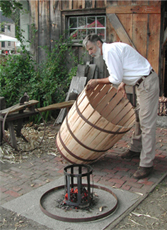
Cooper Ron Raiselis
tips a barrel
over a cresset.
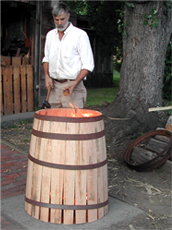
Ron Raiselis taps
metal hoops around
a barrel to bend
in the staves as they
soften from the
fire in the cresset.
The staves are then arranged vertically inside of a metal “raising hoop.” The next step is a “firing” process, where scrap wood shavings are put in an iron basket called a “cresset,” placed in the center of the barrel, and lit. The fire warms the wood allowing the fibers to relax so the cooper can gradually hammer progressively tighter metal hoops around the barrel until it forms the finished shape-a process called “trussing.”
The ends of the cask are then leveled off and a groove cut into the inside edge to receive the barrel heads-the round ends that close up the casks. Almost all 18th and 19th century barrels were finished off by binding them together with wooden hoops, usually made from split hickory, oak, or ash saplings.
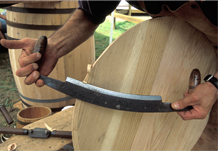
Ron shaving the top of a barrel
with a draw shave knife.
Photographs in this essay are of master cooper Ron Raiselis who demonstrates regularly at Strawbery Banke.
 Rosamond Press
Leave a comment