Nadya Tolokonnikova, the co-founder of the feminist art collective Pussy Riot, was sitting in a replica Russian prison cell in downtown Los Angeles when the police started shutting down the streets around the art museum.
Police helicopters hovered overhead. Somewhere, through a loudspeaker, an officer delivered a tinny order to disperse.

Pussy Riot showed solidarity on “No Kings” Day, participating in the march in Los Angeles on Saturday. They joined the demonstration while displaying a red banner that read, “It’s Beginning to Look a Lot Like Russia.”
After seeing this video of Pussy Riot being flogged, I turned my female Bond into a Lesbian.
Seer John


More Stories
Trump approval rating: Is California satisfied with Trump, Newsom?news
Gavin Newsom changes his tune on running for presidentnews
Discover a prostate cancer Rx treatment.xtandi.com|
Nadya Tolokonnikova, the co-founder of the feminist art collective Pussy Riot, was sitting in a replica Russian prison cell in downtown Los Angeles when the police started shutting down the streets around the art museum.
Police helicopters hovered overhead. Somewhere, through a loudspeaker, an officer delivered a tinny order to disperse.
Pussy Riot showed solidarity on “No Kings” Day, participating in the march in Los Angeles on Saturday. They joined the demonstration while displaying a red banner that read, “It’s Beginning to Look a Lot Like Russia.”
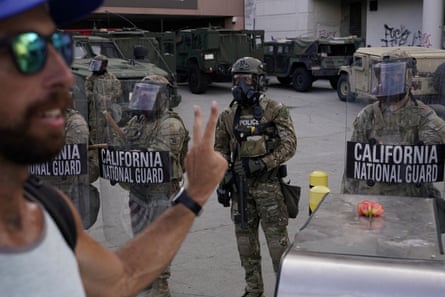
The march in downtown Los Angeles drew about 20,000 people, and was one of 2,000 locations that held “No Kings” Day protests against the president, who has deployed the National Guard and the Marines to L.A. over protests opposing his administration’s aggressive raids by Immigration and Customs Enforcement. The protests were held on the same day Trump threw an expensive military parade on his 79th birthday in Washington, D.C.
Pussy Riot co-founder Nadya Tolokonnikova’s “Police State” installation at the Geffen Contemporary at MOCA was postponed Sunday, when the National Guard was deployed. “Due to evolving conditions in downtown Los Angeles and the proximity of The Geffen Contemporary at MOCA to ongoing demonstrations and military activity near the Los Angeles Federal Detention Facility, the museum has made the decision to adjust its operating hours and event schedule out of concern for the safety of staff and visitors,” MOCA said on its website. The 10-day exhibit was originally set to conclude tomorrow, with a panel and performance of Siberia. The rescheduled dates have not yet been released.
In a statement regarding Pussy Riot’s participation in the “No Kings” march, Tolokonnikova reflected on Russia and the current state of the world in relation to her exhibit. “It’s not quite a penal colony here, but a halfway house,” she said. “Once again, when I write a statement or a song, a demon on my left shoulder is whispering: ‘How much is too much? Will this get you jailed or not quite yet??’ The answer is – idfk. When the law is being used not to protect freedoms, put to punish – selectively and voluntarily – those who speak out, no lawyer can tell you what’s safe, and what’s not. As my Russian lawyer used to say, “Nadya, stop asking me what’s safe – if you want to be safe, leave Russia.”
Tolokonnikova said that she refused to leave her home country, until she realized “If I stayed, I’d spend the rest of my life behind bars.” She added that Russian President Vladimir Putin promised “safety and stability” and instead is “waging the bloodiest war in modern Europe.”
“It’s beginning to feel a lot like Russia…. Everywhere you go,” she continued.
“My job as an artist is to interpret those feelings. I felt that tingle for a bit now, that is why I did the POLICE STATE exhibit,” she said. “The walls are closing, the camera systems are getting AI upgrades, you have to censor what you say or unidentified masked men will show up at your home, at your work, at your church. One day, leaving the museum, I stepped into an actual police state – rows of police assaulting peaceful protesters.”
“I guess you could say it’s my first artistic collaboration with the United States Military,” she concluded. “Now we are on the street protesting alongside people who believe immigrants make America great.”
Here
Pussy Riot’s founder built a ‘police state’ in an LA art gallery. Then the national guard arrived
Nadya Tolokonnikova tells the Guardian she felt she had ‘entered a wormhole’ when her police state exhibition was shut down – by the police state

Lois Beckett in Los AngelesSun 15 Jun 2025 10.00 EDTShare
Nadya Tolokonnikova, the co-founder of the feminist art collective Pussy Riot, was sitting in a replica Russian prison cell in downtown Los Angeles when the police started shutting down the streets around the art museum.
Police helicopters hovered overhead. Somewhere, through a loudspeaker, an officer delivered a tinny order to disperse.
Tolokonnikova was only three and a half days into what was supposed to be a “durational performance” reenacting her two years as a political prisoner in Vladimir Putin’s Russia.
But Donald Trump had ordered national guard troops into Los Angeles, over the objections of California’s governor, and the protests against immigration raids that Trump wanted to target were happening just a block from the gallery where Tolokonnikova was performing.
https://cds.connatix.com/p/plugins/cnx.bridge-1.0.9-compressed.htmlThe video player is currently playing an ad.
The Museum of Contemporary Art (Moca) hastily decided to shut its doors. But Tolokonnikova, 35, whose political art has left her as a wanted criminal in Russia, chose to continue her performance inside the empty museum.
“Police State Exhibit Closed Today Due to the Police State,” she posted on Instagram.
The situation “felt like I had entered a wormhole,” Tolokonnikova told the Guardian the next day via email. She wanted to be out on the streets, but she decided to finish her performance while live-streaming audio of the protests outside into her prison cell. It felt important, she wrote, “not to bend to the whims of Ice or the national guard”.
Tolokonnikova was in Los Angeles to display a new performance piece called Police State, which includes a replica Russian prison cell like the ones in which she was incarcerated for nearly two years, including in the notorious penal colony IK-14 in Mordovia. Tolokonnikova had been just 22 when she and two other members of Pussy Riot were convicted of “hooliganism motivated by religious hatred” for staging an anti-Putin “Punk Prayer” protest in a Moscow cathedral in early 2012.
After her release in late 2013, she kept demonstrating, and kept making art. In 2021, the Russian government labeled her a “foreign agent”. A recent multimedia performance, Putin’s Ashes, which came to Los Angeles in 2023, had landed her on Russia’s wanted list, and led to her being arrested in absentia for the crime of “insulting the religious feelings of believers”.
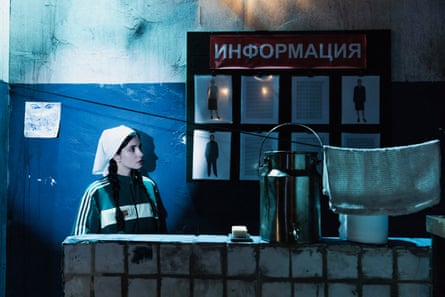
Los Angeles was the latest stop in a series of museum exhibitions that had brought the artist to Berlin and Linz in Austria for a show called Wanted. Police State, which was being performed at the Geffen Contemporary at Moca, had been designed for an audience, with museum visitors peering at her through observation holes in the walls, or following the surveillance video from her cell on gallery screens. It was her first time doing a “durational” performance, and she had planned to spend hours each day inside the cell creating music, mixing it with leaked audio from Russian prisons, and sewing protest slogans on military shirts, all the while surrounded by a crowd of supportive people outside the fake cell walls.
Now, suddenly, she was alone again. A block away, protesters had gathered outside the federal buildings where detained immigrants, including families with small children, were reportedly being held in basements, with little food or water.
In her replica cell, Tolokonnikova thought about the Los Angeles mothers and fathers who had just been torn away from their families, people who were “hard-working breadwinners and caretakers”, not violent gang members. She looked at the art decorating her cell’s walls, drawings sent by current and former political prisoners in Russia and Belarus, “people imprisoned for 10, 15, 20 years, simply for being good”.
“I was thinking of dehumanization and scapegoating as a universal mechanism – applied with heartbreaking ruthlessness both back home and here,” she wrote in the email. “I was thinking how the western idea that history inevitably moves toward progress is a mirage.”
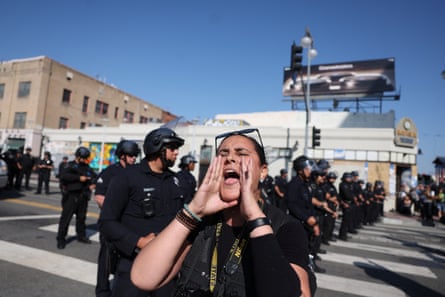
When her performance hours were done, she walked out into the Los Angeles streets for comfort. It was early Sunday evening, and the protests downtown had been going on most of the afternoon. “People were giving out gas masks, water, and protective glasses,” she wrote. What captured her attention was not moments that would be played and replayed on the news, like Waymo automated vehicles set on fire, or protesters streaming on to the 101 highway. It was the way being at a protest feels: “That spirit of care and solidarity is precious,” she wrote. “People were being shot with rubber bullets and burned by tear gas, yet they refused to leave.”
On Wednesday, the museum announced that the rest of Tolokonnikova’s performance would have to be postponed indefinitely, because of “ongoing demonstrations and military activity”.
“Every single event I did in Russia was shut down by the cops,” she posted on Instagram, “and now it’s starting to feel a lot like Russia.”
‘Now I just want to comfort people’
Tolokonnikova, who faces immediate arrest if she returns to Russia, is not an optimist. In recent months, she has repeatedly compared her art practice to the musicians who kept playing on the Titanic as the ship went down.
“I think we live in a world that doesn’t really belong to us any more,” she told me in an interview the week before her Los Angeles performance began. “If 15 years ago, I wanted to radically change the world, now I just want to comfort people.”
“I mean, I still wouldn’t mind changing the world,” she added. But at the moment, the change she’s seeing “goes in the opposite direction”.
Still, Tolokonnikova, 35, does not take her ability to keep making big art installations for granted.
“It’s awesome,” she told me in our Los Angeles interview, as she and her collaborators were working on the final touches to her replica prison cell. “I don’t know if victory is the right word, but it’s rewarding.”
We need to be ready to offend ourselves and other people. Otherwise, Maga people are just going to keep winning
Nadya Tolokonnikova
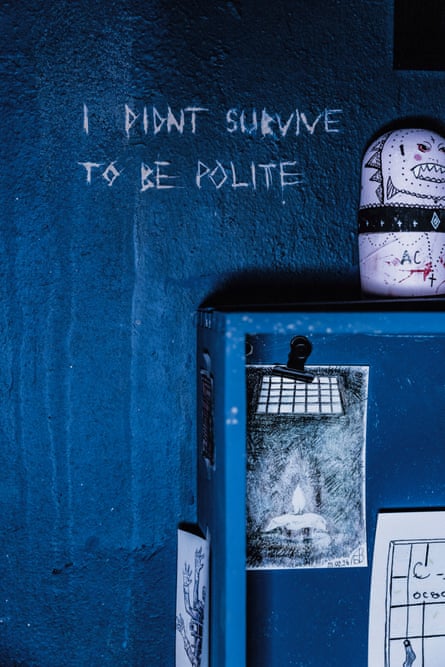
When I walked inside the replica cell, it was bigger and far more detailed than I expected, with battered, blue-painted plaster walls etched with graffiti, a desk for Tolokonnikova’s music equipment, and a toilet in the corner that she planned to use during her performance shifts, which would last either six or eight hours. The floor of the cell was dirty, and the observation holes fit into the walls had heavy metal covers that could slide open or closed. There were surveillance cameras all over the cell, even one pointed at the toilet.
The Russian prisons where she was incarcerated had “cameras right above the toilet bowl, which makes no sense for us people who live outside of jails”, she said. “But once you’re in, you kind of just know, well, that’s what it is.”
We talked with the noise of construction around us, and the sharp smell of iron in the air, a sign of the metalwork in progress nearby. Partway through our conversation, the metalworker approached, wheeling the massive cell door, to ask Tolokonnikova about the finish she wanted on the metal.
Each of these details mattered to Tolokonnikova. One of her inspirations for the durational prison performance is her friend Marina Abramović, known as “the grandmother of performance art”. Another is the late conceptual artist Ilya Kabakov, who had meticulously replicated an old, deteriorating Soviet public bathroom and displayed it in a European gallery so western audiences could understand the context of his art. “It’s one of the works that changed my life for ever,” she said.
For authenticity, the table in her cell was covered with a garish plastic tablecloth printed with lemons, a “very post-Soviet thing” that people incarcerated in Russia use “to recreate this idea of comfort of coziness, in jail”.
To more directly connect her performance to other political prisoners still incarcerated in Russia, Tolokonnikova had collected drawings they had made to display in the cell, including a depiction of a candle by Russian anti-Ukraine war activist Andrey Boyarshinov. This was a laborious process, she explained, working with the prisoners’ family members and lawyers, and some of the art had not yet arrived. But she was hopeful that displaying Russian prisoners’ work in a prestigious American museum might help their cases, even help them get on a prisoner exchange list.
Tolokonnikova and another jailed member of Pussy Riot, Maria Alyokhina, staged hunger strikes and drew international attention to the conditions in their different prisons.
When she was incarcerated in prison colony No 14 in the Russian region of Mordovia, Tolokonnikova was forced to work 16-hour days, seven days a week, sewing uniforms for police officers. The sewing machine she had used in prison had constantly broken down, something she believes was not a coincidence: the prison staff wanted to make her life “completely impossible”.
A decade later, in her re-enactment of prison life, Tolokonnikova was planning to again sew military-style uniforms on a battered old sewing machine, but this time she would be embellishing them with “some simple words that mean something to me like exiled or voided, cancelled, expelled, alien – how I feel these days’”. She would trim some of the uniforms with lace, she added, “because I always like to add some cuteness”.
Danger for Russian dissidents
The lives of Russian dissidents are not easy, and becoming a prominent Putin critic, as Tolokonnikova has done, is dangerous, even after dissidents have left Russia. One of the art works in Tolokonnikova’s Los Angeles exhibit is a candy machine labeled with the different poisons that have been used to murder enemies of the Russian state: Polonium 210 Isotope, Thallium, Sarin.
On certain subjects, Tolokonnikovia can be laconic, even dismissive. Asked about how she was preparing to protect her mental health while reenacting her imprisonment in Los Angeles, she said she had not really made any plans. “Self-care is not my strong suit. I’m just like: I don’t have time for this.”
When it came to performance, she said, Ambramović had told her several years ago that “once you commit to an idea, it basically negates all the fear” and that “if you believe that the particular artistic idea that you chose is good enough, then you just kind of don’t care about physical safety, or emotional safety”.
“I’m sure it’s gonna be triggering as fuck at some points for me to sit there,” she added. “But do I care? No. Because I think the work has to be done, and I’ll deal with it later.”
Tolokonnikova’s punk aesthetic is not something she adopts for performances. She told me cheerfully about almost getting blown up by pyrotechnics at a recent unauthorized concert, and praised the work of LA’s Dead City Punx, a hardcore punk band and one of her planned collaborators in Los Angeles.
“One thing that I just don’t vibe with in modern American society – there’s an entire thing about safety. And I’ve lived my life in a way that safety was the last thing that I would care about,” she said. “This is a thing I think about a lot lately. We need to be less safe, be ready to offend ourselves and other people. Otherwise, Maga people are just going to keep winning, because they’re not afraid.”
Tolokonnikova told me she had hoped that people would come to her Moca exhibit with their children. “I’ve always been obsessed with building a version of Disneyland, but much more radical and grim,” she said. She had worked with Banksy on Dismaland, the artist’s 2015 dark Disney satire, but she’s still thinking about the possibilities of a more revolutionary theme park.
“It’s just a giant waste of time and money the way that Disneyland looks now. It just doesn’t accomplish anything,” she said. Imagine, she suggested, if the animatronic characters of the Pirates of the Caribbean ride were instead a way for kids “to learn the history of the feminist movement”.
“So instead of pirates doing this,” she said, jerking her arms, “it could be like, you’re a suffragette being arrested.”
“Obviously, I don’t have a budget to build Disneyland,” she added. “But it was a dream of mine for ever.”
Police State had been scheduled to run through 14 June, with a final performance by Pussy Riot Siberia, Tolokonnikova’s new performance collective, to close it out. Now, it is postponed to an unknown date in the future.
“I guess the National Guard will be performing POLICE STATE instead of me this week,” Tolokonnikova wrote on Instagram.
This article was amended on 16 June 2025 to correct Nadya Tolokonnikova’s surname on two mentions; it is Tolokonnikova, not Tolokonnika. Police State’s show date was also corrected; it is scheduled to run through 14 June, not the 13th as previously stated.
 Rosamond Press
Leave a comment