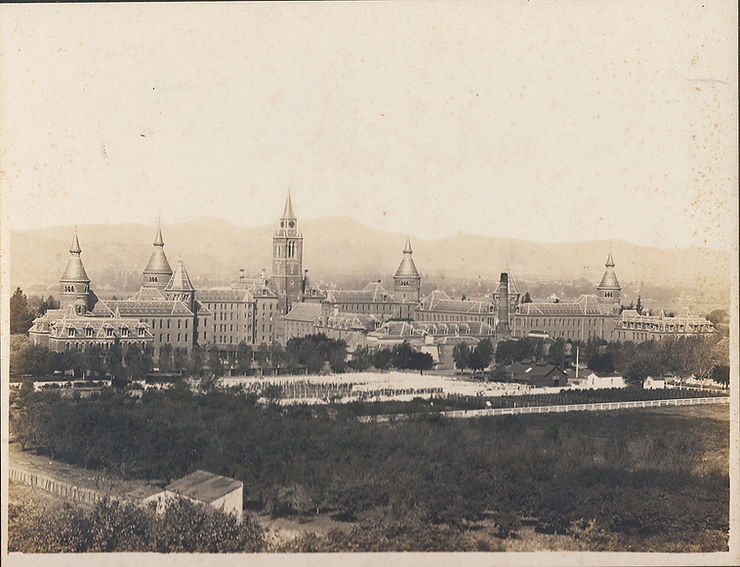

Napa Hospital and Janke Stagecoach
San Sebastian Avenue
EXTRA!
CARL JANKE WAS A DIABETIC WITH URINARY CRISIS
I saw my doctor yesterday for a follow-up to my visit to the Emergency room on June 4, 2025. I was given a stronger dose of anti-biotics to help relieve me of a very painful urinary infection. I will going to see Doctor DeMarco in two hours. He will be looking inside my bladder with a scope. I will be seeing Dr. Krughoff in August for extensive tests concerning my inability to urinate.
Twenty minutes ago I re-read my post this morning, and gasped! I had not looked at it for almost a year.. There was a fight over the legacy of Carl Janke who suffered from diabetes and a very painful urinary infection. I was going to get lab work done, but my blood sugar level dropped, and I got the chills and had breakfast. I told my doctor and Pacific Source I am concerned about my mental healthy because I do not sleep well due to having to pee four times in the night. The pain is degrading my will to live. They are going to help me get someone to help me with my chores.
In the battle over the sale of Belmont land, a famous Doctor. Benjamin Shurtleff of Napa State Hospital was called to testify about the mental well-being of the Founder of Belmont. There is a history of mental illness in my natal family. I have filled out many forms that ask me for the history of diabetes in my family. I was treated for prostate cancer by Doctor Estrich and the Oregon Urology Center in Springfield. I believe Carl had prostate cancer. I will be sending a message to UC Med and Law school to see if they want to do a COMPLETE HISTORY of the Janke-Struttmeister family.
John Presco
President: Royal Rosamond Press
Thu contest is made on the ground of mental incapacity of the Accused, and undue influence. It is sought to be proven, that the disease from which the old man suffered, was so painful and severe that his mmd was affected. Diabetes is said by the books to be an affection of the urinary organa, and is excruciating in the extreme. Irregularity in the making of the will is also endeavored to be shown. The whereabouts of a sum of $50,000, which the dead man had from the sale of real estate in San Francisco, is a matter of great interest and anxiety to counsel
EXTRA! On July 21, 2024, I found an article in the Redwood Gazzette Times about the court battle over the legacy of Pioneer Carl A. Janke. Finding out his father was dying, William A, Janke CHARTERED a locomotive in San Francisco and sped to Belmont in or get there before Carl died. What is interesting, Elizabeth Johnson is claiming FIVE ACRES near the center of Belmont. She is the mother of Doris Vannier who said Elizabeth told her the Janke grave was dug up in the middle of th night. This is evidence a LAND FIGHT took place! Is the BHS aware of this article – and fight – that I copyright!
John Presco
Copyright 2024
JANKE’S JOURNEY. The Big Belmont Stake in Course of Probate. Twe«l) .r»,r Mllr,’ Itldr .n . 1 mm. live-1 hr Lrgnl Srarrh for • MflsaiKK
Text
Why may this text contain mistakes?
JANKE’S JOURNEY. The Big Belmont Stake in Course of Probate. Twe«l) .r»,r Mllr,’ Itldr .n . 1 mm. live-1 hr Lrgnl Srarrh for • MflsaiKK
On the 13th of Sup ten; her last) Carl Augnst Janke, of Belmont, died of the disuast) Known as diabetes, leaving three surviving children, and considerable projierty. His will has been tiled fur probate in the Super* ior Court at Redwood City, ami for the past three weeks, a protracted legal contest between the heirs has been going on. The litigation is being conducted by Fox & Ross, of Redwood, representing the contestan s, and Kincaid & Fitzpatrick, with Charles F. U Hanlon, an enterprising young advocate uf San Francisco fur the will The costs uf the suit are rapidly roiling up. Extended short hand notes of the testimony are being taken, and medical experts Lum a distance, including the distinguished Dr. Shurtlefl* of the Napa State asylum, are prolonging the issue, to the eminent satisfaction of the legal luminaries engaged in the trial. From the mass of material already extracted from the mouths of willing and unwilling witnesses, and from other information the interesting particulars which follow are extracted.
At the time of the last illness of the deceased, William August Janke, the secund son,who occupied a store in a Belmont building belonging to his father was in San Francisco. Upon receiving the news that his parent just lingered in he shadows of the unknown and the hereafter, he hastened like a dutiful son to his bedside. Chartering a locomotive he reached the bed of the dying not long before death closed around the aged man. A notary was brought from Redw‘»od, and the will was prepared and witnessed some 36 hours before the eyelids of the deceased closed on Earth forever. By the terms of the testament, the picnic grounds and resort known as Belmont park, valued all the way from twenty to thirty thousand dollars, was bequeathed to Charles F. and William A., his two sons to share alike. A sum of 53.500 in in money was left, one third each to his three children, (the two sons aforesaid, and his daughter Elizabeth the wife of a resident of Belmont named Johnson,) all of whom are residents of this county. A store in Belmont owned by the testator, was left to Mrs Johnson, together with a tive acre lot which it is claimed already belonged to her husband. The land on which this siore is, was left to the two sons, and all the personal property to the son William August Janke.
Thu contest is made on the ground of mental incapacity of the Accused, and undue influence. It is sought to be proven, that the disease from which the old man suffered, was so painful and severe that his mmd was affected. Diabetes is said by the books to be an affection of the urinary organa, and is excruciating in the extreme. Irregularity in the making of the will is also endeavored to be shown. The whereabouts of a sum of $50,000, which the dead man had from the sale of real estate in San Francisco, is a matter of great interest and anxiety to counsel. Thus far it has not been found, and if discovered, and the will is sustained as the personal property of the estate, it would add materially to the legacy of the son William August. The events surrounding the drafting of the will, substantially are, as the contestants expect to prove them, that upon the return of William A. by express, ho had an interview with his father in the sick chamber, and that the rest of the family were directed to leave the room. A witness named Schmoll translated the contents of the will to the father and children, the whole conversation being conducted in the German language. ‘ These are the principal points of contention between the lawyers, and as usual in an extended trial over an important stake they are conducting the case with vigor, and occasionally indulging themselves in a little humorous relaxation. The eminent, but juvenile jurist from San Francisco, is conducting his case with much enthusiasm. During the trial he seems to have determined to put a certain question, not only agaiqst the objection of opposing counsel, but his associates as well. Judge Kincaid thereupon retorted on him with the sarcasm—“As Senior counsel in this case your Honor I withdraw that question.” The young man submitted.
Benjamin Shurtleff (September 7, 1821 – December 21, 1911) was an American politician and physician from California.[1][2] He was member of the California State Senate and was the director of the Napa State Hospital.[3][4]
| Benjamin Shurtleff | |
|---|---|
| Shurtleff c. 1875 | |
| Member of the California Senate from the 26th district | |
| In office January 7, 1861 – December 6, 1863 | |
| Preceded by | Seat established |
| Succeeded by | John P. Jones |
| Personal details | |
| Born | September 7, 1821 Carver, Massachusetts, U.S. |
| Died | December 21, 1911 (aged 90) Napa, California, U.S. |
| Political party | Whig (before 1856) Democratic (1856–1864) Republican (after 1864) |
| Spouse | Ann M. Griffith(m. 1853; div. 1905) |
| Children | 3 |
| Education | Pierce Academy Fremont Medical School of Boston Harvard University |
| Occupation | Physician, hospital director |
Contents
Early life
He was born September 7, 1821, in Carver, Massachusetts to Hannah Shaw and Charles Shurtleff. He was educated in the public schools until the age of fifteen, and then attended Pierce Academy, where he began teaching at age nineteen.[2]
He studied medicine with his brother, Dr. G. A. Shurtleff, and with Dr. Elisha Huntington of Lowell, Massachusetts. He attended the Fremont Medical School of Boston and was taught by Dr. Oliver Wendell Holmes Sr. Shurtleff graduated from the medical school of Harvard University in 1848.[2]
Career
In 1849, he traveled to California and settled in Shasta County, where he began practicing medicine.[2] He also owned a drug store and engaged in mining.[2] He was elected as the first treasurer of Shasta County and, later, became a California State Senator representing Shasta County and Trinity County from 1861 to 1863.[1][2] In 1863, he was the Democratic candidate for U.S. Senator, but lost to Unionist John Conness. He was a Republican.[2]
In 1874, he moved to Napa, California, where he served as director of the Napa State Hospital for nineteen years.[2] He was also mayor of Napa for many years.[1][2] He was a member of the California constitutional convention of 1879.[1][2]
Personal life
While on a trip to New England, he married Anna M. B. Griffith, who was born in Middleboro, Massachusetts, on February 21, 1853[2] They had three sons, Benjamin E. Shurtleff, Charles A. Shurleff, and George C. Shurleff.[2]
The University of California College of the Law, San Francisco (abbreviated as UC Law SF or UC Law) is a public law school in San Francisco, California, United States. It was known as the University of California, Hastings College of the Law (abbreviated as UC Hastings) from 1878 to 2023.
Founded in 1878 by Serranus Clinton Hastings, UC Law SF was the first law school of the University of California as well as one of the first law schools established in California. Although part of the University of California, UC Law SF is not directly governed by the Regents of the University of California. UC Law SF is also one of the few prominent university-affiliated law schools in the United States that does not share a campus with the university’s undergraduates or other postgraduate programs.
History
[edit]
Founding of the law school
[edit]
In 1878, Serranus Clinton Hastings, the first chief justice of California, gave $100,000 to be used to create the law school that once bore his name. He arranged for the enactment of a legislative act on March 26, 1878, to create the Hastings College of the Law as a separate legal entity affiliated with the University of California.[3]: 44, 71–72 [4] This was apparently intended for compatibility with Section 8 of the university’s Organic Act, which authorized the board of regents to affiliate with independent self-sustaining professional colleges.[3]: 44, 71–72 [5] Another reason for making the gift in this fashion was that Hastings desired to impose certain conditions on his gift, while “policy and law dictated that a free-gift could not be hedged by power of reversion.”[3]: 81–82
 Rosamond Press

Leave a comment