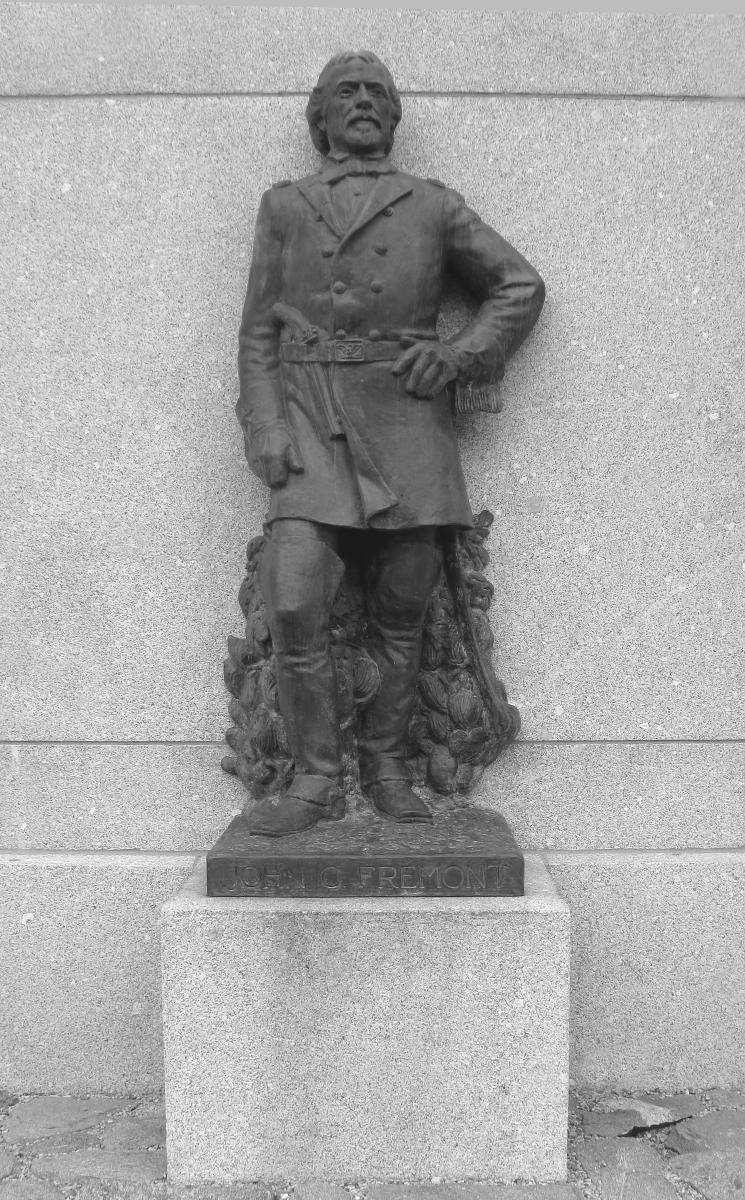
Bronze figure representing John C. Frémont by Mahonri M. Young, part of This Is the Place Monument, situated on the east bench of Salt Lake City, July 2012. Photograph by Alexander L. Baugh.
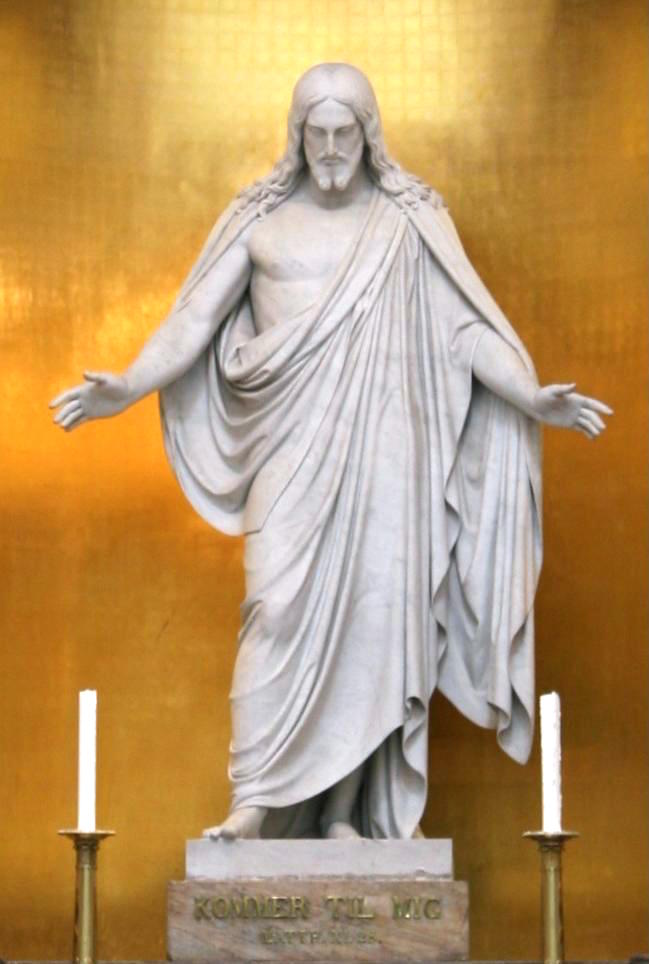

Today, I begin my search for Christian Leaders and Christian sects, who oppose the President of the United States threatening human beings inside our borders with the U.S. Marines. How many American Citizens FEEL TERRORIZED by a military force whose aim is to – TERRORIZE ENEMY LEADERS – and NOT CITIZENS? I keep hearing elected Democrats say this is unprecedented. They are wrong. President Buchannan sent Federal Troops to destroy the Mormons, in what is called ‘The Utah War’. How many Mormons all over the world know about his war – and feel threatened? Could they be –
NEXT?
John Presco
Given President Donald Trump’s push for “mass deportation” of those he calls “illegal immigrants,” questions surrounding the issue have become even more urgent for The Church of Jesus Christ of Latter-day Saints, which counts hundreds of thousands of immigrant converts.
A cloud of uncertainty hung over Los Angeles on Tuesday, where questions remained over the role that Marines and National Guard troops would play after being called in by President Donald Trump amid protests over immigration raids in the area.
The 700 Marines arrived in the Los Angeles area, but they hadn’t been called to respond to the protests as of Tuesday afternoon and were only there to protect federal officials and property, the Marine Corps commandant said.
The Mormon Battalion was the only religious unit in United States military history in federal service, recruited solely from one religious body and having a religious title as the unit designation.[4] The volunteers served from July 1846 to July 1847 during the Mexican–American War of 1846–1848.[5] The battalion was a volunteer unit of between 543[6][7] and 559[8][Note 1] Latter-day Saint men, led by Mormon company officers commanded by regular United States Army officers. During its service, the battalion made a grueling march of nearly 1,950 miles from Council Bluffs, Iowa, to San Diego, California.
The Utah War (1857–1858), also known as the Utah Expedition,[4] the Utah Campaign,[5] Buchanan’s Blunder,[6] the Mormon War,[7] or the Mormon Rebellion,[8] was an armed confrontation between Mormon settlers in the Utah Territory and the armed forces of the US government. The confrontation lasted from May 1857 to July 1858. The conflict primarily involved Mormon settlers and federal troops, escalating from tensions over governance and autonomy within the territory. There were several casualties, predominantly non-Mormon civilians. Although the war featured no significant military battles, it included the Mountain Meadows Massacre, where Mormon militia members disarmed and murdered about 120 settlers traveling to California.[9]
In 1857–1858, President James Buchanan sent U.S. forces to the Utah Territory in what became known as the Utah Expedition. Members of the Church of Jesus Christ of Latter-day Saints (LDS Church), also known as Mormons or Latter-day Saints, fearful that the large U.S. military force had been sent to annihilate them and having faced persecution in other areas,[10] made preparations for defense. Though bloodshed was to be avoided, and the U.S. government also hoped that its purpose might be attained without the loss of life, both sides prepared for war. The Mormons manufactured or repaired firearms, prepared war scythes, and burnished and sharpened long-unused sabers.
Rather than engaging the Army directly, the Mormon strategy was one of hindering and weakening them. Daniel H. Wells, Lieutenant-General of the Nauvoo Legion, instructed Major Joseph Taylor:
Although the Utah Expedition had begun to gather as early as May under orders from General Winfield Scott, the first soldiers did not leave Fort Leavenworth, Kansas, until 18 July 1857. The troops were originally led by Gen. William S. Harney. However, affairs in “Bleeding Kansas” forced Harney to remain behind to deal with skirmishes between pro-slavery and free-soiler militants. The Expedition’s cavalry, the 2nd Dragoons, was kept in Kansas for the same reason. Because of Harney’s unavailability, Col. Edmund Alexander was charged with the first detachment of troops headed for Utah. However, the overall command was assigned to Col. Albert Sidney Johnston, who did not leave Kansas until much later. As it was, July was already far into the campaigning season, and the army and their supply train were unprepared for winter in the Rocky Mountains. The army was not given instructions on how to react in case of resistance.
Thomas L. Kane
[edit]
Thomas L. Kane in the uniform of a Union lieutenant colonel in 1861. He received a brevet promotion to major general in 1865.
The lull in hostilities during the winter provided an opportunity for negotiations, and direct confrontation was avoided. As early as August 1857, Brigham Young had written to Thomas L. Kane of Pennsylvania asking for help. Kane was a man of some political prominence who had been helpful to the Mormons in their westward migration and later political controversies. In December, Kane contacted President Buchanan and offered to mediate between the Mormons and the federal government. In Buchanan’s State of the Union address earlier in the month, he had taken a hard stand against the Mormon rebellion, and had actually asked Congress to enlarge the size of the regular army to deal with the crisis.[49] However, in his conversation with Kane, Buchanan worried that the Mormons might destroy Johnston’s Army at severe political cost to himself, and stated that he would pardon the Latter-day Saints for their actions if they would submit to government authority. He therefore granted Kane unofficial permission to attempt mediation, although he held little hope for the success of negotiations.[68] Upon approval of his mission by the President, Kane immediately started for Utah. During the heavy winter of 1857–1858, he traveled under the alias “Dr. Osborne” over 3,000 miles from the East coast to Utah, first by ship to Panama, crossing the isthmus via the newly constructed (1855) Panama Railway, and then taking a second ship to San Francisco. Upon learning that the Sierra passes were blocked for the winter, he immediately took a ship to San Pedro, the unimproved harbor for what is now Los Angeles. He was met there by Mormons who took him overland through San Bernardino and Las Vegas, to Salt Lake City on the strenuous southern branch of the California Trail, arriving in February 1858.
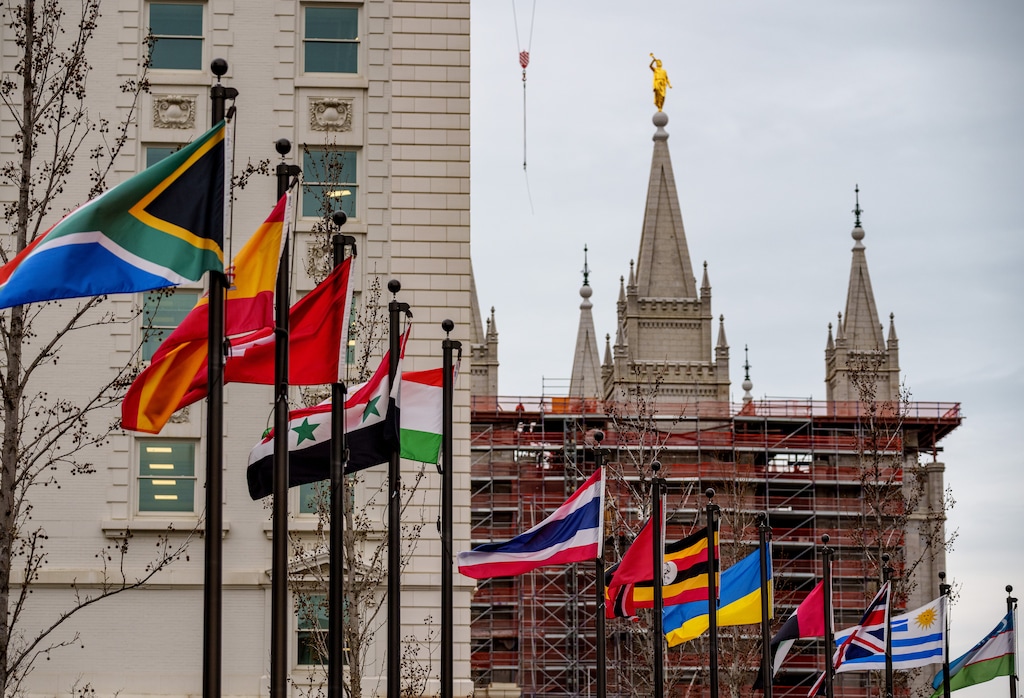
(Trent Nelson | The Salt Lake Tribune) Flags from around the world line a plaza east of the Salt Lake Temple in Salt Lake City on Monday, Feb. 3, 2025.
| Jan. 30, 2025, 3:14 p.m.
| Updated: Feb. 3, 2025, 9:13 a.m.
Comment
Given President Donald Trump’s push for “mass deportation” of those he calls “illegal immigrants,” questions surrounding the issue have become even more urgent for The Church of Jesus Christ of Latter-day Saints, which counts hundreds of thousands of immigrant converts.
On Thursday, the Utah-based faith waded delicately into the debate, issuing a news release reiterating long-standing principles that “guide the church’s approach.”
They are:

Report This Ad
• Obedience to the law.
• Loving “all God’s children.”
• Providing “basic food and clothing, as our capacity allows, to those in need, regardless of their immigration status.”
• Keeping families together.
Get Mormon Land newsletter. Explore the news and culture of The Church of Jesus Christ of Latter-day Saints every Thursday.
SIGN UP NOW
In addition to emphasizing principles of love, law and family, the global faith of 17.2 million members encouraged bishops and other local lay leaders to consult with the faith’s attorneys on how to deal with immigrants lacking permanent legal status in their congregations.
“The Office of General Counsel (OGC) has created guidelines to help local leaders comply with federal laws that criminalize harboring, transporting or encouraging undocumented immigrants to remain in the United States,” the release said. Church lawyers continue to “carefully track legal developments to ensure local outreach and area-initiated humanitarian activities are appropriate.”
Mixed reactions
South Jordan Latter-day Saint Karim Jones, a first-generation U.S citizen born to an immigrant mother from El Salvador, said she has “always been grateful to those members of the church who took us in and treated us as their own.”
Report This Ad
“I appreciate the church’s statement that reiterates loving our neighbors and keeping families together,” she said, “though I wish a clearer stand had been made on how they plan to keep our places of worship a safe haven for all — including our undocumented brothers and sisters.”
Meanwhile, a Brigham Young University student with undocumented family members said she was especially grateful for the church’s emphasis on family unity.
The student, who asked that her name not be used out of concern for her undocumented loved ones, also appreciated the release’s focus “on how we’re all God’s children, regardless of your documentation and legal status.”
She said she hoped that whatever guidelines the church provides local leadership would help to ensure the meetinghouse remains a place where all can worship in peace.
Victoria Gomez, a Latter-day Saint whose father immigrated from Mexico, was disappointed by the church’s statement, which she called “self-contradictory.”
Report This Ad
”If we really do care about” undocumented immigrants, said a women’s Relief Society president in her Monterey, California, congregation, “then we can’t be siding with harmful” laws.
 Rosamond Press

Leave a comment