Where Art Thou?
by
John Presco
I put the brakes on in my last post. Then I asked, “What is the last conversation man had with the Lord. Here is that conversation.
8 Then I heard the voice of the Lord saying, “Whom shall I send? And who will go for us?”
And I said, “Here am I. Send me!”
9 He said, “Go and tell this people:
There has been a marvelous breakthrough in establishing whom wrote the Bible. What I am looking at is the reason Jesus is called the “Son of God” ? It is because he is having CONVERSATIONS WITH GOD. The Gideon Computer is ENDING THE CONVERSATION that began when God asked Adam and Eve THE FIRST QUESTION……”Where art thou? Who is Gideon? Gideon has a cnversation with an Angel of the Lord, while Isaiah talks directly to the Lord.
God chose Gideon, a young man from the tribe of Manasseh, to free the people of Israel and to condemn their idolatry. The Angel of the Lord, or “the Lord’s angelic messenger”[12] came “in the character … of a traveller who sat down in the shade [of the terebinth tree] to enjoy a little refreshment and repose”[13] and entered into conversation with Gideon. The narrative has echoes of the meeting between Abraham and the visitors who came to him in the terebinths of Mamre and promised Abraham and Sarah, in their old age, that they would have a son (Genesis 18:1–15).[citation needed] The angel greeted Gideon: “The Lord is with you, you mighty man of valor!”[14]
Isaiah’s Commission
6 In the year that King Uzziah died, I saw the Lord, high and exalted, seated on a throne; and the train of his robe filled the temple. 2 Above him were seraphim, each with six wings: With two wings they covered their faces, with two they covered their feet, and with two they were flying. 3 And they were calling to one another:
“Holy, holy, holy is the Lord Almighty;
the whole earth is full of his glory.”
4 At the sound of their voices the doorposts and thresholds shook and the temple was filled with smoke.
5 “Woe to me!” I cried. “I am ruined! For I am a man of unclean lips, and I live among a people of unclean lips, and my eyes have seen the King, the Lord Almighty.”
6 Then one of the seraphim flew to me with a live coal in his hand, which he had taken with tongs from the altar. 7 With it he touched my mouth and said, “See, this has touched your lips; your guilt is taken away and your sin atoned for.”
8 Then I heard the voice of the Lord saying, “Whom shall I send? And who will go for us?”
And I said, “Here am I. Send me!”
9 He said, “Go and tell this people:
“‘Be ever hearing, but never understanding;
be ever seeing, but never perceiving.’
10 Make the heart of this people calloused;
make their ears dull
and close their eyes.[a]
Otherwise they might see with their eyes,
hear with their ears,
understand with their hearts,
and turn and be healed.”
11 Then I said, “For how long, Lord?”
And he answered:
“Until the cities lie ruined
and without inhabitant,
until the houses are left deserted
and the fields ruined and ravaged,
12 until the Lord has sent everyone far away
and the land is utterly forsaken.
13 And though a tenth remains in the land,
it will again be laid waste.
But as the terebinth and oak
leave stumps when they are cut down,
so the holy seed will be the stump in the land.”
‘There are no authors of the Bible in the modern sense’
Who wrote the Bible? A pioneering new algorithm may shatter scholarly certitude
Breakthrough method analyzes word distribution to clarify origins of biblical passages — including disputed stories in Genesis, Samuel and Esther
By Rossella Tercatin Follow6 June 2025, 8:10 am
Share
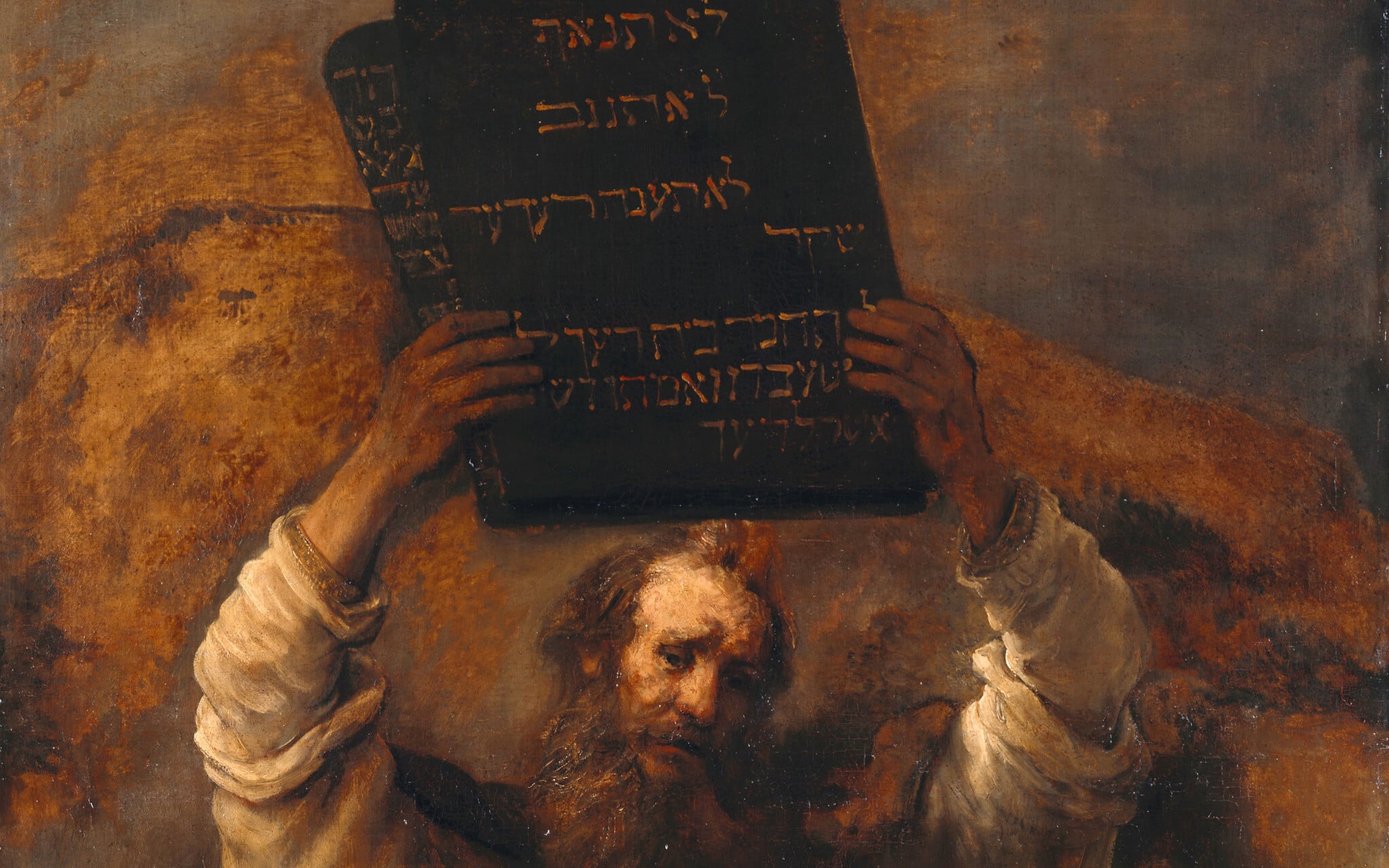
Rembrandt’s Moses with the Ten Commandments,1659, Germaldegalerie, Staatliche Museen, Berlin (photo credit: Google Art Poject / Wikipedia Commons)
A group of Israeli and international scholars has employed computer-assisted word-frequency analysis to pioneer a new method that may show who wrote the Bible and redacted it some 2,800 years ago.
Combining custom-built software with an algorithm developed in the field of statistics, the methodology is detailed in a groundbreaking study published on Tuesday in the leading academic journal PLOS ONE.
The researchers applied the new system to tackle longstanding debates over authorship in several contested passages, including the Book of Esther, the so-called “Ark Narrative” in the first and second books of Samuel, and stories about Abraham in the Book of Genesis.Promoted: Jewish Crossroads, Dan SenorKeep Watching
While many people of faith view the Bible as the product of divine revelation, scholars typically regard it as a patchwork of distinct documents and traditions that were later compiled and edited.
“As far as I can judge, the earliest texts in the Bible were composed in the Kingdom of Israel in the first half of the 8th century BCE,” said Prof. Israel Finkelstein, head of the School of Archaeology and Maritime Cultures at the University of Haifa and one of the PLOS ONE paper’s authors.
Get The Times of Israel’s Daily Editionby email and never miss our top storiesNewsletter email addressGet it
By signing up, you agree to the terms
“Composition of texts intensified in the 7th century [BCE] in Judah, mainly in the days of King Josiah,” he told The Times of Israel via email. “The latest texts were put in writing around the 2nd century BCE.”
Yet, when and how the different parts of the Bible were redacted is often disputed among scholars.

L-R: Scholars Eli Piasetzky, Shira Faigenbaum-Golovin and Israel Finkelstein, among the authors of a PLOS ONE paper published on June 3, 2025, as they appear in the documentary ‘Ark of the Covenant: The Bible’s Origins’ directed by Thierry Ragobert. (Screenshot)
According to Thomas Römer, a renowned biblical expert from the Collège de France and another author of the PLOS ONE study, it is essential to remember that no single individual can be considered the sole author of biblical texts.
Advertisement
“There are no authors of the Bible in the modern sense,” Römer told The Times of Israel via email. “The original versions of the scrolls were continuously reworked and rewritten by redactors who added, altered and sometimes also omitted parts of the former texts.”
Three schools of writers
The PLOS ONE paper focused on three schools of writers, the so-called Deuteronomy, Deuteronomist History, and Priestly Writings.
“Deuteronomy refers to the last book of the Torah/Pentateuch,” Römer explained. “There is a wide consensus that the first version of this scroll was written down in the 7th century BCE. The core of this first version was the laws that stipulate that the God of Israel had chosen only one place [Jerusalem] for the sacrificial cult.”

Scholar Thomas Römer, among the authors of a PLOS ONE paper published on June 3, 2025, as he appears in the documentary ‘Ark of the Covenant: The Bible’s Origins’ directed by Thierry Ragobert. (Screenshot)
Scholars use the term Deuteronomistic History to describe the biblical books that cover the history of Israel from the conquest of the land (the Book of Joshua) to the Babylonian exile (Kings I and II)
“The redactors who edited these books were inspired by the style and the ideology of the book of Deuteronomy,” Römer said. “This Deuteronomistic History was also re-edited several times. It started probably at the end of the 7th century under King Josiah and was then revised after the destruction of Jerusalem and its temple.”
“In this revision, the catastrophe is explained by the assertion that most kings did not respect the divine laws in Deuteronomy,” he noted.
Advertisement
Finally, according to Römer, the Priestly Writings include several texts in Genesis, Exodus, and Leviticus.
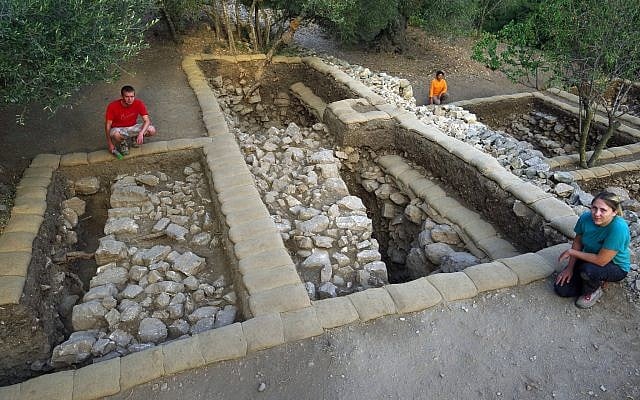
In the upper terrace at Kiriath-jearim, a massive wall was unearthed some 15 cm below topsoil. The site is said to have hosted to Ark of the Covenant (Shmunis Family Excavations at Kiriath-jearim)
“These texts were written for the first time around 520 BCE in the context of the reconstruction of the Second Temple,” he said. “The priestly authors and redactors want to show the importance of rituals and the different types of sacrifices.” To do so, he added, they anchored them in the times of the biblical patriarchs — the origins of the Jewish people.
50 chapters from nine books
The study considered 50 selected chapters in the Hebrew Bible’s first nine books — Pentateuch and the Early Prophets — to investigate the distinct literary traditions.
“In the first nine books, it is easier to identify blocks which represent different authors/schools of authors and redactors,” Finkelstein said. “For these books, critical biblical scholarship has also elaborated on an important number of hypotheses regarding composition.”
Dr. Shira Faigenbaum-Golovin from the Mathematics department at Duke University explained that to research the authorship of the Hebrew Bible, the team adapted an algorithm that analyzes word distribution in English-language texts.
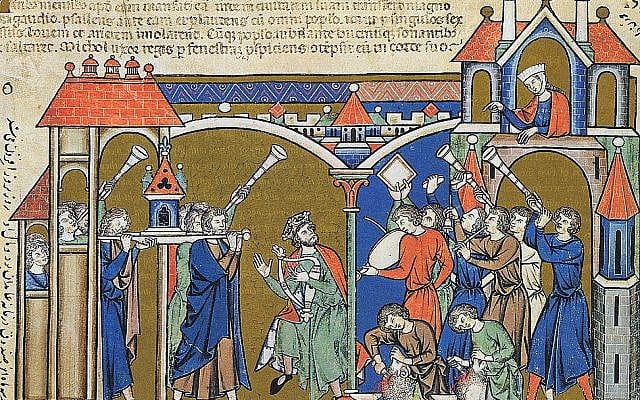
Illustration from the 13th-century Morgan Bible of David bringing the Ark into Jerusalem. (Public domain)
This method enables the comparison of two texts and the assessment of their similarity.
In the new study, the researchers were able to determine whether a particular biblical text could be considered similar enough to one of the three bodies — Deuteronomy, Deuteronomistic History, and Priestly Writings — to be compiled by the same author(s).
“We took a specific word, and we tested the number of its appearances in a text,” Faigenbaum-Golovin told The Times of Israel over a video interview. “We could quantify the word’s distribution in text one and in text two and check if they were the same. We repeated the process for several words, words that appear in both texts and those that appear only in one of them.”
Advertisement
“Eventually, we compiled an entire dictionary of words for each body,” she added. “This way, we had some measurement of the word-distribution similarities that reflected the writer behind the texts.”
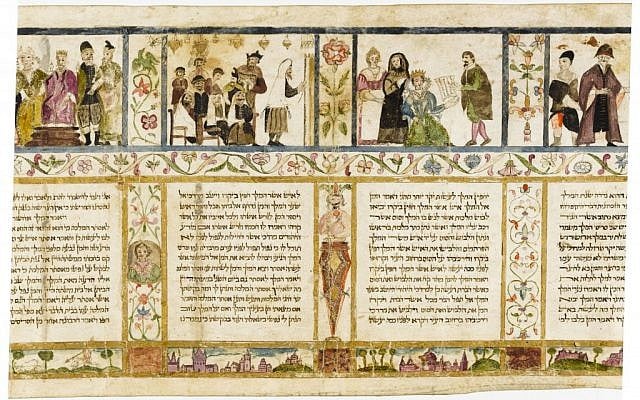
Illuminated Esther Scroll Manuscript; ink and pigment on parchment from Ferrara, Italy, circa 1615. (photo credit: Ardon Bar-Hama)
The researchers uncovered how the words Elohim (one of the names of God) and lo (meaning “no” in Hebrew) could be considered characteristic of the Deuteronomy body of texts. Deuteronomist History also includes these two words very frequently, in addition to melech (king) and asher (which), according to the study. Finally, zahav (gold) is a word characterizing the Priestly Writings corpus, the researchers found.
After creating the dictionary of terms for all three authorship schools – with some 1,447 unique terms (594 in Deuteronomy, 821 in Deuteronomist History, and 846 in Priestly Writings, with some overlap) – the scholars retested their analytical methodology on the 50 chapters.
“In 84% of the cases, the automatic attribution coincided with biblical scholarship assessments,” the researchers stated in the paper. They noted that the methodology’s accuracy was higher for longer texts as opposed to shorter ones and that five out of the eight chapter misclassifications occurred between Deuteronomy and Deuteronomist History, which maintain closer similarities.
Orphaned or disputed books
In the second part of the study, the researchers applied their model to additional biblical texts whose origin is disputed among scholars.
“A very interesting result concerns a historical and literary question about the so-called Ark Narrative,” said Finkelstein and Römer.
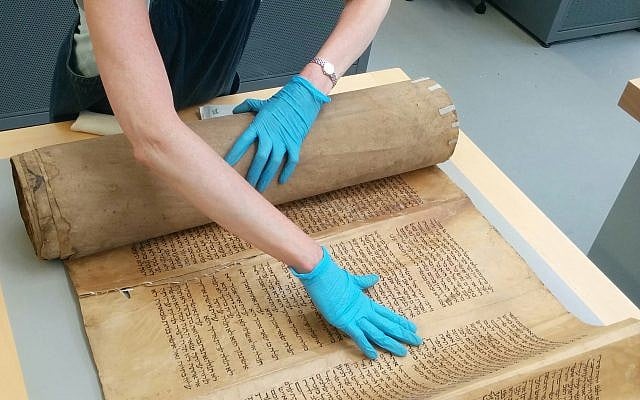
Conservator Lea Havelock handling the longest scroll in the Hebrew collection: a 16th-century Torah scroll (courtesy British Library)
According to the Bible, during the time of Eli, the High Priest, widespread corruption among Israel’s leaders provoked God’s wrath. When the Israelites faced the Philistines in battle, they not only suffered a devastating defeat, losing tens of thousands of men, but also saw the Ark of the Covenant fall into enemy hands. The Ark was returned only after God afflicted each Philistine city that held it (I Samuel 4–7:1). Later, the Second Book of Samuel recounts how King David sought to bring the Ark from Kiryat Yearim to Jerusalem (II Samuel 6).
Advertisement
“Most scholars think that the narrative in I Samuel and the narrative in II Samuel belong to the same story, whereas a minority consider the first one an originally independent story, which was later expanded by the second,” the researchers said. “Our analysis has shown that the opinion of the minority is right: II Sam. 6 is written in a different style and with different vocabulary than I Samuel 4:1-7:1.”
The scholars also analyzed other parts of the Hebrew Bible, including some stories about Abraham (for example, when he wages battles against local kings to save his nephew Lot in Genesis 14-15), which are believed by academics to have been written later than the rest of the book of Genesis. They also investigated the Book of Esther, which narrates the story of the Jewish-Persian queen and that academics believe was written in the Hellenistic period (333-63 BCE).
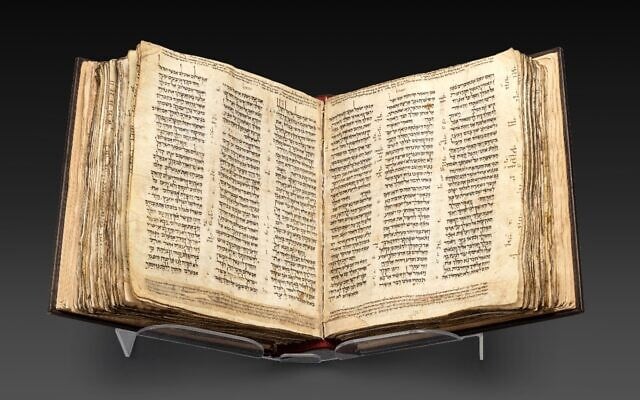
Codex Sassoon, the oldest and most complete ancient Bible, dates back 1,100 years. (Courtesy Anu)
In both cases, the researchers found that these texts are most likely not associated with any of the three schools of writers, confirming the previous assessments of scholars.
“This study is important for both biblical and ancient Israel scholars,” Finkelstein said, “because it has the potential to place disputed texts in their proper literary and historical settings.”
The researchers said they are eager to continue using their model on other parts of the Bible.
“There are many open questions in relation to the prophetic books, as well as the last revisions to the Pentateuch,” Römer noted. “This method will be of great help to get more objective results.”
 Rosamond Press
Leave a comment