
Pope Leo weighs in, calling for “sufficient humanitarian aid” to be allowed in, while Doctors Without Borders says medical supplies in Gaza are critically low
Very little food is reaching the starving people of Gaza. Isreal says they have to make sure the food does not feed Hamas who see themselves as the leaders and defenders of their nation. If Hamas had tanks and jets, like the ones the U.S. is selling to Qatar, then they would fight their enemy in a conventional manner.
When the Zionists wanted to become a nation, they resorted to terrorism. pointing to what the Nazis did to the Jews, as a God-given right to defend themselves as a new nation and do what the Nazis did. – such as bombing the King Davide hotel killing British officers. The Zionists Jews bitterly complained the West did not do enough to rescue the Jews, thus the issue of NO EMPATHY TOWARDS JEWS, continues to be a huge consideration. For Israel to FORBID empathy toward starving children of Gaza, and punish what is ruled Anti-Semitism, is a continuation of the Untired Nation’s effort to find a peaceful solution. Zionist Terrorists assassinated Folk Bernadette, after he published a paper the Zionist – hated!
John Presco
Torture
Starvation could also be prosecuted as torture, although depending on the legal forum, prosecutors might need to prove a specific purpose of the starvation or that the victims were under the control of the perpetrator.[1] Legal scholar Tom Dannenbaum argues that blockade-induced starvation should be considered a form of torture and prohibited on this basis.[22]
Starvation (crime) – Wikipedia
After Agatha ended, the kidnapped British officers were released, and High Commissioner Alan Cunningham commuted the Irgun members’ death sentences to life imprisonment.
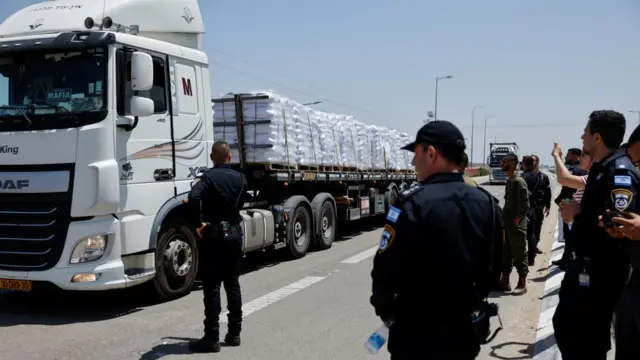
- The UN and humanitarian groups say much-needed aid is not reaching civilians in Gaza, despite around 100 aid trucks entering the Strip on Monday and Tuesday
- Israeli authorities have not yet commented, but military body Cogat said yesterday that the IDF would “continue to facilitate humanitarian assistance” while making “every effort to ensure that the aid does not reach the hands of the Hamas terrorist organisation”
- The UN’s humanitarian office says aid is not being released by the Israeli military on the Palestinian side of the crossing for distribution to the wider population
- A representative of the UN’s World Food Programme says the amount of aid being let in is “not sufficient at all” and that “so far, only very few trucks managed to leave from Kerem Shalom [border crossing] and the platform that is in Gaza towards the Strip”
- Speaking to the BBC, a member of Israeli PM Netanyahu’s Likud party says Israel is trying to ensure Hamas does not steal the aid
- Pope Leo weighs in, calling for “sufficient humanitarian aid” to be allowed in, while Doctors Without Borders says medical supplies in Gaza are critically low
- Meanwhile, the Hamas-run Civil Defence service says 15 people were killed overnight in Gaza by Israeli air strikes
King David Hotel bombing – Wikipedia
The Irgun committed the attack in response to Operation Agatha, known in Israel as “Black Saturday”.[11] British troops had searched the Jewish Agency on 29 June and confiscated large quantities of documents directly implicating the Haganah in the Jewish insurgency against Britain. The intelligence information was taken to the King David Hotel,[12] where it was initially kept in the offices of the Secretariat in the southern wing. The Irgun was determined to destroy that wing of the hotel in order to destroy the incriminating documents.
In the plan, Irgun men, disguised as Arabs, except for Gideon, the leader, who would be dressed as one of the hotel’s distinctive Sudanese waiters, would enter the building through a basement service entrance carrying the explosives concealed in milk cans. The cans were to be placed by the main columns supporting the wing where the majority of the offices used by the British authorities were located.
University of Oregon students, faculty and staff launch hunger strike in solidarity with Palestine
- Robert Desaulniers
- May 19, 2025 Updated May 19, 2025
- 11

EUGENE, Ore. – A coalition of students, faculty and staff members at the University of Oregon are going on a hunger strike in solidarity with starving Palestinians in Gaza.
The hunger strike started at 9 a.m. on May 19. Strikers said they condemn what they call Israel’s campaign of mass starvation in Gaza. Hunger strikers are demanding that elected officials help send food and supplies to Gaza and cease providing aid and weapons to Israel. Strikers are also calling upon the UO to financially divest from companies involved with Israel, fulfill prior commitments to scholarships for Palestinian students, uphold sanctuary campus protections, and cease what they call the repression of speech and protest related to Palestine on campus.
The hunger strike is primarily led by the organization “UO Jewish Voice for Peace.” Organizers said that while some participants have committed to striking until they are no longer physically able, others are participating in shorter strikes meant to represent reports that the average resident of Gaza is only able to eat once every three days. Hunger strikers are gathered near the EMU on the UO campus.
Operation Agatha (Saturday, June 29, 1946), sometimes called Black Sabbath (Hebrew: השבת השחורה) or Black Saturday because it began on the Jewish sabbath, was a police and military operation conducted by the British authorities in Mandatory Palestine during the Jewish insurgency. Soldiers and police searched for arms and made arrests in Jerusalem, Tel Aviv, Haifa and several dozen settlements; the Jewish Agency was raided. The total number of British security forces involved is variously reported as 10,000, 17,000,[1] and 25,000. About 2,700 individuals were arrested, among them future Israeli Prime Minister Moshe Sharett. The officially given purpose of the operation was to end “the state of anarchy” then existing in Palestine. Other objectives included obtaining documentary proof of Jewish Agency approval of sabotage operations by the Palmach and of an alliance between the Haganah and the more violent Lehi (Stern Gang) and Irgun, destroying the Haganah’s military power, boosting army morale and preventing a coup d’état being mounted by the Lehi and Irgun.[2]
Background
[edit]
On June 16, 1946, the “Night of the Bridges” had the Palmach blow up eight road and rail bridges linking Palestine to neighbouring countries. On June 17, the Lehi attacked railway workshops in Haifa. Shortly afterwards, the Irgun kidnapped six British officers. One officer subsequently escaped, and two were released. The Irgun announced that the remaining officers would be released only in exchange for the commutation of death sentences for two Irgun members.[3]
The British Army had for months wanted to take military action against the Zionist underground organizations, but it had been blocked by High Commissioner Alan Cunningham, who was also particularly opposed to military action being taken against the Jewish Agency. Cunningham changed his mind after the “Night of the Bridges” and flew to London to meet the British Cabinet and army chief Field Marshal Bernard Montgomery in London. Montgomery formulated the plan for Operation Agatha. With reluctance, Cunningham accepted it in the hope that with the more militant Zionists restrained, the way would be open to reaching a political settlement with the more moderate and pro-British leaders such as Chaim Weizmann. During the operation, a radio broadcast had Cunningham say, “[The arrests] are not directed against the Jewish community as a whole but solely against those few who are taking an active part in the present campaign of violence and those who are responsible for instigating and directing it…”[2]
The Chief of the Secretariat, Sir John Shaw, outlined the official objective of the operation at a press conference in Jerusalem: “Large-scale operations have been authorized to end the state of anarchy existing in Palestine and to enable law-abiding citizens to pursue their normal occupations without fear of kidnapping, murder, or being blown up”. Shaw believed that the British should end the existing situation by partitioning Palestine into Jewish and Arab states and then leaving or by dismantling the Jewish Agency, which claimed administrative authority but secretly supported acts by the underground Zionist military organizations and governed without the authority. Thus, Shaw approved of the operation.[2]
Several other objectives underlay the official one such as to obtain documentary proof of the Jewish Agency‘s approval of sabotage operations by the Palmach and an alliance between the Haganah and the more violent Lehi (Stern Gang) and Irgun in carrying out violent acts. Another was to forestall a coup d’etat. In June, members of the Jewish Agency’s Executive and the Haganah High Command had met with delegates of the Irgun and Lehi at which the latter, according to intelligence, had stated its intention of asking the Yishuv to participate in a coup “for the proclamation of a future Jewish State and the interruption of all relations with the existing Palestine Administration”. In the wake of the “Night of the Bridges”, another objective was to break the military power of the Haganah. Since the Haganah had appeared to be acting in co-operation with the Lehi and Irgun, the British authorities believed mistakenly that breaking its military power was also necessary because the Haganah might co-operate with the prospective Irgun and Lehi coup. Lastly, Montgomery had stated that the operation was required to boost army morale.[2]
Operation
[edit]
_H_ih_040.JPG)
On June 29, Operation Agatha began; it lasted until July 1. Curfews were imposed throughout Palestine, low-flying planes circled Jerusalem, roadblocks were put up, trains were flagged down and passengers were evacuated and escorted home. Special licenses were required for the operations of emergency vehicles. British troops and police raided the Jewish Agency headquarters in Jerusalem, the Jewish Agency office in Tel Aviv and other Jewish institutions such as the Women’s International Zionist Organization and the Histadrut. A total of 27 Jewish settlements in Palestine were searched, and the residents of these settlements sometimes put up fierce resistance. Four Jews were killed resisting British searches. Mass arrests of Jewish leaders and Haganah members were carried out. A total of 2,718 people were arrested, including four members of the Jewish Agency Executive, seven Haganah officers, and nearly half of the Palmach‘s fighting force. However, a Haganah intelligence warning allowed most Haganah commanders to evade arrest. David Ben-Gurion was not arrested as he was in Paris at the time.[4]
Searches of Jewish settlements uncovered 15 arms caches, including one of the Haganah’s three central arsenals at Kibbutz Yagur, where 325 rifles, 425,000 bullets, 96 2-inch mortars, 5,200 mortar shells, 5,000 grenades and 78 revolvers were confiscated. The arms were displayed at a press conference, and all of the men of Yagur were arrested.[5][6]
The searches were resisted by large swathes of the Jewish population, many of whom were Holocaust survivors. Roadblocks were constructed and British troops were attacked while conducting searches. Some Jews conducted lie-ins to prevent the movement of military trucks, and others publicly displayed their concentration camp tattoos to the British in order to try to elicit their sympathy. A few British soldiers exacerbated the tense atmosphere by shouting “Heil Hitler” and scrawling swastikas on walls while they conducted searches.[7]
Aftermath
[edit]

After Agatha ended, the kidnapped British officers were released, and High Commissioner Alan Cunningham commuted the Irgun members’ death sentences to life imprisonment.
The Haganah and Palmach were dissuaded from continued anti-British operations.[9] However, the more extreme groups, the Lehi (Stern Gang) and the Irgun Tzvai Leumi, headed by future Prime Minister Menachem Begin, continued and even intensified their attacks.[10]
Specifically, the Irgun retaliated for Operation Agatha by bombing the south wing of the King David Hotel, which was the headquarters of the British government in Palestine. One reason for bombing the south wing was that it was presumed to be the place to which the British had taken the documents from the Jewish Agency.
 Rosamond Press
Leave a comment