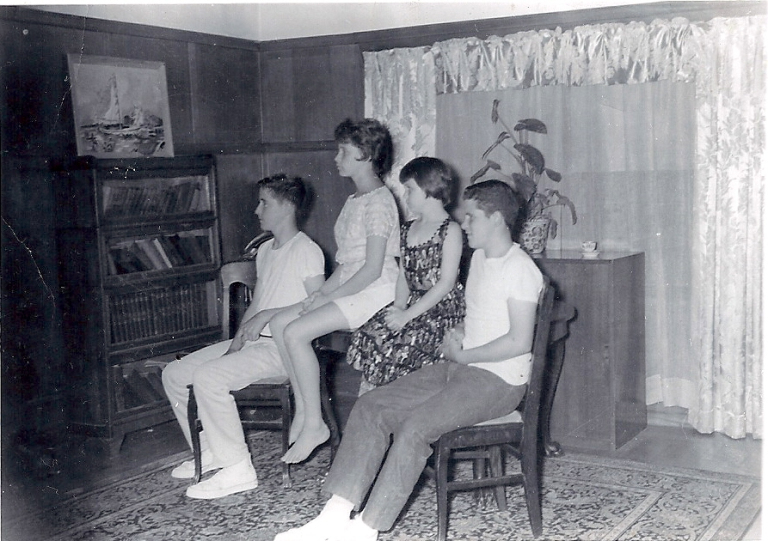
I just talked to the wife of Rick Young, our childhood friend, who still lives on San Sebastian Avenue! We have not talked in a long time. What prompted me to get in touch was Clint Eastwood lived on Ardley St. a few doors down from my friend Berl Aldridge, and went to my elementary school, Glenview. Clint lived in several homes close to San Sebastian Avenue. He worked on hotrods. My friend Bill Arnold had a 51 Ford we all got involved in, as was the custom. Rick worked on several cars. Clint is still good friends with his childhood friends.
We stole the flocked X-Mas tree you see in the window. We threw it in Dimond Canyon, and got it the next day. Mark is eating an apple on the front porch. He made the weather vein in metal shop at Oakland High.
John Gregory Presco
There are three “nicer” grammar schools in the area around the Eastwood home in Piedmont, California, and a young Clint Eastwood managed to attend them all.
There was Glenview {just down the street from home}, the Frank Stevens School (named for a Piedmont city father), and “Crocker Highlands” (named for the Crocker banking family, who donated the site for the school).
[Pictured Left]
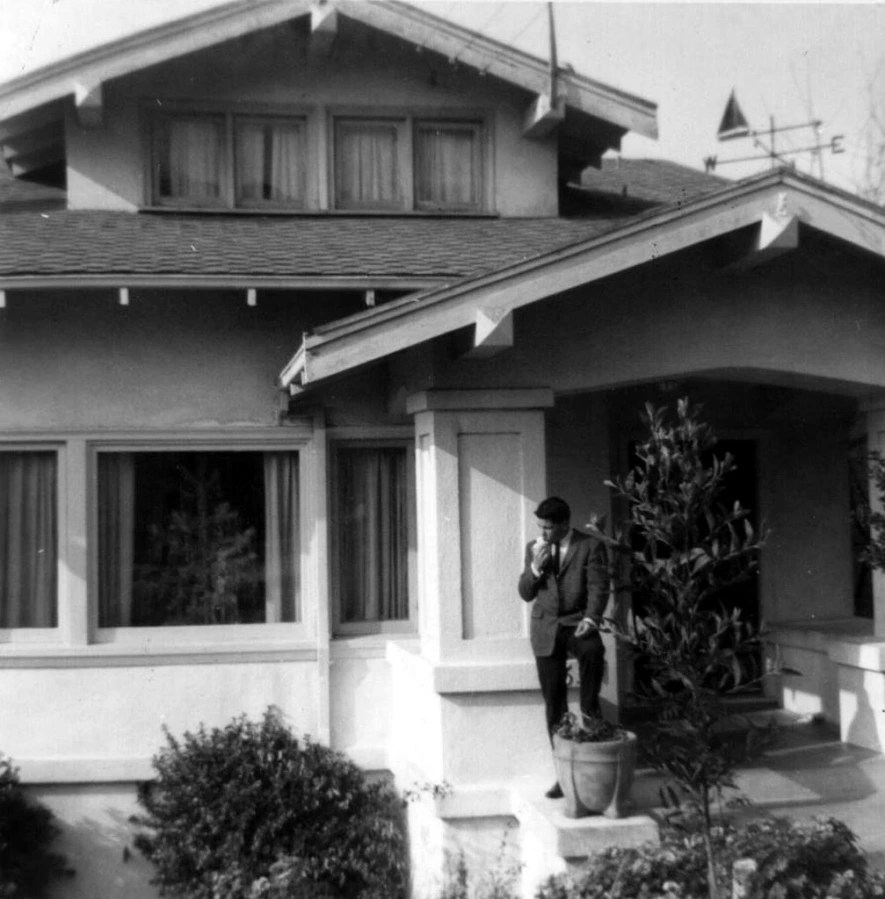
141 Bonita Ave
Her
Clint Eastwood in Piedmont: A Cinematic Prelude to Stardom
- Jan 10, 2024
- 7 min read
Clinton Eastwood Jr. (born May 31, 1930) is an American actor and film director. After achieving success in the Western TV series Rawhide. Eastwood was born on May 31, 1930, at Saint Francis Memorial Hospital in San Francisco, California, to Ruth (née Runner; 1909–2006) and Clinton Eastwood (1906–1970). During her son’s fame, Ruth was known by the surname of her second husband, John Belden Wood (1913–2004), whom she married after the death of Clinton Sr.
Eastwood was nicknamed “Samson” by hospital nurses because he weighed 11 pounds 6 ounces (5.2 kg) at birth. He has a younger sister, Jeanne Bernhardt (b. 1934). He is of English, Irish, Scottish, and Dutch ancestry. Eastwood is descended from Mayflower passenger William Bradford, and through this line is the 12th generation born in North America. His family relocated three times during the 1930s as his father changed occupations. Contrary to what Eastwood has indicated in media interviews, they did not move between 1940 and 1949. Settling in Piedmont, California, the Eastwoods lived in an affluent area of the town, had a swimming pool, belonged to a country club, and each parent drove their own car. Eastwood’s father was a manufacturing executive at Georgia-Pacific for most of his working life. As Clint and Jeanne grew older, Ruth took a clerical job at IBM.
Eastwood attended Piedmont Middle School, where he was held back due to poor academic scores, and records indicated he also had to attend summer school. From January 1945 until at least January 1946, he attended Piedmont High School, but was asked to leave for writing an obscene suggestion to a school official on the athletic field scoreboard and burning an effigy on the school lawn, on top of other school infractions. He transferred to Oakland Technical High School and was scheduled to graduate mid-year in January 1949, although it is not clear if he did. “Clint graduated from the airplane shop. I think that was his major”, joked classmate Don Kincade. Another high school friend, Don Loomis, echoed “I don’t think he was spending that much time at school because he was having a pretty good time elsewhere.” Fritz Manes, a boyhood friend two years younger than Eastwood, said “I think what happened is he just went off and started having a good time. I just don’t think he finished high school.” Biographer Patrick McGilligan notes that high school graduation records are a matter of strict legal confidentiality. According to the author, Eastwood’s school principal had to call his management first before deciding whether to be interviewed, and “whoever answered the phone at Malpaso advised him against talking to me, and he didn’t”. [Wiki]
So where did the Eastwoods live?
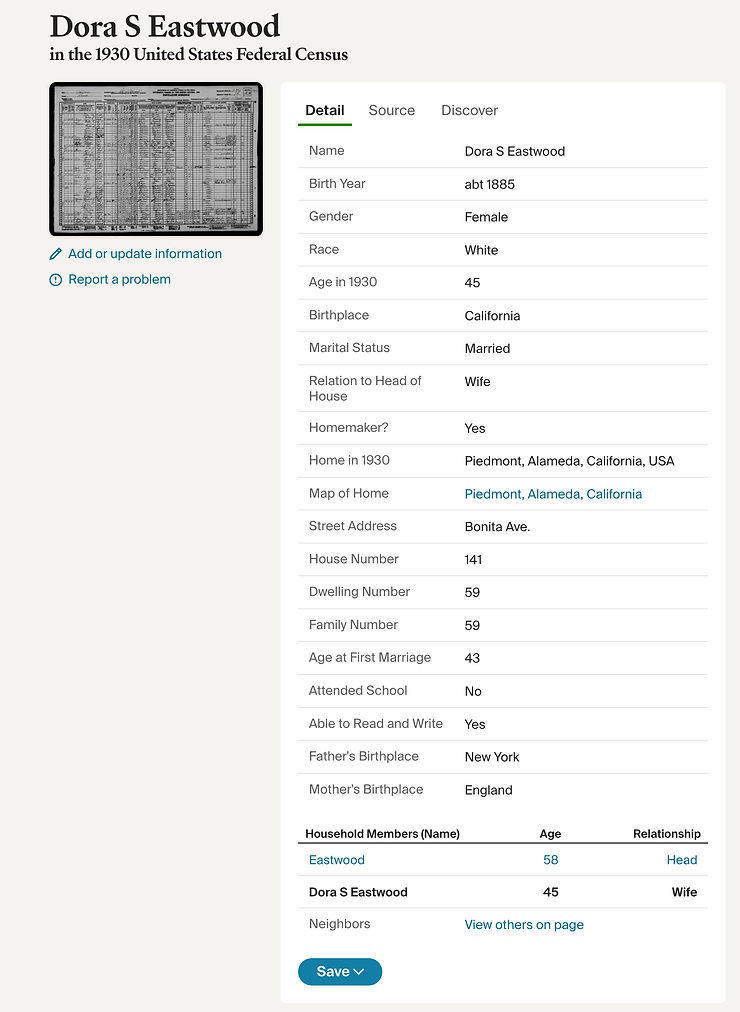
His grandparents lived at 141 Bonita Avenue according to the 1930 Census
Clint Eastwood: A Biography by Richard Schickel:
He was fifteen, she thirteen, when they met in Piedmont, California, not long after her family moved from San Francisco to this prosperous Bay Area suburb, which lies due east of Oakland, due south of Berkeley. His father, Burr, built a house there soon after Clinton Sr. was born and worked as a manager in a wholesale hardware concern. Ruth’s father, Waldo, had been a railroad executive— she moved back and forth across the country several times as a child because of his work—and then founded, with a partner, the Graybar Company, which manufactured automobile bumpers and luggage racks.
…He has fond memories of visits to Grandpa Burr, who also upped stakes during the depression, surprising everyone by selling his Piedmont house and, with his second wife, buying a little farm devoted to apple trees and chicken raising near Sebastopol.
Where did Clint, Jr live while attending PHS?
A J W Knowland article from The Oakland Tribune on 23 Jul 1955, Page 5 incorrectly states 1. he graduated from PHS and 2. he lived at 5655 La Salle Avenue in Piedmont.

While doing Walking on Wednesdays around Piedmont, we wanted to understand where the 108 Hillside Ave address for Clint Eastwood came from since it is not in any census.
108 Hillside address:
- Oakland Tribune 15 Jun 1924, Sun ·Page 24 – mentions the 108 Hillside for lease
- Oakland Tribune 27 Apr 1935, Sat ·Page 20 – mentions the the Kelley family lives there – (Clint Eastwood was born May 31, 1930)
- Oakland Tribune 04 Aug 1942, Tue ·Page 23 – house is for sale
- He transferred to Oakland Tech in around 1947/48
- So it had to be a time between 1942 – 1954.
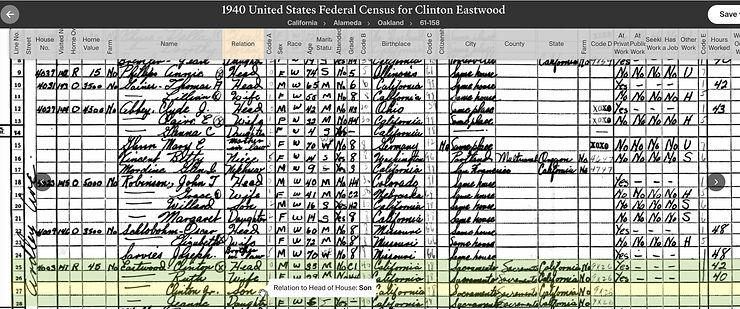
- I found on a 1940 Census that they were living at: 4003 Ardley Ave, Oakland, California in Oakland there is a Clinton Sr and Clinton (Clint) Jr living there
And a Ruth Eastwood (his great aunt) owned a house at 108 Hillside Ave.

Clint Eastwood: A Biography by Richard Schickel:
Around this time the family was favored by another stroke of good luck. Perusing the newspaper real estate section, the elder Eastwoods observed that one of Ruth’s aunts had placed her home in Piedmont on the market. “We knew the house very well,” Ruth recalls, “and so we went ripping up the next day and sure enough it was for sale and they would sell it to us for what we would give them. Houses weren’t selling in Piedmont at all, so we bought it for very little down and very little a month.” Ruth Eastwood was working, too, at this time, for IBM, and, at last, the family was able to settle down; the Eastwoods would remain in Piedmont for eight years, until Clint was in his last months of high school.
It was a middle- and upper-class enclave. Some of California’s oldest money (the Crockers of the bank, the Hills of the coffee company, the Witters of the Dean Witter stock brokerage) was settled here. The Eastwoods did not travel in those circles.
Indeed, their modest shingled house was close to the Oakland line, and it was that blue-collar port and industrial city, always invidiously compared to glamorous San Francisco across the bay, not conservative Piedmont, that would eventually claim his loyalty. In interviews he gives it, not the suburb, as his hometown.
He attended Havens Elementary School, then Piedmont Junior High School. He made lifelong friends during his first years in Piedmont, among them a good-natured boy named Harry Pendleton, who spent much of his adult life on the fringe of lawlessness and died early; Jack McKnight, who in late adolescence would live with the Eastwoods for almost a year; Fritz Manes, who would eventually work for Clint as a line producer in his production company; Don Kincade, through whom Clint met his first wife, Maggie, and with whom he remains close.
…His father bought Clint the first of them—a 1932 Chevy touring car the family referred to as “the bathtub” because it had no top-before it was legal for him to obtain a driver’s license. The rationale was that he needed it for his newspaper route, but according to Manes, lots of Piedmont kids had cars before they passed their driver’s tests; it was something of a local tradition. In Clint’s case, the gift was conditional; he was obliged to take full financial responsibility for the vehicle’s upkeep.
The bathtub soon gave way to a ’34 Ford, then to subsequent jalopies, even, for a time, a motorcycle. To support those ramshackle wheels Clint took on jobs in addition to his newspaper route: He bagged groceries at the Peabody Market, caddied at the Claremont Country Club.
…He didn’t even like hanging out at Bud’s Bar, where the Piedmont jocks and those from the University of California often met. There was no live music there, only a jukebox stocked with mainstream pop.
He was beginning to gather a sense of Piedmont’s contempt for people who didn’t match its norm, a contempt that included Clint. “The kids were driving better cars than my parents were,” he recalls, “and I learned very early on that I was at the low end of the social structure.” His mother confirms this assessment.
“Particularly in his class there were an awful lot of wealthy kids, and I could see where Clint would have a funny-looking car and they would have Cadillacs or something.”
The prejudices he encountered extended beyond the automotive. He vividly remembers some junior-high schoolmates asking him what his father did, and putting him down when he told them that he worked in a shipyard. Their dads, they proudly told him, were merchants and executives, and his argument that his father was at least engaged in vital war work made no impression on them. He was, as well, acutely conscious that there were no blacks in Piedmont, no Asians, only one or two Jewish families. And precisely because it was so “white bread” (Manes’s description) the place was rife with a kind of heedless bias. “That’s where I was first introduced to bigotry,” Clint recalls, and though he says he doesn’t know how or when the conviction came to him, “I never could stand intolerance. In my soul, I couldn’t buy into it.”
His response was, as he gently puts it, “Fuck you and move on.” Which was quite all right with Piedmont High and, as it happened, with his mother. “That didn’t worry me at all, because I knew he was going to be different than the rest of the group.”
Leaving Piedmont:
The Life and Legend
By Patrick McGilligan · 2002:
Many years later Ruth Eastwood would confirm to an Oakland newspaper that Clint left Piedmont High School because he was ‘asked’ to. Clint not only wrote an obscene suggestion to a school official on the athletic field scoreboard, but buried someone in effigy on the school lawn.’ According to his mother, it was these incidents, on top of other school infractions, that prompted a Piedmont school official to firmly suggest her first-born might thrive elsewhere.
Rumor has it that he rode his motorcycle in the quad and that also added to the move out of Piedmont and to Oakland Tech High School. Eastwood was inducted into Oakland Tech’s Hall of Honor in 2015.
The Eastwoods of Oakland
Posted on June 3, 2012 by Royal Rosamond Press






In the biography of Clint Eastwood by Patrick McGilligan ‘Clint, The Life and Legend’ I read this on page 30.
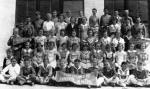
“Glenview, near Ardley Avenue, Crocker Highlands (named for the banking Crockers, who donated the site) and Frank Havens School (named for one of the Piedmont city fathers – three of the grammar schools the boy attended – were within a close radius of Piedmont. Haven was already a local institution, and one day, at Crocker Highlands, the tousel-haired boy sat for a class photograph with schoolmates that included Jackie Jensen, the future outfielder for the Boston Red Sox.*
The American Leagues most valuable player in 1958”
My grandmother, Melba Wilkins, raised the Jensen brothers after their parents were divorced, and their mother had a nervous breakdown and was hospitalized. Jackie and Bobby Jensen went to Oakland High with my father, Vic Presco, who was present when his daughter presented her portrait of the actor, Jimmy Stewart, in Carmel. Mayor Clint Eastwood was present. Vic wore a white suit and tried to upstage Jimmy who he looked like when young. Bobby taught art at McCheznie Junior High where all four Presco children attended. We also went to Glenview Elementary – and so did Clint when his family moved to Ardley Avenue where my good friend, Burl Aldridge lived. Clint also lived on Woodhaven Way that is down the street from where the Harkins family lived, on Pinehaven. Were these two streets named after Frank Havens?
My friend, Sparky, lived on Pinehaven as did Bruce Perlowin, the King of Pot, who has a movie coming out. Sparky got his name after a crazy women in the Piedmont Loundge (in Oakland) frisked him for a piece, she mistaking him for a real bad dude named Sparky. My friend was asked to contribute to the movie ‘The Doors’ he a good friend of Jim Morrison, but refused, saying Stone would not do Jim justice. The bar scene in Sudden Impact was very authentic.
What amused me about this biography was the attempt to get a very famous movie star out of Oakland all together, and permanently place him in Piedmont, which was once ranked in the top 10 wealthiest places to live in America. I had stumbled on this book after telling the Librarian I might come upon something while looking for books on boat building. I am thinking of building a Shanty Boat and living in Alaska – as a total recluse. After reading about 32 pages, I showed the librarian my find, and told her some of my family history.
My mother wanted to get Vic into movies. But, he hated all those “phonies” as he put it. Vic looked like the guy on the Oakland Raiders emblem and wore a black patch after crazy Dee-Dee knocked his eye out with a five pound ashtray! Did he eyeball Clint with his good eye, or his bad? Vic smuggled his last wife over the Mexican border in a marijuana shipment, and was in with the Mexican Mafia.
“Duck Vic. Incoming!” Says Vic’s old war buddy on Iwo Jima.
Yep! If it were not for real bad guys in the world, like my Pops, Clint would be out ofa job -and his offspring out of a reality show Did I tell you my Godfather, Sergeant Skip Sutter, also went to highscool with Jackie Jensen, the Golden Boy. Skip led fifty Oakland cops against the Hell’s Angels at their Oakland clubhouse – and ended up in the hospitca for two weeks. It was a showdown – with gloved fists.
“Right turn, Clyde!”
When I read the Eastwoods were a long line of Cartman who delivered the vegetables they grew in the city, all of a sudden, I was not mad at my daughter anymore. I was furious because she and her boyfriend got in the way of the most creative project of my life, which was to turn our family story into a HBO series, or, a Soap Opera, for the reason we are the no man lands for the cultural Warfare that wages in our nation. With the mention of Jackie Jensen we now had a real foothold in history, and, I own some credibility, for there are just a handful of folks who lived in Oakland that became famous, because being real has its own rewards, an idea that is going out of fashion. Jack London took full advantage ofhard Oakland Reality – like Clint.
Clint Eastwood, and Christine Rosamond Benton – along with Jackie Jensen – are at the top of the list. Then there is my friend, Paul Drake, one of the most famous movie villains of all time, because he played Mick in Eastwood’s movie, ‘Sudden Impact’. Just as McGilligan employed my Oakland history in his biography, I could employ Clint’s in Rosamond’s biography, because Vic was the president of Acme Produce, my father working out of an old Victoria warehouse in Jack Lond Square. I wondered if Clint was a Lumper as a teenager. Did his Cartman kindred put him to work as a teenager loading and hauling produce like my brother and I.
I suddenly had empathy for Vic, and wished I could write only nice things about him, because he tried. Not everyone can be famous and successful. I thought about redoing my autobiography, taking all the kinks out of it, and present it as smooth sailing Waltonish fairytale that would put everyone in a good light. But, poo-pooh happened, and will aways happen to us all as you will read in regards to a $100,000 dollar handbag.
An hour ago, while surfing channels, I saw on the Entertainment channel ‘Mrs. Eastwood and Company’. I was floored as I watched a famous photographer fighting with his Muse, who is Clint’s daughter from a previous marriage, named Francesca, a name that appears on page 30. I am then watching the maid push a giant turtle around in the Eastwood home in Pebble Beach where the Benton’s lived, and their daughters, Jessica, Shannon, and Drew. There is talk about fifteen year old Morgan getting pregnant if her mother, Dina Eastwood, allows her to throw a a crazy drinking party. Consider the famous fashion photographer, Stephen Silverstein who did of a study of Marilyn in Malibu, and Rena, my Muse. Before my eyes Rosamond Women were everywhere!
Then, in the door walks The Man of the House, the Tan Man with a Rolex watch that I suggested Heather’s aunt wanted her to marry – and that I long claimed was the kind of Dad my daughter always wanted – and prayed for – before she ever lay eyes on me!
No! I am a real Oakland Boy who has not copped out and gone to Hollywierd. And all my friends were bad-ass Okland lads, that Clint claims he was, he learning to call folks “assholes” because he grew up in Oakland – and went to Oakland Tech about a quarter mile of my apartment on Broadway, where Heather was conceived, and where she lived with Randall Delpiano her fake father, who is another famous dude from Oakland.
Stay tuned, folks! It’s time to see how the other half live, those scallywags and hillbillies that Mr. Tough guy left in his wake! It’stime to go – Back to Oakland – where I lived with the Loading Zone from wence The Tower of Power came. The Eastwood pal around with a boy band from Australia, that look like ___ ____and would get their ass kicked if they walked in downtown Oakland looking like that! This is a fake band like the Monkeys whom my friend, Bryan McClean of ‘Love’ auditioned for. Bryan dated Lisa Minelli in Junior High.
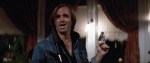
You are only as good as your badist bad guy! That’s a pic of Paul waving a piece. Paul was Heather’s neighbor and played Roach in the T.V. series ‘Fresno’ that spoofed Dynasty and Dallas. Are these Pebble Beach folks – for real? Pebble Beach is a sissy name! The bad guy turns out to be one of the stars because he destroyed a $100,000 dollar handbag – and now offers to donate to charity because fans complained! Get real! This is no Reality Show! Time for a Reality Transfusion. Time to get back to your Oakland roots and let the world behold the – real you! Com’on Clint. Let it all hang out!
How about forming a charity in the hoods of Oakland that help little old ladies that have had their cheap handbags snatched?
“Here you go, Mam. A gift cirtificate for Wal-Mart, care of the Eastwoods – and you know who!”
“To hell with that! I want a new Glock! They got my gun. I want my gun back. Make my day! There’s some bad mother f———s on my street! ”
Hmmmm! Welfare Gun Queen For a Day! Now we’re talking. Lights! Cameras! Action!
This handbag should have never been made. It screams “Let them eat cake.” It is the Eastwood Trojan Horse that was let in, and out pour all those socialists who took hold in blue collar Oakland
Who needs Dirty (old) Harry when you got old ‘Bait Broads’ roaming the street, packing some serious heat – and delivering the most famous movie line – of all time!
Time to spread the wealth! Clint has been hogging the show for too long!
Jon Presco
Copyright 2012
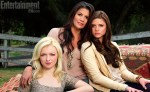
Photographer Tyler Shields is trying to make amends for burning an expensive handbag on the E! reality series, Mrs. Eastwood & Company.
On Monday’s episode, Shields and his girlfriend, Francesca Eastwood (daughter of legendary actor/director Clint Eastwood), burned a $100,000 Birkin bag after putting a chainsaw to it.
The act led to fans calling the couple narcissistic and horrible for destroying something so expensive when the money it cost could have been used to help people in need.
However, Shields accepted the blame for the incident and is now making up for it by donating $100,000 to a needy family.
http://www.youtube.com/watch?feature=fvwp&v=IthvO9RzPdM&NR=1
http://insidetv.ew.com/2012/04/08/eastwood-trailer/
There are three “nicer” grammar schools in the area around the Eastwood home in Piedmont, California, and a young Clint Eastwood managed to attend them all.
There was Glenview {just down the street from home}, the Frank Stevens School (named for a Piedmont city father), and “Crocker Highlands” (named for the Crocker banking family, who donated the site for the school).
[Pictured Left]
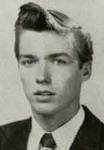
Note: Clint in the front row (3rd from right),
“Too Cool” to hold the banner.
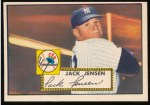
Another interesting note is the boy on the left (squeezed out of the front row and refusing to join that female 2nd row) is young Jackie Jensen, future Boston Red Sox slugger, and 1958 American League MVP.
After completing grammar school, Clint followed in both his parent’s footsteps, and went to Piedmont Jr. High. Three years later (Jan. 1945), he graduated to Piedmont Sr. High School, located right next door to the Jr. High.
Things got a little rougher for Clint by the end of his first year at Piedmont High (Jan. 1946).
Eastwood was born on May 31, 1930, in San Francisco to Clinton Eastwood, Sr. (1906–70), a steelworker and migrant worker, and Margaret Ruth (née Runner; 1909–2006), a factory worker.
After his father died in 1970, Eastwood’s mother remarried to John Belden Wood (1913–2004) in 1972, and they remained married until his death 32 years later. Eastwood is of English, Irish, Scottish, and Dutch ancestry and was raised in a middle class home with his younger sister, Jean (born 1934).
Eastwood was born in San Francisco to Clinton Eastwood, Sr. (1906–70), a steelworker and migrant worker, and Margaret Ruth (née Runner; 1909–2006), a factory worker.[3] He was nicknamed “Samson” by the hospital nurses as he weighed 11 pounds 6 ounces (5.2 kg) at birth.[4][5][6] After his father died in 1970, Eastwood’s mother remarried to John Belden Wood (1913–2004) in 1972, and they remained married until his death 32 years later.[7] Eastwood is of English, Irish, Scottish, and Dutch ancestry[3][8] and was raised in a middle class home with his younger sister, Jean (born 1934).[9][10] His family relocated often as his father worked at different jobs along the West Coast, including at a pulp mill.[11][12] The family settled in Piedmont, California, where Eastwood attended Piedmont Junior High School and Piedmont Senior High School, taking part in sports such as basketball, football, gymnastics, and competitive swimming.[13] He later transferred to Oakland Technical High School where the drama teachers encouraged him to enroll in school plays, but he was not interested. As his family moved to different areas he held a series of jobs including lifeguard, paper carrier, grocery clerk, forest firefighter, and golf caddy.[14]
In 1950, Eastwood began a one-year stint as a lifeguard for the United States Army during the Korean War[15] and was posted to Fort Ord in California.[16] While on leave in 1951 Eastwood was a passenger onboard a Douglas AD bomber that ran out of fuel and crashed into the ocean near Point Reyes.[17][18] After escaping from the sinking aircraft he and the pilot swam 3 miles (5 km) to safety.[19]
Eastwood directed and starred in the fourth Dirty Harry film, Sudden Impact, which was shot in the spring and summer of 1983 and is considered the darkest and most violent of the series.[149] By this time Eastwood received 60 percent of all profits from films he starred in and directed, with the rest going to the studio.[150] Sudden Impact was the last film which he starred in with Locke. She plays a woman raped, along with her sister, by a ruthless gang at a fairground and seeks revenge for her sister’s now vegetative state by systematically murdering her rapists. The line “Go ahead, make my day” (uttered by Eastwood during an early scene in a coffee shop) is often cited as one of cinema’s immortal lines.
http://www.youtube.com/watch?v=DWospt-Nezs
Things got a little rougher for Clint by the end of his first year at Piedmont High School (Jan. 1946). Junior’s Dad, Clinton Sr., had picked up an old “beater” for his son to fix up and drive. Although too young to drive at 15, the lanky freshman was fast approaching his 6 ft. 4 in. height, a head taller than his classmates. Thanks to his height, the police never noticed that he was too young to be behind the wheel. Once he had the “old rattletrap” running, there was no reason to wait until he was legal. The first in his crowd to drive didn’t hurt in his high school social standing. He had always drawn attention from the females, but now he had a car… Awash with testosterone, he now found interests other than academics. Auto shop was now more important than Algebra, and his academic indifference began to show. By the end of the first year, his joyriding with the boys and time spent in the backseat of his car with the girls ( he lost his virginity at 14 & saw no reason to stop), resulted in a major drop in his grades. It was, as Clint confessed in an interview, “Cars, girls, and beer”. Sporting a “ducktail” and leather jacket, he personified the new “Jimmy Dean” – “Elvis Presley” rebel. Hanging out at “Coffee Dan’s”, Omar’s Pizza, and sittin’ in on blues piano at Hambone Kelly’s in El Cerrito, now took priority over homework. Summer school didn’t do the trick and, as Clint’s Mom discreetly confessed, “He was asked not to come back to Piedmont High”. Oakland Tech would now have a new student.
Jensen was born in San Francisco, California. His parents divorced when he was five, and he was raised by his mother, who frequently moved the family. After serving in the Navy toward the end of World War II, he became an All-American in two sports at the University of California. As a baseball pitcher and outfielder, he helped California to win the inaugural College World Series in 1947. He pitched Cal to victory in the regional final by outdueling Bobby Layne of Texas, and in the championship Cal defeated a Yale team featuring future President George Bush. As a football halfback, Jensen was a consensus All-American as a junior in 1948, becoming the first Cal player to rush for 1,000 yards. In the season-ending 7-6 victory over Stanford he ran for 170 yards, kicked a punt for 67 yards, and had a 32-yard run late in the game in a 4th-and-31 situation. Cal ended the regular season at 10-0 under coach Pappy Waldorf, winning a share of its first Pacific Coast Conference title in ten years, and Jensen placed fourth in the Heisman Trophy voting, with Doak Walker taking the award. In the 1949 Rose Bowl, Jensen scored a touchdown in the first quarter to tie the game 7-7, but 4th-ranked Cal was upset 20-14 by 7th-ranked Northwestern.
In 1949 Jensen, who batted and threw right-handed, left college after his junior year and signed with the Oakland Oaks in the Pacific Coast League. His contract – along with Billy Martin’s – was sold to the New York Yankees in 1950 with the intention of him being a backup for Joe DiMaggio. But he played in only 108 games for the Yankees over three years, primarily in left field. He appeared as a pinch runner for Bobby Brown in the eighth inning of Game 3 of the 1950 World Series against the Philadelphia Phillies, but was in the game only briefly before Johnny Mize popped up to end the inning. Jensen did not stay in the game defensively, and the Yankees completed a sweep of the Phillies in Game 4; he did not appear in the 1951 Series against the New York Giants.
Following the arrival of Mickey Mantle with the Yankees, in May 1952 Jensen was sent to the Washington Senators in a six-player deal, and he made his first All-Star team. He finished the season with a .286 batting average and 80 RBI, leading the league with 17 assists and placing third in the AL with 18 steals, a total he duplicated in 1953. He was traded to the Red Sox in December 1953, and led the AL with 22 steals in 1954, also finishing third in RBI (117) and fourth in home runs (25).
 Rosamond Press
Leave a comment